
A brief overview for Sunday School teachers and Bible study leaders, of Lifeway’s “Explore the Bible” lesson of Genesis 12:1-5, 13:11-18, for Sunday, February 4, 2024, with the title, “Promised.”
A video version of this overview is available on YouTube at:
INTRO: ??? Can you share a step of faith you once took???
(When Cheryl & I were talking with the search committee here at FBC Angleton about moving to Angleton. We’d determined that we felt like God was calling us, so the committee said, let’s set up a time for you to come and look around, see the church and the area, and then if you are amenable, we’ll set up a time for you to come in view of a call. But earlier that week I had read in Hebrews 11 where it said that Abram when God called him, “went out, not knowing where he was going.” All of the sudden it hit me that I should do the same thing; that I should just go, because God was calling me, “not knowing where I was going.” If God was calling me, it was not a matter of geography. It didn’t matter what the area looked like; it didn’t matter what the church looked like, etc. Just obey and go. And we did, and we’ve loved it and I believe we’ve had a good ministry here. But looking back, it was a pretty good step of faith to go without seeing it first! I would not say that faith is my “spiritual gift” or generally my strong suit; but occasionally God gives me the ability to take a big step of faith, and that was one of those times.)
You are welcome to share my story if you’d like, and/or you and your group can share similar stories, then say something like: today in Genesis 12 we’ll see how God called Abram to take a step of faith, and promised him a great blessing, if he would.
CONTEXT:
We just covered the Tower of Babel in Chapter 11 on our study through Genesis. The godless, self-centered nations were judged by God and scattered.
Then beginning in 11:10 we find the genealogy of Shem, Noah’s oldest son, from whom the Jews are descended (remember “antiSemitism = “anti-Shem-ism”, that’s where that came from). So it traces the genealogy from Shem to Terah in :24, who became the father of Abram, Nahor, and Haran. :29 says Abram married a wife, Sarai, and :31 tells how Terah took Abram and family to go to the land of Canaan, but at Haran, Terah died.
This brings us to Genesis 12, where the focus of the text becomes God’s call and promise to Abram.
In the big picture, this is God’s next step in preparing a people from whom the Messiah would come, whom God promised in Gen. 3:16 (the protevangelium, or first gospel). The whole rest of the Bible is the unfolding story of the Messiah coming. This is the next step in that story, God calling Abram to start a Messianic nation, which would become Israel, from whom the Messiah would eventually come to save the world.
OUTLINE:
I. God’s Call (12:1-3)
II. Abram’s Response (12:4-5)
III. Abram’s Meekness (13:11-13)
IV. God’s Blessing (13:14-18)
(Now just FYI I have kind of “front-loaded” this lesson; most of this overview will be on the first 5 verses, because I feel like that is where some of the most important and applicable lessons are for us this week. But I will cover the whole text at least briefly.
TEXT:
I. God’s Call (12:1-3)
NOTICE the contrast between :1, and :2-3:
— In :1 “Now the LORD said to Abram, ‘Go forth from your country, and from your relatives, and from your father’s house, to the land which I will show you;
— Then :2-3 say: ‘And I will make you a great nation, and I will bless you, and make your name great; and so you shall be a blessing; (:3) and I will bless those who bless you, and the one who curses you I will curse. And in you all the families of the earth will be blessed.”
In :1, the focus and the action is Abram:
— “Go forth from YOUR country” (literally, “go for YOURSELF” from YOUR country”)
— and from YOUR relatives
— and from YOUR father’s house
YOU go, for YOURself, from YOUR country, YOUR relatives, YOUR father’s house.
The focus here in on Abram — and especially what God is calling him to LEAVE:
Make no mistake: when God calls us, He calls us to leave some things. Someone once said, “You don’t have to leave anything to follow the Lord.” That’s not Biblical at all:
— Here God called Abram to leave all these things.
— In Exodus He called Moses & Israel to leave Egypt.
— We just saw in Jeremiah He called the remnant to leave and go to Babylon and settle
— In the New Testament, Jesus then made it very clear that those who follow Him must leave: father & mother, no other relationship more important than Him; He told Peter, Andrew, James & John to leave the boats and their father; He told Levi to leave his tax office; He told the Rich Young Ruler to leave his money; in Luke 9:23 He said to follow Him you must “deny yourself” — maybe the hardest thing of all; leaving the “self-centered life” to follow Him, whatever that means for each of us.
Don’t ever say you don’t have to leave anything to follow the Lord. Like Abram, we do too.
You might ask your group one or both of the following questions:
??? What are some things the Lord might ask us to leave to follow Him???
(Particular sins; disobedience; self-centered life in general; maybe a change in location; maybe a change of vocation/life plans; leave a harmful/sinful relationship … you/your group can think of many examples.)
And/or you might also ask for testimonies: ??? Was there anything particular YOU had to leave to follow the Lord???
(For EX: I had to leave my own plan I had for my life: I wanted to be a lawyer/politician, or a sports broadcaster. But that was all left behind to follow Him and His call for me. Harder than that, the whole “egotistical,” self-centered life that Jesus talked about in Luke 9:23 …)
You/your group can share other things. But we DO have to leave some things to follow the Lord. Abram did, and we do too.
NOW NOTICE a particularly important element here in :1. God tells Abram to leave and go where? “To the land which I will show you.”
??? Did Abram know this land? Had he been there? Was he familiar with it???
(NO! This was entirely a step of faith. He didn’t know this place; he had never been there. Yet God said, I want you to go to this “land which I will show you.” He called him to take a step of faith.
An illustration from history that you might use here is from George Washington’s famous Christmas Day attack on the Hessians at Trenton. You may not know that when they left on that freezing Christmas Eve, crossing the icy Delaware River in those long boats, and landed on the other side, the American soldiers had no idea where they were doing. They just followed Washington one step at a time. They crossed when he told them to cross; when he said do not say a word, they did not. When he told them to divide at one particular road, they did. And when he said advance on Trenton, they did. They didn’t know the plan; they just obeyed, one step at a time. It could be said of them as it was of Abram, “they went out, not knowing where they were going.” And those steps of faith were blessed, as that battle may have turned the course of the Revolutionary War.
And of course the Lord still calls us to take steps of faith too, as we follow Him:
??? What are some steps of faith that God might call us to make TODAY???
(— the step of faith to trust Jesus as your Savior. We don’t know/understand everything about it; in the end it is a step of faith.
— take what is sometimes a “leap of faith” to tithe
— like Abram, sometimes God calls us to move/to change locations for His purposes; this can be a big step of faith
— to change jobs
— to witness to someone: I’ve been numerous times at the door of a house, knocking, or in the car, driving to a house to share with someone — not knowing how they would receive me, or exactly what I was going to say — that can be a big step of faith.
— going on a mission trip: will I have the money; what will I say/do; will I be safe on the trip; and so on. It’s a step of faith.
You/your group can think of many … But the point I would emphasize is, that this is not just a history lesson from the life of Abraham. God STILL calls us to take steps of faith today.
So :1 was all about Abram, and his leaving, and the step of faith God wanted him to take. Then in :2-3, the focus is more on what GOD will do, as Abram follows Him:
— :2, I will make you a great nation
— I will bless you
— and make your name great
— :3 I will bless those who bless you, and the one who curses you I will curse.
So God says if Abram will take the step of faith, He will bless him for it.
And when WE take the steps of faith God calls us to today, He blesses us as well. Now, our blessings are different from those He promised Abram here. He doesn’t promise to make US a “great nation” like Israel; that was specific for Abram. God was creating the people of Israel to whom He would give His Law, and from whom the Messiah would arise.
But God DOES bless us when we leave whatever He calls us to leave, and follow Him:
— He blesses us with eternal life as we follow Christ.
— He blesses us with peace as we walk with Him daily.
— He blesses us with all kinds of financial and material blessings as we tithe and give and follow the principles of His word.
— He blesses us with joy as we serve Him in the ministries He calls us to.
He gives us TONS of blessings as we follow Him.
But notice a principle here that I believe is very important, and we see it in BOTH :2 and AND :3:
— He says in :2, “And I will bless you …” WHY? 2b = “and so you shall BE a blessing.”
— He says in :3, “and in you all the families of the earth will be blessed.”
??? So WHY did God bless Abram???
(To BE a blessing to others. You may have heard the expression, “Blessed to be a blessing.” That is God’s purpose in us. He blesses us, yes — but He doesn’t just bless us to bless us; He blesses us so that we will BE a blessing to others and especially for His Kingdom purposes.
+x Psalm 67, which is one of my favorites:
“God be gracious to us and bless us, and cause His face to shine upon us” (so it’s repeating the old Levitical blessing, asking God to bless.) But WHY? Verse 2 then says: “THAT (here’s the purpose!) “THAT Thy way may be known on the earth, Thy salvation among all nations.” God says He blessed them so that they may BE a blessing; to make His name known to the world.
We see this again at the end of Psalm 67, where it says:
“God our God blesses us; God blesses us (WHY?) THAT (here’s the purpose again!) THAT all the ends of the earth may fear Him.”
So Psalm 67 is a great commentary on Genesis 12:2-3. God blesses us, NOT just for our own sake, but so that we may BE a blessing to others, and especially so that we can make His name known in the earth, through evangelism and missions.
??? THINK OF SOME WAYS GOD CAN USE OUR BLESSINGS TO BE A BLESSING???
(— He can use our gifts to preach/teach/sing/serve/care that minister to others. For example, God didn’t give us a great voice so we could entertain ourselves in our car! He gave it to us to share with others and glorify Him. He didn’t give you insight into His word just to savor for yourself, but to share with others.
— He can use our financial gifts to support churches and missions/missionaries. Every one of us who has wealth (and let’s remember that the poorest American is in top 10% of riches in the earth!) WHY has God blessed us with what we have? According to Genesis 12 and Psalm 67, He blessed us so that we can BE a blessing: to help others; to support the work of the church; to help fund missions. I think this concept really applies to us in America: WHY has God blessed America so? So that we can send missionaries and Bibles all over the world, which to a great extent we HAVE done — and should do even more. God HAS blessed America, and each of us, but He has not just done it merely to bless us; but like Abram here, so that we might BE a blessing to others.
So each of us needs to consider our blessings: our gifts and abilities; our finances; every blessing, and ponder: “What is God’s purpose for blessing me? How does God want me to use my blessings to be a blessing in this world?”
God called Abram to leave some things behind, and to follow Him and take a big step of faith — and He promised that if he would do that, He would bless him, and use him to BE a blessing to the world. And while our specific call is a little different from Abram’s He still calls us in similar ways today.
II. Abram’s Response (12:4-5)
:4 says, “So Abram went forth as the LORD had spoken to him; and Lot went with him. Now Abram was seventy-five years old when he departed from Haran. (:5) Abram took Sarai his wife and Lot his nephew, and all their possessions which they had accumulated, and the persons which they had acquired in Haran, and they set out for the land of Canaan; thus they came to the land of Canaan.
We see Abram’s response there in the first part of :4, “So Abram went forth …”. He DID what God asked him to do. He went out in faith; He departed from Haran, and “they came to the land of Canaan.” He left where God told him to leave; and he went where God told him to go.
Abram’s life was to a great extent characterized by obedience.
Several times in his life he moved when God told him to.
And of course he faced the great test of his obedience when the Lord asked him to sacrifice his son Isaac in Genesis 22. His life was a life of obedience.
We should all ask ourselves: ??? Is my life towards God characterized by more obedience — or by disobedience???
It’s something worth spending some time pondering.
One of the best ways we show our faith in God is by our obedience to Him. So is my life characterized by obedience?
(Now, of course NONE of us always obeys God. “All have sinned and fall short of the glory of God.” But the good news is, our salvation does not depend on our perfect obedience to God’s commands, but on JESUS’ perfect obedience to God’s commands! This would be one good place to share the GOSPEL in your class this week.
But then stress, if we have really accepted the gospel, we will want to walk with the Lord in faith and obedience like Abram did.
SHOW A MAP of Abram’s journey, so your class can see just where he came from, and where he went when he obeyed in faith: From UR to HARAN to CANAAN.
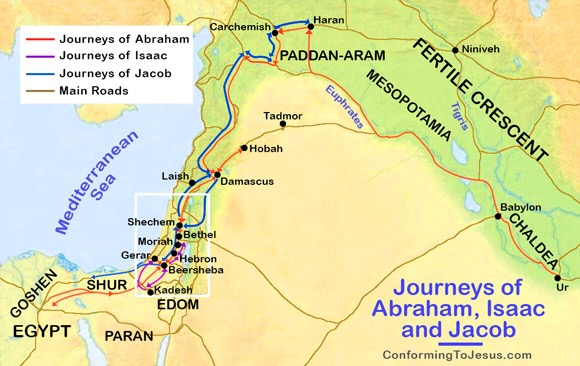
(One possible exercise some of you might want to use in this point, would be to give each of your class members a sheet of paper and have them draw their own “life map” of where God called THEM: maybe some physical moves, maybe some spiritual moves! What does YOUR “life map” look like?
And then you might ask for some volunteers to share their “map.”
(You could also use this for an alternative INTRO to the lesson: begin with a time where your class draws their “life map” of how God has called and led them — and then share how today we are going to study how God led Abram.
But make no mistake: God does not just “leave us where we are” — and I am not just talking about our physical location. He may leave you in the same spot physically (or He may move you); but He will definitely not leave you in the same spot spiritually. He will call us to take steps of obedience to follow Him, just like He did Abram.
Now honestly, there’s so much in these first two points in :1-5, I don’t know if my own class is going to get past these; there’s just so much here; but in case you do, I’ll give a brief overview of these verses:
III. Abram’s Meekness (13:11-13)
The Lifeway Focus Passage starts in :11, but you really have to go back to earlier in the chapter to get the context. After a brief visit to Egypt, Abram camped between Bethel & Ai (:3) in central Palestine, just north of where Jerusalem is today. (Ai is the little town where Joshua & Israel were defeated because of Achan’s disobedience). But Abram was very rich, very blessed, and :5 says Lot was also, and :6 says the land could not hold them both, so :7 indicates there was strife between their herdsmen.
Verse 8 then gives us another remarkable insight into Abram’s character; it says “So Abram said to Lot, ‘Please let there be no strife between you and me …” and in :9 he makes a very generous offer: he gives LOT the choice of where to go, and says he will go the opposite direction.
Then in our “focus passage” of :11+, Lot chooses the valley of the Jordan, “like the garden of the LORD,” including Sodom and Gomorrah, and :12 says Abram settled in the land of Canaan.
??? What is remarkable about this passage???
Well, Abram was the one to whom God gave the promise, wasn’t he? If he were like many of US, he might have said something like: Hey man, I am the one God gave this land to; you go the other way, and I am going to take the best property. And in many ways, he would have been justified in doing that.
But he didn’t. Instead he demonstrated the Biblical quality of “meekness.” Biblical meekness is not weakness, which many of us picture; rather it is surrendering one’s own “rights” and being gracious to others, trusting that GOD will bless you in the end for doing it.
Psalm 37 is the great commentary on meekness; Jesus quotes it in the 3rd Beatitude, “Blessed are the meek/gentle, for they shall inherit the earth.” If you study Psalm 37, you will find that verse in :11, and also the whole Psalm shows us what meekness is: it is not “weakness,” rather it is “trusting in the Lord and doing what is good,” as :3 says. It is not being angry and doing evil, as :8 says. It is waiting for the Lord, that HE will give you the land (or whatever the issue is).
Biblical meekness is humble, it does not seek its own and its own rights, does not get angry or try to get revenge, but trusts in the Lord and does what is right.
Abram is a great example of Biblical meekness here: he didn’t “grab for his ‘rights’ about the land,” instead he was gracious and gave Lot first choice. He trusted in the Lord, and did what was right.
— David exhibited that too, when he wouldn’t stretch his hand out against Saul; he trusted in the Lord and did what was right.
— We see this character of meekness in a number of figures in scripture. Numbers 12:3 says “Now Moses was the meekest man in all the earth.” He didn’t respond or seek his “rights” or revenge when he was accused. He just trusted God — and the Lord stood up for him.
Psalm 37, Jesus in Matthew 5:5, and other passages in scripture call for us to follow these examples of meekness in OUR dealings with others too. The world says: Stand up for your rights; Do whatever you have to do to get what you think is yours.
But God’s people are “Gentle-men” (a pretty good translation of this concept of meekness!) We don’t push and shove and grasp like others — instead we “trust in the Lord and do good.”
And in the final verses of Genesis 13 see the reward of Biblical meekness:
IV. God’s Blessing (13:14-18)
What happens when you exhibit meekness like Abraham did? God rewards you for it.
After Abram let Lot choose the best part of the land, God tells him in :14, “Now lift up your eyes and look from this place where you are, northward and southward and eastward and westward; (:15) for ALL the land which you see, I will give it to you and to your descendants forever.
(Of course God’s promise in :15 is the basis of Israel’s claim on the Promised Land, which they are holding to to this day!)
And He tells him in :16 that He’ll make his descendants “as the dust of the earth.”
So God rewarded Abram for his meekness.
This is just what Psalm 37 in the Old Testament, and Jesus in the Beatitudes, says will happen to the meek:
— Psalm 37:11 says “But the humble will inherit the land.” (And look at Psalm 37, several times in that chapter it says the reward of the one who trusts in the Lord and does what is right will “inherit the land.”
— And Jesus said in Matthew 5:5, “Blessed are the meek, for they will INHERIT THE EARTH.” This is virtually a quote from Psalm 37:11: “the humble will inherit the land/the meek will inherit the earth” — in Hebrew its virtually the same wording.
The Bible is saying here that God will bless the person who does not “grab” for his rights, or lie/cheat/steal to get ahead, but instead who will be humble, gracious, righteous, and trust God instead of “clawing and scratching to get ahead.” If you will “trust in the Lord and do good,” then God will “give you the land.” He will bless you for it. Many times we will see that blessing even here on earth. But if not, you can trust by faith that you will get that reward in glory.
I’d challenge my group — because we face a lot of contentious situations like Abram had with Lot here — somebody in your class may be facing something like this right now! Encourage them not to fight over it; not to be tempted to respond with anger or pride; but trust the Lord, and do what is right — and He will “give you the land” — He will reward you in the end.
Remember Hebrews 11, which refers to the faith of Abraham, says that we are to believe that “God is, and that He is a rewarder of the one who has faith in Him.” Believe that. Do the right thing, and trust that God will reward you, just like He did Abraham.
______________________________________________________
— If you’ll type your email into the “Follow blog via email” blank on my blog home page, WordPress will automatically send you next week’s lesson and you won’t have to search for it.
— And if you write something in the Comments below, I’ll be sure to pray for your and your group by name this week.
Per my licensing agreement with Lifeway:
— These weekly lessons are based on content from Explore the Bible Adult Resources. The presentation is my own and has not been reviewed by Lifeway.
— Lifeway resources are available at: goExploretheBible.com and: goexplorethebible.com/adults-training
— If you have questions about Explore the Bible resources you may send emails to explorethebible@lifeway.com


 shawnethomas
Pastor Thomas, thank you for being a blessing to me as you share your walk with Lord and you help readers and listeners to grow in their walk with the Lord. Your teaching really makes scripture come alive. I teach a group of ladies comprised of new and older believers and your lessons are a tremendous guide for preparing our lessons.
Thank you so much for letting me know that the overviews are helpful to you; that means a lot to me! God’s word is amazing, as we see week after week: “the unfolding of Your words gives light”! How great that you a group with both newer and more mature believers in it; please know that I am praying for you and your class this week!
Thank you so much. This was a great blessing, which I hope to share with the class. Fred Jones
Pastor Thomas, you mentioned in the second paragraph under Context that Shem was Abram’s oldest son. In Genesis 10:21, it says “Sons were also born to Shem, whose older brother was Japheth…” Would you clear this up for me. I know it really is not that important maybe but I’m just curious… Thanks for your explanation.
Shawn, Enjoy your lessons that are related to our Explore the Bible lessons.
They are so helpful in our study each week. Continue to look for them each week Thank so much. We have a class of 25 ladies that meet each Sunday. Your lessons are so helpful to me as I plan each week.
Wanda
I have a business decision to make. Please pray that I will recognize and submit to Gods will as I finalize this business deal. Thank you.
Yes ma’am; I have been praying for you. I hope the Lord has/is making your way straight!