
An overview for Sunday School teachers and Bible study leaders, of Lifeway’s “Explore the Bible” lesson of Acts 18:1-11, 18-21 for Sunday, October 20, 2024, with the title, “Together.” A video version of this overview is available on YouTube at:
INTRO: Ask your group: ??? What’s the most “worldly”/sinful city you have ever visited???
(You/your class members can share your experiences. For example: when I was in college a group of us went to Paris on mission; and although it is called “The City of Lights,” it was a very dark place spiritually. Later as a pastor I also attended the Southern Baptist Convention when it was held in Las Vegas. I definitely saw some things there that I have never seen before! These are very worldly places.)
So after you/your group share your experiences like that, and some of the things you saw, then you could say something like: in our lesson for today we see how the Apostle Paul came to a very worldly place to minister, the city of Corinth, Greece!
CONTEXT
As we continue our study in the Book of Acts, the Apostle Paul is on his “Second Missionary Journey.” Last time we saw that he went to the Greek city of Athens, and preached on the Areopagus, or Mars Hill, and used some references to Greek gods and poets to “connect” with the culture around him there. He got a mixed response (as the Gospel always has a mixed response) but some there did believe.
Now as we come to Chapter 18 today we read about how Paul travels to Corinth, and then concludes his Second Missionary Journey.
OUTLINE
I. A New Ministry (:1-8)
II. God’s Assurance for the Ministry (:9-11)
III. Wrapping Up the Ministry (:18-21)
TEXT:
I. A New Ministry (:1-8)
18:1 “After these things he left Athens and went to Corinth.”
You might want to give a little background here on the city of Corinth. (Like Athens and Sparta, Corinth was actually a “city-state” — it was a city, but it was also like a little state/country.) First, I’d show on a MAP where this stop was on the Second Missionary Journey:

Then you might show a more detailed MAP, which shows just where the city is in Greece. Corinth really is in a strategic location: it is right on the “isthmus,” or narrow strip of land that separates northern from southern Greece.
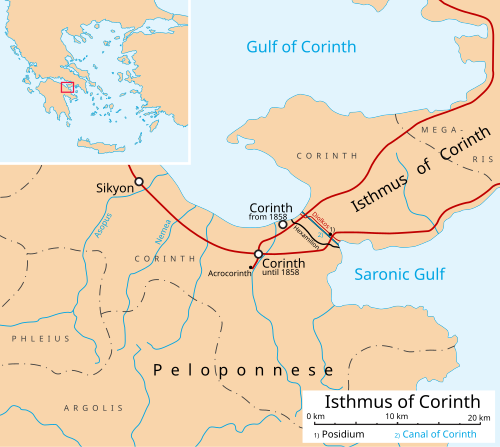
As a result, SO much traffic came through this spot; it was a very cosmopolitan city; a center of commerce — and very worldly. Corinth was famous for their temple to the goddess of love, Aphrodite, where there were 1000 temple prostitutes. Because of this, the name “Corinth” became associated with debauchery; to “Corinthianize” meant to lower one’s moral standards, etc. It was like a New York, Las Vegas, or Paris; a worldly trade center with lax moral standards. THIS was the place Paul came next to minister to!
Corinth was undoubtedly like some of the worldly places that we have experienced, like we share in the introduction. Imagine trying to plant a church in some of these places! That is what Paul was doing here! And of course this lax moral context is what led to many of the problems we read about in the Book of I Corinthians: the divisions, the low moral standards we see in Chapter 5 where a man was living in immorality with his father’s wife, the disorderly worship services, and so on. That’s Corinth!
:2 “and he found a Jew named Aquila, a native of Pontus, having recently come from Italy with his wife Priscilla, because Claudius had commanded all the Jews to leave Rome”
Here Luke continues his pattern of introducing characters who will be very important later: in this case the married couple Aquila and Priscilla. We will see them later:
— at the end of this chapter in :26 they take Apollos and disciple him, and he becomes a powerful spokesman for the Lord with many followers, as I Corinthians shows us.
— In Romans 16:3 Paul tells us they had a church in their house
— Then in II Timothy 4:19, as Paul is heading towards his death, he greets them, evidently still serving the Lord in ministry.
So Paul discipled Aquila and Priscilla, and they were very influential in God’s Kingdom work for years to come, touching many lives.
??? You might share/have your group share about a married couple they know whom God used to influenced you/others greatly???
(Cheryl & I can look at several couples who ministered to us as youth/young adults; our youth minister Steve & his wife Janet Bushey; laypeople Troy & Janet Hill from First Baptist Harrah Oklahoma. There are of course many men and women whom God uses individually, or in separate ministries; this does not negate that at all; but this does remind us that God sometimes uses a married couple, working together, in a particularly strong and powerful way, as He did with Aquila and Priscilla in Acts — and many others in our own experience as well.)
Then it says “He came to them, (:3) and because he was of the same trade, he stayed with them and they were working, for by trade they were tent-makers. (:4) And he was reasoning in the synagogue every Sabbath and trying to persuade Jews and Greeks.”
So Aquila and Priscilla were tent-makers. And it says Paul “was of the same trade.” The word “trade” here in Greek is “homo-technos,” “homo” meaning “same,” and “technos” meaning “art, craft, trade” (we get our word “technique,” or “technology” from this word). So we find out something about Paul here: he was a tent-maker. And so he worked with Aquila and Priscilla in their tent-making business. That’s what he did to “get by;” to “pay the bills,” if you would.
But what we he really there for? We see that in :4, “he was reasoning in the synagogue every Sabbath and trying to persuade Jews and Greeks.” So his REAL business was ministering the word of God to people; he was just doing the tent-making to support himself while he did what God had called him to do.
Thus Paul is an example of what we used to call a “bi-vocational preacher” (or “dual vocational pastor” nowadays): someone who has a full-time job to support themselves, but pastors or ministers at a church part-time.
This is a valuable ministry: not every church can afford a full-time pastor, or worship leader, or youth or college leader — or many other ministry positions. So many, many churches depend on people who have a secular, full-time job which is their primary support, which allows them to do this vital ministry in the local church. Many of you are in churches where this is the case. Thank God for all the “bi-vocational ministers” who are “tent-makers” like Paul was here. This is definitely a Biblical concept.
(You might talk about different “Bi-vocational ministers” that you/your group members know of, as examples: maybe one/more in your church, or other churches/situations.)
But then I would make this point: in a sense, EVERY CHRISTIAN IS A “TENT-MAKER”! Every Christian has been called and gifted by God to do something for His kingdom: to teach the word of God, to go on mission trips, to minister at Crisis Pregnancy Centers or other ministries — we’re just doing what we’re doing at our “secular jobs” to “pay the bills” to allow us to serve God in whatever ministry He has called and gifted us to do.
For example, our son Michael graduated with a degree in music and drama, and He wants to glorify God through His writing. Of course, actual “jobs” in that field are very limited. So he said, “I’m just going to get a job where I can work from 8-5, to pay the bills, so that in my off hours I can write music.” And he is! He graduated from college, is working at a desk job for a pest control company, paying the bills for himself and his wife — but when he comes home he writes music — and he and Abigail just put on an original musical based on T.S. Eliot’s “The Wasteland” at North Greenville University in South Carolina! Michael’s job is his “tent-making;” but that job is not his whole life. His real purpose is to glorify God through his music and writing.
I think more of us as God’s people need to see ourselves this way. We should work to provide for ourselves and our families. But God doesn’t have us here on earth just to be an electrician, or school teacher, or salesman, or whatever. He has placed us where we are to glorify Him, through our witness and service. The job “pays the bills” — but our REAL purpose is to serve and witness for the Lord through the ministry He’s given us. So in a sense, most of us are “tent-makers,” just like Paul was!
But then in :5-8 Paul gets a new direction for ministry in Corinth:
“But when Silas and Timothy came down from Macedonia, Paul began devoting himself completely to the word, solemnly testifying to the Jews that Jesus was the Christ.”
So Paul worked at his “tent-making” while he waited for Timothy and Silas to join him — but when they arrived, his focus changed: it says he “began devoting himself completely to the word.” There’s a time and place to be a “tent-maker” — and there’s also a time and place to be devoted to ministry full-time. Paul was both at different times.
So some of us may be called to be “tent-makers” — working full time to support ourselves and the ministry God calls us to. But others of us God may be calling to full-time ministry. Perhaps someone in your class — maybe even YOU! There is a shortage today of full-time pastors, worship leaders, youth and children’s directors in our Southern Baptist churches. Part of our ministry as preachers and teachers is to “call out the called,” so you might emphasize this as part of your lesson Sunday. (And even if those in your group are not called to full-time ministry, then encourage them to PRAY for workers for the harvest! They are greatly needed!)
:6 says that the Jews did not receive this ministry well: “But when they resisted and blasphemed, he shook out his garments and said to them, ‘Your blood be on your own heads! I am clean. From now on I will go to the Gentiles.’”
As we have seen repeatedly in Acts, everyone does not receive the message. But when they reject it, our consciences are clear. Paul said to them, “Your blood be on your own head.”
(+x Ezekiel 3:17-19 17 “Son of man, I have appointed you a watchman to the house of Israel; whenever you hear a word from My mouth, warn them from Me. 18 When I say to the wicked, ‘You will surely die,’ and you do not warn him or speak out to warn the wicked from his wicked way that he may live, that wicked man shall die in his iniquity, but his blood I will require at your hand. 19 Yet if you have warned the wicked and he does not turn from his wickedness or from his wicked way, he shall die in his iniquity; but you have delivered yourself.”
So Paul was basically quoting this scripture to them in this situation. He was innocent of the judgment that was coming on them; he’d told them. They had rejected it.
The question for many of us today is: Can we say that WE are innocent of the blood of those around US? Have we shared the message with them? It’s a sobering thought, and it should be!
But it also brings up another point: we are not responsible to continue to share the gospel where it is being ridiculed and blasphemed. Verse 6 here says the Jews “resisted and blasphemed.” Paul did not stay there. He moved on.
+x Matthew 7:6, “Do not give what is holy to dogs, and do not throw your pearls before swine, or they will trample them under their feet, and turn and tear you to pieces.”
The Gospel is a precious treasure — a “pearl” if you would — don’t throw it to “swine” who are mocking and blaspheming it. Move on, like Paul did here.
??? If you or your group were ever in a situation like this, you might have some discussion/sharing about that here???
Then in :7-8 Paul went to “better soil”, Titius Justice’s house (which happened to be next to the synagogue — so he didn’t have to go far to find “better soil”!)
:8 says: “Crispus, the leader of the synagogue, believed in the Lord with all his household, and many of the Corinthians when they heard were believing and being baptized.”
So an amazing thing happened: “The leader of the synagogue,” Crispus, was saved! (Crispus is actually mentioned later in scripture, where Paul says in I Corinthians 1:14, “I thank God that I baptized none of you except Crispus and Gaius.” So Paul did personally baptize him — but not many others.
And it says that “MANY” of the Corinthians were being saved as well. So Paul’s new ministry was very fruitful; MANY were saved in Corinth — one of the best, most fruitful ministries that Paul had on any of his mission trips.
I think one application for us here is, that God grants us some seasons of very fruitful ministry — but also that He does not always. How many mission stops did Paul have where he experienced only rejection — or very little fruit? But now here in Corinth, he was having a very fruitful season. I think one lesson is, when God is blessing in a strong way, and people are being saved and baptized, thank Him for that. But don’t take it for granted. And know that there will likely be “slower” seasons for you when that does not happen. Another application is for us just to continue to be faithful to witness and minister and serve even when it is not the most “fruitful season.” As Galatians says “in due season we shall reap, if we do not lose heart.” Keep sowing; keep planting; keep working.” I’ve seen it in churches over 40 years of ministry: it’s not always harvest season. But if we’re faithful to sow and work, harvest time will come. There will be another fruitful season. So don’t quit or get too discouraged about it. Just keep working and praying until the next fruitful season comes — it may be just around the corner!
II. God’s Assurance for the Ministry (:9-11)
:9 “And the Lord said to Paul in the night by a vision, “Do not be afraid any longer, but go on speaking and do not be silent; 10 for I am with you, and no man will attack you in order to harm you, for I have many people in this city.” 11 And he settled there a year and six months, teaching the word of God among them.”
“Do not be afraid any longer” — this is an interesting word to Paul from the Lord. He used the phrase “any longer.” So evidently Paul HAD been afraid! Is that possible? Absolutely.
In I Corinthians 2:3 Paul reminded the Corinthians that when he first came to them, “I was with you in weakness and in fear and in much trembling.” So YES: Paul was afraid when he went to Corinth!
Some of us really need to hear this: Paul did not minister and evangelize because he didn’t have any fear — NO! He ministered and evangelized DESPITE his fears, with God’s help!
You might explain this to your group, and then ask them to share:
??? What are some times when YOU had “weakness/fear/trembling” and might have been tempted not to share/serve, but God helped you to do it anyway???
(I have been in that position many times: heading to make an evangelistic visit with a pit in my stomach, not knowing what to say; once on a mission trip in a Muslim area, I thought they may have been about to beat me with cricket bats, and I was afraid, but God helped me to share; because of an illness I have been very shaky in recent years, and it is often hard to stand and speak, and I’ve thought of Paul’s words in I Corinthians: “I was with you in weakness and in fear, and in much trembling.” Several times I’ve been in a very shaky, uncomfortable situation where it just made me really trust God — and He’s helped me! The last one I was in, I picked up a rock, and said, “Here’s my ‘Ebenezer,’ God helped me here — so I know He will help me again!”)
Sharing these times that you’ve been afraid, and what God did through you despite your fear, may encourage others who are afraid, that the Lord can use them too, just like he used Paul, and you! But challenge your class: we don’t witness and minister because we aren’t afraid; we witness and minister despite our fear, with God’s help, just like Paul did!
An illustration of this was on my wife Cheryl’s first day at rehab, the therapist had her stand, and gave her a big stick, and said, “Take a step!” Cheryl said she was so filled with fear. Her left side was virtually useless; the floor was hard. She was almost petrified; how could she take a step? All she could do was lean on God’s word, Joshua 1:9, “Be strong and courageous …”. And with God’s help, she took that step. She didn’t step because she didn’t have any fear; she took the step despite her fear, with God’s help.
Paul shows us here that this is what we need to do when we’re afraid in a witness/ministry situation. Don’t wait until you’re not afraid; just like Cheryl, ask God to help you, claim His word — and then with His help, take that step!
(In verses 12-17, between the Lifeway “focus passage,” there is a somewhat humorous episode: the Jews tried to cause trouble again, and brought Paul before Gallio, the Roman governor. Verse 14 says Paul was about to defend himself, but the governor intervened and said, this is not some “vicious crime,” it’s just about “words and names” and I’m not going to waste my time with this! Then they began to beat the new leader of the synagogue! The Jewish interference, which hindered so many of Paul’s mission attempts, backfired on them this time! And Paul’s new ministry there flourished with God’s blessing.)
III. Wrapping Up The Ministry (:18-21)
“Paul, having remained many days longer, took leave of the brethren and put out to sea for Syria, and with him were Priscilla and Aquila. In Cenchrea he had his hair cut, for he was keeping a vow. 19 They came to Ephesus, and he left them there. Now he himself entered the synagogue and reasoned with the Jews. 20 When they asked him to stay for a longer time, he did not consent, 21 but taking leave of them and saying, ‘I will return to you again if God wills,’ he set sail from Ephesus.”
This last little section wraps up our focus passage for this week, and it describes the conclusion of Paul’s first mission in Corinth, and his Second Missionary Journey. Several things here:
— We see him take Priscilla and Aquila with him on his trip back. We saw he did that earlier with Timothy: he took him with him on the mission trip. Now he’s taking Aquila and Priscilla with him from Corinth. Taking people WITH you can be an important aspect of discipleship.
— It’s also notable that Luke changes the order of their names here: it’s not “Aquila and Priscilla,” but reversed: “Priscilla and Aquila”! Why does he do this? Could it be random? Maybe. But it’s interesting that he does this again in :26, when they meet Apollos and disciple him: Priscilla is mentioned first again. Same thing in Romans 16:3, Priscilla and Aquila and the church that is in their house. And again near the end of Paul’s life in II Timothy 4:19 (Aquila is mentioned first in I Corinthians 16:19, interestingly, in the letter to the church where Paul met them!) Is this order random? Or has Priscilla become the stronger disciple, with greater influence? I don’t know how much we should make of it, but it is an interesting and notable observation in these scriptures.
— :19 says he came to Ephesus on his return voyage (this is back in what we call today “Turkey.”) It says he left Aquila and Priscilla there — evidently to minister. So he spent some time with them, discipled them — and then brought them to a new place to minister.
— Then it’s significant that when Paul left Ephesus to conclude his mission, he told them: “I will return to you again IF GOD WILLS.” I love that phrase, and use it often, “Lord willing.”
James 4:13-15 talks about this: “Come now, you who say, “Today or tomorrow we will go to such and such a city, and spend a year there and engage in business and make a profit.” 14 Yet you do not know what your life will be like tomorrow. You are just a vapor that appears for a little while and then vanishes away. 15 Instead, you ought to say, “If the Lord wills, we will live and also do this or that.”
I don’t think this is a minor thing. I think it’s very important. We are not in control of our lives. We don’t know what will happen tomorrow. Cheryl & I just saw that in a very dramatic way when she had her stroke the last day of August. That was NOWHERE on our radar; we do not know what our life will be like tomorrow.
Will Rogers’ wife Betty gives us another illustration of his in her biography of her husband: “A wealthy Los Angeles businessman bought a large plot of land near our ranch. Sunday after Sunday he would ride over his own hills, and once he confided to Will that some day he expected to build a beautiful home there — probably would start building within four years, by which time he hoped to have satisfied himself as to the most desirable site and be sure that his house plans were absolutely perfect. Will was dumbfounded: ‘How does he know where he will be in four years?,’ he demanded of me. ‘If he loves the site and wants a home there, why doesn’t he build it and enjoy it now?’ I could have answered that he was a careful planned and a foresighted man, but I am glad that I did not, for four years later the depression had wiped him out and he never did live in his perfect house.” (Betty Rogers, Will Rogers, pp. 264-265)
This is why we need to purposefully keep this attitude that James talks about in the front of our minds: that we will do “this or that,” “IF THE LORD WILLS.” “If the Lord wills,” or “Lord willing,” should be a regular part of the Christian person’s vocabulary; it’s the vocabulary of faith. You know how when you are talking to someone and you just know almost instantly if they are a Christian or not by the way they talk? (We can all share instances of that, and you/your group might do that here) But THIS is one of those phrases that should punctuate the Christian’s vocabulary: let’s make sure that we are not arrogant in our view of the future. Let’s say “Lord willing!”
I hope this overview will help you as you prepare for Sunday’s lesson. I hope to see you here again next week: “Lord willing!”
___________________________________________________
— If you’ll type your email in the “follow blog via email” blank on my blog home page, WordPress will automatically send you next week’s lesson and you won’t have to search for it.
— And if you write something in the Comments below, I’ll be sure to pray for your and your group by name this week. Thank you for the prayers of so many of you for my wife Cheryl as she recuperates from her stroke. If you’d like to follow her progress, feel free to follow me on Facebook, or read occasional articles on my blog.
Per my licensing agreement with Lifeway:
— These weekly lessons are based on content from Explore the Bible Adult Resources. The presentation is my own and has not been reviewed by Lifeway.
— Lifeway resources are available at: goExploretheBible.com and: goexplorethebible.com/adults-training
— If you have questions about Explore the Bible resources you may send emails to explorethebible@lifeway.com


 shawnethomas
follow blog via email skvpav@yahoo.com
You should be added Kelly; please let me know if you don’t start receiving it next week! And I’ll be praying for you and your class this weekend!
follow blog via email
Steve I just added you to the subscriber list. Let me know if you have any problem with it, or do not receive it Saturday. I’ll be praying for you this weekend!