
An overview for Sunday school teachers and Bible study leaders, of Lifeway’s “Explore the Bible” lesson of Exodus 20:1-17 for Sunday, January 12, 2025 with the title, “God’s Commands.”
A video version of this overview is available on YouTube at:
I have TWO different suggestions for an INTRODUCTION to the lesson this week:
INTRO OPTION 1:
A survey by Kelton Research found that more people in America can name the ingredients of a Big Mac than can list all Ten Commandments.
— 80 percent of 1,000 respondents could name the burger’s primary ingredient — two all-beef patties — but less than six in 10 knew the commandment “thou shalt not kill.”
— Less than half of respondents — 45 percent — could recall the commandment “honour thy father and mother” but 62 percent knew the Big Mac has pickle.
Which leads to the question: “How many of the Ten Commandments can you name?”
(Pass out paper and pens, secret ballot survey; keep for yourself)
You could post something fun with the scores like:
0-2 You’re A Pagan!
3-4 Go Back to VBS!
5-6 You’re A Good Average Baptist!
7-8 Ready for Bible College!
9-10 BIBLE SCHOLAR! (Now try LIVING them!)
(As a humorous/interesting point of comparison you might then ask: “How many ingredients of a Big Mac can you name?”
Song: “2 all-beef patties, special sauce, lettuce, cheese, pickles, onions on a sesame seed bun.
Then transition by saying something like: today we will look at the Ten Commandments of Exodus 20:1-17.
INTRO OPTION 2:
(In July, 1955, the 4 world powers met for a summit meeting in Geneva, Switzerland.) “By a quirk of fate, the Reverend Billy Graham was holding a revival crusade in the city that coincided with the summit. Graham acknowledged that the timing was accidental, although he did not rule out the possibility that Providence may have played a role, Graham told The New Yorker’s Richard Rovere that he was much in favor of the summit. ‘Moses long ago held a parley at the Summit,’ said Graham, ‘and had there received a ten-point directive that the heads of government would do well to restudy.’”(Jean Edward Smith, Eisenhower in War and Peace, p. 666)
Then transition to say: today we ARE going to restudy God’s “10 point directive” as we come to Exodus 20 ..
CONTEXT
We are continuing our study of the Book of Exodus. The children of Israel have left Egypt and are on their way to the Promised Land, having been rescued by the LORD by His miraculous hand at the Red Sea, and nourished by His provision along the way despite their grumblings.
Exodus 19 says on their third month out of Egypt, they came to the wilderness of Sinai. It describes how YHWH came down upon Mt. Sinai in the sight of the people in fire and smoke and the mountain shook violently. From Mt. Sinai, Exodus 20:1 says “God spoke all these words,” a powerful way to open our focus passage for this week.
OUTLINE
I. The Authority of the Commandments (:1-2)
II. The Content of the Commandments (:3-17)
III. The Purpose of the Commandments
TEXT
I. The Authority of the Commandments (:1-2)
:1 “Then God spoke all these words, saying, ‘I am YHWH your God, who brought you out of the land of Egypt, out of the house of slavery.’”
It would be easy to just skip over these first words of :1, but we shouldn’t. It’s important: WHERE did these commands come from? They didn’t come from Moses; “Then GOD spoke all these words, saying …”. Because GOD spoke these words, we need to treat them as such. We need to respect them, and share them, as God’s unchangeable word.
Rosaria Champagne Butterfield was a liberal, lesbian college professor in the northeast before she was saved and began following Christ. In her book, Openness Unhindered, she writes:
“Recently the pastor of a well respected church asked me to meet with a woman who was part of his counseling staff. When I entered her office, she directed me to a comfortable chair and made one simple request: “Rosaria, I want you to change your message.” I found this a bold and disarming request, and so I told her that I come in the gospel of peace,
She said, “Change your message.”
I told her that I stand in the risen Christ.
She said, “Change your message.”
Finally, I asked her what I ought to change in my message. She said, “Tell people that it is only in your opinion that homosexual practice is a sin.”
I responded by letting her know that I am not smart enough have this opinion, but that this is the position the inspired and inerrant Word of God upholds. It comes to me from the historic Christian church, handed down to us from the Apostles’ Creed, through the pages of Scripture, and so on down to me. I told her that changing my message would involve denying the plain meaning of Scripture, the testimony of the church, the life, death, resurrection of Jesus, and the gospel.” (p. 47)
Rosaria Butterfield has it right. What we teach in the Bible is not our own opinions or ideas. These are the words of GOD! “GOD spoke all these words, saying …”!
AND NOTICE WHICH GOD gave them these commandments:
:2, “I am (literally) YHWH your God …”. As we’ve seen several times in Exodus so far, it’s significant that God uses His personal name here. THIS IS NOT JUST ANY GOD. This is YHWH GOD who is speaking.
So many people today feel like it doesn’t matter what God you worship. I just finished reading a biography of children’s tv pioneer Fred Rogers, who seemed to be a very kind man. But unfortunately, although he claimed to be a Christian, Rogers felt like all religions were good, and didn’t matter which one you preferred. By his bedside were books by Christians, Buddhists, every religion.
A HuffPost article by Michael Long from May 18 2015 shares this story: “In May 2001… [Rogers] encountered a man who was arguing with his co-workers about salvation. The man recognized Rogers, grabbed him, and said: “Tell these people there’s only one way to God.” … But Rogers did not take the bait of Christian exclusivism: “And I said,” Rogers recounted, “‘God loves you just the way you are.’”
This is the popular view today. It doesn’t matter what God you worship. But it is NOT the view of the Bible. Scripture could not be more clear: it is not just “any” God we serve, but THIS ONE GOD, YHWH God; the God of the Bible; the God and Father of the Lord Jesus Christ, who said “I am THE way, THE truth, and THE life, NO ONE comes to the Father but through Me.” It wasn’t Allah, or Buddha, or anyone else speaking these words, it was THIS God, YHWH God, who said he was speaking to them.
AND NOTICE these commands come to the people God redeemed: “who brought you out of the land of Egypt, out of the house of slavery.’” God saved His people out of Egypt. Several times in the Old Testament God used the word “redeemed” to describe how He brought them out of Egypt and made them His people (Deut. 7:8, 13:15, 15:15, 24:18, I Chron. 17:21)
It was TO the people God redeemed, that He gave these commands.
We too have been redeemed by God, not just out of Egypt, and not just by the blood of a Passover Lamb, but as I Peter 1:18-19 says: “Knowing that you were not redeemed with perishable things like silver or gold from your futile way of life inherited from your forefathers, 19 but with precious blood, as of a lamb unblemished and spotless, the blood of Christ.”
We too have been “redeemed,” bought, by the blood of Christ, so YHWH is our God. And we are the people to whom He is speaking through His word. So we especially need to pay attention to His words here. So what IS He saying? In this next section we’ll look at the Commandments themselves.
II. The Content of the Commandments (:2-17)
Most of us are at least somewhat familiar with the Ten Commandments (whether or not we can name all of them!) Here’s some brief notes on the 10 Commandments themselves that you might find helpful as you review them with your class Sunday:
First, the STRUCTURE of the Commandments.
In the Gospels Jesus said the Greatest Command is to love God with all your heart, and then your neighbor as yourself, and that all the Commandments are summed up in these. We see that in the structure of the Ten Commandments; they show us how to love God, and love other people:
— LOVE GOD: by having no other gods before Him, not worshiping idols instead of Him, not taking His name in vain, remembering His day — and some might add the 5th, honoring the authorities He gave you as His representatives, your parents (this could also go with loving others).
— LOVE PEOPLE: perhaps you put honoring your parents here; then you love people by not killing them, not violating their marriages, not taking from them, not bearing false witness against them, and by not secretly desiring what they have.
So that’s a pretty good, basic overview of the Commandments: Love God, and Love people.
Now let’s look at the Ten Commandments themselves. We could easily spend a week on EACH of the Ten Commandments, so I’d plan to just briefly look at them. I’ll try to give you some brief insight/illustration/application for each one:
ONE: “You shall have no other gods before Me.”
This doesn’t mean we can have other gods as long as we don’t put them in front of Him. Literally this is “no other gods before My face.” So it means we are to have NO OTHER GODS besides Him. YHWH is to be our one and only God.
Missionaries to India tell us we have to be careful when we do evangelism there, because the Hindus, the primarily religion of India, believe in as many as 100 million gods! So if you introduce them to Jesus, they may say, Oh yes, I’ll believe in Him (along with 100 million others)! But what you must make clear is what the First Commandment teaches here, that Jesus doesn’t just come to be ONE of your gods; He comes to be your ONLY God.
I read of one Hindu who was all excited about Jesus, until he asked, “Does this mean I have to put away all my other idols?” Of course the answer is YES. We are to have NO other gods besides Him.
Of course, this applies to us in America as well. Anything we try to put “before His face” (in front of Him) is a potential false god.
Tim Keller has a good quote about this:
“If you love anything at all in this world more than God, you will crush that object under the weight of your expectations, and it will eventually break your heart.” (Timothy Keller, Prayer, p. 193)
Only the One True God will satisfy us. So don’t allow anything else in your life to try to take His place. It won’t work. It won’t satisfy you, and it will be devastating to that other person or thing. Don’t have any other god before Him.
TWO: “You shall not make any graven images.”
This Commandment has a couple of applications:
1) You shall not worship any graven image of any god. It was common in those days (as it is these days in many parts of the world) to worship an image, whether it was Baal, or Molech, or Asherah. We are not to worship images of other gods. (Thus an extension of the First Commandment.)
2) But this has another application: not only are we not to worship other gods through images, we are also not to worship YHWH through images either! Don’t make an image and say “This is YHWH.”
You may know this was actually the case with the Golden Calf later in Exodus. Exodus 32:4 says that when Aaron made the image, “He took this from their hand, and fashioned it with a graving tool and made it into a molten calf; and they said, “This is your god, O Israel, who brought you up from the land of Egypt.” So he wasn’t saying this was Molech or Ra or Baal; he was saying this was YHWH, who had brought them up from Egypt!
So God is not only prohibiting the worship of OTHER gods via graven images, but also any attempt to worship HIM through images.
??? DISCUSSION QUESTION ???
“Why do you think God would prohibit worshiping Him through images?”
(Answers might include: because images only serve to distort the One True God. No image can contain or capture Him. A calf or a bull or some other image doesn’t begin to convey who God is! “Heaven nor the highest heaven can contain Him” — as Hebrews 11:1, 6 says, we are to worship Him by faith, “as seeing Him who is unseen.” We don’t do that through images.
And a followup might be: what are some ways that even we Christians today might be tempted to violate this commandment?
(Some religions — Orthodox — worship through “icons” — basically glorified “pictures” of Jesus and saints. They evade the 2nd Commandment by saying they are flat; they are not “graven” or “carved” images, and thus do not break the commandment. I think this is a weak excuse.
One way many evangelical Christians can be tempted to worship pictures of Jesus in art, media, etc. You might show one of these pictures and ask:
??? How many of you have seen one of these???
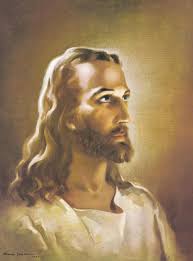
These are probably not as common today as they were a generation ago, but they used to be framed and hung in many Christians’ homes. We might think, “Oh, I would never worship an image.”
We need to be careful to worship Him by faith, not by sight. Don’t be tempted to worship God through the medium of images.
You/your group can think of other ways we might be tempted to violate this 2nd Commandment.
THREE “You shall not take the name of YHWH your God in vain.”
Again, this is one of those places where it makes a lot of sense to translate “LORD” with the name “YHWH” or “Jehovah.” It’s His personal name we are not to take in vain — not the name of any other god.
We often think of “taking God’s name in vain” as meaning something like: “don’t cuss.” But for the people of God, it means much more. “In vain” literally means “empty, worthless.” In other words, don’t use God’s name like it’s nothing.
??? DISCUSSION QUESTION???
??? What are some ways that God’s people might take His name “in vain” or “lightly” today???
(Speak of Him in very light terms: “the Man upstairs,” etc; to call yourself a person of God, but not live with the weight of that calling, etc. You/your group can share some applications.)
ILLUSTRATION
“… when someone mentioned that Rayburn’s father had not left him much of an inheritance, Rayburn quickly corrected him—his father, he said, “gave me my untarnished name. He kept it untarnished.” (Robert A. Caro, The Years of Lyndon Johnson: The Path to Power, p. 310)
This is a good challenge to us as God’s people: let’s keep His name untarnished. Let’s bear His name with honor and integrity, and not tarnish His name by our words, actions, or lifestyle.
FOUR: “Remember the Sabbath Day, to keep it holy.”
I’d point out a couple of things about this 4th Commandment:
— First of all, this is the only command of the 10 that is not repeated in the New Testament. Every one of the other Commandments, you can find a New Testament re-iteration — but not the Sabbath command.
As a result, there are several views on the Sabbath among Christians today: some believe that the Sabbath was changed to Sunday, the day Jesus rose from the dead, and now that is the “Christian Sabbath” (though there is no specific command as such in the New Testament). Others believe that the Sabbath was replaced by a new day, “The Lord’s Day,” which is not a “Sabbath” as such, but a day to gather and worship. And yet others believe that the Sabbath is still on Saturday (“7th Day Baptists”). So there are several different views among sincere Christians about the nature of the sabbath today. One thing the New Testament does tell us: don’t argue about it. Paul wrote in Romans 14:5 “One person regards one day above another, another regards every day alike. Each person must be fully convinced in his own mind.” He wrote in Colossians 2:16, “Therefore no one is to act as your judge in regard to food or drink or in respect to a festival or a new moon or a Sabbath day.” So whatever view we have about the Sabbath, we are to respect other people’s convictions, and not judge them about it. It should not be a source of division among the people of God.
So is the Sabbath command irrelevant now? I don’t believe so. I believe there is a continuing principle of REST taught here. We need rest, regular, weekly rest — and if we don’t get it, we will suffer for it. Conversely, if we DO get it, we do much better.
AN ILLUSTRATION:
In his book, Stolen Focus, Johann Hari, writes about rest:
“For example, in Britain during the First World War, there had been a munitions factory that made people work seven days a week. When they cut back to six days, they found, the factory produced more overall.” (p. 187)
FIVE. “Honor your father and your mother.”
The Hebrew word here for “honor” is the same word (kabad) as “glory,” which is literally “give weight to.” “Give weight” to your parents; consider them as worthy of honor and respect and care.
ILLUSTRATION:
(Writing of the revolution of the 1960’s, author William Manchester says:
“Henry A. Murray, Another Harvard contributor to Daedalus, pointed to one unexpected consequence. Most teen-age aggregates, he observed, were “bound together by an anti-authoritarian, anti-father compact.” It was a strong man who could command respect in his own house. Society seemed to be conspiring against him. One of the greatest offenders was television. TV fathers were pitiful weaklings. Make Room for Daddy’s ineffectual daddy let his wife dominate him simply because she talked the loudest. Uncle Bentley in Bachelor Father was systematically humiliated by his niece and servant, and Mr. Anderson, the antihero of a series sardonically called Father Knows Best, invariably responded to the strange antics of his children by saying, “Let’s keep out of it and see what happens.’”
(William Manchester, The Glory and the Dream, Vol. II, p. 1349)
By the way, notice it says: “AND YOUR MOTHER”! Again we see the Bible is revolutionary in its attitude towards women. It’s not just the father who is to be honored, but the mother as well. Don’t let anyone tell you the Bible teaches hate for women!)
SIX: “You shall not murder.”
We don’t advance the Kingdom of God by killing other people/adherents of other beliefs. No “Islam or the sword” for followers of Jesus. Radical Christians do not kill for their faith. Radical Christians DIE for their faith!
ILLUSTRATION:
In Jack Weatherford’s book, Genghis Khan and the Making of the Modern World, he writes about the Shiite Muslim sect, the Nizari Ismailis. This group became known in the West as the Assassins, because they exercised their control over the Middle East from Afghanistan to Syria, by killing anyone, particularly leaders or other powerful people, who opposed them in any way. They would lure young followers to take hashish, and with promises of paradise as martyrs, they would do anything to kill the sect’s opponents — thus their reign over this vast area until Genghis Khan take it over from them.
Killing others to further your cause is a typical human strategy. But God says to His people, it is not to be so among you. You shall not commit murder. Don’t you personally kill someone so you can take what is theirs. And as God’s people, we don’t try to further His kingdom through violent means. Jesus told His disciples to put up their swords. That’s not how they were going to advance His work. As my old seminary professor said, a radical Christian is NOT one who is willing to KILL for his faith; a radical Christian is one who is willing to DIE for his faith! That’s a big difference! We as God’s people are not to commit murder.
(By the way, this also applies to abortion. Many Baptists emphasize a Sunday in January as “Sanctity of Human Life” Sunday. This would be a good text for that, and a good place to mention that we don’t sacrifice human beings for our own comfort and convenience. The 6th Commandment certainly applies to the issue of abortion, so you might want to discuss that at this point.
SEVEN: “You shall not commit adultery.”
This commandment was given to safeguard the sanctity of marriage, and ultimately the picture of the commitment of Christ to His church. “For this cause a man shall leave his father and mother, and cleave to his wife, and the two shall become one flesh.” God says that commitment is not to be violated.
ILLUSTRATION:
(In 1945 after World War II, President Harry Truman was in Berlin attending the Potsdam conference with Stalin and Churchill.)
“In Berlin the black market—trade in cigarettes, watches, whiskey’ and prostitution were rampant. One evening at the end of an arduous session at the palace, a young Army public relations officer, seeing that Truman was about to leave alone in his car, stuck his head in the window … Floyd Boring, who was driving, could not help overhearing the conversation as they headed off. The officer said that if there was anything the President wanted, anything at all he needed, he had only to say the word. ‘Anything, You know, like women.’
‘Listen, son, I married my sweetheart,’ Truman said. ‘She doesn’t run around on me, and I don’t run around on her. I want that understood. Don’t ever mention that kind of stuff to me again.’”
(David McCullough, Truman, p. 435)
Now, as Jesus points out in Matthew, there is more than one way to violate the 7th Commandment. He said to look at someone and lust for them is to commit adultery in your heart.
EIGHT: “You shall not steal.”
This commandment safeguards people’s property rights. But again, there is more than one way to violate the 8th Commandment.
??? DISCUSSION QUESTION???
“What are some different ways we can violate the 8th Commandment today?”
(Some ways might be: just taking something that is not yours, from the office (“white collar crime”) or someplace else. Not correcting a mistake a cashier or other employee makes. Not paying your taxes! You/your group can think of many applications I’m sure!)
Here’s one for you that might convict many of God’s people: remember Malachi 3:8 says, “Will a man rob God? Yet you are robbing Me! But you say, ‘How have we robbed You?’ In tithes and offerings.” So if you aren’t tithing, you are absolutely breaking this commandment — and you’re stealing from the absolutely worst person to steal from: from GOD HIMSELF!
NINE: “You shall not bear false witness against your neighbor.”
The word “witness” here was used in the context of legal proceedings. The Hebrew system of justice, like ours, depended upon people “bearing witness” to what they saw and heard.
Deuternomy 19:15 “A single witness shall not rise up against a man on account of any iniquity or any sin which he has committed; on the evidence of two or three witnesses a matter shall be confirmed.”
So guilt was to be determined on the basis of witnesses who testified. Deuteronomy 17:6 says a man could be put to death on the testimony of two or three witnesses. So one’s testimony was important, even a matter of life and death! We have the example of the incident of King Ahab and Naboth’s vineyard, when Jezebel got two “worthless men” to testify falsely against Naboth, so that Ahab could take his vineyard that he coveted.
I Kings 21:13 “Then the two worthless men came in and sat before him; and the worthless men testified against him, even against Naboth, before the people, saying, “Naboth cursed God and the king.” So they took him outside the city and stoned him to death with stones.”
So a nation in which people testify falsely is a nation in which there can be no justice, and evil and disorder rule. It’s vital that good people do not bear false witness, but testify truly to all they see and hear.
TEN: “You shall not covet.”
Some might look at this last commandment and think, “Why this is hardly a sin at all! ‘Just coveting?!” But it is actually a very convicting commandment.
To “covet” means “to desire, take pleasure in, delight in.” It’s translated by the New Testament word “lust.” All desires are not bad; one can desire good things! But this means to desire something wrongfully; something you are prohibited from having.
God gives several examples here of things we are not to covet:
our neighbor’s house; our neighbor’s wife; our neighbor’s servants or animals — “or anything that is your neighbors.”
What is so convicting about this commandment is that it not only deals with outward actions, like stealing or killing, but it deals with what we are THINKING in our hearts! What hope do we have of being justified before God if He judges even the secret thoughts of our hearts?! But that is exactly what He does:
— In Psalm 90:8 “You have placed our iniquities before You; our secret sins in the light of Your presence.” Yes, even our “secret sins” in our hearts are seen and judged by Him!
— In Matthew 9:4, when the scribes were grumbling becasue Jesus had told the paralytic that his sins were forgiven, it says “And Jesus knowing their thoughts said, ‘Why are you thinking evil in your hearts?’” What a powerful and convicting verse:
— “Jesus KNOWING THEIR THOUGHTS” said
— “Why are you THINKING EVIL IN YOIUR HEARTS?”
He knows our thoughts! He knows our hearts? This convicts and condemns us all — which fittingly leads us to our last point today:
III. The Purpose of the Commandments
So these are the Ten Commandments. But we also need to make sure our class members understand just WHY God gave them to us, and why they are still important to us today.
— First of all, He DID give them to us as a basic moral code. Here is a summary of basic right and wrong.
— But when you study them, you understand that we cannot possibly keep them all. It is a hopeless pursuit.
One of the most foolish things people say — and people DO say this — is “I’ll just keep the Commandments and get into heaven.” That’s like saying “I’ll just get into college by making perfect score on the ACT.” You can’t do that! NONE of us can!
This is especially true when you understand just what the Ten Commandments really mean, as Jesus explained them in Matthew 5: not to “murder” means not even to be angry with someone; not to “commit adultery” means not to even desire someone in your heart. That takes it to another level entirely — a level which none of us are able to completely obey.
But even on a surface level, we can’t keep the Commandments.
For EXAMPLE take The Rich Young Ruler. He asked Jesus how he could have eternal life, and Jesus told him to keep the Commandments. He naively answered: “All these things I have kept from my youth.” Jesus knew he didn’t get it, so He told him to sell all his possessions and give them to the poor, and come follow Him. But he didn’t want to do it. He went away sorrowful. What happened was, that his heart was exposed. He had NOT kept all the Commandments; he couldn’t even keep the FIRST one! He put his money ahead of the Lord!
And this is true for all of us. We can’t be saved by keeping the Commandments. We can’t keep them. We can’t keep the first one! (And we can’t keep the last one either!)
So in a very real sense, a “good Christian person” is NOT a person who tries their best to KEEP the Ten Commandments to get into heaven. (I think this is what most people believe.) But rather a genuine Christian is one who realizes that they have BROKEN the Ten Commandments, and has asked Jesus to forgive them for it! So the second great purpose of the Ten Commandment is to expose our sin, and cast us all upon the grace of God.
ILLUSTRATION/EXERCISE: In a sermon on Romans 10:4, “All Religion is Not The Same,” Mark Dever said: “The Law was meant to exhaust us. The Law was never meant to save us.”
You might share that quote with your group — OR you might post it on the wall or show it on your video screen, and ask your group to talk about it.
(You might include in your comments that the Bible makes it clear that we could never be saved by keeping the Law. Romans 3:20 says, “By the works of the Law, no flesh will be justified in His sight.” Rather, as Paul writes in Galatians 3:24, “Therefore the Law has become our tutor to lead us to Christ, so that we may be justified by faith.”
As the 2nd verse of the great hymn “Rock of Ages” says:
“Not the labors of my hands
can fulfill thy law’s demands;
could my zeal no respite know,
could my tears forever flow,
all for sin could not atone;
thou must save, and thou alone.
(And the next verse begins: “Nothing in my hand I bring; simply to Thy cross I cling”!)
ILLUSTRATION: A couple of years ago, a man wrote a comment on my blog on a sermon Philippians 3 on the Apostle Paul: “This is mindblowing, the more I try hard to become righteous before God, the more frustrated I become, ‘cause I cannot be able to do everything that I need to do. I totally agree with you to completely trust in Him and stop trusting in my ability. It’s filthy, not good enough, and cannot save me.”
This man got it exactly! The Ten Commandments are God’s word to mankind, giving us a moral standard to follow. We need to know them (all of them!) and we need to teach them to our kids, grandkids, and others. But we also need to realize that keeping them cannot save us. We can’t do it! What they DO accomplish, is that they expose our sin for what it is — and they cast us on the grace of God in Jesus, which is our only hope for salvation.
— If you’ll type your email in the “Follow blog via email” blank on my blog home page, WordPress will automatically send you next week’s lesson and you won’t have to search for it.
— And if you write something in the Comments below, I’ll be sure to pray for your and your group by name this week.
Per my licensing agreement with Lifeway:
— These weekly lessons are based on content from Explore the Bible Adult Resources. The presentation is my own and has not been reviewed by Lifeway.
— Lifeway resources are available at: goExploretheBible.com and: goexplorethebible.com/adults-training
— If you have questions about Explore the Bible resources you may send emails to explorethebible@lifeway.com


 shawnethomas
Wh
I just want you to know how much these lessons have blessed me and improved my teaching. your inclusion of the many literary illustrations have been especially helpful in keeping the interest of my class focused on the lesson. The Big Mac ingredients is one of my favorites.. Please know that you and Cheryl are being prayed for daily.
LOL Mike, yes I’m looking forward to sharing that Big Mac exercise with our class members Sunday! It’s going to be interesting to see how many ingredients/commandments they can name! I’m so grateful that the overviews have been helpful to you; thank you for letting me know. And especially thank you for your prayers for Cheryl & I. We need it, and I really appreciate it. And I will be praying for you and your class this weekend!
Shawne: will you continue doing these lessons for Lifeway? I hope so – you are very thorough! Olga
I am grateful that they are helpful to you Olga. YES I do plan to continue to do these overviews; I’m planning for this to be my primary ministry once I retire — so I hope to be able to devote even more time to the lessons. But just to be clear I am not affiliated with Lifeway. I do them independently as a ministry to help teachers prepare. THANKS and I will be praying for you this weekend!
I’m so glad you will continue! I have 2 co-teachers and they will be happy to hear this news as well. I am praying for you and Cheryl right now. God bless and strengthen you both! Olga Proverbs 3: 5-6
Three: Lightly speaking of God in todays terms is understood as being able to use His name without actually talking to Him.
I was travelling with group of elderly to go see a play. At a stop, I kept hearing repeated or similar type of phrases. For instance, “What in God’s name does he think he is doing?” Referring to a guy checking what used to be a phone booth.
After, several similar terms I stood. Embarrassed that these respectable people would talk like that. And I knew they wouldn’t understand. After a prayer, I got their attention.
I asked them how they felt about a phrase I was about to speak. I wanted their opinion.
Big Daddy, Junior, and the Spook.
They all had something to say about that, that is to say, after they connected it with Father, Son, and Holy Ghost.
They did not like it. I pointed out that I did not use any of their names. So, it wasn’t swearing. They told me it just wasn’t right.
I explained what they were doing, taking the Lords name in vain.
It was a good discussion, and the lesson lasted for about a week. Even speech habits are hard to break, especially when you have list sight of why it’s wrong.
That’s a great application Robert! Some of our subscribers may want to share your story Sunday as an example. Thank you for sharing! I’m praying for you and your class today!
I hesitate on this offer, but, whether or not I teach, I use your offering to delve into the word. When I teach, I always do a power point to go with it. I am afraid, if I offer a copy of the PowerPoint on Tuesday, many teachers may grab your lesson, my PowerPoint, and give a lesson like Ferris Buller’s teacher taking attendance. If they don’t get at least knee dip in it, it will be a perfunctory lesson, no life, no spirit.
Hey Robert! I have actually considered making some sample presentation slides in case people wanted to use them. I’d be interested in seeing a sample of what you are doing. If you get a chance, send them to me at: setfbc@bellsouth.net You are right, of course, on the perfunctory part — there is always that danger. But I think that same danger exists at least somewhat with a quarterly, teacher’s guide, or my overviews already. There is no substitute for personally walking with the Lord every day, and being led by His Holy Spirit. THANKS — and know that I’m praying for His Spirit to lead and bless your group this weekend!
especially when you have t sight of why it’s wrong.
lost sight
Hi ,
(Exodus 20:8-10) states : ‘God gave a command to lsraely people through Moses. He said,”Rememb er the sabbath day, to keep it holy .Six days shalt thou labour & do all thy work: But the seventh day is the sabbath of the LORD thy God: in it thou shalt not do any work, thou, nor thy son, nor thy daughter, thy man servant, nor thy maidser vant, nor thy cattle, nor thy stranger that is within thy gates. ‘
The verse is propounded
nicely in this article.
These consistent verses
highlight on The Sabbath day_:
##########
(Genesis 2 : 2_3) says :’ God Him self ended His work & rested on the seventh day He blessed the seventh day, & sanctified it.’
He spoke to Moses, ‘Observe the Sabbath, because it is holy to you. Anyone who desecrates it is to be put to death; those who do any
work on that day must be cut off from their people.’ (Exodus 31:14 )
‘‘There are six days when you may work, but the seventh day is a day of sabbath rest, a day of sacred assembly.You are not to do any work; wher ever you live, it is a sabbathto the Lord. ‘(Leviticus 23:3 )
Thus the Old Covenant was a
strict rule. The New Covenant
is not so. The reason is :‘The Son of man is Himself Lord of the Sabbath.’
This is stated in,( Mark 2 : 27 – 28) :’ He said unto Pharisees ,”The sabbath was made for man, & not man for the sabbath:Therefore the Son of man is Lord also of
the sabbath.”
About Jesus,God said, “I will make Him [Christ] My first-born, higher than the kings of the earth”.(Psalm 89 : 27)
And,
(Matthew 11 : 27) states :All things of The Father are delivered unto Jesus .’
‘All authority in heaven & on earth has been also given to Jesus .’ (Matthew 28:18 )
Even, the authority to lay down His life & authority to take it up again.’ (John 10:18)
Jesus kept the importance of
holiness of the Sabbath day _:
################
This is seen in,(Matt. 24: 20):‘He said, to the disciples:“Pray ye that your flight be not in the winter, neither on the sabbath day.”
ln the ten commandments
though the commandment about Sabbath is the fourth,A lawyer asked Jesus, “Master, which is the great commandment in the law?
Jesus said unto him, Thou shalt love the Lord thy God with all thy heart; with all thy soul & with all thy mind.This is the first & great commandment & the second
is like unto it, Thou shalt love thy neighbour as thyself. On these two commandments hang all the law & the prophets.’ ( Matt. 22 : 36 -40 )
But, Jesus did good works on Sabbath day, such as :
1) Healing a man having withered hand.
( Matt12 :1-13) states :’At that time Jesus went on the sabbath day through the corn & his discipl es were an hungred & began to pluck in the ears of corn to eat.
When the Pharisees saw it,they said unto him, Behold, thy disciple s do that which is not lawful to do upon the sabbath day.”But he said unto them,” Have ye not read what David did, when he was an hungred & they that were with him; How he entered into the house of God & did eat the shewbread, which was not lawful for him to eat ,neither for them which were with him, but only for the priests? Or have ye not read in the law,
how that on the sabbath days the priests in the temple profane the sabbath & are blameless? But I say unto you, That in this place is one greater than the temple.lf ye had known what this meaneth,
I will have mercy & not sacrifice, ye would not have condemned the guiltless.For the Son of man is Lord even of the sabbath day. Later, He went into their synago gue & behold, there was a man which had his hand withered.
& they asked him, saying,Is it lawful to heal on the sabbath days? Jesus said unto them , “What man shall there be among you, that shall have one sheep & if it fall into a pit on the sabbath day, will he not lay hold on it& lift it out ? How much then is a man better than a sheep ? Wherefore it is lawful to do well on the sabbath days.”Then saith he to the man, ” Stretch forth thine hand” &
he stretched it forth & it was restored whole, like as the other. ‘
2) He healed a woman who had a spirit of infirmity for eighteen years. (Luke 13:11-12)
3) He healed a man born blind on the Sabbath. (John 9:1,14)
4) He healed a man at the pool of Bethesda on the Sabbath, (John 5: 5,8)
_
(Collossians 2 : 16) says :‘Let no man judge you in meat, or in drink, or in respect of an holyday, or of the new moon or of the sabbath days.’
<><><><><><><>