
Includes a sample introduction to get the lesson started, text highlights and outline, illustrations you can share, discussion questions for your group, and spiritual life applications. A video version of this overview is available on YouTube at:
INTRODUCTION:
??? Can you think of someone in history/literature, whose name is associated with greed and compromise? As soon as you hear their name, you think of greed/love of money?
(— Marcus Crassus of Rome is infamous in classical history for his greed: he bought and sold slaves — human souls — for profit. He also took advantage of people by buying their burned out homes to turn around and make a profit.
— More recently, Charles Ponzi’s name has become infamous. Ponzi would promise investors a 50% profit within 45 days, and repay his old investors with money from the new investors — until the scheme caught up with him. We get the term “Ponzi scheme” from Charles Ponzi!
— Scrooge was greedy; Benedict Arnold and Judas sold their souls for money … You/your group may be able to think of others. Then transition to the lesson, indicating that today we’ll look at the story of a man of God who compromised himself spiritually for money: the prophet Balaam in Numbers 22.
CONTEXT:
We continue our study in Numbers this week with the people of Israel still in the Wilderness. We saw last time in Numbers 20 that 38 years had gone by, and the previous generation of those who failed to enter the Promised Land had passed away. Now the people are ready to enter the land — but they grumble and rebel, just like their fathers did. Moses loses his patience and disobeys God, and so lost his opportunity to enter the Promised Land. Then at the end of Chapter 20, Aaron dies.
Chapter 21 opens with the King of Arad coming out to fight Israel, and they defeat him. As they progress around the Red Sea and the land of Edom, the people complain again, and God sends fiery serpents to kill many of them. Moses lifts up a bronze serpent, that whoever looks and believes might be saved (which Jesus says in John 3 was a picture of saving faith in Him).
In the second part of the chapter, Israel defeats two kings who came against them: Sihon king of the Amorites, and Og king of Bashan.
Then Chapter 22:1 opens: “Then the sons of Israel journeyed, and camped in the plains of Moab beyond the Jordan opposite Jericho.” So here they are, after 40 years, encamped on the Plains of Moab, just across the Jordan River from Jericho, ready to enter the Promised Land (again!). (You might show where this is on a MAP like this one, and see where MOAB is, and where they were camped, across the Jordan from Jericho:)
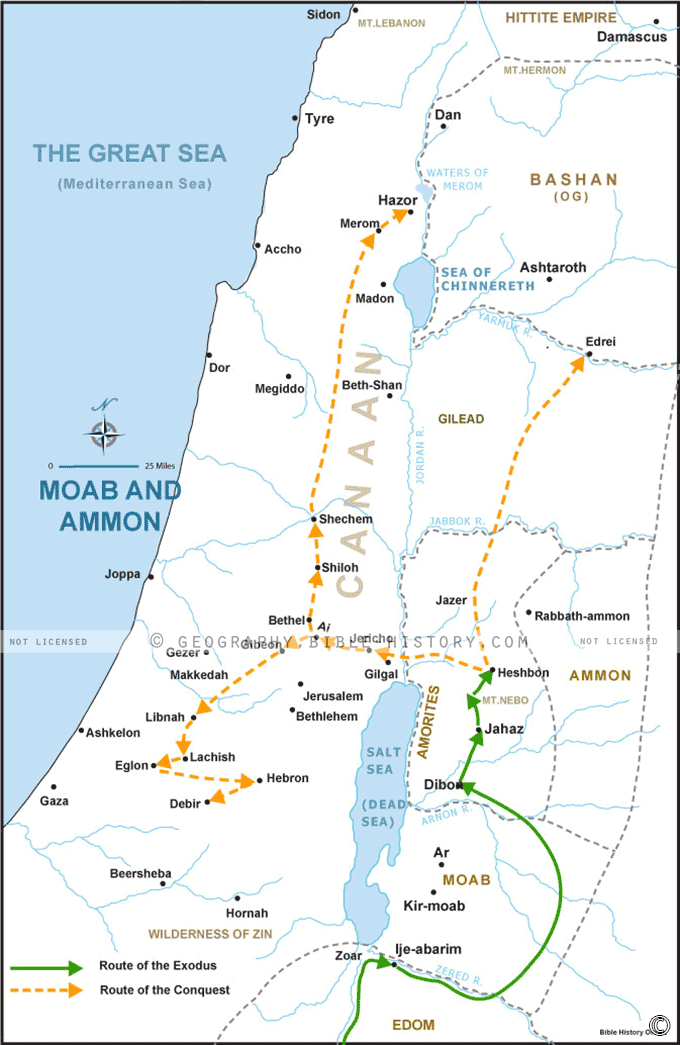
But Israel still had some obstacles to face before they could enter — including the King of Moab and his schemes.
Verse 5 says that Balak was King of Moab. Balak saw how large and powerful Israel was, and so :5 says he sent for Balaam, “near the River.” “The River” in the Old Testament often refers to the Euphrates River, one of the borders of Mesopotamia, the cradle of civilization, where Abram originally came from. This was about 500 miles from Moab, which in those days was a huge distance! (Again, you might show your group on a MAP where that is.) But Balak was serious about wanting help, so he sent far away to get it. In :6 he said, “Come curse this people for me …”. So Balak thought recruiting Balaam to curse Israel was his only hope.
Balaam is an interesting character. Either here in the introduction/context or later in Point I you might share what we know about him. We glean several truths about Balaam from the first part of Chapter 22:
— He was the “son of Beor” — many people in those days were identified by the father/a family name — not too dissimilar to our “surnames” today
— His name literally meant “not-people;” or “not of the people,” so perhaps he was a foreigner there.
— He was living at the city of Pethor, near the Euphrates River.
— Interestingly enough, as we see in the text, he knew YHWH.
He says in :13, “the LORD has refused to let me go with you.” LORD is all 4 caps is YHWH, as we have seen — so he was talking with YHWH! YHWH is known beyond Israel. Of course this is the area that Abram came from, so perhaps this shouldn’t be too surprising to us.
— And he was some kind of prophet, for Balak says at the end of :6, “he whom you bless is blessed, and he whom you curse is cursed.”
The story of Balaam is a long one, spanning Numbers 22–24, and it tells how God would not allow him to curse Israel, but only bless them — though as we will see, he did end up finding a way to tempt them and get them to curse themselves before God.
Balaam’s name has become associated with greed and compromise — and example we do NOT want to follow!
OUTLINE:
I. The Compromised Servant (:22)
II. The Unlikely Messenger (:22b-30)
III. The LORD’s Rebuke: (:31-35)
TEXT: Numbers 22:22-35
I. The Compromised Servant (:22)
:22 “But God was angry because he was going, and the angel of the Lord took his stand in the way as an adversary against him.”
Our focus passage opens with God angry with Balaam for going to Balak. To understand why, we have to go back to earlier in Chapter 22. God originally told Balaam in :12 NOT to go: “God said to Balaam, “Do not go with them; you shall not curse the people, for they are blessed.” So at first he didn’t.
But then it says Balak sent more prominent men and more money, and asked Balaam again, and he kind of “waffled”: even if you gave me more money, I can’t say anything God won’t let me … It’s like he wanted to do it, but he knew God wouldn’t let him. God eventually let him go — but as we see here in :22, He was angry with him. Balaam’s heart was not with God and His people, rather he was after the money that Balak was offered him. As we see in the story that unfolds, Balaam kept looking for some opportunity to curse Israel and get the money (and he finally did find a way to hinder them, as we will see).
So Balaam was a prophet, who really did communicate with YHWH, as we saw in the introduction — but he had a love for money in his heart, which compromised him before God.
EXERCISE: have group members read these New Testament scriptures that refer to Balaam, then ask them
??? “What do we learn about Balaam from these verses”???
— 2 Peter 2:15, “forsaking the right way, they have gone astray, having followed the way of Balaam, the son of Beor, who loved the wages of unrighteousness”
— Jude 11, “Woe to them! For they have gone the way of Cain, and for pay [a]they have rushed headlong into the error of Balaam, and perished in the rebellion of Korah.”
— Revelation 2:14 “But I have a few things against you, because you have there some who hold the teaching of Balaam, who kept teaching Balak to put a stumbling block before the sons of Israel, to eat things sacrificed to idols and to commit acts of immorality.” (Writing to the church at Pergamum)
WHAT DO WE LEARN:
— II Peter 2:15 says Balaam “loved the wages of unrighteousness” — he loved money! This reveals his motivation to go to Balak, even when God had first told him not to.
— Jude :11 speaks of “the error of Balaam,” “for pay.” The New Testament word for “error” there is “plane” (“plan-A”) which means to “wander off.” (Think of an airplane that takes you away!) Balaam had “wandered”/“flown away” from God’s plan for him — and he, like those who follow in his steps, did it from greed.
— Revelation 2:14, “Balaam … put a stumbling block before the sons of Israel … to commit acts of immorality.” So Balaam made Israel stumble (as we will see later) — and he did it for money!
So Balaam had a great gift from God, but he compromised it. He kept looking for a way to “skirt around” the will of God and make money. Thus he revealed the sin of his own heart. He loved money more than he loved God and His truth.
APPLICATION: This is not just a “story;” this is a lesson to warn all of us as God’s people, not to compromise our faith through love of money, or anything else.
The New Testament warns us against greed/love of money. Some verses you can share include:
— Luke 12:15 “Then He said to them, ‘Beware, and be on your guard against every form of greed; for not even when one has an abundance does his life consist of his possessions.’”
— I Timothy 6:10 “10 For the love of money is a root of all [g]sorts of evil, and some by longing for it have wandered away from the faith and pierced themselves with many griefs.”
— When Paul writes about the qualifications of the pastor in I Timothy 3:3, he says he must be “free from the love of money.”
APPLICATION:
From this passage, do you understand why the New Testament would say that a pastor must be “free from the love of money”?
God doesn’t want “Balaams” as pastors of his churches! He wants them to love Him and His people, not money!
??? What might some “giveaway signs” that a pastor/spiritual leader has a love of money???
(Maybe it’s the first thing he asks about, in considering a new church; or maybe he lives/tries to live above the financial level of his church members; maybe he always makes his decisions for the church based on money. You/your group can share your ideas/experiences here.)
THEN follow up with the application/discussion question:
??? What are some “giveaway signs” that WE as church members have an inordinate love of money???
It’s not only pastors who are to avoid the sin of greed, ALL of us as believers should.
(Not tithing/giving can be a sign that we love money; making decisions primarily based on their financial impact instead of moral/spiritual value; making money more important than family/other people;
You/your group can think of a lot of signs that indicate that we may be compromised servants of God like Balaam was.
II. The Unlikely Messenger (:22b—30)
“Now he was riding on his donkey and his two servants were with him. 23 When the donkey saw the angel of the Lord standing in the way with his drawn sword in his hand, the donkey turned off from the way and went into the field; but Balaam struck the donkey to turn her back into the way. 24 Then the angel of the Lord stood in a narrow path of the vineyards, with a wall on this side and a wall on that side. 25 When the donkey saw the angel of the Lord, she pressed herself to the wall and pressed Balaam’s foot against the wall, so he struck her again. 26 The angel of the Lord went further, and stood in a narrow place where there was no way to turn to the right hand or the left. 27 When the donkey saw the angel of the Lord, she lay down under Balaam; so Balaam was angry and struck the donkey with his stick. 28 And the LORD opened the mouth of the donkey, and she said to Balaam, “What have I done to you, that you have struck me these three times?” 29 Then Balaam said to the donkey, “Because you have made a mockery of me! If there had been a sword in my hand, I would have killed you by now.” 30 The donkey said to Balaam, “Am I not your donkey on which you have ridden all your life to this day? Have I ever been accustomed to do so to you?” And he said, “No.”
So because Balaam was compromised in his greed, God sent His angel to kill him — but the donkey could see him, and kept “stalling” to avoid the angel. Balaam didn’t understand, and kept hitting the donkey — until :28 says “the LORD opened the mouth of the donkey” and she spoke to Balaam and asked why he struck her like that! Needless to say, this is a very unusual event: God speaking to a man, through the voice of an animal.
???DISCUSSION QUESTION???
??? Why do you think God used the donkey to speak to Balaam???
(Might have been a subtle way of humbling Balaam. Balak had given him all these compliments, trying to entice him to come, saying “whom you bless is blessed,” and so on. Maybe God used the donkey to “put him in his place”: you are supposedly this “great prophet,” but don’t get too proud; I can use a DONKEY to share My message if I want to!
This is a potential warning from God to all of us who may be tempted by pride in ministry: do you have a big church, a large class, what some consider a “powerful ministry” or position?
DO NOT be proud about it; God knows how to humble you! You’d better humble yourself before GOD does!
???DISCUSSION QUESTION???
“Has God ever spoken you/someone you know in an unlikely way?”
(You/your group can share your answers. If you are led to, you can also share this recent story as an illustration of an “unlikely messenger”:
ILLUSTRATION
There is a punter on the University of Oklahoma football team right now (fall 2025), Grayson Miller, who was trying to decide where he should go to college. So as a Christian, he began praying about whether he should attend OU. He later shared:
“A hot air balloon landed in my mom’s backyard about three weeks after I started praying & asking God if I should be here (OU). As it fell & the logo of the balloon faced right toward my window, it said #OU Sooners on it. I was like, holy smokes.”
(Bob Przybylo (Shuh-BY-lo) Twitter, 9/28/25)
Can God use a hot air balloon as His messenger? It’s unlikely — but He can do it! Can God use a donkey? Can God use some of the odd “messengers” that you & your group members can share about? The answer is yes — AND the good news is that He can also use US! That should be encouraging to us. No matter how unlikely, or untalented we may feel we are, God can use us!
Let my wife Cheryl’s testimony encourage you/others:
For almost 40 years of my full-time pastoral ministry, Cheryl had never been a public speaker. We just always said, She doesn’t want the spotlight; she can’t do public speaking, teach classes, and so on; that’s just not her ministry. But since her stroke last year, God has been using her more publicly. She asked to speak at our church in Angleton and thanked them for all the ways they blessed us. And a couple of weeks ago she was one of the featured speakers at a spiritual growth meeting for small group leaders at Trinity, Norman where we attend. God used her to share how memorizing scripture helped her through the dark early days of her stroke. Multiple people have come up to us for the last several weeks, sharing that what Cheryl said, really spoke to them. Three different people actually said she was so funny that “she needs to take that on the road!” So God can use even Cheryl — always so reluctant to be in the spotlight — as His messenger!
God used an “unlikely messenger” here in Numbers — and He can use US as “unlikely messenger” too! Lead your group to pray that He will use them to share His message with someone this week!
III. The Rebuke of the LORD (:31-35)
31 Then the Lord opened the eyes of Balaam, and he saw the angel of the Lord standing in the way with his drawn sword in his hand; and he bowed [a]all the way to the ground. 32 The angel of the Lord said to him, “Why have you struck your donkey these three times? Behold, I have come out as an adversary, because your way was [b]contrary to me. 33 But the donkey saw me and turned aside from me these three times. If she had not turned aside from me, I would surely have killed you just now, and let her live.” 34 Balaam said to the angel of the Lord, “I have sinned, for I did not know that you were standing in the way against me. Now then, if it is displeasing to you, I will turn back.” 35 But the angel of the Lord said to Balaam, “Go with the men, but you shall speak only the word which I tell you.” So Balaam went along with the leaders of Balak.”
So it says God opened Balaam’s eyes, and he saw the angel with the drawn sword in front of him. The angel asks why he struck his donkey and says, “Behold, I have come out as an adversary, because your way was contrary to me.”
To me, those are some of the KEY WORDS here: “Your way was contrary to Me.” Classic Old Testament scholars Keil & Delitzsch translate it: “your way leads headlong into destruction before me.” This was certainly true for Balaam. His way was contrary to God’s way. He loved money, as we saw, so he wanted to help Balak and get what he offered him. But his greed was leading him to destruction: the angel of the LORD was standing there with a sword, ready to strike him down. Only by God’s grace (and the intervention of the donkey!) was Balaam warned off of this destruction — but as we will see, his greed did lead him to destruction in the end.
Balaam offered to go back, but again God allowed him to continue, with the warning to speak only what He told him. But there is plenty of evidence that Balaam’s heart was still not right — as we will see.
But Balaam’s way was “contrary” to God’s way, so that God was opposing him. We all need to ask ourselves the question:
??? Is there any way in my life that is “contrary” to God’s way???
Anything in my morals, in the way I do business, in the way I treat people, in the way that I serve God, in my attitude, actions, anything — is there anything in my life that is “contrary” to God’s way? Some of us may have something come right to mind, because you know there is an area you are disobeying God or “missing the mark.”
Maybe you even sense, like Balaam did here, that God is an “adversary” to you — you feel like He is blocking you, or working against you — and this is why: because your way is “contrary” to God’s way! We know that Romans 8:31 says “If God is for us, who can be against us?” — but we need to remember that the OPPOSITE is also true: if God is against us, who can help us? Jonah experienced that. You can’t fight God and win. You can’t live contrary to His ways and be blessed.
CONCLUSION: Before you leave the story of Balaam, if you have time, you might present what Paul Harvey would call: “THE REST OF THE STORY”:
— Though Balaam tried to curse Israel from several different directions, he never was able, as God would only give him blessings for Israel.
— But in the end Balaam DID find a way for Balak to try to attack Israel: Numbers 25 says a number of the Israelites got involved with Moabite women, and worshiped the Baal of Peor with them, which led to a plague from God which killed 25,000 of them.
How did this come about?
In Numbers 31:16 Moses says: “Behold, these caused the sons of Israel, through the counsel of Balaam, to trespass against the LORD in the matter of Peor, so the plague was among the congregation of the Lord.”
So it was Balaam who advised Balak and Moab to tempt Israel to stumble by getting them involved immorally with the women of the land, and turning them from YHWH to serve false gods.
WHY would Balaam do this? Every sign points to his love of money: he wanted that reward from Balak, so in the end he came up with a “scheme” to get it!
As a result, Balaam was eventually put to death by Israel:
— Numbers 31:8, “They killed the kings of Midian along with the rest of their slain: Evi and Rekem and Zur and Hur and Reba, the five kings of Midian; they also killed Balaam the son of Beor with the sword.”
— Joshua 13:22 “The sons of Israel also killed Balaam the son of Beor, the diviner, with the sword among the rest of their slain.”
So it did not end well for Balaam — Israel ended up killing him, and the special gifts that God gave him did not protect him from that. Of course, the ultimate “end of the story” will come even later, when he is judged for all eternity by the Lord as well.
ILLUSTRATION:
Agatha Christie was of course a well-known mystery writer, but in real life she went on an archeological dig to Syria with her husband Max in the 1930s. In her autobiography she wrote about how on the dig they were finding a large number of very beautifully carved small animal amulets (charms) in stone and ivory, which were very valuable and resulted in a reward for the men who dug them up. As a result, the men began digging deeper, trying to “outdo” the others and get to the new amulets sooner. Christie wrote that her husband stopped this, since it was dangerous, and he ordered them work their way gradually across the dig, as they were supposed to. She writes:
“And now comes a tale of base treachery and greed. The men were all stretched out on the hillside near the water jars. A gang of men who had been working on the other side crept away, sneaked round the mound to the rich spot, and began furiously digging in at the already undercut spot. They were going to rob the other men’s pitch, and pretend to produce the filched objects from their own patch of ground.
And then Nemesis overcame them. They undercut too far, and down came the higher levels on top of them!
The yells of the one man who escaped brought the whole crowd running to the spot. At once they and the foremen realized what had occurred, and three pickmen began hurriedly to dig their comrades out. One man was alive, but four others were dead.”
(Agatha Christie: Come, Tell Me How You Live, pp. 174-175)
Agatha Christie’s story is a reminder that greed kills. Sometimes it leads to physical death, but if not, it will surely destroy one’s relationship with God, and can lead to the eternal death of one’s soul.
That was Balaam’s experience. He was a man greatly gifted by God, but he allowed his greed to destroy his spiritual life — and that’s an example that we as God’s people need to make sure we avoid!
_________________________________________________
— If you’ll type your email address in the “Follow blog via email,” WordPress will automatically send you next week’s lesson and you won’t have to search for it.
— And if you write something in the Comments below, I’ll be sure to pray for your and your group by name this week.
Per my licensing agreement with Lifeway:
— These weekly lessons are based on content from Explore the Bible Adult Resources. The presentation is my own and has not been reviewed by Lifeway.
— Lifeway resources are available at: goExploretheBible.com and: goexplorethebible.com/adults-training
— If you have questions about Explore the Bible resources you may send emails to explorethebible@lifeway.com


 shawnethomas
Please send to me the prepared lesson for Sunday October the12th Thank you Gene King E-Mail geneking@bellsouth.net
Gene I sent you an email a bit ago; please let me know if that is what you need, and if I can help you in some additional way. Praying for you!
Brother Shawn, I’ve been following your teaching for a little over a month now. So excited about what the Lord is revealing. I will be teaching lesson 6 this Sunday as a guest speaker, I have facilitated an evangelism class before but not like this. Is it acceptable to teach from your notes in whole or in part? Your brother in Christ, Angel Perez
Absolutely; these lessons are to help teachers. You can copy and paste the whole lesson to your word processor and teach from it if you want to — or you can just use a quote or an illustration or a discussion question that fits into your lesson if you are led to do that. I’ll be praying for you this week! God bless you as you share His word this Sunday!
Thank you for your insights. This is the second quarter that I have used your notes as an additional study guide as I prepare. I don’t feel qualified to teach but God is equipping me each week.
God gives grace to the humble: I know He will bless and use your humble attitude as you seek His help and work hard to share His word in an effective way. I’ve been praying for you!
Thank you for your insight. It helps bring the verses to life. Anita
nanny2jwlj@gmail.com
I’m so thankful that it is helpful to you Anita! I appreciate that you took time to let me know. Praying for you!