
An overview for teachers, including a suggested introduction to the lesson, text highlights and outline, illustrations you can share, discussion questions for your group, and spiritual life applications you can make. A video version of this overview is available on YouTube at:
INTRODUCTION:
???DISCUSSION QUESTION???
“Can you share a time when you talked with someone who had a strange/different idea about who Jesus is?”
(For example: when I was in India on mission I talked to a Hindu man who believed that Jesus was “one of the gods” and only one of many, many ways to God — but not the only way.
Some of your class members may have talked to Mormons, who believe that Jesus is the brother of Satan! Or to Jehovah’s Witnesses, who believe that Jesus is “a god”— and so on.
(You may also opt to use this question in Point I below instead, in relation to :13)
Then you can share how in today’s lesson from Matthew 16, we’ll see how Jesus asked His disciples who people thought He was, and how confessing Who He really will lead us to follow Him — and how much that discipleship cost both Him and us.
CONTEXT:
As we continue our study in the Book of Matthew this quarter, last time in Chapter 15 Jesus had confronted the scribes & Pharisees about how they kept the traditions of men, but broke the commandments of God. Following that confrontation, Jesus left Galilee and went to the northern coastal area to the two port cities of Tyre & Sidon (:21). After ministering to a Canaanite woman there, He went back to the Galilee area again, where He fed 4,000 this time, and had more clashes with the Jewish religious leaders.
Chapter 16 then opens with the Pharisees and Sadducees testing Jesus (interesting that these two religious groups were working together here, as they were usually opponents. But “the enemy of my enemy is my friend,” as the saying goes, they unified against Jesus). They asked Him to show them a sign, but He told them, you’re not going to get a sign, except the “sign” of Jonah. And He warned His disciples against the “leaven” or teaching of the Pharisees and Sadducees.
That brings us to our focus passage for today, Chapter 16:13+, which says Jesus came to the region of Caesarea Philippi — NOTE there are TWO “Caesareas” in the Gospels (The word “Caesarea” comes from “Caesar,” they named these places to honor him). One is on the central coast, as you can see in this map, sometimes called “Caesarea Maritima” because it is by the sea. The other, where Jesus is now, is marked by the red arrow, Caesarea Philippi, so named by Philip the Tetrarch, a son of Herod, to honor both Caesar — and himself!
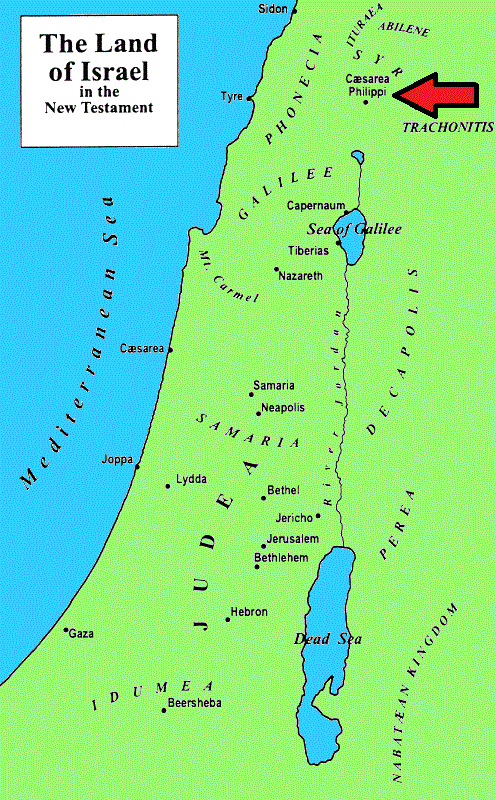
As you can see, it’s about 25 miles (or a long day’s travel for them) north of the Sea of Galilee. Caesarea Philippi was located at the base of Mt. Hermon, and was a major center of pagan worship. They worshiped the god Pan (the name of the city now is Pania, reflecting that) and of course a temple to Caesar, where they performed emperor worship. Interestingly, there was a cave called “the gates of hell” located there, which was considered an entrance to hell, and so pagans would throw sacrifices to Pan into it. “The gates of hell” will of course play into something Jesus says later in our scripture for today!
OUTLINE:
I. The Confession of Following Jesus (:13-20)
II. The Cost of Following Jesus (:21-26)
A. The Cost to Jesus (:21-23)
B. The Cost to His Disciples (:24-26)
TEXT: Matthew 16:13-26
I. The Confession of Following Jesus (:13-20)
:13 “Now when Jesus came into the district of Caesarea Philippi, He was asking His disciples, “Who do people say that the Son of Man is?” 14 And they said, “Some say John the Baptist; and others, Elijah; but still others, Jeremiah, or one of the prophets.” 15 He *said to them, “But who do you say that I am?” 16 Simon Peter answered, “You are the Christ, the Son of the living God.” 17 And Jesus said to him, “Blessed are you, Simon Barjona, because flesh and blood did not reveal this to you, but My Father who is in heaven. 18 I also say to you that you are Peter, and upon this rock I will build My church; and the gates of Hades will not overpower it. 19 I will give you the keys of the kingdom of heaven; and whatever you bind on earth shall have been bound in heaven, and whatever you loose on earth shall have been loosed in heaven.” 20 Then He warned the disciples that they should tell no one that He was the Christ.”
So Jesus brought His disciples into this pagan area of Caesarea Philippi, and while they were there, He asked them this key question: “Who do people say that the Son of Man is?” (Remember “Son of Man” is Jesus’ favorite name for Himself, from a Messianic verse in Daniel 7:13).
(If you don’t use the Discussion Question about different things your class members have heard people say about Jesus, you might use that here: “Jesus asked His disciples, ‘Who do men say that I am” — what are things YOU have heard people say about who Jesus is?”)
In :14 the disciples give their answers: “Some say John the Baptist; and others, Elijah; but still others, Jeremiah, or one of the prophets.” But then He asks them in :15, “But who do YOU say that I am?” And let us make it clear: Jesus is not asking for “information” here! He absolutely KNEW who He was!
I remember buying a magazine back in the 1980s, with an image of Jesus on the front cover, with the question, “Who do men say that I am?” And the article inside talked about how man Jesus was going around, psychologically confused, trying to figure out who He was, almost like the spirit of the little bird in the old Dr. Zeuss book, “Are You My Mother?” Here was this “poor Jesus” going around asking everyone, “Who do people say that I am?”
Well as we know, Jesus was not asking for His OWN sake! That is a total misreading of the Gospels. He absolutely KNEW who He was! He powerfully indicated that on numerous occasions:
— In this passage, when Peter told Him He was “the Christ, the Son of the Living God,” Jesus said “Flesh and blood didn’t reveal this to you, but My Father …”. In other words, “correct;” “right answer”! He KNEW who He was! Jesus also calls God here “MY FATHER who is in heaven.” So he obviously KNEW He was the Son of God!
— He told Nicodemus in John 3:13 “No one has ascended to heaven and descended but the Son of Man.” He knew where He was from: from heaven!
— He told the Jews in John 8:58 “Before Abraham came into being, I AM”! He knew He was the pre-existent Son of God, Yahweh, “I AM” Himself.
— When Thomas called Him “My Lord & my God” Jesus did not rebuke or correct him like Peter in Acts 10 or Paul is Acts 14 did when people tried to worship them. He knew He WAS indeed Lord & God!
So there is every indication in scripture that Jesus unequivocally knew exactly who He was! So let’s don’t allow any of this nonsense like from that magazine and other speculators, that Jesus was searching for who He was. He wasn’t. He was giving His disciples an opportunity to give THEIR answer at this point.
The word “you” in Greek is EMPHATIC: “YOU!’ “Who do YOU say that I am?!” This question is emphatically personal. And for good reason: this is THE SINGLE MOST IMPORTANT QUESTION OF EVERY PERSON’S LIFE: more important than the job you have, more important than the money you make, more important than anything else: Who do YOU say that Jesus is? This calls for a PERSONAL DECISION from each of us.
Peter shares his personal decision is his famous answer in :16, “You are the Christ, the Son of the Living God.”
The word “Christ” is familiar to us as a title for Jesus, but it is literally the Greek translation of the Hebrew word (meshiach) for “Anointed One” or “Messiah.” So Peter was confessing that Jesus was the Messiah!
And not only that, he goes a step further and says He is “The Son of the Living God” — meaning that He is God Himself. This was quite a claim — and it was correct. Notice that Jesus doesn’t say “Oh, maybe you’re right!?” No, He said in :17 that he was blessed, because only God could reveal this to him — in other words, “right answer”!
Peter’s confession was followed by the confession of early Christians as “Jesus is Lord.” “Lord” is the Greek “kurios,” which is how they translated “Yahweh” from the Old Testament into Greek. It was also the word the Romans gave to Caesar, by the way, and when they worshiped him they would burn a pinch of incense in his temple and say “Kaisar Kurios,” or “Caesar is Lord.” And this is why Christians got in trouble with Rome, because they wouldn’t do it. They said, no, “Christos Kurios,” “Christ is Lord”!
So “Jesus is Lord” became the very first Christian confession. We see evidence for that both in the New Testament and in history:
— In presenting the Gospel, Paul wrote in Romans 10:9, “If you confess with your mouth Jesus as Lord and believe in your heart God has raised Him from the dead, you will be saved.” But the confession you make with your mouth, is “Jesus is Lord.”
— In Philippians 2:11, “every knee will bow … and that every tongue will confess” (what is the confession that everyone will make?) “Jesus Christ is Lord.”
— In I Corinthians 12:3, Paul writes, “no one can say, ‘Jesus is Lord’ but by the Holy Spirit.” “Jesus is Lord” was the confession that the early Christians made when they professed their faith. He’s only the Holy Spirit can help you say that (like Jesus told Peter here). But the point is, “Jesus is Lord” was the profession they made to declare their faith.
— There is also evidence from history that “Jesus is Lord” was the early Christian confession of faith at baptisms, etc.:
APPLICATION:
— Have you ever made a public confession that “Jesus is YOUR Lord”?
— Have you followed through with public baptism, which the church has always recognized as the time of public confession of Jesus?
— You might also ask your group a ???DISCUSSION/APPLICATION QUESTION:
“What are some ways other than profession of faith, and baptism, that we can confess Jesus today?”
(Talking of Him in personal conversations; sharing His words with others; living and proclaiming His standards. Y’all can think of many ways.
Then conclude this point: There is no greater question in life than Who is Jesus to you? And there is no greater confession you can make, than to publicly testify that “Jesus is Lord”! Encourage them to do it today if they never have.
A couple of further notes on this passage:
— When He told Peter “right answer,” Jesus said on this rock I’ll build my church, and the gates of hell will not prevail against it. Remember, they were likely standing near “the gates of hell” cave that the pagans believed was a path to the underworld. Jesus said His church would prevail against those “gates of hell.” His followers need not fear demonic spirits like the pagans do.
You also may need to address the Roman Catholic interpretation of :18-19 here, which they claim is Jesus “making Peter the Pope” by saying he was “the rock” upon which He would build His church, and giving him the keys to the kingdom. Jesus was NOT doing that. There is NO other New Testament evidence that He set up any kind of “pope” to lead His people on earth, or that Peter was that person.
There are a couple of good interpretations of this “rock” passage:
— ONE is that when Jesus said “this rock,” it referred to the rock of the confession of faith that Peter had just made. Peter’s would be the first of multiplied millions of confessions of faith in Jesus! That makes a lot of sense in context.
— ANOTHER interpretation is that Jesus was proclaiming that HE HIMSELF was the “rock” upon which the Church was built. The conversation would go like this: “You are Peter (his name “petros” means a small rock) but upon THIS rock (meaning/perhaps even pointing to HIMSELF, I will build My church. This makes sense with later scriptures: Ephesians 2:20 Paul writes “Christ Jesus Himself the cornerstone.” And of all places, I Peter — written by the SAME PETER from here in Matthew 16 — Peter himself calls Jesus the “living stone,” “cornerstone,” over and over. So Peter was THERE here in Matthew 16, and he himself later indicated that it was JESUS who was the rock upon which His church was built, not himself/Peter.
— On top of that there is just no New Testament evidence that the Lord set up anything like a “pope” of the churches as is practiced by the Roman Catholic Church, in the person of Peter. If you look at Acts, JAMES is the acknowledged leader of the church at Jerusalem, not Peter. And when Peter came to Antioch, he hypocritically caved in to the Judaizers and Paul had to rebuke him, Galatians 2 says. Peter was not the first “pope.” Now, I wouldn’t necessarily focus on all that, because there’s so much other to cover, but in case there are questions about it, you might be ready to address it.
— Another issue from this passage: Why did Jesus tell His disciples in :20 not to tell anyone that He was the Christ? Weren’t they supposed to tell everyone? Well, there WOULD later come a time to tell everyone — as He later commanded them in Matthew 28:18-20, Acts 1:8, etc., but that time was NOT YET. “Timing is everything,” and this was not yet the right time. It would come soon for the disciples — and that time IS here for us now! We DO need to be telling everyone now that Jesus is Lord!
II. The Cost of Following Jesus
A. The Cost to Jesus (:21-23)
:21 “From that time Jesus began to show His disciples that He must go to Jerusalem, and suffer many things from the elders and chief priests and scribes, and be killed, and be raised up on the third day. 22 Peter took Him aside and began to rebuke Him, saying, “God forbid it, Lord! This shall never happen to You.” 23 But He turned and said to Peter, “Get behind Me, Satan! You are a stumbling block to Me; for you are not setting your mind on God’s interests, but man’s.”
So having talked to them about how He is the Christ, the Messiah, Jesus now begins to tell them something of what that involves, for Him personally. He said He “must go to Jerusalem, and suffer many things … and be killed …”. Being the Christ was not all glory. It was going to cost Him dearly. He would suffer — suffering beyond our wildest imagination — and He would die.
This was, of course, the COST of our salvation, that gave us the opportunity to follow Jesus. Jesus had to suffer and die — for us.
ILLUSTRATION
At the Los Alamos lab in New Mexico during World War II, scientists were working on the atomic bomb. One of them was Louis Slotkin. William Manchester shares in his epic history of America, The Glory & the Dream:
“(Slotkin) would tinker away with two live hemispheres, using screwdrivers to slide them toward another on a rod while he watched, engrossed. It was like Russian roulette. Sooner or later the law of probability would claim its own and he would neglect to separate the halves in time. It happened. One day a screwdriver slipped. The hemispheres came too close to one another; the lab was filled with a blinding blue glare. He tore the halves apart, breaking the chain and saving the community. He knew that in the process he had forfeited his own life. On the way to the hospital with a friend who had been working near him, he said, ‘You’ll come through all right. But I haven’t the faintest chance myself.’ After nine days of suffering he died.’”
(William Manchester, The Glory and the Dream, p. 385)
Louis Slotkin put his hands into that deadly experiment, to save his colleagues from that deadly chain reaction. But it cost him his life to save them. This is what Jesus did for us: He saved us — but it cost Him his life to do it. There was no other way, as the Garden of Gethsemane made clear.
Peter, of course, being the great “spiritual leader” that he was, “took Him aside and began to rebuke Him.” Can you imagine? Pulling Jesus aside like some child, and rebuking Him for what He said? It seems the height of arrogance. But on the other hand, have YOU ever told the Lord you had a better idea? Kind of hits home for all of us, doesn’t it?!
But then in :23 Jesus really lets Peter have it. “Get behind Me, Satan! You are a stumbling block to Me.” WHY such a stinging rebuke from Jesus? Because this was at the heart of Satan’s temptation of Him, from Matthew 4: those original temptations were all about avoiding the suffering of the Messiah — offering Him what we might call “the crown without the cross”:
— You don’t have to fast like this, just make bread from stones
— You don’t have to endure suffering to be the Messiah, just throw Yourself down from the Temple and have angels pick You up, and everyone will see and follow You.
— Here’s an “easy shortcut”: just fall down before me, and I’ll GIVE you all the kingdoms.
All of these temptations were about avoiding the suffering on His way to glory.
And we know from Matthew 26, that Jesus was aware of the tremendous suffering that awaited Him at the crucifixion — not merely the physical suffering — Jesus wasn’t afraid of some nails and whips — it was about the spiritual agony of bearing our sins in His body. All the punishment, all the wrath of God for all the sins of all people of all time, would come upon Him, which would separate Him from the perfect fellowship He’d had with the Father from all eternity. It would be suffering unequalled in all history — and the thought of it was so agonizing to Him that He sweat drops of blood as He prayed about it! It took all He had, after 3 sessions of prayer, to finally nail it down and say: “Thy will be done.” I’ll pay that horrific cost.
So that puts things in perspective, that when Peter now pulls Jesus aside and says, “Lord, this shall never happen to You,” Jesus immediately and forcefully rejects that temptation. This is exactly what He had been wrestling with. This was Satan’s work. And He didn’t want anything to do with that line of thinking.
And by the way, Jesus’ response to Peter (or Satan’s temptation through Peter) is a good example for us: Immediately identify and reject the temptations of the devil.
In fact, I have memorized this very verse and have used it as my “quick sword” against temptation dozens and dozens of times: when I’m tempted to look at something or do something, it’s so easy to draw this “sword” out: “Begone Satan …”. Just let it become a “knee jerk response” to your temptation(s). Every time it comes at you, just immediately quote, “Begone Satan!” and let God’s Spirit help you push that thought, that temptation, out of your mind. I’ve done that multiple times even this week — and maybe you and your group members can benefit from that as well.
So Satan was using Peter here, to tempt Jesus again, NOT to have to pay that price for us. But Jesus knew He had to pay that cost, as it was the only we could be saved and get to follow Him.
B. The Cost to His Disciples (:24-26)
;24 “Then Jesus said to His disciples, “If anyone wishes to come after Me, he must deny himself, and take up his cross and follow Me. 25 For whoever wishes to save his life will lose it; but whoever loses his life for My sake will find it. 26 For what will it profit a man if he gains the whole world and forfeits his soul? Or what will a man give in exchange for his soul?”
Here Jesus shares the cost of following Him. First, He gives the open invitation: “If ANYONE wishes to come after Me.” As we’ve seen throughout the New Testament, His love and call are for all. “For God so loved the world … that whoever believes in Him.”“Whoever will call upon the name of the Lord will be saved.”
But, Jesus says, I’ll tell you up front: it will cost you everything. Three elements here, though they are similar:
— Deny yourself (the big “I” that is at the heart of all our lives; we’ll talk more about that in a minute)
— Take up your cross: the “cross” wasn’t a “religious phrase” yet; the cross was the instrument of the death penalty in their day. So Jesus was saying you’ve got to be willing to put that “self” of yours to death; be willing to lay down your life for Him.
— And follow Him. Follow His example; obey His commands. Live for Him.
This is costly discipleship. Don’t let anybody tell you “it doesn’t cost anything to follow Jesus.” He makes it very clear here that it will cost you everything you have! That’s why He used the illustration in Matthew 13 of the Pearl of Great Price: when the man found that Great Pearl, he sold “everything he had” to buy the field that contained it. We know JESUS is the Pearl! Knowing and following Him is worth everything else we have! But don’t say there’s not a cost to following Him. NOW: don’t confuse this with salvation: there is NO COST for salvation; it is “the gift of God” just as Romans 6:23 says. We can’t buy His salvation for all the sacrifices in the world. But as we freely receive His gift of salvation, we must be willing to leave anything, and do anything that our Lord asks us. That’s what “Lord” means! Jesus asks for total commitment from His followers. It will cost us to follow Him. Some EXAMPLES of that cost:
— Those early Christians I mentioned, who would not burn a pinch of incense to Caesar and say “Kaisar Kurios,” were crucified or thrown to lions. It cost them to confess and follow Jesus.
In the same way, there are Christians right now, in Nigeria and other places in Africa who are facing similar “convert or die” ultimatums from Muslims. Our Baptist Press has run several articles about Christians in Indonesia who have been attacked by Muslims, beaten, killed, threatened to convert to Islam or die. It can cost our life to follow Jesus.
But even in places where confessing Christ does not threaten our life, there can be a cost to following Jesus. As we mentioned, intrinsic to Jesus’ call is that a person must “deny himself.” The “self” is the very central part of us, that wants its own way, it’s own pleasure. Jesus says we must deny that “self” when we follow Him.
I’m reading a fantastic book right now by Carl Trueman, entitled Strange New World. He describes how philosophers and activists have brought about the sexual revolution in our society, resulting in such bizarre manifestations as the trans movement and more. Central to what happened, Trueman says, is that modern philosophers have taught the the “expressive” self” is central to our happiness and well-being: that is, that the inner part of us that is the real “us” wants to “do its own thing” — without any prohibitions from what they call outdated moral codes. And if society represses them from expressing their inner selves in these ways, it is oppressive to them. So in their view, everyone must affirm what anyone feels is their inner “self.” This is modern philosophy. This is what we’re seeing all across our country today. Trueman says this “expressive self” has become the central driving force of many modern Americans today. The “self” is the center of it all.
But opposed to that, Jesus says if you’re going to follow Him, you don’t “express” that self; you must put that self to DEATH! — “Deny him-SELF” He said — and put JESUS on the throne of your life instead. So following Jesus will cost our inner wants, our desires, our plans, our feelings, our wishes. Now Jesus becomes our Master; our “boss” if you would — which is what “Lord” really means! Jesus makes it clear that becoming a Christian is not about “just adding a little Jesus” to the life you already have. It is about taking the “self” OFF of the throne of your life, and putting Jesus there instead. It is a radically different life than you had before.
You can change the color of your hair and still be basically the same person you were.
You can change where you live or your vocation and still be basically the same person.
But you cannot become a follower of Jesus and still be basically the same person you were. The old person dies, and a brand new person emerges. As II Cor 5 says, “old things have passed away, new things have come.” If old things haven’t passed away, and new things haven’t come, then you are not a new creation in Christ. If the “self” hasn’t died, then you have not become a follower of Christ. Jesus says you “MUST” deny yourself, take up your cross, and follow Him. This is an “imperative” in the Bible — which means it’s a command, not a “suggestion.” (It’s why a lot of translations read “you MUST deny yourself.”) It’s a command, not a “suggestion.” You must pay this cost this to follow Jesus.
So Jesus makes very clear that there is a cost to following Him.
???DISCUSSION/APPLICATION QUESTION???
“Can you share about someone of your own acquaintance who suffered the loss of something for the sake of Jesus?”
(I know of a professor who was not given a promotion in his university, because of his Christian faith. We’ve all read of Jack Phillips, the baker in Colorado who was fined $500 for not making a cake for a transgender couple, because he believed in Jesus’ teachings on marriage. Our country is not as antagonistic as many others, but there are still many who have lost jobs or promotions; who have endured ridicule or scorn, and even sometimes physical harm, for the sake of Jesus.
And beyond all those outward physical and social losses, the truth is that many of us have given up very much of what our “inner self” might have wanted to do, in order to follow Jesus. It is costly!
And again, Jesus didn’t hide this. He led with it! He said right off: You’re going to have to “take up your cross and follow Me.” “Blessed are you when men revile you … on account of Me.” “If they hated Me they will hate you.” And so on. Those who teach that Jesus promised us a “bed of roses” have missed a huge part of His teaching. We need to be ready to endure hardship and persecution for His name.
Now, lest all that sound too hard, and maybe you’ll just turn away, Jesus adds a couple of final warnings in :25-26:
— Whoever wishes to save his life will lose it. So if a person says, I don’t want to lose my life for Jesus. He says, if you try to keep it, you will lose it in the end. You’re going to lose it one way or another — so you’d best lose it for Him!
— And then He added, what will it profit you if you gain the whole world, and lose your SOUL? Yes, you can make a lot of money, and enjoy a lot of things in this world by NOT following Jesus. But it will cost you. In fact, He says, it will cost you your soul. You will come to the end of your life, and discover that everything you’ve given your life for, was all in vain. You’ve lost it all — and now you’ve lost your soul. Many, many people have experienced that sad and devastating end.
ILLUSTRATION
In William Manchester’s epic trilogy on Winston Churchill, he writes of how at one of Churchill’s birthdays near the end of his life, everyone was toasting his life and all his accomplishments. But Churchill, who was not a Christian, “muttered to his daughters Diana and Sarah: ‘I have achieved a great deal to achieve nothing in the end.’” (William Manchester, The Last Lion, Visions of Glory, p. 23)
That’s a sad testimony for someone to have, but it’s exactly what will happen to so many people who pursue the treasures of the world and ignore God and Christ. They are going to trade their whole lives and souls for, as Churchill said: “nothing in the end.”
So Jesus says yes, following Him is costly. It will cost your very “self.” It may cost you many other things, including your life. But here’s the thing: THERE’S ALSO A COST TO NOT FOLLOWING HIM! It will cost you your very soul, for all eternity. So God’s word for us, our class members, and for all those we know and love: let’s be willing to pay the cost, and follow Jesus today!
____________________________________________
— Remember there is now a “PRINT” button at the end of the lesson on my blog, that you can hit to print out the lesson in its entirety.
— If you’ll type your email address in the “Follow blog via email,” WordPress will automatically send you next week’s lesson and you won’t have to search for it each week.
— And if you write something in the Comments on my blog or YouTube, my commitment is to pray for your and your group and any special request you make, by name this week.
Per my licensing agreement with Lifeway:
— These weekly lessons are based on content from Explore the Bible Adult Resources. The presentation is my own and has not been reviewed by Lifeway.
— Lifeway resources are available at: goExploretheBible.com and: goexplorethebible.com/adults-training
— If you have questions about Explore the Bible resources you may send emails to explorethebible@lifeway.com


 shawnethomas
Thank you for these lessens.
Thank you for doing this. It helps me.
You are such a big help. Thank you!
Sent from my iPhone
Vickie Graham
Senior Lecturer (Ret)
Mathematics Dept
Valdosta State University
God bless and thanks for the explanation on th8s topic.
You are very welcome! I’m glad it was a help to you. I’ll be praying for you and your group Saturday and Sunday.
Im already subscribed.
you have helped me so much, explaining the questions I would have had ! Thank you
Praise God for His providence! I’m so grateful that it is helpful to you, Peggy. Thank you for taking the time to let me know. I’m praying for you and your class this weekend!