
An overview for Sunday school teachers and Bible study leaders of Lifeway’s “Explore the Bible” lesson of Acts 8:26-39, for Sunday, July 28, with the title, “Baptizing.” A video version of this overview is available on YouTube at:
INTRO: ??? What was the most exciting/interesting/special baptism you have seen???
— Beach baptisms are fun; we did several at a nearby river at one of our previous churches; some churches here by the Gulf of Mexico have baptized down at Surfside Beach.
— We just attended our two grand daughters’ baptisms in North Carolina in May. Our older grand daughter had actually led the younger one to the Lord after she was saved, so that was neat for us. I said I wasn’t missing that baptism for anything!
— I once heard a pastor tell of how a young boy was baptized, but he exited the baptistry to the opposite side – the women’s side. He didn’t know what to do, so he decided to just wait there, and swim underwater to the other side as the service progressed, so no one could see him while he got over to the men’s side. He didn’t realize, however, that the baptistry of their church had a glass front, so when he looked over, the whole church could see him swimming across!
— AND I actually had the privilege of baptizing my own WIFE, who was the pastor’s wife at our first church in Oklahoma City. As I shared once before, she had made a profession of faith when she was 6 and was baptized, but really came to know Christ when she was 16. This had always bothered her, so one Sunday she came down to the front — as a pastor’s wife — and said she needed to be baptized. And we did!
You/your group can share some baptism stories — yours/others — that were special to you. Then talk about how today’s lesson is from Acts 8, where Philip baptizes the Ethiopian treasurer.
CONTEXT
We are continuing our study through the Book of Acts. We have followed the theme of how the Gospel continued to spread against all opposition, not only EXTERNAL forces like the Jewish Sanhedrin, but also overcoming INTERNAL problems, like the hypocrisy of Ananias and Sapphira, and the complaints of the Greek widows being neglected, which ended up being addressed with the Deacon ministry in Acts 6. One of those deacons, Stephen, was martyred for his faith in Chapter 7 — and this brings us to today’s passage in Acts 8, which follows another one of the church’s deacons, Philip, and how the Lord led him to minister. The first part of Chapter 8 details how a persecution broke out against the church after Stephen’s death (more external opposition) but how God used it to scatter His people and spread the gospel.
It tells how Philip went to Samaria and preached, and they had the “Samaritan Pentecost” (a re-enactment of the coming of the Spirit in Acts 2) which was probably necessary because the Jews would never have received them in the church otherwise! But God made it evident through that “Samaritan Pentecost” that they too were now His people in Christ. Verse 25 says that they were preaching the gospel to many villages of the Samaritans. this brings us to today’s passage, Acts 8:26-39.
OUTLINE
I. The Lord’s Direction (:26)
II. The Purpose Revealed (:27)
III. The Gospel Shared (:29-35)
IV. The Man Responds (:36-39)
TEXT:
I. The Lord’s Direction (:26)
“But an angel of the Lord spoke to Philip saying, ‘Get up and go south to the road that descends from Jerusalem to Gaza.’ (This is a desert road.)
I would use some kind of MAP like this one, so your class can see where this all took place:
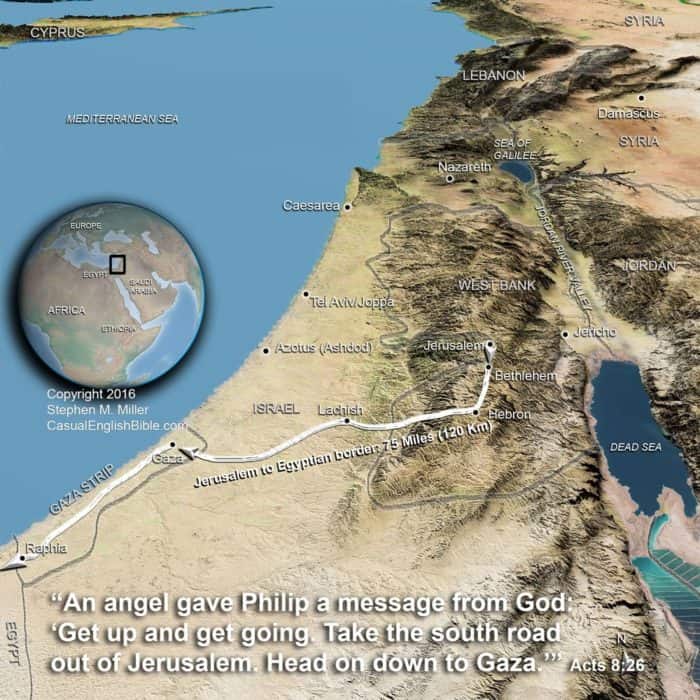
Talk about how this might not have made sense, to leave the revival that was going on in Samaria, to go on this “desert road.”
To illustrate this, you might ask your group: ??? Can you think of a relatively “deserted” road in your area???, that you might think, “Why would God tell me to go there?” instead of somewhere else.
(For example, here in Angleton, you’d think God might want you to go down 288B, the “main drag” through town, with so many businesses and homes just off of it. If His Spirit told you, “Go take Country Road 210 East”, you might think, “WHY? THere’s nothing out there but bayous?!”
You have similar streets like that, that you can use for your own area, to help illustrate this.
But the point is: sometimes God leads us to do things that may not “make sense” humanly speaking — but we need to be open to what He is doing. HE knows what we don’t; His ways are beyond us. This is why we need to practice obedience to His Spirit’s leading.
??? Can you/your group share a time when you were obedient to the Lord, maybe didn’t know why/make sense at first — until you saw later how this was His plan???
Once when I was recuperating from my illness in Norman, I felt a strong leading — as if it were from the Lord — to go out to the mailbox. It was such a strong leading that I thought, does He have something for me in the mailbox? It was freezing cold out, but I walked out there (we were in a condo, and it was 75 yards down the parking lot.) But when I got there, there was nothing in that box. I thought, “That’s really odd; I just felt like that was from the Lord.” Then a voice called out: “Could you help me?”, and a young lady had locked herself out of her apartment and car. I got Cheryl & I we were able to take her to help, and also got to share with her, and invite her to church on the way! So at first it didn’t make sense — but God had a purpose in it.
You/your group can share your own examples. But wrap up this point by talking about how this verse reminds us that we need to LISTEN to the Spirit’s leadership — even when it might not “make sense” to us; and do whatever He shows us. He has a Kingdom reason for it!
II. The Purpose Revealed (:27)
“So he got up and went; and there was an Ethiopian eunuch, a court official of Candace, queen of the Ethiopians, who was in charge of all of her treasure; and he had come to Jerusalem to worship.”
So God had a plan here, though it may not have made sense to Philip at first, to leave the “revival” that was going on at Samaria, to go out on that desert road. But then the plan was made clear: he this court official from Ethiopia.
— We often call this man the “Ethiopian eunuch” — the Greek word “eunochos” literally means “one having a bed” — they traditionally oversaw the king’s harem, so they liked to have eunuchs there. But the term came to mean a royal official of any kind — in this case, it says this man was “a court official of Candace, the queen of the Ethiopians,” and it says he was “in charge of all her treasure.” So it is very likely that “eunuch” was just his title, not his physical state. For that reason, I like to call him the “Ethiopian treasurer,” because that’s really what he was. He was a very important official of the Queen of Ethiopia.
NOW does it start to make sense why God would have Philip go to the desert road? Here is the guy He had planned for him to meet there, who might witness for Jesus to a whole new nation!
And notice that :27 says he had come to Jerusalem to worship.
Now, I’m going to go off on what you may think is a tangent here, but I believe this is really important: WHY did this guy need to be saved?
1) He a very RELIGIOUS man. We see a couple of evidences of how “religious” he was:
— :27 “he had come to Jerusalem to worship”
This was a LONG distance. It was about 1600 miles!
You might show them another MAP detailing how far it is from Jerusalem to Ethiopia:

1600 miles is about the distance from here south of Houston, to NEW HAMPSHIRE in New England! That is a huge distance! (You can research and use the example of something 1600 miles from your location)
And remember, this man wasn’t taking a “flight” back & forth; he didn’t take a bus — or even drive! According to :28, how was he traveling? (by chariot) So they were doing well to cover 20 or 30 miles in a day. (1600/25 = 64 days! That’s over TWO MONTHS to make this trip, ONE WAY! The total trip took over FOUR MONTHS, for this religious journey! So this was no “trite” experience for him, going up to Jerusalem to worship. It showed the depth of his religious commitment. The point being, this was a very religious man.
2) Another evidence of his religious commitment is :28, that he “was reading the Prophet Isaiah.” So he was reading the Bible as he traveled. Again, a very religious man!
So since he was SO religious, WHY did God take Philip “out of his way” to share the gospel with Him? It just re-emphasizes that Jesus is the only way that anyone can be saved!
THIS IS NO “TANGENT”! SO many people today say, It doesn’t matter what God you worship; all the religions are just different ways to the Lord, different names for the same God.
We saw an EXAMPLE of this at the Republican National Convention in mid-July. Harmeet Dhillon, who is an Asian Indian background Sikh, sang and prayed a benediction at the closing of the first night, which was an “Ardas,” a worship prayer, which she addressed to “Waheguru,” which Sikhs believe to be the one true God.
Afterwards, many Christians on Twitter criticized her prayer as unscriptural; it wasn’t to the God of the Bible. But the first comment on one tweet was by a man who said, “It’s the same God; just a different name.” And several made that same kind of comment.
You might ask your group: ??? What would YOU say to someone who said something like this (that this was just a different name for the same God??? (This would be good practice for your group to think about this, and address it.)
(You might make sure that something like this is said:
— We just saw how in Acts 4:12 the apostles said: “There is salvation in NO ONE ELSE; for there is NO OTHER NAME under heaven, given among men, by which we must be saved.”
— Also point out that a name represents something. Jesus and Muhammed are not just two names for the same God. They are names for two different beings entirely. For example:
— Islam teaches that the Koran is the word of God; Christianity teaches that the Bible is the word of God. They teach totally different things.
— Islam teaches that there is ONE God; who has no Son, or Holy Spirit; but as Christians, “when we say ‘God,’ we mean ‘Father, Son, and Holy Spirit.’” (Gregory Nazianzen, early church father)
— Islam teaches that “There is one God and Muhammed is His prophet.” In John 14:6 Jesus says “I AM the way, and the truth, and the life, no one comes to the Father but through Me.”
So when you compare the two faiths, it is obvious, these are NOT just “two names for the same thing.” They are entirely different.
So the Bible clearly teaches that there is ONE God, and the ONE WAY to Him is through Jesus. All the different religions are NOT “just different names for the same God.”
THE POINT IS: THIS is why this Ethiopian Treasurer had to have the gospel shared with him. It was not enough that he was “religious;” it was not enough that he was so committed to his faith that he took over 4 months to make a pilgrimage to worship. It was not enough that he was reading the Bible.
HE HAD TO KNOW JESUS TO BE SAVED! That is why the Lord took all this time and effort to get Philip to witness to Him.
AND we need to apply this TODAY too: it is not enough that someone we know has “some kind of religion.” It is not enough that they are “sincere.” We can’t just “leave them to their faith.” It is NOT “just another name for the same God.” As the Apostles made clear in Acts 4:12, “THERE IS SALVATION IN NO ONE ELSE; there is no other name under heaven, given among men, by which we must be saved.” This is one of the most important issues that we face today as Christians, and we are constantly being pressured to compromise on this; so we need to teach this to our groups, and we need to KEEP it in front of them repeatedly, because I can promise you they are getting continually hammered with the false doctrine that all the religions are the same, from friends and media, all the time!
So make the point: this very “religious” man, still needed Jesus. Because Jesus is the only way to God. That should be the impetus for our missions and evangelism as followers of Jesus.
III. The Gospel Shared (:29-35)
:29 “Then the Spirit said to Philip, ‘Go up and join this chariot.’”
(don’t say the Lord doesn’t lead us, and speak to us, through His Holy Spirit; He does!)
And what is Philip’s response here?
:30 “Philip RAN up and heard him reading Isaiah the prophet, and said, ‘Do you understand what you are reading?”
A couple of things:
1) When God told him what to do, how did he respond?
“HE RAN”! Instant, exuberant obedience is important. He couldn’t have waited until the chariot was on the horizon; he’d have missed it. He didn’t have time to research Ethiopia! He had to go right then, when he had the opportunity.
This is a good reminder to us that we need to practice instant obedience to the Holy Spirit.
2) He had a great “opening line” here, didn’t he? “Do you understand what you are reading?”
Sometimes just getting the conversation started can be the hardest thing. So 1) lean on the Holy Spirit, “What can I say?”, and He will give us what we need. Also 2) it would be good for us to have some “good intros” ready to use, like “Where do you go to church?”, or “I see that you have a cross, what does that mean to you?”, or all kinds of good conversation starters.
(You might ask your group if they know/can think of any others)
But the Lord gave him a great opening.
:31 “And he said, ‘Well, how could I, unless someone guides me?’ And he invited Philip to come up and sit with him.”
This is just such an open door! Come up and teach me!
It’s like one time I was at my first church with a group of people, and a guy pulled into the parking lot in his pickup truck and said, “I just need to know how to be saved.” I was like, are you kidding me? This is like a softball right down the middle! And I led him to Christ. That’s what God gave Philip here.
Then :32 “Now the passage of Scripture which he was reading was this: ‘He was led as a sheep to slaughter; and as a lamb before its shearers is silent, so He does not open His mouth. (:33) In humiliation and judgment He was taken away; who will relate His generation? For His life is removed from the earth.”
You might ask your group if anyone knows where this passage from the Old Testament is?
(Isaiah 53, perhaps the greatest chapter in the Old Testament, that prophesies how the Messiah would suffer for us on the cross. This chapter is quoted in the New Testament more than any other scripture.)
:34 “The eunuch answered Philip and said, ‘Please tell me, of whom does the prophet say this? Of himself or of someone else?” It didn’t make sense to him; he needed someone to help him understand it.
:35 is a key verse: “Then Philip opened his mouth, and beginning from this scripture he preached Jesus to him.”
So Philip “opened his mouth” (we’ve got to open our mouths and share!) and “beginning with this scripture” (he evidently referred to other verses as well), and then the key:
“He preached Jesus to him”
THIS is the most important thing. “He preached Jesus to him.”Jesus is Who the gospel is all about!
The gospel is NOT just “God loves you.” The Gospel is NOT just “God has a great plan for your life.” The Gospel is NOT “God wants you to have your best life now.” The Gospel is about JESUS, what He came and did for us.
Paul said in I Corinthians 15:1-4 what the Gospel was:
(:1) “Now I make known to you, brethren, the gospel … (:3) … that Christ died for our sins according to the scriptures, (:4) and that He was buried, and that He was raised on the third day, according to the scriptures.”
WHO is this gospel about “CHRIST”! And specifically about His death on the cross for us. This is what the verses in Isaiah 53 that :32 & :33 quoted, were about: Jesus “led as a sheep to slaughter” (to die on the cross); Jesus “life is removed from the earth” (on the cross). This is the Gospel message: that CHRIST JESUS died on the cross to pay for our sins, and rose again.
This is what we must believe, to believe the gospel.
This is what we must share, when we share the gospel.
Recently I heard a pastor share a gospel presentation. It was a very sharp presentation in many ways; but when he had finished, I thought: There was no mention of the cross, of Jesus dying on the cross to pay for our sins!
This is not a minor thing.
Paul said in I Corinthians 2:2 “For I determined to know nothing among you except Jesus Christ, and Him crucified.” Paul said, this is all I preached and taught: Jesus dying on the cross! This is the gospel! We must share the cross!
(Now, if someone says there is no “cross” here in Acts, point out that although the word “cross” is not used here, it does quote Isaiah 53, which describes in great detail how Jesus would suffer on the cross for our sins. There is no way that Philip “preached Jesus to him” without sharing the cross. He most likely used that famous verse of I Peter 2:24, which comes right out of Isaiah 53, “He Himself bore our sins in His body on the cross.” Philip shared the cross — and we must too.
This is a good challenge for all of us as Christ followers. Share Jesus with people. And be sure you share the message of the cross when you do.
As Charles Spurgeon famously said, take whatever passage you have, and go straight to Jesus! That’s what Philip did here. Whatever passage you have, find Jesus in it. Share Jesus.
And don’t forget the cross when you do.
It might be good to go over a good GOSPEL OUTLINE again:
— God’s Plan (for us to live with Him in glory forever John 17:3)
— Man’s Sin (Romans 3:23, Isaiah 59:2)
— God’s Provision (I Peter 2:24, Isaiah 53, etc.)
— Man’s Response (Acts 20:21, Romans 10:13)
??? Where does the cross of Jesus fit in here???
(God’s provision. The cross was God’s provision for our sin.)
Philip “preached Jesus to him.” And he preached the cross. Let’s follow his example and make sure that we do the same thing.
IV. The Man Responds (:36-39)
:36 “As they went along the road they came to some water; and the eunuch said, ‘Look! Water! What prevents me from being baptized?’”
So Philip had obviously told him about baptism as he shared, as part of his response of obedience in faith.
:37 “And Philip said ‘If you believe with all your heart you may.’ And he answered and said, ‘I believe that Jesus Christ is the Son of God.”
(I would not be concerned with the footnote that says that this verse is not found in some of the oldest manuscripts. There is nothing taught here which is not found all through the rest of the New Testament, and I do believe that something like this must have been said.)
We shared a couple of weeks ago all the scriptures which detail how everyone who was baptized in the New Testament, had believed first. You can go back to our lesson/video on Acts 2:41 where all those verses are listed. Every time someone was baptized in the New Testament, they had believed first. If you didn’t use that exercise then, of having your group read all those scripture, I’d use it here, to emphasize to them that FAITH ALWAYS PRECEDES BAPTISM in the New Testament. New Testament baptism is believers’ baptism.
— This is why the Ethiopian Treasurer wanted to be baptized; because he had first believed — and now the next step for him was for him to be baptized. The New Testament is believe, then be baptized.
— This is why we don’t baptize babies; it is no “small” thing. It is contrary to the teaching of the whole New Testament.
— This is why my wife Cheryl came forward, even as a pastor’s wife, to be baptized at our first church.
Because New Testament baptism, is “believers’ baptism.”
Verse 38 says “And he ordered the chariot to stop; and they both went down into the water, Philip as well as the eunuch, and he baptized him.”
So they did it! The treasurer had made his “profession of faith,” confessing Jesus in :37, so Philip baptized him.
And NOTICE: it says “they went down into the water.” WHY is this important? This wasn’t a “puddle”! They didn’t sprinkle him! “They went down into the water” because they were baptizing by immersion. This is another good example of that from scripture.
We are reminded from this passage that New Testament baptism is baptism of a BELIEVER, by IMMERSION, in the TRIUNE NAME of the Father, Son, and Holy Spirit, which is SYMBOLIC of their faith in Christ. This might be a good point to remind them of these things.
— You may have members in your class who need to respond to their faith in Christ, by being baptized. Encourage them to do that.
— You may have some who were baptized as babies, who need to follow through with scriptural baptism.
— You may have others like my wife Cheryl, who made a “decision” as a child, but who were genuinely saved later, and they need to be scripturally baptized AFTER their faith in Christ.
— You may even have someone in class Sunday who has never put their faith in Christ as their Lord & Savior, and this may be the day you explain the gospel and they are saved! I pray that happens!
Encourage all these kinds of people who may be in your group this Sunday, to follow in the steps of this Ethiopian Treasurer, in first believing, and then being baptized to express their faith in Christ.
And encourage all your group members, to be ready to obediently share their faith, like Philip did here! You might close in prayer by asking that God would give us Divine Appointments to share Jesus and His death on the cross, this week.
____________________________________________________
— Remember if you’d like to read/print a text version of this overview, to print out the lesson, or use one of the quotes or stories, that is available on my blog at http://www.shawnethomas.com (I’ll post that address in the comments section below).
— If you’ll hit “Subscribe” to this video, YouTube will automatically send you next week’s video and you won’t have to search for it.
— And if you write something in the Comments below, I’ll be sure to pray for your and your group by name this week.
Per my licensing agreement with Lifeway:
— These weekly lessons are based on content from Explore the Bible Adult Resources. The presentation is my own and has not been reviewed by Lifeway.
— Lifeway resources are available at: goExploretheBible.com and: goexplorethebible.com/adults-training
— If you have questions about Explore the Bible resources you may send emails to explorethebible@lifeway.com


 shawnethomas
Thanks Pastor Shawn for once again sharing great insights. I’m sure I have read/studied this passage 100 times, but you brought out some insights that I had never thought about. This will be very helpful for me as I teach this Sunday.
Thanks again
Sam
Thank you Shawn for providing such basic clarity to these Lifeway Sunday School Sessions. Your insight and explainations have helped me tremendously in my study and understanding of scriptures and the Gospel. I pray for your family and continued guidance for all Christains who are seeking truth about Jesus Christ. You have given me a completely different understanding on how to share the Gospel with those who profess to be Christains but may be misguided. Thank you for that shift in my thinking and providing me a entirely different outlook on how to talk to both believers and non believers. I look forward to my study time on your presentations. God has surely gifted you with the ability to guide and teach the Gospel truth. Love and prayers to you and yoir family.
Catherine Cason, Sunday School teacher of Ladies class, Sancy Baptist of Ravenna Texas.