
An overview for Sunday School teachers and Bible study leaders of Lifeway’s “Explore the Bible” lesson of Psalm 110:1-7, “God’s Messiah,” for Sunday, July 6, 2025. A video version of this lesson is available on YouTube at:
INTRODUCTION:
One way to begin the lesson this week would be by asking the
??? DISCUSSION QUESTION???
“Do you have a favorite mystery: perhaps a favorite mystery writer, or mystery tv series — or even a mystery from history of science?”
(A lot of people do have favorite mysteries: my wife Cheryl loves the Agatha Christie mysteries; I enjoy watching some of the BBC mysteries with her.
If you want to share some famous mysteries of history/science, according to an AI search, they would include:
— The disappearance of Amelia Earhart
— The identity of Jack the Ripper
— The Bermuda Triangle
— The Mystery of Stonehenge, and others.)
Then = “Today we are going to look at Psalm 110, at what was at one time a great mystery in the Bible, but which Jesus and the New Testament, show us the conclusive answer to!”
CONTEXT:
We are continuing our study of the Psalms this quarter with Psalm 110.
— The title/historical note appended to the Psalm is “A Psalm of David.” We need to remember that these notes ARE part of the Hebrew text; they are not added modern notes. So we do believe that David himself wrote Psalm 110. (We will see more in regard to this when we come to the exposition of the first verse: Jesus Himself says he wrote it! That settles it!)
— Psalm 110 is a Messianic Psalm: that is, it points to and prophesies about the coming Messiah, 1000 years before His birth, thus these Messianic Psalms are some of the most powerful witnesses to the authenticity of Jesus as the Messiah.
OUTLINE:
I. The Mystery of the Messiah (:1)
II. The Rule of the Messiah (:1-3)
III. The Priesthood of the Messiah (:4)
IV. The Triumph of the Messiah (:5-7)
TEXT: Psalm 110:1-7
I. The Mystery of the Messiah (:1)
:1 “The LORD says to my Lord: “Sit at My right hand
Until I make Your enemies a footstool for Your feet.”
What does this verse mean? If it sounds difficult to us, we are not alone. Jesus actually used this passage in the New Testament to confound His religious enemies:
The context is Matthew 22, where the Sadducees were trying to “trap” Jesus with a gimmick scenario: asking Him if a man had 7 wives in this life, one after the other, whose wife would she be in the resurrection. They were trying to trap Him with this, because they were “religious liberals” who didn’t believe in the resurrection. This was their “straw man,” if you would, that they used to “get” their opponents.
But Jesus completely turned the tables on them. First, He told them that in the resurrection there is no marriage. Then the Pharisees took their turn, asking Him what the Great Commandment was — and He answered them with the famous “Love God/Love your neighbor.”
But then is where Psalm 110 comes into play: Matthew 22 says that while the Pharisees were gathered together, Jesus asked THEM a question which stumped them, which we find in :41-46:
:41 “Now while the Pharisees were gathered together, Jesus asked them a question: 42 ‘What do you think about the Christ, whose son is He? They *said to Him, ‘The son of David.’ 43 He *said to them, ‘Then how does David in the Spirit call Him “Lord,” saying, 44 “The Lord said to my Lord, ‘Sit at My right hand, until I put Your enemies beneath Your feet’”? 45 If David then calls Him “Lord,” how is He his son?” 46 No one was able to answer Him a word, nor did anyone dare from that day on to ask Him another question.”
So it’s kind of humorous; the Pharisees and Sadducees tried to stump Jesus, but Jesus totally turned the tables on them, and stumped THEM!
But what DOES this passage mean? From the vantage point of the future, we can clearly see its interpretation now:
— YES, the Messiah was the Son of David (we saw that last week in Psalm 132 and we see it elsewhere in the Old Testament). Matthew 1:1 makes it clear, He is the Son (descendant) of David.
— And YES, David called his son/descendant “Lord.”
WHY? Because although He was his descendant, He was also His Lord and God! Because when Jesus came, He was not only a 100% man, He was also 100% God! As John 1:1 says, “In the beginning was the Word, and the Word was with God, and the Word WAS GOD”! THAT is why David called Him “Lord,” because He was and is His Lord & God.
(Notice too here that Jesus specifically indicated that David said this “in the Spirit” — thus teaching us 1) that David absolutely was the author of this Psalm; we have Jesus for our authority on that, and 2) that the words of David in the Psalms were written under the inspiration of the Holy Spirit of God. These Psalms are NOT merely the words of men; rather they are the inspired words of God, just as II Timothy 3:16 says: “All scripture is inspired of God (theo-pneustos, “God breathed”)
We saw a few weeks ago in II Peter 1 where Peter taught that Paul’s writings were inspired scriptures, and here we see Jesus Himself teaching us that David’s words in the Psalms are Spirit-inspired scripture as well. Don’t miss this! These Psalms are the word of God! And how could they be anything else? Who else could have inspired David to say, 1000 years before Christ ever came, that the Messiah who was coming would be his Lord & God? Only God could do that!
So this is “The Mystery of the Messiah”: that David would call Him “Lord” because He would be God. This refers to the Doctrine of Christ: that He is 100% Man, and also 100% God, “fully God and fully Man” as our BFM states. (The 50-cent theological term for this is the “hypostatic union,” that Jesus has two natures: He has always had the nature of God, and that He also took on a human nature in the Incarnation. Never say (as I heard one Sunday School teacher say one time) that Jesus is 50% God and 50% Man! NO! He is 100%, fully God, and 100% fully man. It may seem hard to understand and it may seem like “nit-picking,” but it isn’t. It is a very important theological concept, and if a person errs about the doctrine of the Person of Christ here, they end in “high weeds” of error theologically. This is what the cults do. So one thing that you as a Sunday School teacher can do to help your group stay out of those “high weeds of heresy” is to emphasize from time both the perfect Deity, and the perfect Humanity of Christ. He is 100% God, and 100% Man.
Looking back from our vantage point today, knowing what we now know about Christ, this doctrine perfectly explains “The Mystery of the Messiah” that we find here in Psalm 110:1!
II. The Rule of the Messiah (:1-3)
:1 “The LORD says to my Lord: “Sit at My right hand Until I make Your enemies a footstool for Your feet.” 2 The LORD will stretch forth Your strong scepter from Zion, saying, “Rule in the midst of Your enemies.” 3 Your people will volunteer freely in the day of Your power; In holy array, from the womb of the dawn, Your youth are to You as the dew.”
So, knowing that this “Lord” is the coming Messiah, what does Psalm 110 tell us about His rule?
— :1 says that YHWH (remember when we see “LORD” in all caps it means that it is YHWH/Yahweh in the Hebrew text) says to Him: “Sit at My right hand until I make your enemies a footstool for Your feet.”
— the word “says” may not translate this Hebrew word with enough force or power. It’s not the typical Hebrew for says (“amar”) but “neum,” a “declaration, oracle, decree.” It is more like an official statement.
It’s like the difference between you & I saying something, and a decree that is printed on White House letterhead — an official Presidential decree! That is the idea here; God is “making an official statement” here about the Messiah, David’s Son (Jesus).
And what does He decree about Him? He says: “Sit at My right hand.” The “right hand” is the position of honor and power. We see it used that way a number of times in scripture:
— Psalm 45:9 “At Your right hand stands the queen in gold from Ophir.” The queen was the king’s pride and glory, in the place of his favor: at his right hand!
— In Matthew 20:21 the mother of James and John asked Jesus:
“Command that in Your kingdom these two sons of mine may sit one on Your right and one on Your left.” She was asking Him to give her sons the position of honor and power.
— In Matthew 26:64 Jesus told the Jews: “I tell you, hereafter you will see the Son of Man sitting at the right hand of Power, and coming on the clouds of heaven.” Jesus said He would be at “the right hand of Power” with God, before He came on the clouds.
— Acts 2:33 Peter says of Jesus in his sermon on the Day of Pentecost: “Therefore having been exalted to the right hand of God …”.
And there are numerous other examples. But you can see, the “right hand” is the place of honor and power. So God tells Jesus that HE is to have that place with Him!
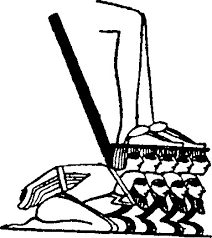
— NOTICE also the expression: “until I make Your enemies a footstool for Your feet.” This refers to the ancient Eastern practice of putting their feet on their enemies — humiliating them by putting their feet (their lowest and dirtiest and meanest parts) on their person, as if they were a doormat.
ILLUSTRATION:
There are a number of artistic renderings from history of this idea of “putting your enemies under your feet.” I’ll have a couple of examples of these on my blog at www.shawnethomas.com if you’d like to print and share one or more with your group Sunday:
— one from some Egyptian art of enemies as one’s footstool:
— the other is an ancient sculpture of the Roman Emperor Hadrian with an enemy under his feet:
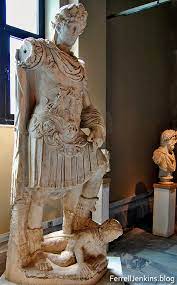
So you get the idea: the person is victorious, and their enemies are humbled before them, becoming basically a footstool for their feet.
ILLUSTRATION
This is almost a kind of “anti-illustration” of this — but I have never really “gotten” the idea of having a doormat at your home with your favorite team’s logo on it. People are going to come to your house, and wipe their feet on the treasured logo of your favorite team? And we’ve all heard the expression that a bad team is a what? “Doormat”! So I don’t really get the symbolism of using your team as a doormat!
But that’s the picture here in Psalm 110:1. God tells Jesus, Sit here until I make Your enemies Your “doormat”! You’re going to “wipe your feet” on them!
— Now, there is a little word here that has a great meaning: the word “until” means it is not yet
As Hebrews 2:8b says, quoting Psalm 8 about how all things will be subject to the Son of Man, “But now we do not yet see all things subjected to Him …”. In other words, he’s saying, we can look around, and it sure doesn’t look like all things are subjected to Jesus! It doesn’t look like He’s in charge!
??? DISCUSSION QUESTION???
You might ask your group to share:
??? What are some things we might look around and see today, that might cause us to think, “All things are not yet subjected to Christ at this time?”
(There are all kinds of things, right? Sickness and tragedy and death, harm to children, the prosperity of wicked men; the seeming triumph of evil men and philosophies — and on and on. “Now we do not yet see all things subjected to Him”!
But this is what :1 here refers to: God tells the Messiah sit here, at My right hand, “UNTIL” — UNTIL means, it is not yet. All things are NOT yet subjected to Him. They WILL be, one day, but they are not yet. One day, as Philippians 2 so powerfully says “Every knee will bow, in heaven, on earth, and under the earth, and every tongue will confess that Jesus Christ is Lord, to the glory of God the Father.” That hasn’t happened yet, has it? But it WILL! God the Father has told Jesus, after His resurrection, “Sit here, at My right hand, UNTIL I make Your enemies a footstool for your feet.” In other words, wait here for a minute, until I do this for You. But it WILL be done — that is our perseverance of faith; believing that this will one day happen, when we don’t yet see it happening. But it will. God has promised that His Messiah would rule over all His enemies: they will be His footstool!
:2 says He will tell Him, “RULE in the midst of Your enemies,” again speaking of His rule.
THEN :3 is an interesting verse: “Your people will volunteer freely in the day of Your power; In holy array, from the womb of the dawn, Your youth are to You as the dew.”
This verse gives us several insights into the PEOPLE of the Messiah’s reign:
— First, He says, they will be VOLUNTEERS: “Your people will volunteer freely in the day of Your power.” In other words, His people will happily and voluntarily serve Him. Where Jesus reigns, His people happily serve Him.
Several times during my ministry I have thought of this as applied to our churches: when Jesus is working in a church, and His people love Him, there is no lack of volunteers: “His people volunteer freely in the day of His power.” When you’ve got Bible School workers, and youth workers, and nursery workers, and people stepping up to serve — you can know the Lord is really working in that church! But conversely, when you do NOT see people stepping up to serve, it says something about whether the Lord is really reigning in the hearts of those people. For “His people volunteer freely in the day of His power”!
— Then it says they will be HOLY. The expression we see here that His people are assembled “in holy array” is the same as the expression “beauty of holiness” that we saw in Psalm 96, where it says that we are to “worship the Lord in the beauty of holiness.” In fact, this is the verse that makes it clear that “the beauty of holiness” refers to the beauty to God of the holiness of His people. Reinforce this idea here: when God’s people make themselves holy in His sight, it is a beautiful thing to God. It makes us attractive to Him. This should be our greatest motivation to personal holiness: we want to be pleasing and beautiful to God!
— Finally it adds that they will be MANY: “The youth are to You as the dew.” This is picture of how the dew just covers the ground in the morning. When there’s dew on the ground, it’s not usually just in one or two isolated spots; it’s all over the grass and plants!
ILLUSTRATION:
John Milton uses this same metaphor in his classic “Paradise Lost,” when he describes the multitude of the angels of heaven:
“An host
Innumerable as the stars of night
Or stars of morning, dewdrops, which the sun
Impearls on every leaf and every flower.”
Milton’s figure here refers to the virtually limitless number, which I believe is what Psalm 110:3 here conveys as well.
So the point is, the Messiah’s army of followers will not be small; the youth, His army, will be many. To sum :3:
— His army will be voluntary
— His army will be holy
— His army will be many
Does this not describe Christ’s people today? You only become His follower when you volunteer, when you personally surrender to Him as your Lord & Savior (ask your people to make sure they have done this!). One of our primary goals as His followers is to become more and more gradually holy as we mature (+x II Corinthians 7:1, etc.). And we are indeed many: countless millions have followed Christ. Revelation 7:9 says they will be “a great multitude which no one can count.”
But this Messiah is not only a great Ruler; as we see in :4, He is also a great Priest:
III. The Priesthood of the Messiah (:4)
4 The LORD has sworn and will not change His mind,
“You are a priest forever according to the order of Melchizedek.”
What does this mean, that He is “a priest forever according to the order of Melchizedek”? Melchizedek of course refers to the priest who met Abram when he returned from the Battle of the Kings, and to whom he gave a tithe of all the spoils he had captured. But how is the Messiah like this Melchizedek?
Again here in :4, as in :1, the New Testament give us some clarity as to the meaning of this Old Testament passage.
Hebrews 6:19-20 says: “:19 This hope we have as an anchor of the soul, a hope both sure and steadfast and one which enters [p]within the veil, 20 where Jesus has entered as a forerunner for us, having become a high priest forever according to the order of Melchizedek.”
Then Chapter 7:1-3 goes on to describe just what this means:
“For this Melchizedek, king of Salem, priest of the Most High God, who met Abraham as he was returning from the slaughter of the kings and blessed him, 2 to whom also Abraham apportioned a tenth part of all the spoils, was first of all, by the translation of his name, king of righteousness, and then also king of Salem, which is king of peace. 3 Without father, without mother, without genealogy, having neither beginning of days nor end of life, but made like the Son of God, he remains a priest perpetually.”
This passage tells us several ways that Jesus is “a priest according to the order of Melchizedek”:
— He is “king of righteousness.” The Hebrew word “melek” means “king,” and “tzedek” means “righteousness.” So the name “Melchizedek” literally means “King of righteousness.” This prefigures the Person of Jesus perfectly; He is the perfectly righteous, holy, King, who came to make us righteous through His sacrifice.
— This man Melchizedek was “King of Salem.” The Hebrew word “Salem” (shalom) means “peace.” Again, Jesus IS the Prince of Peace! He came to make peace between us and God (Romans 5:1) and give us a peace that passes all comprehension (Philippians 4:7)
— The author of Hebrews points out that Genesis doesn’t give any genealogy for Melchizedek; he is “without genealogy,” etc., which is a symbol for the fact that Jesus is eternal. Jesus has “neither beginning of days nor end of life.” “In the beginning was the Word …” (John 1:1)
Thus it concludes, “He remains a priest perpetually” — as Hebrews 7 goes on to discuss more in depth, concluding in 7:24-25, “Jesus, on the other hand, because He continues forever, holds His priesthood permanently. 25 Therefore He is able also to save forever those who draw near to God through Him, since He always lives to make intercession for them.”
???DISCUSSION QUESTION???
“Can you share a favorite pastor/staff member who blessed you and helped you draw near to God, but who has passed away and can’t help you any longer?”
(Many of us can share: Pastor Rod Masteller was very instrumental in Cheryl’s and my life when we were in high school in Harrah, Oklahoma, but Bro. Rod passed away from complications of COVID in December of 2020. You/your group can share some of your experiences with beloved ministers who have passed on.)
But then make the point: Our Great High Priest, Jesus, will serve eternally! As Hebrews 7:24 says, “He holds His priesthood permanently”! He saves us forever, because He lives forever!
So the Messiah is not only a great King, He is also our great eternal High Priest!
IV. The Triumph of the Messiah (:5-7)
5 “The Lord is at Your right hand;
He will shatter kings in the day of His wrath.
6 He will judge among the nations,
He will fill them with corpses,
He will shatter the chief men over a broad country.
7 He will drink from the brook by the wayside;
Therefore He will lift up His head.”
In these final three verses we have some more examples of the ultimate Triumph of the Messiah. Because the Lord (here “Adonai,” Lord) is at His right hand — God is truly with Him:
— :5 “He will shatter kings” — the Hebrew word “machatz” means “smite, crush, wound, shatter.” Jesus doesn’t cower before the kings of the earth like we often do; He shatters kings! Revelation calls Him “King of Kings”!
— :6 “He will judge among the nations” — this is the same word for “judgment” that we saw in Psalm 96:10. As we saw there, the Messiah will judge ALL the nations and peoples of the world. The word “nations” here is “goyim,” the “nations,” the typical Hebrew word for the “Gentiles” or non-Jews. The Messiah is not merely Israel’s God; He is the God of the whole world. It’s not that the Arabs have their god, and the Hindus have theirs, and we have ours. No, YHWH, the Messiah, Jesus Christ, is the King of all the earth. “Every knee will bow, in heaven, on earth, and under the earth, and every tongue will confess that Jesus Christ is Lord”!
And as Revelation makes clear, when He judges the nations in the end, it will be a bloody day! “He will fill them with corpses,” :6 says.
— :7 is picturesque: “He will drink from the brook by the wayside;
Therefore He will lift up His head.”
But what is the meaning of this picture? There are basically two “streams” of interpretation here (forgive the pun!)
1) it pictures a warrior pausing to drink at a stream. Not that the Messiah “needs a drink,” but that He will not grow tired; He will refresh Himself in God, who will lift His head, so that He will relentlessly pursue His victory.
2) Others see the waters as symbolic not of refreshing, but of affliction — water in scripture often does symbolize difficulty. Thus this line of interpretation sees the Messiah as going through the waters of affliction, the sufferings that He underwent at the cross, on the way to His victory.
ILLUSTRATION:
Thus Matthew Henry wrote:
“We have here the Redeemer saving his friends, and comforting them. He shall be humbled; he shall drink of the brook in the way. The wrath of God, running in the curse of the law, may be considered as the brook in the way of his undertaking. Christ drank of the waters of affliction in his way to the throne of glory.”
I absolutely agree that the Messiah underwent agonizing afflictions at the cross, but I think it may be stretching it to see that point in THIS particular verse. So I myself lean more toward the first interpretation, that it’s a picture of the Messiah being refreshed by His God, like a warrior pausing at a stream. The main point of course, either way, is that the Messiah will be ultimately victorious, our “King of Kings, and Lord of Lords.” “Prophet, Priest and King” — amazingly and accurately portrayed by King David, 1000 years before He ever came to earth, through the inspiration of the Holy Spirit in this “Messianic Psalm.”
__________________________________________________
— If you’ll type your email address in the “Follow blog via email” blank on my blog home page, WordPress will automatically send you next week’s video and you won’t have to search for it.
— And if you write something in the Comments below, I’ll be sure to pray for your and your group by name this week.
Per my licensing agreement with Lifeway:
— These weekly lessons are based on content from Explore the Bible Adult Resources. The presentation is my own and has not been reviewed by Lifeway.
— Lifeway resources are available at: goExploretheBible.com and: goexplorethebible.com/adults-training
— If you have questions about Explore the Bible resources you may send emails to explorethebible@lifeway.com


 shawnethomas
Thank you. As I was reading that last verse about the stream out loud this morning, I told my husband that I would need to do some research on that before I could teach our class. I read your blog every week and always use some bit from it in my lesson preparation.
I am so appreciative of the time and knowledge you give each week.
I am so thankful that the overview is a good resource for you as your prepare; that is just what I hope and pray for. God bless you as you prepare and teach this week. I am praying for you today!
Thank you, i particularly loved the final with the refreshing and the suffering view point, not sure of my own opinion so i’ll leave it to the class
Thanks, God bless you.