
An overview for Sunday School teachers and Bible study leaders of Lifeway’s “Explore the Bible” lesson for November 9, 2025 on Deuteronomy 12. Includes a sample introduction to the lesson, text outline and highlights, illustrations you can share, discussion questions for your group, and spiritual life applications. A video version of this overview is available on YouTube at:
Several of you have asked for an easier way to print out the lesson — good news: there is now a “PRINT” button at the very end of this article on my website that you can press to print. I hope that will make it easier for you if you want to print the overview out to mark up as your prepare, or to use to teach your group.
INTRODUCTION:
The novelist David Foster Wallace was not a Christian, but he said this in a famous commencement speech he made at Kenyon College in 2005, that he entitled: “This Is Water”:
“You get to decide what to worship. . . . In the day-to-day trenches of adult life, there is actually no such thing as atheism. There is no such thing as not worshipping. Everybody worships. The only choice we get is what to worship. And an outstanding reason for choosing some sort of God . . . to worship . . . is that pretty much anything else you worship will eat you alive.
If you worship money and things . . . then you will never feel you have enough.
Worship your own body and beauty and sexual allure and you will always feel ugly, and when time and age start showing, you will die a million deaths before they finally plant you.
Worship power—you will feel weak and afraid, and you will need ever more power over others to keep the fear at bay.
Worship your intellect, being seen as smart—you will end up feeling stupid, a fraud, always on the verge of being found out.”
You could read that quote, and/or print/post a portion of it, like:
“Everybody worships. The only choice we get is what to worship.”
And then ask your group to DISCUSS that quote. You could even share some of what Wallace said in the discussion: that if you worship your body, age will do you in, etc.
Then after you’ve discussed that, you can transition by saying that in our lesson for today in Deuteronomy 12 we find some of God’s commands for how He wanted His people Israel to worship — and how they apply to us today. We DO get to choose how we worship, and it is the most important choice we have to make. God wants us to obey Him in the way that we choose to worship.
CONTEXT:
Israel is still in the Plains of Moab, across the Jordan River from Jericho (where we have been studying for several weeks now) and Moses is still giving some of his last instructions to Israel before they cross over to enter the Promised Land.
Remember many scholars believe there are 3 major “addresses” or sermons in Deuteronomy, and Moses is still in his second address. We saw last time that he gave the famous “Shema” command, for them to love the one true God with all their heart, and that they are to make His word prominent in their lives.
Over the next several chapters Moses reviews their experiences with, and reiterates that God did not choose them because of their own righteousness, but by His grace. He talks about how they disobeyed Him with the Golden Calf, and other times, but he interceded and God showed mercy and did not destroy them.
He repeatedly emphasizes the importance of obedience. I mentioned last time that I think we had three lessons in a row that emphasized obedience — and that will continue in our lesson today.
Moses ended Chapter 11 by saying in :31-32, “For you are about to cross the Jordan to go in to possess the land which the Lord your God is giving you, and you shall possess it and live in it, 32 and you shall be careful to do all the statutes and the judgments which I am setting before you today.”
Then he begins Chapter 12 by saying “These are the statutes and the judgments which you shall carefully observe …”. So in today’s lesson we’ll see what some of the specific commands were that God wanted His people to be sure to obey. All of these commands have to do with the way He wants His people to worship, thus our outline for today deals with worship:
OUTLINE:
I. Eliminate False Forms of Worship (:1-3)
II. Observe God’s Commands for Worship (:4-7, 10-11)
III. Avoid Compromising God’s Commands for Worship (:8, 29-32)
TEXT: Deuteronomy 12:1-11, 29-32
I. Eliminate False Forms of Worship (:1-3)
:1 “These are the statutes and the judgments which you shall carefully observe in the land which the LORD, the God of your fathers, has given you to possess [a]as long as you live on the [b]earth. 2 You shall utterly destroy all the places where the nations whom you shall dispossess serve their gods, on the high mountains and on the hills and under every green tree. 3 You shall tear down their altars and smash their sacred pillars and burn their Asherim with fire, and you shall cut down the engraved images of their gods and obliterate their name from that place.”
So as we mentioned in the introduction, Moses says in :1, these are the specific commands God wants you to obey in the Promised Land, and these all deal with worship. First He commands them to to destroy the false forms of worship that already exist in the land.
He says in :2 “You shall utterly destroy all the places where the nations whom you shall dispossess serve their gods.” And he mentions specifically what those are: “on the high mountains and on the hills and under every green tree.”
These are what the Old Testament calls in many places “the high places.” The “high places” were places all throughout the land of Canaan, where the residents worshiped their gods. These were usually high on a mountain, or hill, so they had the feeling of being “closer” to their god — though the term “high place” also came to be applied to any place of worship in Canaan, whether it was physically “high” or not. Basically it was a place of worship of what to Israel was a false god. God said they were to “utterly destroy” them.
He said in :3 to “tear down their altars and smash their sacred pillars and burn their Asherim with fire.” The Asherim were wooden pillars dedicated to the Canaanite goddess Asherah. (The “im” ending in Hebrew is plural, so “Asherim” is plural and means all of the poles dedicated to Asherah). But the point is, they were to hate these false religious practices, and destroy the remnants of them, and not participate in them.
???DISCUSSION/APPLICATION QUESTION???
“How can/should we apply this command in a multi-cultural society like we have in America today? Should we destroy others’ religious property?”
(This is a good question and one that you/your group can spend some time and thought on. Does this mean that we should go into other people’s homes and places of worship today and destroy their idols and forms of worship? I don’t think it does. This is not the monarchy of Israel in 1400 B.C.; this is the United States in 2025. We have a Constitution that respects the right of each citizen to worship. (The First Amendment states of worship that: “Congress shall not … prohibit the free exercise thereof”) So though we may not agree with others’ worship in the United States, we respect their right to worship as they choose.
For guidance, we can look at the activities of the Apostles and God’s people in the Book of Acts/New Testament. Do you see them rushing into temples and destroying other people’s idols and property? No. Now we DO see them burning their OWN forbidden books of magic, etc. in Acts 19:18-20 “8 Many also of those who had believed kept coming, confessing and disclosing their practices. 19 And many of those who practiced magic brought their books together and began burning them in the sight of everyone; and they counted up the price of them and found it [f]fifty thousand pieces of silver. 20 So]the word of the Lord was growing mightily and prevailing.” They brought “THEIR BOOKS” — not others’; their OWN! — and they burned them.
SO we can make the application here that in our society too, we will follow the New Testament example of respecting others’ property and rights, but making sure that WE OURSELVES to do not have ungodly idols and forms of worship/the occult in our own midst. In other words, you take care of YOU! You make sure that YOU don’t have it; and leave the other person to God (and your prayers and witness for them). But eliminate all false forms of worship from your own life.
Another ???DISCUSSION/APPLICATION QUESTION???
“What are some practical ways we can eliminate false religious practices from our lives today?”
(Do not explore other religions TO PRACTICE THEM. This doesn’t mean we can’t learn about other religions in order to refute them, or witness to them. But don’t look into them to see if there’s anything you can gain from them.
Do not dabble in the occult, witchcraft, seances, or Ouija boards. These are doorways to demonic power and influence. Destroy any of these kinds of things that may be in your home.
Keeping these kinds of things around will come around to hurt you later — as we will see happened to Israel when they disobeyed this command.
II. Observe God’s Commands for Worship (:4-7, 10-11)
4 You shall not act like this toward the LORD your God. 5 But you shall seek the LORD at the place which the LORD your God will choose from all your tribes, to establish His name there for His dwelling, and there you shall come.
6 There you shall bring your burnt offerings, your sacrifices, your tithes, the [d]contribution of your hand, your votive offerings, your freewill offerings, and the firstborn of your herd and of your flock. 7 There also you and your households shall eat before the LORD your God, and rejoice in all [e]your undertakings in which the LORD your God has blessed you.
:10-11
10 “When you cross the Jordan and live in the land which the Lord your God is giving you to inherit, and He gives you rest from all your enemies around you so that you live in security, 11 then it shall come about that the place in which the LORD your God will choose for His name to dwell, there you shall bring all that I command you: your burnt offerings and your sacrifices, your tithes and the [f]contribution of your hand, and all your choice votive offerings which you will vow to the LORD.”
??? DISCUSSION/BIBLE ACTIVITY???
“What are some of the commands God gave Israel to observe regarding their worship?”
(Answers should include:
— :5 “You shall seek the LORD at the place which the LORD your God shall choose … THERE you shall come.”
— :11 “the place in which the LORD your God will choose for His name to dwell, THERE you shall bring all that I command you …”.
So they were only to worship at the one place He commanded them (this would be the Tabernacle where it was set up in the Promised Land, and then the Temple). They were not to worship at all the “high places” all over the land like the Canaanites did.
ALSO: He commanded them to bring various sacrifices (:6 He lists seven kinds of offerings; the first 5 are also repeated in :11):
— burnt offerings
— sacrifices
— tithes
— contribution of your hand
— votive offerings: things you’ve vowed to give to the Lord (:11)
— freewill offerings: these are just offerings that you WANT to give to God as an expression of love or thanks
— firstborn offerings: God commanded them to give their firstborn livestock (and their first fruits) to Him
Now, we are not today under the Old Testament Law like Israel was; but the principle still applies: God wants us to worship Him the way He has commanded.
???DISCUSSION/APPLICATION QUESTION???
“What are some of the ways God has commanded US to worship Him today?” — what are some specific New Testament commands to worship that you can think of?
(You might suggest/include the following — perhaps distribute these verses on slips of paper to class members as they arrive, and have them read them at this point in class:
— Acts 20:7 “7 On the first day of the week, when we were gathered together to break bread, Paul began talking to them …”(Also: I Corinthians 16:2, the Corinthians gathered and collected their offerings on the first day of the week; John 20:19 Jesus meets with His disciples on the first day of the week). John says in Revelation 1:10 that he was “in the spirit on the LORD’S DAY” so the example and practice of the New Testament is to gather and worship on Sunday.
— Hebrews 10:25 “not forsaking our own assembling together, as is the habit of some, but encouraging one another …”
— I Timothy 4:13, “Until I come, give attention to the public reading of Scripture, to exhortation and teaching.”
— Ephesians 5:19 “speaking to one another in psalms and hymns and spiritual songs, singing and making melody with your heart to the Lord”
— The Apostle Paul gives this command for New Testament worship in I Timothy 2:1: “First of all, I urge that entreaties, prayers, petitions, and thanksgivings be made on behalf of all men …” so he teaches us to pray in our services.
— Matthew 23:23 on tithing; I Corinthians 9:7 on giving: “Each one must do just as he has purposed in his heart, not grudgingly or under compulsion, for God loves a cheerful giver.”
— I Corinthians 11:23-26 “For I received from the Lord that which I also delivered to you, that the Lord Jesus in the night in which He was betrayed took bread; 24 and when He had given thanks, He broke it and said, “This is My body, which is for you; do this in remembrance of Me.” 25 In the same way He took the cup also after supper, saying, “This cup is the new covenant in My blood; do this, as often as you drink it, in remembrance of Me.” 26 For as often as you eat this bread and drink the cup, you proclaim the Lord’s death until He comes.” So we are commanded to observe the Lord’s Supper as well.
All of these are Biblical elements of worship that God has commanded us as New Testament believers to adopt. You/your group may share others. So God’s commands for worship are different for us than they were for Israel here in Deuteronomy 12, but the point is that like Israel we should be committed to follow God’s commands for worship.
III. Avoid Compromising God’s Commands For Worship (:8, 29-32)
:8 “You shall not do at all what we are doing here today, every man doing whatever is right in his own eyes; 9 for you have not as yet come to the resting place and the inheritance which the LORD your God is giving you.”
29 “When the LORD your God cuts off before you the nations which you are going in to dispossess, and you dispossess them and dwell in their land, 30 beware that you are not ensnared [a]to follow them, after they are destroyed before you, and that you do not inquire after their gods, saying, ‘How do these nations serve their gods, that I also may do likewise?’ 31 You shall not behave thus toward the LORD your God, for every abominable act which the LORD hates they have done for their gods; for they even burn their sons and daughters in the fire to their gods.
32 “[b]Whatever I command you, you shall be careful to do; you shall not add to nor take away from it.”
A. One way of compromising God’s commands to worship is by thinking that we can just do whatever we want to in worship.
He tells us in :8, ““You shall not do at all what we are doing here today, every man doing whatever is right in his own eyes …”.
This phrase “every man doing whatever is right in his own eyes” is one of the most pernicious in all of scripture. It’s used repeatedly in the Book of Judges for how Israel strayed, without the leadership of the word of God: “There was no king in Israel; every man did what what right in his own eyes.” (Judges 17:6, 21:25) The Book of Judges shows us tragically how far Israel fell away from the Lord, by following what “seemed right” to them.
This is actually a danger we face in America today too. We have many freedoms in our country today — but we need to be careful lest we succumb to this ungodly mindset that we can do whatever seems right to us. Just because we have the freedom in America to do something, does not mean that it is right before God to do it!
A good ???DISCUSSION QUESTION??? for some of our classes might be:
“What is the difference between the historic Baptist doctrine of ‘The Priesthood of the Believer,’ and what Deuteronomy says here about ‘every man doing what is right in his own eyes’?”
(The doctrine of The Priesthood of the Believer means that every Christian has direct access to God through Christ. We don’t need a “priest” to mediate God’s truth to us; we all have that access.
But that is FAR from saying “everyone can do what is right in his own eyes” — though some have taken it that way. God will not give us anything as a “priest” that does not line up with His word!)
We need to be committed to keep God’s commands, and worship Him as He instructs us.
B. Another way of compromising God’s commands for worship is by mingling ungodly practices with our Biblical worship.
God commanded Israel here in :30, “Beware that you are not ensnared to follow them, after they are destroyed before you, and that you do not inquire after their gods, saying, ‘How do these nations serve their gods, that I also may do likewise?’ 31 You shall not behave thus toward the LORD your God.” God says, watch out, and do not follow the ungodly practices of these people.
Often times we have a natural curiosity, and when we see others’ practices, we want to mimic them — it’s something “new,” and it’s easy to be corrupted and compromised with them.
Unfortunately, we see in scripture that this is just what happened to Israel. They did NOT in fact destroy the high places. I Kings 3:2 says that in the early days of Solomon “The people were still sacrificing on the high places, because there was no house built for the name of the Lord until those days.” These high places remained then, and as a result they became snares for them throughout their history — they turned Israel’s hearts to worship idols on them just like the Canaanites did — and they were eventually judged and lost their nation because of it.
ILLUSTRATION:
The Biblical Archeology Society website has this picture of a worship “pole,” similar to an Asherah, which they worshiped on the “high places. Odd as it may seem to us, this pole is dedicated to both Yahweh and Asherah: alternating rows, one for Yahweh, and one row for Asherah!
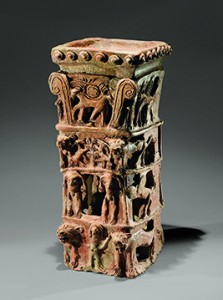
The BAS says that there is evidence that many considered Asherah to be the “wife” of Yahweh.
This is just an example of how the true faith of Israel had been corrupted by idolatry — they didn’t necessarily “reject” Yahweh worship; they just “added” some of the Canaanite practices to it — exactly the kind of thing that God was warning Israel about here in Deuteronomy 12!
Jeremiah 7:30-31 tells us that Israel even adopted the evil Canaanite practice of burning their children in the fire as offerings to these false gods:
“30 For the sons of Judah have done that which is evil in My sight,” declares the Lord, “they have set their detestable things in the house which is called by My name, to defile it. 31 They have built the high places of Topheth, which is in the valley of the son of Hinnom, to burn their sons and their daughters in the fire, which I did not command, and it did not come into My mind.”
So the lesson here is: we must guard ourselves against being seduced and ensnared by false religions in the world around us, so that we compromise the true faith God has given us in His word.
???DISCUSSION/APPLICATON QUESTION???
“What are some ways that Christianity may be in danger of being corrupted and compromised today?”
(EXAMPLES:
— Many churches are compromising what the Bible clearly teaches, in order to embrace feminism, calling women pastors, and some even referring to God as “our Mother.”
— Others are doing that with homosexuality: welcoming and affirming in their churches what God has clearly in both Testaments forbidden and called sin.
— Eastern religious practices are making their way into some churches
— as well as worldly “entertainment” practices that are much more “Hollywood” than they are genuine Biblical worship.
— Some may allow political preferences, liberal or conservative, to overshadow the purity of Biblical commands.
You/your group can think of others.)
You might add that part of the problem we face is, that when we are immersed in a culture, it can be difficult for us to separate what is “cultural” from our worship practices — because “everybody is doing it” in the world around us! This is why we must have a clear commitment to the word of God. We need to keep reading and studying our Bibles so that we are very clear on just what the Bible teaches — and be committed to practice it, no matter what “everyone” is saying and doing in the culture around us. It will not be popular with the world for us to do that — but this is what God calls us to do: to serve HIM, and not the popular opinion of the world.
That’s why :32 closes our focus passage with a final reminder: “Whatever I command you, you shall be careful to DO; you shall not add to nor take away from it.” So again, for a 4th/5th week in a row, God emphasizes: OBEY these words! Put them to practice in your life. Make sure as a teacher that you set some practical means of obedience of God’s commands regarding worship before your class this week — and emphasize how important it is that we obey them. As David Foster Wallace said in the introduction: we DO get to choose what to worship. This passage reminds us that the One True God commands us to choose to obey HIM in the way that we worship!
_________________________________________________
— Remember there is now a “PRINT” button at the end of the lesson on my blog, that you can hit to print out the lesson in its entirety.
— If you’ll you’ll type your email address in the “Follow blog via email” blank on my blog home page, WordPress will automatically send you next week’s lesson and you won’t have to search for it each week.
— And if you write something in the Comments below, I’ll be sure to pray for your and your group and any requests you mention, by name this week.
Per my licensing agreement with Lifeway:
— These weekly lessons are based on content from Explore the Bible Adult Resources. The presentation is my own and has not been reviewed by Lifeway.
— Lifeway resources are available at: goExploretheBible.com and: goexplorethebible.com/adults-training
— If you have questions about Explore the Bible resources you may send emails to explorethebible@lifeway.com


 shawnethomas
Thank you for your outlines and questions to ask while teaching. Found that in teaching the OT finding good information if hard to come by compared to NT passages. Really enjoy listening to you.
Hey Brother Shawn, I have just recently found your page, and I want to say I appreciate your insights to these Bible truths. I am a retired Baptist minister and always enjoy and appreciate the insights of others who share the truths of God’s Word. I look forward to reading and studying The Word with you.
thank you for the outline of our SS lesson , it helps a lot…Will you please pray for my daughter she lost her mate last week and she also struggles with some health issues ..Thank you and God Bless..
I have enjoyed you commentaries. i use these in teaching Sunday School. Thank you.
I really enjoy your lessons. It makes it easier for me to study and prepare for my nursing home class. Pray for my husband, both of his vocal cords was damaged after intubation during a surgery. He was on a feeding tube for 15 months. By the grace of God and an excellent God loving speech therapist and great ENT he is eating again. He has a treachostomy and may always have unless he has vocal cord healing. After a year it is unlikely it will heal but I know with God all things are possible.
My husband and I teach an adult class and love your insight into the scriptures.
I try to listen to you at least a couple of times each week, maybe even while washing
dishes and then again while actually studying. Seems that again God is taking care of
you and your family. So happy to hear of the progress Cheryl is making.
Thank you for taking the time to share this with us. It’s been helpful to me.
I have been teaching Sunday School Class at First Baptist Church for the last 2 1/2 years. Turned my life over to JESUS CHRIST 4 1/2 years ago from being caught up in addiction.
Now, I share my testimony of my faith with others. What a blessing it is for me to see how the LORD equips me to help others.
Thank you for your time to share these podcasts with us.
Sincerely Grateful,
Samantha
Thank you so much for your comments on the lessons. It helps so much as I lead a ladies Sunday school class.
I have suddenly stopped receiving your wonderful weekly overviews of Lifeway Explore the Bible lessons. They are most helpful in my teaching preparation for senior adults at First Baptist Centerville, George. Please continue to send them each week. I pray for you and Cheryl every day! Thank you, and God bless!! Shirley Stricklelnsmstrick35@aol.com
Hi Shirley; I added that email address to my subscriber list, but also tried to send you a link to my blog to that email address, but it came back as a bad address. Can you check it and let me know? Also I hope you know if you don’t get the email you can always go to http://www.shawnethomas.com and get both the text and video. Let me know about the email, and please know that I am praying for you this weekend!