
Includes a sample introduction to the lesson, teaching outline and highlights, illustrations you can use, discussion questions for your group, and spiritual life applications. A video version of this overview is available on YouTube at:
INTRODUCTION:
???DISCUSSION QUESTION???
“What is your favorite hymn/song about salvation?”
(For example, one of mine is the old hymn, “At Calvary.” I can remember singing it as a newly baptized child, on the tailgate of our old blue pickup truck” “Mercy there was great and great was free, pardon there was multiplied to ME …”. I didn’t understand as much about salvation then as I do now, but I did know that Jesus had saved me, and I didn’t deserve it! I loved that song, and I still do!)
After you/your group have shared some of your favorites, then transition with: Today we’re going to see how God is the Savior and Trust of His people, from Deuteronomy 33.
CONTEXT:
This is our last lesson in the Book of Deuteronomy, and Moses and Israel are still in the Plains of Moab, across the Jordan from Jericho. Moses is sharing his last messages with Israel before he dies, and Joshua leads them into the Promised Land.
Last time in Chapter 30 Moses told the people that God’s word was near them, very available, and that the decision to follow Him was extremely important, so “Choose life!”
Then in Chapter 31 he tells them that he is 120 years old, and will not be leading them into the Promised Land. He tells them in :3, “It is YAHWEH your God who will cross ahead of you” and that He would give them victory. Then he calls Joshua, and tells him to be strong and courageous, and to lead the people in. He also gave the priests a copy of the Law, and told them to read it regularly in the Promised Land. Then God tells Moses he is about to die, and to teach the people a song, which will witness against them when they fall away — which, He says, they will. In the last verse of Chapter 31 it says Moses began to teach them this song: which comprises Chapter 32 of Deuteronomy.
So the song in Chapter 32 begins, “Give ear O heavens …” and it tells how God is righteous, but His people are unfaithful. That though He blessed Israel (Jeshurun), they “grew fat and kicked” and provoked Him with their idolatry to judge them. But it ends hopefully, saying that He is the One True God and He will atone for His people. (Again, pointing forward to the Messiah!) When the song was finished, the Lord told Moses to go up to the mountain to die.
Now in Chapter 33, our passage for today, Moses gives his final blessing to Israel before he dies.
(Chapter 33 divides up into 3 parts: In the first part, :1-5, Moses gives a general introduction to the blessings, then in :6-25 he gives specific blessings for each tribe (except Simeon!), and then :26-29 give the conclusion the blessings. Our focus passage for today includes the introduction and the conclusion, but not the specific tribal blessings in between).
OUTLINE:
I. God the Glorious King of His People (33:1-5)
II. God the Savior and Trust of His People (33:26-29)
TEXT: Deuteronomy 33:1-5, 26-29
I. God the Glorious King of His People (33:1-5)
:1 “Now this is the blessing with which Moses the man of God blessed the sons of Israel before his death. 2 He said,
“The LORD came from Sinai,
And dawned on them from Seir;
He shone forth from Mount Paran,
And He came from the midst of ten thousand holy ones;
At His right hand there was flashing lightning for them.
3 “Indeed, He loves the people;
All Your holy ones are in Your hand,
And they followed in Your steps;
Everyone receives of Your words.
4 “Moses charged us with a law,
A possession for the assembly of Jacob.
5 “And He was king in Jeshurun,
When the heads of the people were gathered,
The tribes of Israel together.”
Verse 1 says that Moses pronounced this blessing on Israel before he died, and the blessing begins in :2, “The LORD came from Sinai, and dawned on them from Seir; He shone forth from Mount Paran.”
Interestingly enough, Muslims claim that Deuteronomy 33:2 refers to Mohammed. They point to the 3 geographical places mentioned there: “Sinai,” “Seir,” and “Mount Paran,” and say that they represent the 3 great world religions: “Sinai” for Moses and the Law; “Seir” for Jesus and the Gospel (they claim that Seir represents Palestine), and then “Mount Paran” for Muhammed and Islam, because they claim Mt. Paran is in Arabia where he began conquering. And that “He came with 10,000 holy ones,” and “lightning flashing” represent the swords of Mohammed’s conquering army. But this is a faulty interpretation; we will see that these are NOT what these places are/represent, and this passage is NOT speaking about Muhammed, but of Yahweh, the incomparable God of Israel!
HOW DOES :2 OPEN? “The LORD came from Sinai.” As we have noted repeatedly, when we see “LORD” in all 4 caps in the Old Testament, it means that in the Hebrew text the word is “YHWH,” “Yahweh” or “Jehovah,” the personal name of God that He gave Moses when he asked Him what he should tell Israel His name was. SO THIS PASSAGE IS SPEAKING OF YHWH. Some also believe that :5 is referring to Moses, how HE was king in Israel — but again, it is clear that the focus of this passage is not on Mohammed or Moses or any other human being; its focus is on the glory of YHWH as Israel’s Warrior King, and no other!
Secondly, “Sinai,” “Seir” and “Mount Paran” are three mountaintops where God showed Himself glorious as He led Israel.
— Mt. Sinai is indeed where God gave Moses the Commandments, and also where He appeared gloriously in fire.
— But Mt. Seir is the land of Edom, which was given to Esau (Deut. 2:5), NOT Palestine/where Jesus lived/ministered. This verse is talking about how God led His people safely through Seir on their way to the Promised Land.
— The exact location of “Mount Paran” is unknown but it is somewhere in “the wilderness of Paran” in the Sinai Peninsula on their wilderness wanderings, so it was not Arabia. But even if it were, this passage is talking about how Yahweh manifested His glory to His people as He led them through the wilderness, not about anyone else!
As you’re referring to these places, you might want to use a MAP so you can show your group where these places are:
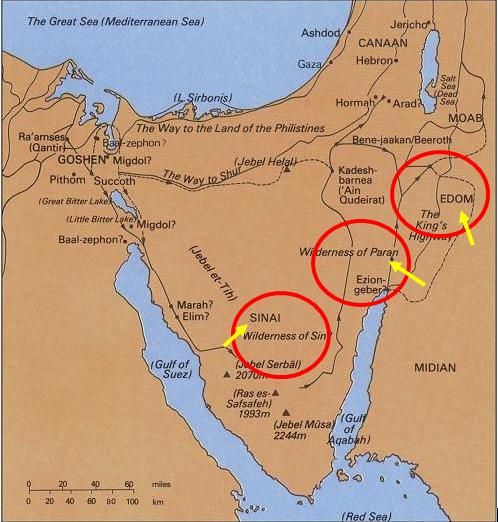
This one shows Mt. Sinai (many believe Jebel Musa at the bottom here is “Mt. Sinai”) and also the Wilderness of Paran (the mountain is located somewhere there); and Edom/which where “Mt.Seir” is.
The real point of this section is that Yahweh manifested His glory as He led His people, as their Glorious Warrior King, through all these places on their way to the Promised Land. These verses tell us: A. WHO He is, and B. WHAT He does for His people.
A. First of all these verses tell us Who He is: The Glorious King!
As we’ve seen, this is clearly talking about YAHWEH, as it opens “The LORD (YHWH) came from Sinai.”
And notice how it describes how glorious He is. It says:
— He “dawned” on them: this is the Hebrew “zarach,” which is used of the rising of the sun. God’s glory is like the sun — as we see in Revelation 21:23, “And the city has no need of the sun or of the moon to shine on it, for the glory of God has illumined it, and its lamp is the Lamb.” God’s glory is all the sun we’ll need forever!
— Then it continues that thought, saying He “shone forth”: the Hebrew “yapha” means to shine like beams of light. Psalm 50:2 says “Out of Zion, the perfection of beauty, God has shone forth.” Again this speaks of the shining beauty and glory of God.
— “At His right hand there was flashing lightning.” This comes from the Hebrew word “esh,” or “fire.” God is pictured as fighting His enemies with thunder bolts! No other King is like Him; powerful and glorious!
Verse 5 that this Glorious Warrior was the King of Israel: “He was KING”!
In these early days, Israel had no earthly king. Yahweh was their King.
— In I Samuel 8, Israel asked for a king, so they could be “like all the nations.” God said in :7, “They have rejected Me from being King over them.” GOD wanted to be their king, but they rejected Him, and selected a succession of faulty earthly kings instead. (People today still trade God for earthly kings and gods)
— In Malachi 1:14 God told Israel that their problem was that they didn’t treat Him like the King that He is. “for I am a great King,” says the Lord of hosts, “and My name is feared among the nations.”
— Those of us who are New Testament Christians make Him our King today. The picture of Jesus that Revelation 19:12-16 gives us is very like that of Yahweh in Deuteronomy 33 (and we know that Jesus Himself said He is “I AM”!):
“His eyes are a flame of fire, and on His head are many diadems; and He has a name written on Him which no one knows except Himself. 13 He is clothed with a robe dipped in blood, and His name is called The Word of God. 14 And the armies which are in heaven, clothed in fine linen, white and clean, were following Him on white horses. 15 From His mouth comes a sharp sword, so that with it He may strike down the nations, and He will rule them with a rod of iron; and He treads the wine press of the fierce wrath of God, the Almighty. 16 And on His robe and on His thigh He has a name written, “KING OF KINGS, AND LORD OF LORDS.”
Jesus is our Ultimate, Glorious King!
B. What He does for His people:
:3 “Indeed He loves the people”
“Indeed” here is the Hebrew “aph,” meaning “indeed, moreover, also, yea” — or “how much”! We might say, “MAN, He loves the people,” or “YEAH, He loves the people,” or “He REALLY loves the people.” It just emphasizes the intensity of the statement. It’s not “merely” that God loves the people; it’s that He REALLY intensely loves the people! It’s quite a statement!
— It reminds me of I John 3:1 in the New Testament, “Behold how great a love the Father has bestowed on us …”.
ILLUSTRATION
C.S. Lewis’ Screwtape Letters is written from the perspective of a fictitious demon who is writing counsel to his nephew Wormwood on how to tempt humans. At one point he writes:
“For we must never forget what is the most repellent and inexplicable trait in our Enemy; He really loves the hairless bipeds He has created.” Lewis’ point coming from a demon is humorous, but it is true: He really does love us!
Like Wesley’s classic hymn: “Amazing love, how can it be …”. Or “I stand amazed in the presence of Jesus the Nazarene, and wonder how He could love me, a sinner, condemned, unclean. How marvelous, how wonderful …”.
Those songs present the sense of this verse: “INDEED, He loves the people.” This is the motivation for all that God does for us, as John 3:16 makes so clear: “For God SO LOVED the world that He gave His only begotten Son …”. Why did He do what He did for us in Jesus? Because He loves us. “Indeed He loves the people.” Thank God He does!
And because of His love, what does He do for His people? We see several examples of what He does for them in the next verses:
— :3b He keeps His people “All Your holy ones are in Your hand”
This is a great picture. It reminds me of what Jesus said in John 10:28-29, “I give eternal life to them, and they will never perish; and no one will snatch them out of My hand. 29 My Father, who has given them to Me, is greater than all; and no one is able to snatch them out of the Father’s hand.”
His sheep are in His hand, and no one can snatch us out! This is our confidence and the basis of our eternal security. We are not so faithful that we can’t fall away, but “if we are faithless, He remains faithful” (II Timothy 2:13) and we are not kept secure because we are holding on to Him, but because HE is holding on to US! “All Your holy ones are in Your hand.” What a comforting verse!
— :3b “they followed in His steps.” God LEADS His people. Israel didn’t have to try to figure out how to make their way through the wilderness to the Promised Land. God led them through the pillar of fire and cloud, as we have seen. Psalm 78:52 says, “He led forth His own people like sheep And guided them in the wilderness like a flock.”
Jesus today leads His people. He said earlier in John 10:28, “My sheep hear My voice, and I know them, and they follow Me …”. We also do not have to figure out how to manage our own way through this world; no our loving God leads us as we walk with Him in His word and prayer daily.
— :3b-4 He gives His Revelation/Word
“Everyone receives of Your words. :4 “Moses charged us with a law.”
This tells of how God gave His people His word, laws and rules and examples to learn from and follow. As we saw last week, we don’t have to go up to some high mountain, or cross some vast sea to find God’s truth; we have it, accessible to all, in His word! This is a great gift, a treasure (as we talked about previously) and it is another evidence of His love for us.
So God is portrayed here as the Glorious King of His people, loving them, leading them, and holding them, as they move towards the Promised Land. And that is just what He does for us today too, isn’t it?
You may choose to include something from these next two parenthetical points in your lesson:
(1. Before we leave this section, you/your group may wonder, What is this “Jeshurun” where it says “He was King in Jeshurun.”
“Jeshurun” is a Hebrew word meaning “upright” or “straight. It’s a nickname for Israel, like “Uncle Sam” or “Yanks” would be for Americans. We see this clearly in scripture:
— Deuteronomy: 32:15: “But Jeshurun became fat and kicked—
You have become fat, thick, and obstinate …”. God’s talking to Israel there of how they rebelled against Him.
— Isaiah 44:2 “Do not fear, Jacob My servant, And Jeshurun, whom I have chosen.” This is an example of Hebrew “synonymous parallelism” poetry, where they repeat something in a slightly different way, which is the way they do poetry. In the first part of the verse He calls them “Jacob,” (another name for Israel) and in the second He calls them “Jeshurun.”
So these scriptures indicate for us that “Jeshurun” is another name for God’s people, Israel. The point of the verse is that God is King over Israel His people.
(2. You may want to note that at the conclusion of :1-5, as we shared in the Context, in :6-25 Moses gives the specific blessings for each of the tribes of Israel, except for Simeon.
You might want to share an example or two of these blessings, such as:
:6 “May Reuben live and not die,
Nor may his people be few.”
7 And this was regarding Judah; so he said:
“Hear, Lord, the voice of Judah,
And bring him to his people.
With his hands he contended for them,
And may You be a help against his adversaries.”
And so on for all the tribes but Simeon! Why not Simeon? It may have its origins in Genesis 49:5-7, when Jacob is blessing his sons, but he says: “Let my soul not enter into their council … because in their anger they slew men, and in their self-will they lamed oxen. Cursed be their anger, for it is fierce … I will disperse them in Jacob …”. The blessing in Deuteronomy 33 was not withheld from Levi, perhaps because of their priestly role, but it was withheld from Simeon, which history tells us was indeed diminished as a tribe and they were assimilated into Judah.
But most of the tribes did receive a blessing. You can look at more of those if you’d like to; they are interesting. But after the blessings on the tribes, the focus moves back to the Blesser:)
II. God The Savior and Trust of His People (:26-29)
:26 “There is none like the God of Jeshurun,
Who rides the heavens to your help,
And through the skies in His majesty.
27 “The eternal God is a dwelling place,
And underneath are the everlasting arms;
And He drove out the enemy from before you,
And said, ‘Destroy!’
28 “So Israel dwells in security,
The fountain of Jacob secluded,
In a land of grain and new wine;
His heavens also drop down dew.
29 “Blessed are you, O Israel;
Who is like you, a people saved by the LORD,
Who is the shield of your help
And the sword of your majesty!
So your enemies will cringe before you,
And you will tread upon their high places.”
After the blessings upon the individual tribes in :6-25, this second section of our focus passage concludes Moses song of blessing by pointing back to God, and saying in :26, “There is none like the God of Jeshurun.” There’s that name “Jeshurun” again, which we saw in :5 is a “nickname” for Israel.
He says “There is none like the God of Jeshurun,” in other words, there is no God like Yahweh, the God of Israel.
— It reminds me of the phrase from the song “Days of Elijah”: “There’s no god like Jehovah!”
Indeed there is no god like our God, the God of the BIble:
— There’s no God who split the Red Sea so His people could walk through it like a wall on each side!
— There’s no God who delivered His people from the fire like Yahweh did Shadrach, Meshach, and Abed-Nego.
— There’s no God who knows the end from the beginning so that He could write an Isaiah 53, who accurately pictures the coming Messiah Jesus, hundreds of years in advance.
— There is no other God who loved the world, that He gave His only begotten Son, that whoever believes in Him may not perish, but have everlasting life!
“There’s no God like our God!”
And the second part of :26 says He “rides the heavens to your help.” This is poetic; of course God doesn’t literally “ride” anywhere; but it is a poetic way of saying that He is there to help you wherever you are.
The word “help” there is the Hebrew “ezer,” which you may recognize from “eben-ezer,” from I Samuel 7, when Israel was oppressed by the Philistines, but Samuel said God will help you, and they sought Him, and He gave them a victory. So Samuel set up a stone and named it “Ebenezer,” “eben” meaning “stone,” and “ezer” meaning “help.” He set this stone up to remind Israel that Yahweh was their help. (And of course we get the verse “Here I raise mine Ebenezer …” from “Come Thou Fount of Every Blessing” from this occasion. If you have a worship time in your class/department you might consider singing that this Sunday.)
But God is the help of His people. He is our Savior, and He alone is to be our trust. That is the focus of this second section, :26-29.
There are repeated verses here on how God saves and helps His people.
(If you want to use a GROUP ACTIVITY you could ask your class to call out all the ways they see in :26-29 that God saves/helps His people; OR you can just point these out).
Answers/points should include:
— :26b He “rides the heavens to your help”
— :27 says He is “a dwelling place” and has His “everlasting arms” underneath us (here’s another hymn origin: “leaning on the everlasting arms”!
(ILLUSTRATION: Elisabeth Eliot was the wife of Jim Eliot, who was killed on mission to the native tribes in Ecuador. She loved this verse, and always opened her radio program by saying: “You are loved with an everlasting love, and underneath are the everlasting arms.” (Jeremiah 31:3, and Deuteronomy 33:27)
Another quote of hers you might want to share: “We are not adrift in chaos, we are held by the everlasting arms.” Some of our group members may need that quote this week! Maybe YOU do!)
— :27b He drove out the enemy from before Israel
— :28 He makes them to dwell in security
— :28b He makes His heavens drip dew (a symbol of all the ways He blesses and provides for His people, which we’ve celebrated on Thanksgiving!)
— :29a they are “saved by the LORD”
— :29b God is their “shield,” and “sword” and He gives them victory over their enemies.
So in all these ways Moses says, God saves and helps and delivers His people. And we as God’s New Testament people have experienced these same kinds of help from us. All of us who have become Christians have been saved by the grace of Jesus. And we have all likely experienced His help in other times in our lives too.
???DISCUSSION/APPLICATION???
“Can you share a time when you specifically ‘leaned on the Lord’ (like :27 says) and He helped you (like :26 says)?”
(For EXAMPLE: when I was in college several of us FBC Harrah went on a mission trip to Europe, and at one point we were to sing and share at the European Baptist Convention in Interlaken, Switzerland. I remember we were backstage, about to go on, and I was a bit anxious, but the old hymn, “leaning on the everlasting arms” came to my mind. I sung it, and more importantly, asked the Lord to help me — and He did!)
You can share that story if you’d like, but this would also be a good opportunity for you/your group to share testimonies of how God helped YOU when you “leaned” on Him! He is still the Savior of His people today!
:29 “Blessed are you, O Israel …”
Remember, in between our two “focus passages” for today, Moses gave a special blessing for each tribe of Israel (save Simeon). Here he just summarizes it, “Blessed are you, O Israel …”, reminding them that they are a blessed people.
This is even more true for us as New Testament Christians. Ephesians 1:3 says we have been “blessed you with every spiritual blessing in the heavenly places in Christ.” We are a very blessed people, even more than Israel was in their day.
I LOVE this next part of :29. “Who is like you, a people saved by YHWH.” Israel WAS so blessed, like no other people in the world. But WHY were they so blessed? Were they more numerous, more powerful, more pure, more intelligent, than all the other nations? NO! The reason they were so blessed is simple: they were just “a people saved by YHWH.” THAT was their glory; that was their “claim to fame.” They themselves weren’t anything; they were just saved by YHWH.
It’s like Deuteronomy 7:7 said: “The LORD did not set His love on you nor choose you because you were more in number than any of the peoples, for you were the fewest of all peoples.” Rather, like :8 goes on to say, it is just because God loved them, and redeemed them. They were just “a people saved by YHWH,” just like Deuteronomy 33:29 says.
And that’s so for us in the New Testament too, isn’t it; and even more so. WHY are we so blessed today, with “every spiritual blessing in the heavenly places”? It’s not because of how good or how great WE are; we are just “a people saved by the Lord.”
It’s like Ephesians 2:8-9 says, “For by grace you have been saved through faith; and that not of yourselves, it is the gift of God; 9 not as a result of works, so that no one may boast.”
What do we have to “boast” about as Christians? NOTHING! We ourselves haven’t done anything to earn or deserve all our blessings. We are just a people saved by the grace of Jesus. That’s it! We are saved by Him alone, and our trust is to be in Him alone.
So many people in this world are looking to be “great,” to “be somebody.” As Christians we walk in humility; we know we ourselves aren’t “great;” but we are saved by the One who is great! GOD IS GREAT! This is the message of scripture, and especially the message Moses conveys in his blessing here in Deuteronomy 33.
ILLUSTRATION/APPLICATION:
I hope I’m not being too “persnickety,” but I don’t like it when I see people at football games with signs or tee shirts saying, “In Lane we trust,” or “In Brent we trust,” and so on. Not that I have anything against supporting those coaches — I just hate to see us put anyone else’s name in a place where GOD’S name should be. GOD and GOD ONLY is the ultimate trust of His people.
A coach will occasionally let you down. A politician will eventually let you down. Even a friend or loved one may one day let you down. But GOD will never let you down. He is absolutely trustworthy and faithful.
Yahweh is the Glorious God, and He and He alone is the Savior and King and the trust of His people. We have no great “claim to fame” in and of ourselves; we are just “a people saved by the Lord”! That reminder is a good way to close our study in Deuteronomy.
I’ve enjoyed studying this book — but I’m also ready to move on to the Book of Matthew in the New Testament next quarter — it’s one of my very favorite books! Hope to see you next time as we begin that study together!
_________________________________________________
Remember there is now a “PRINT” button at the end of the lesson on my blog, that you can hit to print out the lesson in its entirety.
— If you’ll type your email address in the “Follow blog via email” blank on my blog home page, WordPRess will automatically send you next week’s lesson and you won’t have to search for it each week.
— And if you write something in the Comments below, I’ll be sure to pray for your and your group by name this week.
Per my licensing agreement with Lifeway:
— These weekly lessons are based on content from Explore the Bible Adult Resources. The presentation is my own and has not been reviewed by Lifeway.
— Lifeway resources are available at: goExploretheBible.com and: goexplorethebible.com/adults-training
— If you have questions about Explore the Bible resources you may send emails to explorethebible@lifeway.com


 shawnethomas
Thanks for your Godly work.
Get Outlook for iOShttps://aka.ms/o0ukef
Thank you; I appreciate your encouragement. And I’ll be praying for you Sunday morning!
So thankful for your ministry of providing ‘extra’ content for me and SOOOO many others! Blessings!
I just grateful that it is helpful to you, Betty! Thank you for letting me know. Praying for you this weekend!