
For Sunday School teacher and Bible study leaders of Lifeway’s Explore the Bible lesson. Includes a sample introduction to the lesson, text outline and highlights, illustrations you can use, discussion questions for your group, and spiritual life application. A video version of this overview is available on YouTube at:
INTRODUCTION:
Several years ago I read a book by former football coach and current tv commentator Urban Meyer with the title, Above the Line. “The line” he was talking about was the standard he set for himself and his team. The book consisted of a number of qualities to adhere to, to be “above the line” as a football team — although I’ve seen his book quoted on a number of business sites, as it certainly applies to a lot of different aspects of life.
Either following up on Urban Meyer’s book, OR as an alternate introduction, you might ask your group:
???DISCUSSION QUESTION???
“What is a ‘standard’ that you have/had to keep on your job/profession?”
THEN ask:
“What is ‘the line’ for Christians? What is the standard that we are to live up to?”
(Answers might include the standard of the Bible, which teaches us right from wrong; or the standard of Jesus Christ Himself, who is our Lord & Savior, Whom we are commanded to follow “in His steps.”)
Then transition to the lesson, that in todays passage in Matthew 5 we will study what Jesus tells us “the line”/the standard is for Christians, from His Sermon on the Mount. It’s a standard none of us can ever fully live up to, though we are to try with all our heart — but it ends up casting us all on the grace of the Lord Jesus, which is our only hope of salvation!
CONTEXT:
We’re continuing our study this quarter in the Book of Matthew. We’ve covered the birth and reception of Jesus, and the beginning of His ministry, how He called His disciples, and what His ministry consisted of (“reaching/teaching/caring”).
Now we come to the first long teaching segment/sermon in Matthew (several of these characterize his book). This first one, comprising Matthew chapters 5, 6, and 7, has come to be called “The Sermon on the Mount,” because :1 describes Him going up to the mountain to sit down and teach. Notably, it says “His disciples came to Him, and He began to teach them, saying …”, so Jesus addressed this message to His disciples. (Thus we see Him refer to “you” — “blessed are YOU when men revile you,” etc. — so He’s speaking to His followers.) This is significant: Jesus is addressing His followers here. This message is for US. Some things here may apply to people in the world, but this sermon is primarily for His disciples.
One of the things Jesus shares with His disciples here is the standard we are to live up to as His followers. In :3-12 He gives the famous “Beatitudes,” which describe the character of the ideal citizen of His kingdom — which, by the way, is a portrait of Jesus’ own character. Then He proceeds to give some more standards to His disciples — including the verses that we’ll be looking at today. Here we find the “Standard” for citizens of the Kingdom of Heaven. Jesus shows us here how we should live, pray, give, treat others, and more. It has become so famous because it is so powerful, so comprehensive — and so challenging! As we will see, we all fall short of the standards Jesus gives us here. On our own, none of us can live up to them. But the good news is that when we admit our failures, and trust Jesus as our Savior, He GIVES us His perfect righteousness so that we can enter His kingdom.
OUTLINE:
I. The Standard of Witness to the World (:13-16)
II. The Standard of Obedience to the Word (:17-20)
III. The Standard of Imitating God’s Love (:43-48)
TEXT: Matthew 5:13-20, 43-48
I. The Standard of Witness to the World (:13-16)
:13 “You are the salt of the earth; but if the salt has become tasteless, how can it be made salty again? It is no longer good for anything, except to be thrown out and trampled under foot by men. 14 “You are the light of the world. A city set on a [b]hill cannot be hidden; 15 nor does anyone light a lamp and put it under a basket, but on the lampstand, and it gives light to all who are in the house. 16 Let your light shine before men in such a way that they may see your good works, and glorify your Father who is in heaven.”
As I mentioned in the Introduction, the very first “standard” Jesus gives us is that of His own character, which is summarized in the Beatitudes of :3-12. Immediately following the Beatitudes, He speaks these words in :13-16, which describe how His people are to relate to the world. He uses TWO ILLUSTRATIONS here:
His people are to be like salt, & like light.
A. God’s People are to be “the salt of the earth”
He says “You are the salt of the earth.” (Again, “you” here confirms that Jesus is addressing HIS PEOPLE here. It’s certainly not lost people who are “the salt of the earth/light of the world”!)
People suggest a number of different things about what Jesus meant by “salt” here, but Chuck Quarles of our Southeastern Baptist Seminary points out that salt was used in at least 11 different ways in Jesus’ time. It preserved, it was used for flavor. He quotes Diogenes Laertius, an ancient writer, who advised placing salt on a table in one’s home “to remind us of what is right; for salt preserves whatever it finds, and it arises from the purest of sources.”
I like that expression: “Salt preserves whatever it finds.” The bottom line is, in ANY of the ways in which salt is used, it has a beneficial effect on whatever it comes in contact with. So that makes sense for us as Jesus’ followers: our lives should have a good effect on whoever and whatever we come in contact with: the people we meet; the society we live in. Our world should be better because we are here.
???DISCUSSION/APPLICATION QUESTION???
“What are some ways that Christians can have a good impact on the world around us as ‘salt’?”
(Numerous ways: we can share the gospel so that lives are changed; vote for godly candidates for office; we can give meals/help to the poor; on and on …)
B. God’s People are to be “the light of the world.”
Secondly Jesus said we can glorify God by being “light.” He said “You are the light of the world.” Jesus actually said later in John, “I am the light of the world,” but here He tells us as His disciples, “YOU are the light of the world.” Jesus is the true light, but as we become more like His character (see the Beatitudes) people will see His light in us. So He says, now YOU are the light of the world. “Light” helps others see God’s truth. Followers of Jesus are to be “lights,” shining God’s truth wherever we are.
God’s truth is found in His word. So we should share God’s word with people: in our church, in Bible studies, and in opportunities that God gives us to share personally. Every time we open our mouths to share the word of God, His “light” going out into our world. And of course the most important “light” we have to share is the message of the gospel: that Jesus died on the cross to pay for our sins, and He will save whoever will repent of their sins and call on Him.
ILLUSTRATION
John Piper has a good quote you could use in this section:
“… what is most salty and bright in this insipid and dark world is the almost incomprehensible joy of Jesus’s followers in the midst of persecution and the hardships of life.”
When we suffer joyfully as Christians, it shows the world that we have something more than what most people base their lives and happiness on. (Like Psalm 4:7 says, “You have put gladness in my heart, more than when their grain and new wine abound.”) When the world sees the Pauls & Silases — and US! — rejoicing in tribulation, it is one of the best ways we can be “salt” and “light,” so that people will glorify God as they see us.
So Jesus has given us the life purpose of glorifying Him, by blessing the community in which we live, both with our LIVES as salt, and with our WORDS, as light. That’s a purpose worth living for — and it’s a big responsibility — and sadly, too often we don’t live up to it, which is what Jesus addresses next:
It’s interesting that Jesus spends about half the time in these verses talking about the FAILURES of His disciples to be salt & light! He talks about how the salt can “lose its saltiness,” and that we shouldn’t put the light under a bowl but on a lamp stand.
??? DISCUSSION/APPLICATION QUESTION???
“What are some ways that we can LOSE our “salt/light” to the world?”
(If our lives become compromised with sin, and we become just like the world around us — we lose our “savor.” Or if we fail to be in contact with the world at all — we can’t influence them like “salt” if we are never in contact with them! Or when we “hide our light” by NOT speaking or sharing or going or serving, then the world doesn’t see that witness that Jesus called us to be.
ILLUSTRATION:
“Lillian Parks Leighton worked as a maid at the White House for many years, and afterwards she wrote a delightful book about it. In it she tells how during World War I her brother Emmett ran off and joined the army. He wasn’t old enough, but he sneaked in without his mother’s permission, because he was big for his age and he told them he was 18. When he came home that night in full uniform, Lillian said at first, her mother turned pale — but then she looked at Emmett and said: “Don’t ask me to get you out, and never disgrace that uniform.” (P. 53)
In the same way Jesus gives us the standard here in Matthew 5. He says, I have called you for the purpose of being “salt & light” to the world around you. Don’t let your salt lose its savor. Don’t hide your light. That’s another way of saying: “Don’t disgrace that uniform.” Jesus’ standard is for us to positively impact our world with our lives and witness. The fact is that we all fall short of that standard, and we will talk later about how we deal with that.
II. The Standard of Obedience to the Word (:17-20)
:17 “Do not think that I came to abolish the Law or the Prophets; I did not come to abolish but to fulfill. 18 For truly I say to you, until heaven and earth pass away, not [a]the smallest letter or stroke shall pass from the Law until all is accomplished. 19 Whoever then annuls one of the least of these commandments, and teaches [b]others to do the same, shall be called least in the kingdom of heaven; but whoever [c]keeps and teaches them, he shall be called great in the kingdom of heaven.
20 For I say to you that unless your righteousness surpasses that of the scribes and Pharisees, you will not enter the kingdom of heaven.”
Now Jesus gives His followers the standard we are to hold regarding His word — and it is a high one! Because the things He was saying in this Sermon were so radical, some might think He came to “abolish” the Law — but Jesus says, NO, I have not come to “abolish” it (“kataluo,” “destroy,” used of the Temple walls being torn down in Matthew 24) but rather He says, I have come to fulfill it. “Fulfill” is “plero-o”, “fill up, make complete.”) Jesus had utmost respect for the Old Testament, and we should too. He Himself is the fulfillment of all that it foretells, and its prophecies are some of the strongest proofs that He is the Messiah.
And He sets before His disciples the kind of standard they are to have towards His word: in our belief in it, and our practice and teaching of it.
A. The Standard of Our Belief in the Word
What kind of belief are we to have in God’s word? Jesus said in :18 “truly I say to you, until heaven and earth pass away, not the smallest letter or stroke shall pass from the Law until all is accomplished.” This is a strong statement, and I think it would be good for us to use an ILLUSTRATION here to help our folks understand just what Jesus was saying here:
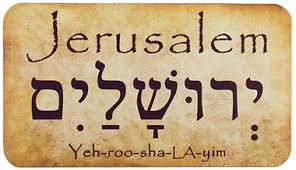
— the word “letter” is the Greek “iota,” (almost exactly like our small letter “i”, the smallest letter). The Hebrew equivalent of the smallest letter would be the “yod,” a small letter that is nothing more than an apostrophe. You can see it here as the first letter (remember the first letter in Hebrew is on the right!) of the word “Jerusalem” (“Yerushalayim”) in Hebrew:
— the word “stroke” is the Greek word “keriah,” a stroke or part of a letter. One example of a stroke is the difference between the Hebrew letter “resh” (like our “r”) on the left of this diagram, and the letter “daleth” (like our “d”) in the middle. They are very similar, aren’t they? The only difference is just a very small “stroke,” as you can see highlighted in red on the second “daleth” in the diagram. That little “stroke,” that little bitty difference between a resh and a daleth, is what Jesus is talking about here!

Now, that’s a lot of technical stuff, but HERE’S THE POINT: Jesus says not even the smallest stroke of a difference between a resh and a daleth will pass away from His word without being fulfilled! We are to have a HIGH view of His word! It is “inerrant,” it is “infallible,” it is “totally true and trustworthy” (BFM 2000) — use whatever description of perfection you will. As II Timothy 3:16 says, “All scripture is inspired (“breathed”) by God, and is profitable …”. THAT is the kind of belief and trust that followers of Jesus are to have in His word! It’s an extremely high standard!
B. The Standard of Our Practice and Teaching of the Word
But His word is not just for us to say we “believe”: we are to practice it ourselves, and teach it to others! Jesus said in :19-20, “Whoever then annuls one of the least of these commandments, and teaches others to do the same, shall be called least in the kingdom of heaven; but whoever keeps and teaches them, he shall be called great in the kingdom of heaven.”
“Annuls” here is “luo,” to “loose, destroy, break.” He says we are not to break or destroy the least of His commandments. He says if we do, we will be called least in His kingdom. (There is a “play on words here: if you break the “least/elaXISton” of the commands, you will be called “least/eLAxistos” in the Kingdom) So we are to take every commandment seriously. He says we are to “keep and teach” them:
— “KEEP” them for ourselves
— “TEACH” them to others.
So we have a double responsibility to God’s word: “keep” it for ourselves, and “teach” it to others.
We should all apply this section by asking ourselves:
— Is there any area of my life, in which I am not “keeping” God’s word? Any areas of disobedience or omission?
— In what ways in my life am I “teaching” God’s word to others?
You don’t have to be a Sunday School teacher to fufill this: teach it to your own children/grandchildren; share it with your friends; there are many ways to apply it.
So Jesus gives us a high standard regarding His word:
— We are believe every letter and stroke of it!
— And we are practice and teach every command of it!
Then He closes this section by adding this ominous warning in :20, “For I say to you that unless your righteousness surpasses that of the scribes and Pharisees, you will not enter the kingdom of heaven.”
Here is another “shocking” statement of Jesus’. Many of us do not think very highly of the scribes and Pharisees, because we have read Jesus’ criticisms of them in places like Matthew 23 where He repeatedly called them “hypocrites.” But the Jews thought of the scribes and Pharisees as the most religious people they knew! It would be like Jesus saying: “Unless your righteousness is greater than your respected pastor and staff members, you won’t get into heaven!” That would be a shocking statement!
Perhaps Jesus MEANT for it to be a shocking statement. He has just said that we have to keep every law, every letter, every stroke of His Law. And we won’t get into heaven unless we are more righteous than the Pharisees, who were the most law-keeping people they knew! So it appears that Jesus was trying to get them to see: “We can’t do this! We can’t keep all this! We can’t be better than the best men we know!” It just brings despair! But that sense of utter inadequacy is what throws us on the grace of God, isn’t it? It takes us back to the very first Beatitude of Matthew 5:3, the one Jesus opened up the Sermon on the Mount with, because it is absolutely foundational to His Kingdom: “Blessed are the poor in spirit, for THEIRS is the kingdom of Heaven.” The “poor in spirit” are those who realize just how “spiritually impoverished” and inadequate they are before God, and so they call out to Him to do for them what they can’t do for themselves. It’s the picture of the Publican in Luke, who beat and chest and said “Lord be merciful to me, the sinner.” When we are “poor in spirit” like that, and ask Jesus to save us, He DOES! THAT is the person who gets into the Kingdom.
And God DOES give that person a righteousness that “surpasses that of the scribes and Pharisees! What does II Cor. 5:21 say: “He made Him who knew no sin, to be sin on our behalf, that we might become the righteousness of God in Him.” When we are saved, God gives us the very perfect righteousness of Jesus, which is enough for us to enter His Kingdom. Before we can enter that Kingdom, we have to realize just how far short of Jesus’ standards we fall, become “poor in spirit” and ask Him to save us. But realizing the high standard that Jesus gives to His word, is the basis of it all. The reason why many people don’t think they need to be saved, is that they don’t take God’s word as seriously as the high standard Jesus sets before us here.
III. The Standard of Imitating God’s Love (:43-48)
“You have heard that it was said, ‘You shall love your neighbor and hate your enemy.’ 44 But I say to you, love your enemies and pray for those who persecute you, 45 so that you may [a]be sons of your Father who is in heaven; for He causes His sun to rise on the evil and the good, and sends rain on the righteous and the unrighteous. 46 For if you love those who love you, what reward do you have? Do not even the tax collectors do the same? 47 If you greet only your brothers, what more are you doing than others? Do not even the Gentiles do the same? 48 Therefore [b]you are to be perfect, as your heavenly Father is perfect.
“You have heard that it was said …” is a refrain Jesus repeats throughout Matthew 5. What He is referring to is the teaching of the Jewish religious leaders they’d heard all their lives. He is NOT comparing God’s Old Testament commands to His New Testament standards. (Remember He said He didn’t come to abolish the Law). Notably, He did NOT say “You have READ” (in the Law) but rather “You have HEARD” — from the scribes’ and religious leaders’ traditions.
— He said in 5:21 “You have HEARD that the ancients were told, ‘You shall not commit murder,’ and ‘whoever commits murder shall be liable to the court” (the local Jewish assembly of judgment.) The Jews had certain “standards” they used to explain all these commandments: such as that this only applied to literal murder. But Jesus took it deeper: He said it applies to speaking evil against people, even being angry with them.
— He does this with several commands, about adultery (:27), and divorce (:31), vows (:33), retaliation (:38, “eye for an eye”) —
AND NOW He comes to His final example in :43 here, where He says: “You have heard that it was said, ‘Love your neighbor and hate your enemy.’ 44 But I tell you, love your enemies …”.
First of all, notice what Jesus says in :43: “BUT I TELL YOU …” We may not appreciate the power and apparent audacity of these words! The Jewish scribes and religious leaders were always quoting past authorities: “Rabbi Hillel said thus and thus,” “Rabbi Shammai said such and such,” and so on. Even the inspired prophets of the Old Testament proclaimed: “Thus says the LORD (YHWH),” they didn’t speak on their own. But here Jesus says, “But I say to you …”! WHO IS THIS who has such authority, that He doesn’t “quote” anyone, but just says, “I say to You”?! Rightly it says at the conclusion of this great sermon in :28-29, “the crowds were amazed at his teaching, because He was teaching as one having authority, and not as their scribes.” This was Someone different than anyone they had ever heard before: He was not just a scribe, not just a teacher; this was the Son of God; God Himself who was personally setting before them the true “standard” of His word for their lives.
And look at the example He gives here: that they had heard they were to love their friends, and hate their enemies. BUT HE (The Son of God) tells them: “Love your enemies.” This was shocking “headline news” to them: LOVE your ENEMIES? Who does that?
???DISCUSSION QUESTION???
“What the biggest headline you can remember seeing on a newspaper?”
(Maybe “Dewey Defeats Truman,” or “JFK Is Assassinated,” etc. You might even print one of those to show your class)

Then make the point: had there been newspaper reporters covering Jesus’ sermon, there would have been “HEADLINES” in Palestine the next day: in BOLD PRINT! “JESUS SAYS LOVE YOUR ENEMIES! This was shocking! Everyone knows, you love your friends and hate your enemies — that’s just what you do! But Jesus sets “the standard” higher for His people, doesn’t He? He tells His followers: “Love your enemies.”
This IS a shocking command — and it goes against our grain. We can understand “love your spouse,” “love your kids,” “love your neighbor” — but “love your enemy”? BUT as incongruous as it seems to us, what Jesus shows us here is that THIS IS WHAT GOD DOES FOR US! He says in :45, “45 that you may be children of your Father in heaven. He causes his sun to rise on the evil and the good, and sends rain on the righteous and the unrighteous.” He says, God loves and blesses ALL people — think about it: He sends rain even on His enemies! He lets even them enjoy His sunshine. And remember the greater truth: that we were ALL His enemies, but as Romans 5:8 says, “But God demonstrates His own love toward us, in that while we were yet sinners, Christ died for us.” Verse 10 goes on to say, “while we were enemies we were reconciled through the death of His Son.” REMEMBER: we weren’t God’s “friends” when Jesus died for us; we were His enemies! But amazingly He still loved us, and came to die for us.
So Jesus says, this is the standard I want YOU to follow: “love your enemies.” Do for others, what I have done to save YOU!
ILLUSTRATION
“Two weeks before his death, Charles (Wesley) made a point to have prayed for those he considered his enemies – with many tears,’ (his wife) Sally recalled. Among these he named in particular Mary Freeman Shepherd, whom he blamed for luring his son Samuel into the Roman Catholic Church. ‘I beseech thee, O Lord, by thine agony and blood sweat,’ he said, ‘that she may never feel the pangs of eternal death!’” (John R. Tyson, Assist Me To Proclaim: The Life and Hymns of Charles Wesley, loc. 4110)
Wesley considered this woman who lured his son away from his church an enemy — yet at the end he prayed for her salvation.
There are people in our lives too, who have hurt us in different ways, and maybe we haven’t thought of them as our “enemy,” but they are. So when we read this passage, we need to make sure we don’t just see it as Jesus telling the Jews to love THEIR enemies, but telling US to love OURS! We need to apply this to OUR lives relationships today.
???DISCUSSION/APPLICATION QUESTION???
“What are some examples of those who could be our ‘enemies’ today?”
(Someone in your family who has hurt you, or someone on the job, or a rival employee or company; maybe “foreigners” who are seen as our country’s adversaries; or political opponents — you/your group can think of many.)
We all have people who oppose us, hurt us, make fun of us — “enemies.” And Jesus says to you and me today as surely as He said to Peter, James, and John that day: “Love YOUR enemies” — yes, even those people you are thinking of right now!
How can we do that? First by remembering that this is exactly what Jesus did for YOU! YOU wouldn’t be saved if He hadn’t loved His enemies. So now He says, this is what I want you to turn around and do for others, too. THIS IS THE STANDARD that He sets before us!
CONCLUSION:
Well, all these things are challenging, aren’t they?
— the high standard we have of being a witness to the world
— the impossible standard of obeying every stroke of His word!
— the challenging standard of loving our enemies
But this IS the standard Jesus has set before us. And He concludes in :48 by raising it even higher: “Therefore you are to be perfect, as your Heavenly Father is perfect.” Now that raises the standard to an impossible level, doesn’t it? Our goal is to be as perfect (the Greek word is “teleios,” mature, but still, the standard is to be like God!
We all fall short of that, don’t we? We DO! Like I John 1 says, if anyone says he doesn’t fall short of this, he is deceiving himself. No, everything Jesus says here is not only a standard for living, but like we mentioned earlier, it also all casts us back on that first Beatitude, “Blessed are the poor in spirit, for theirs is the Kingdom of Heaven.” Those who realize that they are “spiritual beggars,” who fall way short of God’s perfect standards — but who like beggars have asked God to save them, will enter His Kingdom. Like we mentioned, God will GIVE them the perfect righteousness that is greater than anything the Pharisees had — the perfect righteousness of Jesus Himself, which will allow us to enter His kingdom.
Now, does NOT mean that we shouldn’t try to live up to the standards Jesus gives us here. We’re to take them very seriously. These are our goals; this is the standard we’re to follow. But thank God, that because of the cross, when we fall short of these standards, there is forgiveness for us — and that’s the most important reason Jesus came!
_________________________________________________
— Remember that there is now a “PRINT” button at the end of the lesson on this blog page, that you can hit to print out the lesson in its entirety.
— If you’ll type your email address in the “Follow blog via email” blank on my blog home page, WordPress will automatically send you next week’s lesson and you won’t have to search for it.
— And if you write something in the Comments on my blog or YouTube, my commitment is to pray for your and your group and any special request you make, by name this week.
Per my licensing agreement with Lifeway:
— These weekly lessons are based on content from Explore the Bible Adult Resources. The presentation is my own and has not been reviewed by Lifeway.
— Lifeway resources are available at: goExploretheBible.com and: goexplorethebible.com/adults-training
— If you have questions about Explore the Bible resources you may send emails to explorethebible@lifeway.com


 shawnethomas
Thank you for sharing these lessons. You are providing valuable learning experiences for me as I listen to your lessons in preparation for my own lessons.
Question? Did Herod Antipas have anything to do with putting the sign on Jesus’ cross? I know John 19:19 says Pilot put it on. I recently heard a preacher say Herod Antipas “caused” the sign to be put on the cross. I can find no clarification about this issue which was brought to my attention.
Please respond.
Thank you for your service to so many!
William Austin
Hi William; I’m glad the overviews are helpful to you. I don’t believe there is any Biblical evidence that Herod Antipas had anything to do with the sign on Jesus’ cross. You are right that John 19:19 says that “Pilate also wrote an inscription,” and when the Jews argued with him about just what it said, he answered “what I have written, I have written.” So there is every indication that Pilate was responsible for it, and no indication that Herod had any part in it, although Jesus was in Herod’s “jurisdiction.” If he did have a role, the Bible doesn’t indicate it! I hope that helps; I was praying for you and your class this morning!
Good morning and thank you for your quick response to my question. I have no doubt about your answer as it goes along with everything I have always been taught and believe. I think the comment was made to stretch a relationship that did not exist except for both persons trying to out manipulate each other, and I suppose Pilate got the bitter end of it all. I think I would call what I heard as a description of the events between these two cruel politicians one of playing with Biblical hermeneutics. Pilate’s words and actions as described certainly do not indicate another person was involved in his decisions – whether they were or not – regardless of Antipas’ parental heritage and position. And it does not appear that Antipas “caused” any such behavior. I consider such attention getting comments as a misrepresentation and misleading of God’s Word very dangerous. In my years of teaching -about 30 – I have always tried to be very diligent and straight forward about what is happening in any text and what is said by whom in any lesson I present. It may take extra time and effort, but I think it’s the only way to go.
Thanks again for your assistance – may the Lord bless you and yours this Christmas – and I’m happy to hear your wife is doing better.
Also, thanks for praying for me and my class!
Thank you!