
Includes a suggested introduction to the lesson, text highlights and outline, illustrations you can share, discussion questions for your group, and spiritual life applications. A video version of this overview is available on YouTube at:
INTRODUCTION: You could begin with this illustration/quote and then a followup discussion question — or one or the other:
ILLUSTRATION
One of the highlights of Mark Twain’s trip to Europe and the Holy Land in 1867 was seeing the Cathedral in Milan, Italy. He wrote, “We were dying to see the renowned Cathedral.” He was not disappointed:
“It was a vision! —a miracle! — an anthem sung in stone, a poem wrought in marble! Howsoever you look at the great Cathedral, it is noble, it is beautiful. Wherever you stand in Milan, or within seven miles of Milan, it is visible—and when it is visible, no other object can chain your attention. Leave your eyes unfettered by your will but a single instant, and they will surely turn to seek it. It is the first thing you look for when you rise in the morning, and the last your lingering gaze rests upon at night. Surely, it must be the princeliest creation that ever brain of man conceived.”
(Mark Twain, The Innocents Abroad, pp. 144-147)
So Mark Twain was absolutely smitten by the glory of the Cathedral of Milan.
???DISCUSSION QUESTION???
“What would you say is the most ‘glorious’ thing you have personally seen in your lifetime?”
(For me it’s probably the Grand Canyon. We stopped there on way the back from the SBC in Phoenix a few years ago, and it was just magnificent! No picture I could take could convey the view you have when you’re standing there just off the rim of that canyon. It is absolutely glorious!)
All these things we can mention are glorious — but there is a greater glory than any of these! As the hymn says: “Jesus shines brighter, Jesus shines purer than all the angels heaven can boast”! In our lesson for today three of Jesus’ disciples get a glimpse of His glory on the Mount of Transfiguration, reminding us that our ultimate destination, through the gospel, is to experience that glory forever!
CONTEXT:
Continuing in our study of Matthew this quarter, last time in Matthew 16 we saw how Jesus took His disciples away to Caesarea Philippi to ask them Who they believed He was, and Peter responded with his famous confession of Christ as the Son of God. But then he immediately turned around and was rebuked by Jesus for saying that He wouldn’t have to die! Then in :24-27 Jesus spoke of the COST of discipleship, both to Himself, in dying for our sins, and to US, as we must deny the “self” that wants to direct our lives, and follow Him. He said in :27 that He will come in the glory of the Father with His angels to judge the world — and then He ends the chapter by saying something in :28 that will impact our lesson for this week: “Truly I say to you, there are some of those who are standing here who will not taste death until they see the Son of Man coming in His kingdom.” We will see in just a minute that :1 of Chapter 17 refers back to this!
OUTLINE:
I. The Glory of the Lord (:1-3)
II. The Response to the Glory (:4-8)
III. The Followup Question (:9-13)
TEXT: Matthew 17:1-13
I. The Glory of the Lord (:1-3)
:1 “Six days later Jesus *took with Him Peter and James and John his brother, and *led them up on a high mountain by themselves. 2 And He was transfigured before them; and His face shone like the sun, and His garments became as white as light. 3 And behold, Moses and Elijah appeared to them, talking with Him.”
A. Leading Up To Glory (:1)
Verse 1 says “Six days later …”. The first thing we need to address here in this section is, “Six days later from WHAT?” This is a matter of context. We just came from Chapter 16, where they were at the foot of Mt. Hermon where Jesus asked His disciples who they believed He was. So now it’s 6 days after THAT, that Jesus takes His disciples “up on a high mountain.” (NOTE: Luke 9 says “About 8 days” — notice he says “about,” not specifically, and he was likely including each part of a day as a day, like the Jews often did, so there is no “contradiction” here.) And to be clear, the scripture here does NOT specify WHICH “high mountain” it was. Two mountains have been suggested: Mt. Hermon and Mt. Tabor. (You can see these two on this map:)
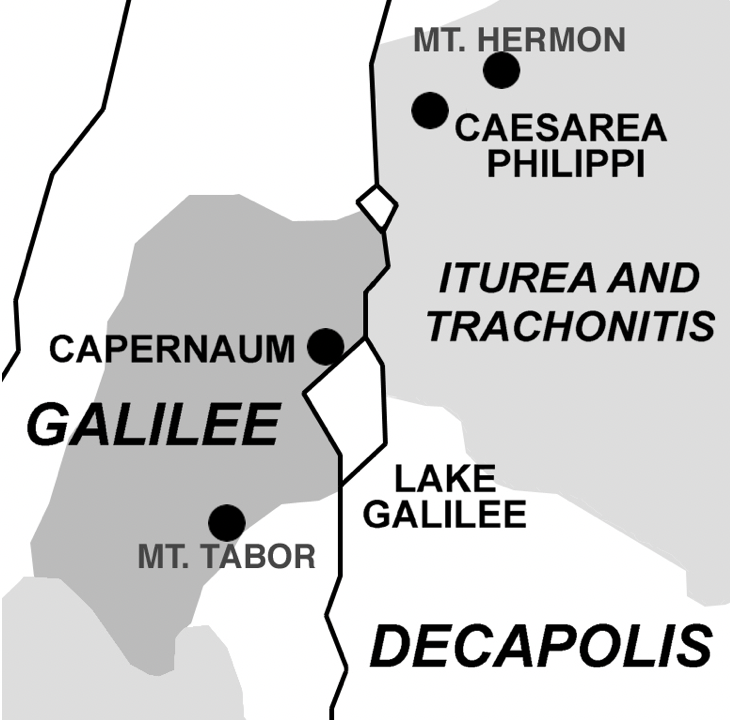
— Mt. Hermon is the last location they were in Matthew 16, by Caesarea Philippi. It would be reasonable that they were still there, perhaps spending 6 days on retreat.
— But the “traditional Mount of Transfiguration” from about 300 A.D., is Mt. Tabor, which is about 40 miles south on the mountain chain — they could have reached it in 6 days. But is Tabor the “high mountain” of :1? Mt. Hermon is about 9000 feet tall, vs. only about 1800 feet for Mt. Tabor, so “high mountain” would fit Mt. Hermon better. And there is archeological evidence that there was a fort on the top of Mt. Tabor, which would’ve precluded their meeting there. So I would lean toward Mt. Hermon — though ultimately I don’t think the particular mountain is as important as what happened there: Jesus took Peter & James & John there to see His glory!
If you want a ???DISCUSSION QUESTION??? here, you might ask: “Why do you think Jesus only took Peter, James, & John up on the mountain?”
(There’s not a definitive answer to that, but this is a pattern of Jesus. He did this THREE TIMES:
— at the raising of Jairus’ daughter (Mark 5, Luke 8),
—here in Matthew 17 at the Transfiguration,
— and then in the Garden of Gethsemane (Matthew 26 and the other gospels).
So Jesus had a few disciples that He spent more time with, pouring into them in special ways, preparing them for future service. Good disciplers still do this today.)
(Luke 9’s version also tells us that He was PRAYING when this happened, which I don’t think is insignificant. God uses prayer to transform us!)
B. The Glory of the Lord (:2)
Then :2 gets to the heart of the lesson here:
— “And He was transfigured before them” — “transfigured” is the Greek “metamorpho-o” — “meta” meaning “change,” “morphe” meaning “form.” We get our word “metamorphosis” from it. It means “change, transform.” (In a moment we’ll see how this applies to what will happen to US in the New Testament also!)
What did this “transformation” consist of? The text specifies TWO things:
— “His face shone like the sun”
— “and His garments became as white as light”
So this was no “little change”: His face shone “like the SUN”! His clothes “as white as light”!
Mark 9:3 (likely written from Peter’s perspective through Mark) describes it this way: “His garments became radiant and exceedingly white, as no launderer on earth can whiten them.”
As we will see from their response, the disciples could not even bear to look at it — He was blindingly glorious!
This is the glory of the Lord Jesus! The Greek word for “glory” is not actually used in this passage, but it WAS used in 16:27, when Jesus said He would come in His “glory” — that’s the Greek word “doxa,” which means “radiance” or “splendor.” And He said some of YOU will not die until you see it. SO there is every reason to believe this is an example of His “glory.”“Doxa” can be used of the sun or stars, but most often in scripture it is used of the glory of God: the radiance or shining forth of His being. And though this scripture doesn’t actually use the word, it does powerfully show us just what it means!
SOME DEFINITIONS OF GLORY:
— Hebrew “Shekinah Glory”: “The manifest presence of God in the world.”
— Billy Graham Center: “the visible manifestation of His attributes and His character.”
— Thomas Aquinas: “Goodness that is made apparent and manifest in its splendor.”
— Jonathan Edwards: “The shining forth of God’s perfections”
— John Piper: “The public display of the infinite beauty and worth of God”
— Ligonier Ministry (Sproul): “The outward manifestation of God’s inward perfection.”
If you will post these on your board/video screen, you can ask:
???DISCUSSION QUESTION???
“Which of these definitions resonates with you the most, and why?”
(Everyone can share theirs; I like Edwards’ “shining forth,” as all of these share the idea of glory as something that “shines”: it’s light; it’s beauty; it’s the splendor and majesty of God shining forth in such a way that we can see and experience it.)
I believe the glory of God is an oft-neglected, yet KEY CONCEPT in scripture:
— God’s glory is the desire of all mankind. It is what God created us to experience in His presence, and what our hearts all yearn for. Moses asked God: “Show me Your glory.” (Exodus 33:18) But he was able to see only a portion of it. Why?
— Because our sin has separated us from the glory of God. Romans 3:23 famously says “All have sinned and fall short of the glory of God.” What do we think that means? It means that God created us to experience His glory in a way that sin causes us to miss out on. As the great hymn says: “Though the eye of sinful man Thy glory may not see.” Sin separates us from God’s glory now and for eternity.
— That’s why Christ came: to atone for our sins, so that we might again have access to that glory. II Thessalonians 2:14 says: “It was for this that He called you through our gospel, that you may gain the glory of our Lord Jesus Christ.” Jesus didn’t just die to “take us to heaven” and see pearly gates and streets of gold. He did it to bring us back to His glory!
Revelation 21:23 promises us that in the end, we will experience His glory, the “shining forth” of His splendor: it says of the New Jerusalem: “And the city has no need of the sun or of the moon to shine on it, for the glory of God has illumined it, and its lamp is the Lamb.” Because of what Jesus has done for us, we will abide in the glory of the Lord forever, and be totally satisfied with pleasure and joy, as Psalm 16:11 says: “In Your presence is fullness of joy; in Your right hand there are pleasures forever.”
So these three apostles got just a “little foretaste” that day, of the glory of the Lord that we will all enjoy in His presence forever!
C. The Fellowship of Glory (:3)
Verse 3 says “And behold, Moses and Elijah appeared to them, talking to Him.”
So Jesus was not the only One they saw; Moses was also there, as was Elijah the prophet. WHY Moses and Elijah? Some have speculated that they represent “the Law and the Prophets.”
A.T. Robertson writes that the Jews expected Moses and Elijah to come before the end times. And both Moses and Elijah had an element of mystery in their deaths.M
Luke’s version in 9:31 tells us a bit more:
— For one, it says that these two were “appearing in glory” too &
— It adds they “were speaking of His departure which He was about to accomplish at Jerusalem.”
1. So first of all, not only was Jesus glorious, Moses and Elijah were too! Here is a doctrine that the New Testament speaks of repeatedly: that Jesus’ followers will be glorified in heaven with Him. We see this in several passages:
— I John 3:2 “We will be like Him, for we will see Him as He is.”
— Romans 8:30, “these whom He called, He also justified; and these whom He justified, He also glorified.”
— Romans 9:23 says we are “vessels of mercy which He prepared beforehand for glory”!
— I Corinthians 15:43 says our bodies are “sown in dishonor, it is raised in glory”!
— II Cor. 3:18 “But we all, with unveiled face, beholding as in a mirror the glory of the Lord, are being transformed into the same image from glory to glory”
So the New Testament repeatedly teaches that one day, we too will be glorified like Jesus is! “We will be like Him”!
I’ve mentioned this 2-3 times in the last couple of months, but this is what C.S. Lewis was talking about in his great sermon, “The Weight of Glory,” when he talks about how the “common people” we are walking with today will one day be made so glorious that if we could see them like that now, we would be tempted to worship them!
ILLUSTRATION
In Lewis’ The Great Divorce, an anonymous man takes a “bus ride” to visit heaven. At one point he sees a glorious person approaching, accompanied by angels:
“ … only partly do I remember the unbearable beauty of her face.
“Is it?…is it?” I whispered to my guide.
“Not at all,” said he. “It’s someone ye’ll never have heard of. Her name on earth was Sarah Smith and she lived at Golders Green.”
“She seems to be…well, a person of particular importance?”
“Aye. She is one of the great ones. Ye have heard that fame in this country and fame on Earth are two quite different things.”
So here was just a “normal person”: “Sarah Smith,” but made so glorious in heaven, with “unbearable beauty” and accompanied by a parade of angels! But the point is, when we receive Jesus as our Lord & Savior, it means we will join Him in glory forever — AND become glorious like He is! “We will be like Him” (I John 3:2) and share the Glory of the Lord!
2. And it’s interesting that what they saw Moses and Elijah doing, was TALKING with Jesus! Here was the glorified Jesus, and Moses and Elijah were “talking” with Him! Luke says they were talking about Jesus’ impending death, resurrection, and ascension to heaven. Moses may have talked about how He was the “prophet like me” that God promised to raise up, the Messianic promise from Deuteronomy 18:15. But what a blessed privilege — talking with Jesus in glory!
This gives us just a little glimpse of heaven will be like: Jesus will be glorified in shining splendor — and we will be too!— and we will be able to talk to Him, as well as others, like Moses and Elijah were doing here: “talking with Him,” as they would speak with anyone. THIS is what we will be able to do with Him in heaven/the New Jerusalem. Oh what we have to look forward to! It ought to consume our thoughts constantly, and encourage us on our difficult days here on earth! So this is the heart of the lesson: the glory of the Lord was manifested, giving us a “peek” into our blessed future!
II. The Response to the Glory (:4-8)
:4 “Peter said to Jesus, “Lord, it is good for us to be here; if You wish, I will make three tabernacles here, one for You, and one for Moses, and one for Elijah.” 5 While he was still speaking, a bright cloud overshadowed them, and behold, a voice out of the cloud said, “This is My beloved Son, with whom I am well-pleased; listen to Him!” 6 When the disciples heard this, they fell [c]face down to the ground and were terrified. 7 And Jesus came to them and touched them and said, “Get up, and do not be afraid.” 8 And lifting up their eyes, they saw no one except Jesus Himself alone.”
A. Peter’s Response (:4)
You probably know someone who’s never at a lack for something to say — it may not be the “right” thing, but they always say something! That’s Peter here. James & John were likely stunned by the glory of the Lord (remember John says in Revelation 1 that when he saw the resurrected Christ he fell at His feet like a dead man!) but Peter’s going to say something, even if it’s wrong! And what he said was: “Lord, it is good for us to be here; if You wish I will make three tabernacles here …” one each for Jesus, Moses, and Elijah.
Matthew Henry writes: “In this he knew not what he said. We are wrong, if we look for a heaven here upon earth.” Peter wanted to stay there, and build something. It’s like us: when we have a “mountain top experience” at camp or retreat or a mission trip, we want to stay there — but we can’t.
B. The Father’s Response (:5)
:5 :While he was still speaking, a bright cloud overshadowed them, and behold, a voice out of the cloud said, “This is My beloved Son, with whom I am well-pleased; listen to Him!”
This “bright cloud” is the shining glory of the Father, what many call “the Shekinah glory.” (From the Hebrew “shachan,” meaning to dwell: God’s glory dwelling with man.) Lots of glory in this passage!
It’s interesting that Peter was going to make a tabernacle each for Moses, Elijah, and Jesus — almost as if they were equals! But the Father clarified things powerfully: “THIS is My Beloved Son … listen to HIM!” They were not conversing as equals; Moses pointed to JESUS; Elijah and all the prophets pointed to JESUS. As we will see in a minute, our focus needs to be on “Jesus, Himself, alone”!
God the Father made it clear in various episodes in the New Testament, that Jesus is His one and only begotten Son, and is the exclusive way to Him:
— He sent the angels to announce His birth in Luke 2.
— He sent a star for the magi to follow in Matthew 2.
— At His baptism in Matthew 3 the Father proclaimed, “This is My Beloved Son.”
— Here in Matthew 17 He does it again.
— In John 12:28 Jesus prayed publicly, “Father glorify Your name,” and God’s voice thundered from heaven: “I have both glorified it and will glorify it again” — a powerful witness!
— And most emphatically, at the Resurrection, God proclaimed to the world that Jesus is His Son. Sometimes you hear of people who shrug and say things like: “Well, with all the different religions in the world, who can know which one is true?” — as if there’s just no way of knowing. BUT THERE IS! Of all the religions, gurus, prophets, so-called Messiahs who have ever walked the earth, only ONE did God raise from the dead! Romans 1:4 says He “was declared the Son of God with power by the resurrection from the dead.” The resurrection was God the Father’s ultimate way of saying: “THIS is My Beloved Son; Hear Him!” He points us all to Jesus.
C. The Disciples’ Response (:6)
“When the disciples heard this, they fell face down to the ground and were terrified.” Mark 9 also adds that they were “terrified.”
The Greek is the word we get our word “phobia” from; and adding “greatly”: greatly feared, or “terrified”! We see this kind of response over and over in scripture. Again, this is the result of our sin. We were created to experience the glory of God, but our sin causes us to shrink back from it. This is the human response to God’s glory, and men all through scripture responded this way. People who talk about experiences with God, who responded in some “flip, casual way,” just betray that they did not truly encounter Him at all.
D. Jesus’ Response (:7)
“And Jesus came to them and touched them and said, “Get up, and do not be afraid.”
Jesus wanted His disciples to get a taste of His glory; it’s why He brought them there. But He also did not want them to fear. We talked about this a couple of weeks ago: How many times Jesus tells His disciples in the New Testament, “Do not fear,” “Do not be afraid,” and so on.
There is a real balance to be kept here, in the Christian’s relationship with the Lord, between “reverence” and “fear.” We are repeatedly commanded in scripture to have a healthy “fear of the Lord,” which we might translate “reverence.” But God also does not want us as His disciples to be “terrified” of Him.
A good ???DISCUSSION QUESTION??? might be:
“How might you describe the difference between being terrified of God, and a healthy reverence for Him?” What might some examples be?
(ILLUSTRATION: Martin Luther was an example of one who was “terrified”: at offering his first Lord’s Supper. He wrote later, “I was utterly stupefied and terror stricken … who am I, that I should lift up mine eyes or raise my hands to the divine Majesty? …”. Luther almost fainted! He only finished the service because his supervisor made him. That may be a little excessive. But on the other hand we should always respect God in our prayers/attitude: don’t address Him too casually: “the Man upstairs,” etc. He is our God, our Father in Heaven. We shouldn’t be flip/casual/disrespectful. Maybe your group can share examples of disrespect for God that they’ve seen recently. I’d say more of us today err more towards the side of not respecting God enough, as opposed to being too fearful. You and your class can share your thoughts about this.)
Then :8 wraps us this section, saying that when they lifted up their eyes again (after falling to the ground, and then Jesus comforting them) “they saw no one except Jesus Himself alone.”
This phrasing is important: “Jesus Himself alone.”
Greek “auton, Iesous, monon”: “Himself, Jesus, only.”
There’s some good application for us today here: we need to keep our eyes fixed on “Jesus Himself only.”
— Not pastors and ministers, they’re only imperfect men.
— Not other people; they will eventually let you down.
— Not our circumstances (like Peter in the storm!) He looked at his surroundings instead of Jesus. If you look at them, you’ll falter.
No; keep your eyes on “Jesus Himself alone,” like Hebrews 12:2 encourages us: “Fixing our eyes on Jesus, the Author and Finisher of our faith.”
ILLUSTRATION
Lindy Boggs was a U.S. Congressman’s wife from Lousiana in the mid-1900s. She said that when she first got to Washington, it was hard to get around. But she found that the Capitol dome in Washington became “the beacon” that she could always look to, to give her direction. She said “I was always pulling over stopping, sometimes getting out of the car to look at it …”.
It’s good to have “a beacon” as Lindy Boggs called it, to guide and orient you. As believers, Matthew 17 here reminds us that JESUS is our beacon. Let’s always be “stopping, pulling over” and keeping our eyes fixed on Him!
III. The Followup Question (:9-13)
:9 “As they were coming down from the mountain, Jesus commanded them, saying, “Tell the vision to no one until the Son of Man has risen from the dead.” 10 And His disciples asked Him, “Why then do the scribes say that Elijah must come first?” 11 And He answered and said, “Elijah is coming and will restore all things; 12 but I say to you that Elijah already came, and they did not recognize him, but did to him whatever they wished. So also the Son of Man is going to suffer at their hands.” 13 Then the disciples understood that He had spoken to them about John the Baptist.”
Just like in Chapter 16, when Peter confessed that Jesus was the Christ, and He told them not to tell anyone that He was the Christ — we find the SAME kind of situation here in :9, “As they were coming down from the mountain, Jesus commanded them, saying, ‘Tell the vision to no one until the Son of Man has risen from the dead.’” It just wasn’t the right time yet. As we mentioned last week, “timing is everything.”
ILLUSTRATION:
In Doris Kearns Goodwin’s renowned chronicle of Abraham Lincoln’s cabinet, Team of Rivals, she wrote how different cabinet members of Lincoln’s would pressure him to do something faster than he seemed to — especially as regards slavery. Why didn’t he act sooner. Lincoln explained: “A man watches his pear-tree day after day, impatient for the ripening of the fruit. Let him attempt to FORCE the process, and he may spoil both fruit and tree. But let him patiently WAIT, and the ripe pear at length falls into his lap.”
Lincoln was making the point that in politics, you need to wait for the opportune moment, or you risk losing your issue. There’s a lot of things in life, that you need to wait for the right time on it. Jesus was saying that to His disicples here. It’s not time yet — “the fruit isn’t ripe” as Lincoln said. But it would be there soon, as is now! But it’s a good lesson for us today: timing can be everything. Make sure it’s the right time to bring up that issue, or to speak that word, or to make that move.
I think it’s curious, too, after Jesus had mentioned “until the Son of Man has risen from the dead,” that the disciples asked in :10 “Why then do the scribes say that Elijah must come first?” They didn’t ask Him about “rising from the dead,” but they did ask about that. I think at this time they just did not “get” the whole thing about His crucifixion and resurrection — even though He mentioned it several times.
And then it’s interesting that they asked: “Why then do the SCRIBES say that Elijah must come first?” Our pastor Sunday asked, “Why didn’t they say, ‘Why do the SCRIPTURES say that Elijah must come first?” But it just shows how reliant the Jews were on the tradition of the scribes. Even the disciples were caught up in it.
And Jesus did answer their question in :11-12. He said “Elijah IS coming and will restore all things” — in other words, YES that is a promise from the Old Testament scriptures. Malachi 4:5-6 closes the Old Testament with God’s promise: ““Behold, I am going to send you Elijah the prophet before the coming of the great and terrible day of the Lord. 6 He will restore the hearts of the fathers to their children …” etc. So Jesus says, Yes, this will happen.
BUT, He says in :12, “Elijah already came, but they didn’t recognize him, but did to him whatever they wished.” From this description His disciples recognized that He was speaking of John the Baptist, who had been killed. And He said they’d do the same to Him.
Now, in case anyone asks, when the scribes and Pharisees asked John the Baptist in John 1 if he were Elijah, he said “I am not.” Is this a contradiction? No, it isn’t. In a literal sense, John was NOT “Elijah.” That was someone else, the prophet who appeared here on the Mount of Transfiguration. But in a “spiritual sense,” if you would, according to the prophecy of Malachi, John WAS “Elijah,” coming in what Luke 1:17 describes as “the spirit and power of Elijah.” So in a literal sense he was not, but in a spiritual, prophetic sense he was. He prepared the way for Jesus the Messiah, who showed His disciples a little “glimpse of His glory” on the Mount of Transfiguration that night — and who by His grace will transform US into the likeness of His glory as well!
____________________________________________
— Remember there is a “PRINT” button at the end of the lesson on my blog, that you can hit to print out the lesson in its entirety.
— If you’ll hit “Subscribe” to this video on YouTube, they will automatically send you next week’s lesson and you won’t have to search for it each week.
— And if you write something in the Comments on my blog or YouTube, my commitment is to pray for your and your group and any special request you make, by name this week.
Per my licensing agreement with Lifeway:
— These weekly lessons are based on content from Explore the Bible Adult Resources. The presentation is my own and has not been reviewed by Lifeway.
— Lifeway resources are available at: goExploretheBible.com and: goexplorethebible.com/adults-training
— If you have questions about Explore the Bible resources you may send emails to explorethebible@lifeway.com


 shawnethomas
Thank you, Pastor Shawn, I am a retired pastor but continue to serve as the senior men’s SS class at our church here in North Alabama. I look forward each week to your insights relating to the SS lesson. Jimmy Smith
I’m so thankful to hear that, Jim! Thank you for letting me know. I’ll sure be praying for you and your men’s class this weekend!
Dear, Pastor Shawn
I want to thank you for your faithfulness to Gods word. I prayed each year to get closer to God. This year I’m trying to do the study guide each week as a teaching lesson so that I can be used as a backup Sunday School teacher in a moment’s notice , this has happened in the past.
Your commentaries on the life way’s study guide lessons are invaluable to me to complete a 12 page (average) lesson within a day or two.
My wife and I on Wednesdays also teach Kds Beach Club after school program than to church for dinner and then over to the Children’s building to teach 3rd, 4th, and 5th graders.
As a very dyslexic, hunt and peck typer , I am grateful to you. I pray that the Lord our God will Bless you and continue to give you His insight into His word. I give you my deepest and heartfelt, Thank-You,