
Includes a suggested introduction to the lesson, text outline and highlights, illustrations you can share, discussion questions for your group, and spiritual life applications you can make. A video version of this overview is available on YouTube at:
INTRODUCTION/ILLUSTRATION:
“In 1513 … Juan Ponce de Leon set out to find the Fountain of Youth. Peter Martyr, (a) trusted authority of the Renaissance, described the Fountain of Youth as “a spring of running water of such marvelous virtue that the water thereof being drunk, perhaps with some diet, makes old men young again.” According to tradition, the fountain was located on the island of Bimini, in the Bahamas. On the strength of his reputation as a soldier, nobleman, and participant in Columbus’s second voyage to the New World, Ponce de Leon received a commission from King Ferdinand to claim Bimini for Spain. In a fruitless search, Ponce de Leon explored the Bahamas and Puerto Rico, but his failure to find the Fountain of Youth did not put the myth to rest. As late as 1601, the respected Spanish historian Antonio de Herrera y Tordesillas wrote confidently about the fountain’s great efficacy in restoring youth and potency to aging men.” (Laurence Bergreen, Over the Edge of the World, pp. 75-76)
Diane de Poitiers was a beautiful mistress to the King of France in the 1500s, renowned for her beauty, but she was afraid of losing it. So she drank a daily mixture of gold chloride and diethyl ether to maintain her youth and beauty — but the mixture, far from giving her eternal life, killed her through chronic poisoning!
???DISCUSSION QUESTION???
“What are some ways that people today mistakenly seek for eternal life?”
(Answers might include trying to clone one’s self, cryonics (preserving the body through freezing in hopes that a future technology can make it last forever), false religions of all kinds, and so on.)
In today’s lesson we see a man who thought he might gain eternal life, but like these others, he was looking for it the wrong way. As we will see, there is only one way to eternal life: through our Lord Jesus Christ!
CONTEXT:
After a jump ahead to Matthew 28 and the Resurrection of Jesus and the Great Commission for Easter Sunday, we return to our regular study of the Book of Matthew this quarter. Jesus had been ministering in the area around Galilee — we’d seen Him come down from the Mt. of Transfiguration in Chapter 17, and teach on sin and forgiveness in Chapter 18 — so now Matthew 19 opens by saying in :1, “When Jesus had finished these words, He departed from Galilee and came into the region of Judea beyond the Jordan” where He ministered and taught some more there. “Judea beyond the Jordan” describes the area called “Perea,” which was “beyond” (or on the other side, from the Jews’ perspective) of the Jordan River, as you can see on this map. This is where our lesson for today unfolds.
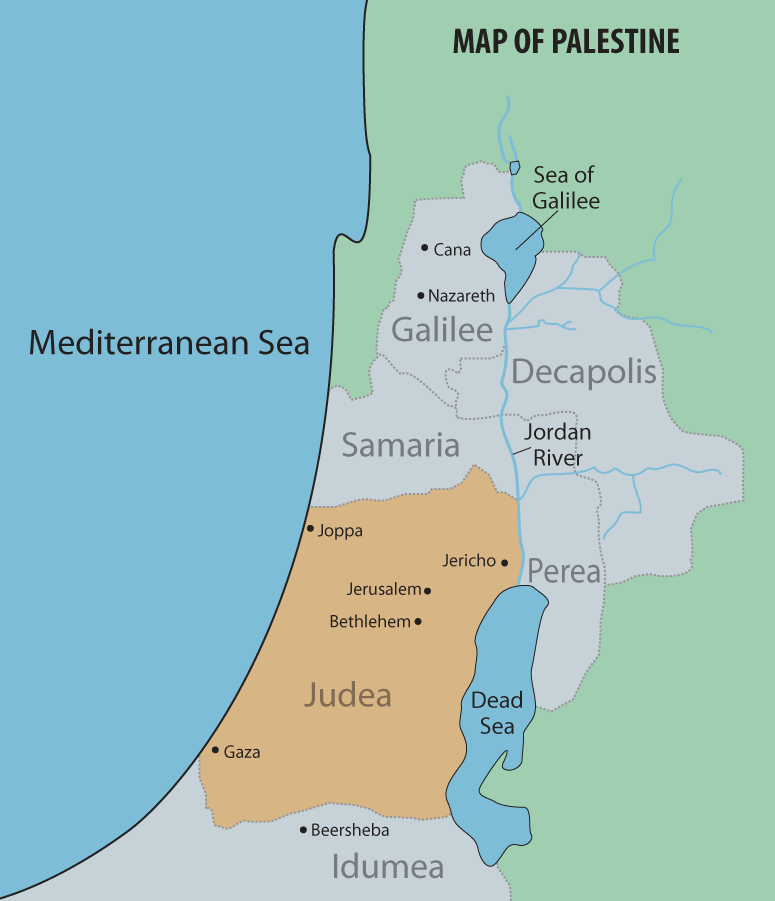
In :3-12 some Pharisees come to Jesus and ask Him about marriage and divorce, and Jesus reinforces the Biblical standard of marriage as between one man and one woman for a lifetime. Then in :13 some children were brought to Jesus, whom the disciples tried to send away — but Jesus received them and blessed them, saying don’t hinder the children from coming to Me.
This is where our “focus passage” for today picks up, in :16, with the young man we’ve come to know as “The Rich Young Ruler.”
OUTLINE:
I. The Mistaken Path to Eternal Life (:16-22)
II. The One Way to Eternal Life (:23-26)
III. The Glorious Rewards in Eternal Life (:27-30)
TEXT: Matthew 19:16-30
I. The Mistaken Path to Eternal Life (:16-22)
:16 “And someone came to Him and said, “Teacher, what good thing shall I do that I may obtain eternal life?” 17 And He said to him, “Why are you asking Me about what is good? There is only One who is good; but if you wish to enter into life, keep the commandments.” 18 Then he *said to Him, “Which ones?” And Jesus said, “You shall not commit murder; You shall not commit adultery; You shall not steal; You shall not bear false witness; 19 Honor your father and mother; and You shall love your neighbor as yourself.” 20 The young man *said to Him, “All these things I have kept; what am I still lacking?” 21 Jesus said to him, “If you wish to be complete, go and sell your possessions and give to the poor, and you will have treasure in heaven; and come, follow Me.” 22 But when the young man heard this statement, he went away grieving; for he was one who owned much property.
Verse 16 just says “someone” came to Jesus — it doesn’t say much about him there. But :20 says “the YOUNG man said to Him,” and then :22 at the end of this section says ‘he was one who owned much property.” And Luke 18:18 says it was “a RULER” who came to Jesus here. So he was “young,” he was rich, and he was “a ruler,” hence the title: “The Rich Young Ruler.”
So although the Bible doesn’t give him that title per se, it is a Biblically accurate description of who he was; it’s an apt moniker.
And what did this “Rich Young Ruler” want? He wanted what everybody wants: He wanted to know how he could have eternal life.
ILLUSTRATION
During the summer of 1956, during his presidency, Dwight D. Eisenhower first invited evangelist Billy Graham to visit him at his farm in Gettysburg. After they looked around at the battlefield in Ike’s golf cart, he brought Graham back to his house to visit his wife Mamie, who had been sick. Graham could tell that the President had something on his mind. Pacing in the den he asked him: “Billy, can you explain to me how a person can be sure when he dies he’s going to heaven?”And Graham got out his New Testament and shared the gospel with him, that it was “not by anything we can do for ourselves,” but what Jesus did for us. (The Preacher and the Presidents, Gibbs & Duffy, p. 52)
There is more to this story which I will suggest you share at the conclusion. But for now I think this makes the point: virtually everyone — president or pauper — wants to know that they have eternal life! That is what this “Rich Young Ruler” wanted to know as well.
But notice something very important here, and it comes from the language the Bible says the young man used. He asked specifically, “What GOOD THING SHALL I DO that I may obtain eternal life?” That says a lot, doesn’t it? He thought that eternal life was a matter of effort on his part; that there was something he might “do” to earn it.
Again, this is a very common belief in people today.
ILLUSTRATION
George Barna shared (Arizona Christian University, release date Aug. 4, 2020) about a survey they did, asking if people agreed with this statement: “A person who is generally good, or does enough good things for others, will earn a place in heaven.” A plurality (48%) of all Americans agreed with it, including 70% of Catholics, 46% of Pentecostals, 44% of mainline Protestants, and, almost unbelievably, 38% of self-identified “born again Christians”!
So this belief that we somehow “earn” our salvation is pervasive in our country today — just like this Rich Young Ruler thought!
Jesus answers this young man, and confronts this false belief, in several ways here:
— First, in :17, He gives what may seem to be a strange answer; He says, “Why are you asking Me about what is good; there is only One who is good …”. There’s two elements to this: 1) why is he coming to Jesus with this, since only God is good? Does he recognize that Jesus is God? He’s likely trying to make him think. But then 2) why is he asking Him about “what is good (to do)” — because only GOD is ultimately good. This man can never be good enough to earn eternal life (as He will make very clear in just a moment!) So He’s implying here, right off, that this young man is on the wrong track. He’s asking the wrong questions.
THEN He takes another tack. Conceding the young man’s question, He says: so you want to know what you can do to earn eternal life? He answers” “If you wish to enter into life, keep the Commandments.” It’s like, OK, we’ll play this game, and see how far you get with it!
The young man’s response was very telling. He asks Him, “Which ones?” Which commandments do I need to keep to earn eternal life. This is how it always is, isn’t it? Which commandments exactly do I have to keep? Which person is my “neighbor”? How many times exactly do I need to forgive (as we saw a couple of weeks ago). When we ask to limit things like this, we give ourselves away. We are not going to win this game, or like what we hear!
So Jesus answered in the second part of :18 and :19, “You shall not commit murder; You shall not commit adultery; You shall not steal; You shall not bear false witness; 19 Honor your father and mother; and You shall love your neighbor as yourself.” So He quotes from the Ten Commandments, (murder is the 6th, adultery is the 7th, stealing is the 8th, false witness in the 9th, honoring your parents is the 5th — and then He adds “love your neighbor as yourself” from Leviticus 19:18. These were all commandments which every Jew knew: the 10 Commandments and “love your neighbor as yourself.” Now, something we might keep in mind here, is a principle we often find in the New Testament, that when they quote a portion of a scripture, they use it as a kind of symbol of the whole passage or book. Hebrews does this a lot, but so do a number of NT books. When they quote the first verse of a chapter, they’re referring to the whole chapter or story, and so on. Jesus did this on the cross when He quoted Psalm 22:1. He wasn’t just saying “My God why have You forsaken Me,” He was referencing that whole Psalm which predicted His suffering on the cross. (This is called a “representative quote” or “pars pro toto” — “part for the whole.”) So in a very real way here, Jesus is telling the young man: “Keep the 10 Commandments and the Levitical Law.” All these things they all knew and grew up with.
Now, this should have stopped this young man in his tracks. Anyone who takes the 10 Commandments seriously knows that we can’t keep them! For example, we can’t even keep the first one: “Thou shalt have no other gods before Me.” Who can say they have never put anything before God? We all have! Or take even the last one: “Thou shalt not covet.” Who in the world can say they have never even WANTED something they shouldn’t have, in their heart?! It totally condemns us all. Any insightful person knows we cannot keep these Commandments. Rather they serve the purpose of showing us just how sinful we are, and how needy of a Savior!
But rather than getting that point, or showing humility, the man instead showed his ignorance and spiritual pride, saying in :20 “all these things I have kept; what am I still lacking?” Notice a couple of things here:
— It says “the YOUNG man said to Him.” This is very revealing. Only a young, proud, foolish person would have said he had kept all these!
— BUT THEN notice he added: “What am I still lacking?” Despite his assertions of righteousness, he KNEW in his heart that it was not enough! He knew that he fell short.
So Jesus finally exposed him in :21: “If you wish to be complete, go and sell your possessions and give to the poor, and you will have treasure in heaven; and come, follow Me.” He calls him to total commitment. But he’s unwilling to do it. :22 says he went away sorrowful, because he had much property. Do you see how Jesus exposed him? He’d just said he’d “kept all these” commandments. But when push came to shove, he put his money ahead of the Lord. He couldn’t keep all those commandments and get to heaven. He couldn’t even keep the first one! Jesus exposed his mistaken path to eternal life.
We need to learn the same thing today. How many so-called “Christians” are there in our churches today, who talk about faith in Jesus, but they are really trusting that they “go to church,” or “give their tithe,” or “are good people” to get into heaven? They need to have this false trust in works exposed, like Jesus did here, and realize that there is only one true way to eternal life:
II. The One Way to Eternal Life (:23-26)
23 And Jesus said to His disciples, “Truly I say to you, it is hard for a rich man to enter the kingdom of heaven. 24 Again I say to you, it is easier for a camel to go through the eye of a needle, than for a rich man to enter the kingdom of God.” 25 When the disciples heard this, they were very astonished and said, “Then who can be saved?” 26 And looking at them Jesus said to them, “With people this is impossible, but with God all things are possible.”
Many of us are used to seeing those with a lot of money get special treatment — that’s just the way of the world. (Sometimes it creeps into the church, like James 2:1+ warns us against; He says don’t do that!) But Jesus tells His disciples here that it is actually very dangerous spiritually for a person to be rich. He says “it is hard for a rich man to enter the “Kingdom of Heaven.”
And He uses a famous analogy to illustrate the point of just how hard it is for a rich person to be saved: “it is easier for a camel to go through the eye of a needle, than for a rich man to enter the Kingdom of God.” (Notice that “kingdom of heaven” and “kingdom of God” here are used as synonyms; they are the same thing.) NOW, BEWARE of something here: you may have heard (as I have) that there was a small gate in Jerusalem called “the camel’s eye” that camels had to kneel to get through, and that is what Jesus was talking about. I have read in multiple trusted commentaries that there is NO historical evidence for this. A good story, but we shouldn’t share it if it isn’t true. What it DOES mean is this: the camel was the largest animal in the area. A needle is obviously a very small opening. It is IMPOSSIBLE for a camel to get through the needle’s eye — and it is just as impossible for a rich man to save himself (and as we shall see, likewise impossible for ALL of us!)
ILLUSTRATION:
Samuel Rutherford was a great Scottish Christian pastor in the 1600s, who wrote against the overreach of the king against the church. His works were burned and he was summoned by the king and the Scottish parliament. But Rutherford was already on his death bed. “His reply to the official summons was: ‘I behoove to answer my first summons, and ere your day come, I will be where few kings and great folk come.’” This is what Jesus was talking about here: few “kings and great folk” enter heaven.
???DISCUSSION QUESTION???
“What are some reasons it could be hard for a rich person to enter the Kingdom of Heaven?”
(Answers could include:
— They have so much in this world that it’s hard to think of another world. For the poor who have nothing here, it’s easier to put their hope in another world.
— The rich are often used to people making exceptions for them and treating them with partiality; it might be easy for them to think that God will do the same. (Rom. 2:11 says He won’t!)
— Especially: they aren’t used to humbling themselves — and you absolutely MUST humble yourself to enter the Kingdom, as Matthew 5:3 makes clear, only “the poor in spirit” who admit their sin have the Kingdom. You must humble yourself and admit your need of Jesus’ salvation. A rich person is not used to having “needs,” and humbling himself. So it’s very difficult for them to be saved.)
The disciples were shocked by these words of Jesus. Like most people, they were used to seeing the rich get preferential treatment — not be excluded, as Jesus asserted here! Verse 25 says they were “very astonished” and said, “Then who CAN be saved?!” If the rich can’t be saved, who can?!
And Jesus gave that famous response: “With men this is impossible, but with God all things are possible.” Jesus made TWO IMPORTANT POINTS in this statement:
A. “With men this is impossible.” Here’s an important point: it’s not only the rich who can’t save themselves; NONE of us can! The Bible makes this very clear:
— Psalm 49:7-8, “No man can by any means redeem his brother
Or give to God a ransom for him— For the redemption of his soul is costly, And he should cease trying forever.” In other words, we can’t redeem ourselves. “With men this is impossible”!
— Jeremiah 13:23 asks if “the leopard can change his spots?” It’s a rhetorical question, the answer to which is “no!” And then it says “Then you also can do good Who are accustomed to doing evil.” In other words, it is impossible for man to change himself. “With men this is impossible.”
— Ephesians 2:12 puts it this way: “remember that you were at that time separate from Christ, excluded from the commonwealth of Israel, and strangers to the covenants of promise, having no hope and without God in the world.” “No hope” for our salvation; again, “with men this is impossible”!
Sadly, this is what the religions of the world are all about: trying to do good deeds, pray prayers, give alms, make sacrifices, hope you can do enough to make yourself right before God and be saved. But as they all find out, “with men this is impossible”!
ILLUSTRATION
When Benjamin Franklin was a young man, he launched a project of “moral perfection” in his life. He listed 12 moral categories that he would work on every day: Temperance, Justice, Sincerity, Industry, and so on. Franklin later wrote: “It was a task of more difficulty than I had imagined.” When he worked on one quality, he failed in another. He kept “score” every day on a paper, until he wore holes through his paper erasing bad marks!(And a Quaker friend told him that he needed to add a 13th quality: pride!) Franklin concluded: “I was surprised to find myself so much fuller of faults than I had imagined.” He could not reach that state of “moral perfection” that he set out on. It was impossible!
We need to realize the same too. We can’t save ourselves. “There is none righteous, not even one … there is none who does good, there is not even one,” as Romans 3:10-12 makes clear. “With men this is impossible”! (Realizing this is actually the first step to salvation!)
B. “But with God all things are possible.” Jesus says God can save us, and HE do for us what we can’t do for ourselves.
— Naaman the leper had NO ability to heal himself of his disease. But God did for him what he couldn’t do for himself, and gave him the skin of a newborn baby. “With God all things are possible.”
— The publican in Luke 18 admitted his lack of righteousness, unwilling even to lift his eyes to heaven, and said “God be merciful to me, the sinner.” Jesus said “this man went to his house justified.” God did for him what he could not do for himself. “With God all things are possible”!
— The thief on the cross is perhaps the best example. He had absolutely NO ability to save himself: his time was running out; he was dying; he had no time or ability to do anything to save himself. He was a condemned sinner and was totally hopeless. And yet Jesus did for him what he couldn’t do for himself, and saved him when he asked! “With God all things are possible”!
THIS IS SALVATION IN A NUTSHELL RIGHT HERE:
1) admit that you can’t save yourself, (“with men this is impossible”) and
2) trust Jesus to do for you what you can’t do for yourself. (“With God all things are possible.”) Jesus said in John 14:6 “I am the way, and the truth, and the life, no one comes to the Father but by Me.” He is the one way we can be saved. “Whoever will call upon the name of the Lord will be saved.” (Romans 10:13)
When you admit that you can’t save yourself, and ask Jesus to save you — you will be saved!
Share this with your class Sunday, and encourage them: Maybe you’ve been struggling with how you can be saved. Just take these two simple steps right now:
1) Admit that you can’t save yourself, and
2) Ask Jesus to save you right now.
Encourage them that if they are doing that today for the very first time, to tell you/the pastor/someone today that they have taken these steps, and from this moment forward, to believe that they are saved. We can’t wash our own hearts; we can’t cause ourselves to be born again. But God can! “With God all things are possible”! But because we can’t save ourselves, it is indeed the one way to eternal life.
III. The Glorious Rewards in Eternal Life (:27-30)
27 Then Peter said to Him, “Behold, we have left everything and followed You; what then will there be for us?” 28 And Jesus said to them, “Truly I say to you, that you who have followed Me, in the regeneration when the Son of Man will sit on His glorious throne, you also shall sit upon twelve thrones, judging the twelve tribes of Israel. 29 And everyone who has left houses or brothers or sisters or father or mother or children or farms for My name’s sake, will receive many times as much, and will inherit eternal life. 30 But many who are first will be last; and the last, first.”
So Peter asks Jesus what will there be for them who have indeed followed Him (as the Rich Young Ruler failed to do!). Jesus gave a very promising answer: “you who have followed me,” “in the regeneration” (this Greek word is “palin-genesia,” “palin” meaning “again,” “genesia” as you can see is related to “genesis,” new beginning, new “genesis” (what we often call “heaven” but is really the “new heavens and new earth” of Revelation 21:1), where we’ll live in the glory of the Lord forever.
Here is what Jesus said would happen there:
— He says you (12) will sit upon 12 thrones judging the 12 tribes of Israel. That’s great for them.
— But the rewards are not only for the apostles: Jesus said in :29, “AND EVERYONE who has left houses or brothers or sisters or father or mother or children or farms for My name’s sake will receive many times as much, AND receive eternal life.
So our rewards will include:
1) being overwhelmingly repaid for everything we may have left for Him (“many times as much” is Greek “hekaton-ta-plasion”! “Hekaton” is 100, “ta plasion” is “mold/shape.” So “100 fold.”) I don’t think we should get out our calculator and make projections of the amount; He’s saying He will reward us many times over, much more greatly, than anything we give up!
???DISCUSSION QUESTION???
“Have you/someone you know been called to leave/give up something for the Lord?”
(My sister shared with me about a Muslim student here in Oklahoma who goes to her church. He gave his life to Jesus, and as a result his whole family now hates him. In fact they have disinherited him, and he’s lost anything he might have received. He’s lost his family, and his whole earthly inheritance for Christ.)
Then share that Jesus promises to repay us “many times as much” for anything we leave/give up for Him.
ILLUSTRATION
You may have heard of the Stanford “Marshmallow Test” in the 1960s-70s, in which young children were given a marshmallow, but told if they would wait 15 minutes and not eat it now, they would be given two when he came back. They tracked the children over time, and those who were able to give up that marshmallow now, and wait for the bigger reward, had higher test scores, fewer addictions, and generally did better in life, than those who would not wait, but wanted the marshmallow now.
There’s a lot of application for Christians in that, isn’t there? In a very real sense, OUR WHOLE LIFE IS THE ULTIMATE “MARSHMALLOW TEST!” Are we willing to give up some temporary things for the Lord now, in order to have a much greater reward from Him forever? That is what Jesus is promising to those who will follow Him.
2) “and will inherit eternal life.” By the way, it’s not just the “rewards,” the real “reward” is eternal life itself. And remember Jesus said in John 17:3 “THIS is eternal life: that they may KNOW THEE, the only true God, and Jesus Christ whom Thou has sent.” So as we’ve said a few times over recent weeks, GOD HIMSELF is our great Reward, living in His presence, and reveling in His all-satisfying glory forever!
Jesus then concludes this section with a convicting word in :30, “But many who are first will be last, and the last, first.” In other words, things are going to be different in the “regeneration”/New Earth than they are now! There’s not going to be any preference for the rich, or anyone else. Each will be rewarded for their true service and devotion to the Lord.
(If you didn’t use the C.S. Lewis quote from The Great Divorce a couple of weeks ago, you might do that here. In the story a man visits heaven and sees amazing things. At one point he watches a glorious parade, with some obviously great person at the center of it:
“Is it?…is it?” I whispered to my guide.
“Not at all,” said he. “It’s someone ye’ll never have heard of. Her name on earth was Sarah Smith and she lived at Golders Green.”
“She seems to be…well, a person of particular importance?”
“Aye. She is one of the great ones. Ye have heard that fame in this country and fame on Earth are two quite different things.”
Yes, things will be different in the New Earth than they are now — thank God! So don’t worry about what reward or recognition you do/don’t get here. Just serve the Lord with all your heart, and know that He is very able to repay you much more in glory, than anything you might have had here!
But the most vital thing, Jesus would tell us, is make sure you ARE going there! Make sure that through Christ, your name is written in heaven. (Luke 10:20) That’s the best thing you can share with your group this week.
CONCLUSION/ILLUSTRATION:
Not long before his death in 1969, former President Dwight Eisenhower called Billy Graham to visit him at Walter Reed Army Hospital. When he arrived, Ike told him: “Billy, you’ve told me how I can be sure my sins are forgiven and that I’m going to heaven. Would you tell me again?” And this time he added, “Nothing else matters now.” Graham did tell him how he could be saved through Jesus’ death on the cross, and Eisenhower said, “Thank you; I’m ready.” (Billy Graham, Just As I Am.)
Like the Rich Young Ruler — and like virtually all mankind — Dwight Eisenhower wanted to know how he could be sure that he had eternal life. Thankfully, we CAN know. But we need to make absolutely sure that we are not trusting our own good works or efforts, only Jesus’ death on the cross for us. Heaven is indeed “impossible” through our own efforts, but through Christ “all things ARE possible, and by putting our faith in Him, we can really know for sure that we will live forever with Him in glory! Encourage your class members to make sure that like the former president, they too are “ready”!
___________________________________________
— Remember there is now a “print” button at the end of this blog that you can hit to print out the lesson in its entirety.
— If you’ll type your email address in the “Follow blog via email” blank on my blog home page, WordPress will automatically send you next week’s lesson and you won’t have to search for it each time.
— And if you write something in the Comments on my blog or YouTube, my commitment is to pray for your and your group and any special request you make, by name this week.
Per my licensing agreement with Lifeway:
— These weekly lessons are based on content from Explore the Bible Adult Resources. The presentation is my own and has not been reviewed by Lifeway.
— Lifeway resources are available at: goExploretheBible.com and: goexplorethebible.com/adults-training
— If you have questions about Explore the Bible resources you may send emails to explorethebible@lifeway.com


In discussing the camel and the needle, A. T. Robertson in his “Word Pictures in N. T.” mentions in Luke 18:25 the word for needle is a surgical needle – rather than the common word for sewing needle.
Thanks for the weekly discussions of the lessons. I especially enjoy the quotes cited.
Howard Kitchens, Anniston AL
That’s good Howard! I often check Word Pictures but did not look at it this week. Thank you for adding that. I hope several others were able to see your comment and use it in their lesson! I was praying for y’all Sunday!