
In 1946, a Bedouin shepherd was out looking for a lost goat, and the shepherd (or technically “goatherd”) was climbing up a steep hillside looking for it. He came across a little cave, which was dark, so he threw a rock inside. He heard a crash, and so he ran away — and later came back with a friend. They looked inside the cave and found hundreds of scrolls in clay jars, hidden from mankind and protected from the weather for almost 2000 years. What those shepherds discovered that day, we call the “Dead Sea Scrolls” one of the greatest archeological discoveries ever. Perhaps the most spectacular find of the Dead Sea Scrolls was a full copy of the Old Testament Book of Isaiah; all 66 chapters, over 1000 years older than any previous copy we had of the book.
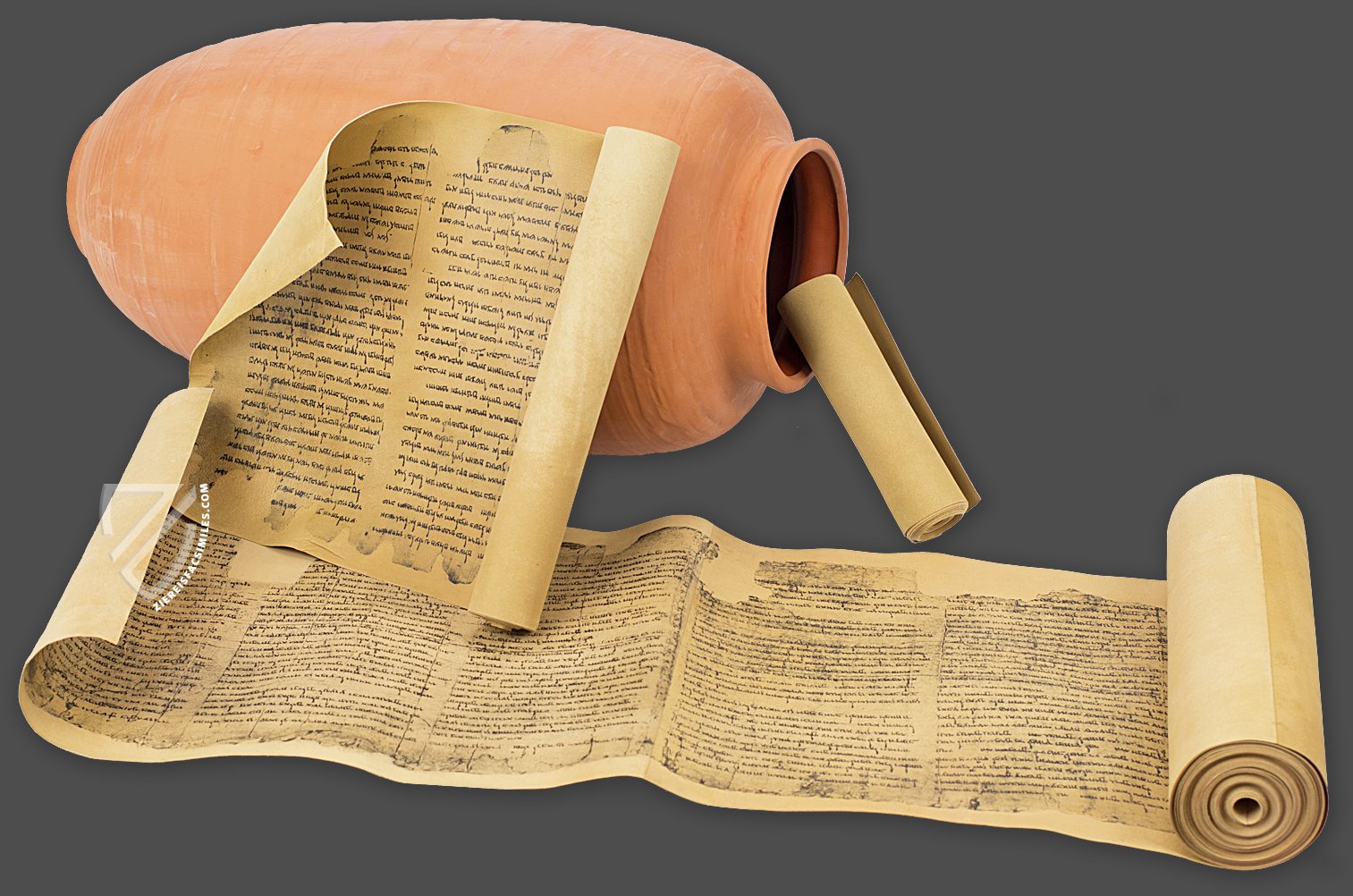
That find was indeed a treasure. But even greater than the archeological treasure of Isaiah is the spiritual treasure contained in the book — and none greater than its 53rd Chapter, one of the most powerful chapters found anywhere in the word of God. Today we are going to begin a study of this chapter with just a word of introduction and an overview, and then next Sunday we’ll start going through Isaiah 53 verse by verse.
THE CONTEXT OF ISAIAH 53
When you read anything, you should always take into account the context in which it was written. This is especially true of scripture. Some of the biggest mistakes people make in theology and practice come from taking scriptures out of context. So what then is the context of Isaiah 53?
A. Its Context in Scripture
The Bible tells us in Genesis that God created man and placed him in the Garden of Eden, to have a relationship with Him. God gave man rules to live by – including that they were not to eat from the Tree of the Knowledge of Good and Evil – but they chose to eat that fruit, and disobey God, which was the first sin. That sin separated them from the fellowship with God He had created them for, and it brought sin into the world, and into each of our lives as well. But right there in Genesis, God promised that He would do something out it. In Genesis 3:15, God told the serpent that there was coming a seed of man whom the serpent would “bruise” on his heel — in other words the serpent would inflict some suffering on this Man — but God said this Seed would CRUSH the serpent’s head. Theologians refer to Genesis 3:15 as the “protevangelium” — the “first gospel” – God’s first promise that He would sent a Messiah who would crush the power of the devil, and bring salvation that would restore fellowship with God back to mankind. All the books of the Old Testament after Genesis point to how God will send this Messiah to restore our relationship with Him. The Book of Isaiah is one of the most important of those books. Many of its chapters talk about the Messiah who was coming, and how blessed the future would be when we are reconciled with God.
B. Its Context in the Book of Isaiah
The book of Isaiah opens in Chapter 1 with a message about how God’s people had continued to sin against Him, but He says to them, “Come, let us reason together, says the Lord … though your sins be red as scarlet, they shall be as white as snow.” God said He would give them an opportunity to turn from their sins and turn back to Him. But HOW would this happen?
In the second part of Isaiah, God gives us the answer. Beginning in chapter 40, the Book of Isaiah turns, from being more about history, and of judgment on Israel for their sins, to being about His promises for the future. Chapter 40 begins, “Comfort, comfort My people says your God” and God begins to share His plans for salvation for His people. A few chapters later then, we see how He will do this: through a “Servant” He will send to deliver them. In Isaiah Chapters 42-53 there are 4 of what scholars call “Servant Songs,” describing the Servant, the Messiah, God was going to send. These 4 “Servant Songs” culminate in Isaiah 53, which describes how God will deal with our sins once for all by putting them on His Messiah. In a very real sense, Isaiah 53 is the climactic point, the “Mt. Everest” if you would, of the whole Old Testament, with its amazing description of the Messiah who would save us from our sins.
C. The New Testament Context
Many people mistakenly think of the Old Testament as almost irrelevant for us as New Testament Christians today — but they are greatly mistaken. You really can’t fully understand the New Testament without understanding its Old Testament foundations. A few years ago, Michael Shepherd, an Old Testament/Hebrew professor at Louisiana (Baptist) College said: “When I pick up Paul (in the New Testament) it is dripping with the Hebrew Bible.” The New Testament is FULL of the Old Testament. Many of us don’t realize to what extent that is true. I know in my New American Standard Bible, quotations from the Old Testament are printed in all capital letters in the text. Some of your Bibles may do the same thing — or have something similar to it. If so, you can see that the New Testament abounds with quotations from the Old Testament.
This is especially true regarding Isaiah 53. Much of our New Testament understanding of the person and work of Jesus comes from Isaiah 53. Isaiah 53 is quoted extensively in the New Testament — in fact, the 12 verses of Isaiah 53 are quoted in the New Testament more often than any other Old Testament chapter!
In Luke 24:27 it says that when Jesus rose from the dead, He appeared to His disciples, and “Beginning with Moses & the prophets, He explained to them what was said in all the scriptures concerning Himself.” One scholar (John R.W. Stott) once said that he would have loved to have been there with Jesus’ disciples, and heard what Jesus taught about Himself in those Old Testament scriptures. When I read that, I thought, “But we CAN know what He taught them: because they passed it on down to us through what they wrote in the New Testament!” And as you read the New Testament, it becomes very obvious that one of the Old Testament scriptures Jesus used to teach His disciples that day was Isaiah 53 — because at least EIGHT of Isaiah 53’s 12 verses are quoted by the writers of the New Testament! Every major writer in the New Testament quotes Isaiah 53: It’s quoted in Matthew, Mark, Luke, John, Acts, Romans & I Peter. Under the inspiration of the Holy Spirit, the apostles passed down to us in the New Testament what Jesus taught them about Himself from Isaiah 53. So we CAN know what Jesus taught them that day in Luke 24; we read it all through the New Testament:
— When Matthew wrote in 8:17 that “He Himself took our infirmities and carried away our diseases,” he was quoting Isaiah 53!
— When Mark 15:38 and Luke 22:37 say “He was numbered with the transgressors” because He was crucified with criminals, they were quoting Isaiah 53!
— When John 12:38 says that despite all the signs Jesus had performed, they still did not believe Him, it says, “Who has believed our report, and to whom has the arm of the Lord been revealed?”, he was quoting the first verse of Isaiah 53!
— The Apostle Paul quotes Isaiah 53 in Romans 10.
— In the Book of Acts, when the Ethiopian Treasurer is reading in his chariot, and Philip comes up and asks him if he understood what he was reading about this One who was led like a lamb to slaughter, the chapter the Ethiopian was reading was Isaiah 53!
— When Peter wrote in I Peter 2:24 “He Himself bore our sins in His body on the cross … for by His stripes we were healed”, he was quoting Isaiah 53!
Undoubtedly Jesus taught Isaiah 53 to His disciples that day. So the book of Isaiah — especially Isaiah 53 — is the foundation for the understanding we have today of the Person and work of Jesus in the New Testament.
Isaiah 53 has a vital place in the word of God: it is the culmination of God’s promise in the Old Testament to send a Messiah to save us from our sins, and it helps us understand who the Messiah was, once He came. So it is in all of these contexts — in the Bible, in Isaiah, and in the New Testament — that we need to see everything that we read in Isaiah 53.
THE CONTENT OF ISAIAH 53
A. Its Astonishing Portrait of Jesus as Suffering Servant.
One of the most outstanding features of Isaiah 53 is that it was written by a prophet who lived 700 years before Jesus was ever born — and yet it gives us one of the most vivid pictures of Him found anywhere:
— :9 describes His sinlessness: “He had done no violence, nor was there any deceit found in His mouth”
— :7 tells how He would go to His fate: “like a sheep that is silent before His shearers” — as Jesus showed when He did not respond to Pilate and those who questioned Him at His trial.
— :5 speaks of His “scourging” — which literally took place after His trial, and before He was crucified.
— :5 also relates how He would be “pierced through” for our transgressions: how His body would literally be pierced by the nails in His hands and feet, and by the spear thrust into His side as He died for us on the cross.
— In several places this chapter describes how Jesus would suffer, not for His own sins, but for the sins of others. It says: “OUR griefs He Himself bore … the iniquity of US to fall on Him… interceded for the transgressors.” This predicts what theologians call the “Substitutionary Atonement” of Jesus — that He died FOR US — which we will speak much of the next few weeks. This is taught repeatedly in Isaiah 53, as we will see.
— :9 says “His grave was assigned to be with wicked men” He would be put to death as a criminal; “yet with a rich man in His death” – He would end up being placed in Joseph of Arimathea’s tomb (Joseph was a well-off member of the Sanhedrin). So this verse, puzzling to anyone who read it before the time of Christ, makes sense when you see how it was fulfilled in His death & burial.
— :12 describes that although He would suffer greatly, in the end He would be victorious: it says He will have “a portion with the great, and divide the booty with the strong”. This Suffering Servant would become the Glorious King!
From the circumstances of His trial, to the sufferings of His death, to the tomb where He would be buried, and to His ultimate glorious victory, Isaiah 53 would have been an incredibly accurate portrait of Jesus whenever it had been written — but it is even more incredible of an account when one realizes that it was written by Isaiah the prophet 700 years before Jesus was ever born!
A couple of years ago I shared the story of a man who had been studying Isaiah 53. He was so captivated by it, and he wanted others to know just how amazing it was. So he printed a copy of Isaiah 53 — without any reference on the page as to where it came from, he just printed the words only — and he took it to his office and had people read it. He asked them, “Who do you think this is talking about?” He said that every single person he showed it to said: “This is talking about Jesus Christ.” With no indications whatsoever about who this was, or even that it came from the Bible, every single person who read it, said, “this is talking about Jesus” — everyone recognizes Jesus in it — and it was written 700 years before He was ever born!
But that’s not even the best part! THEN the man showed this unmarked copy of Isaiah 53 to a Jewish co-worker of his, and he asked him, “Who do you think this is speaking about?” His Jewish co-worker read it and put the paper down and said, “This is obviously from your New Testament, and it is speaking about Jesus Christ.” The man said, “NO! It is NOT from my New Testament; it is from YOUR Old Testament, and even you recognize that it is prophesying about Jesus!”
How striking is is, that Isaiah 53, written 700 years before the time of Christ, could paint such a universally recognizable portrait of Him, that even a Jewish unbeliever, living 2000 years after Christ walked the earth, could recognize it!
B. Its Message In A Nutshell.
There are three simple points in Isaiah 53 that summarize its message to us in a nutshell:
1. We have all sinned and need a Savior.
Isaiah 53 makes very clear is that we have all sinned:
:5 refers to “our transgressions … our iniquities”
:6 says “All we like sheep have gone astray; each of us has turned to his own way.”
:8 talks about “the transgression of My people”
:11 refers to “their iniquities”
:12 talks about “the sin of many … the transgressors.”
Over and over Isaiah 53 makes it SO clear that we have all sinned against a holy God. It’s just like Romans 3 says, “There is none righteous, there is not even one. There is none who understands, there is none who seeks for God; all have turned aside, together they have become useless. There is none who does good; there is not even one … For all have sinned and fall short of the glory of God.” (Romans 3:10-12, 23)
All of us have sinned, the Bible says, and one of us can save ourselves by our own good works. NONE of us. Let’s say we were all to line up on the shore to try to swim across the ocean, who among us would make it? None! Now, some of us might make it further than others: some, who could not even swim, would almost immediately drown. Others, who could swim a little, might go out a few yards, and then they would also drown. Perhaps someone is a triathlete, they can swim a mile, or two miles, or ten, or maybe with superhuman strength, make it 100 miles — but even then, they too would eventually tire, and drown. Some might make it farther than others, but the point is, we would all meet the same end; we would all eventually fall short.
That’s how it is with salvation too. All of us have sinned and fall short. Yes, some of us may be a little more righteous than others, or have a few more good deeds than others — but that’s not going to save us; because in the end we all fall short of the righteousness that is required to enter heaven,” “All have sinned and fall short of the glory of God.” NONE of us would have any hope, unless God did something for us that we could not do for ourselves. Isaiah 53 makes that very clear.
2. The Messiah came as a Suffering Servant to bear our sins. It says:
— :4 “our griefs He Himself bore: our sorrows He carried”
— :5 “pierced through for our transgressions; crushed for our iniquities; chastening for our well-being fell on Him; by His scourging we are healed“
— :6 “The Lord has caused the iniquity of us all to fall on Him”
— :8 “He was cut off out of the land of the living for the transgression of My people, to whom the stroke was due.”
— :10 “He would render Himself as a guilt offering.”
— :11 “My Servant will justify the many, as He will bear their iniquities”
— :12 “He Himself bore the sin of many, and interceded for the transgressors”
Over and over Isaiah 53 shows us how the Messiah would take our sins upon Himself in His suffering on the cross, just as I Peter 2:24 says, “He Himself bore our sins in His body on the cross.”
This is the “Substitutionary Atonement” of Jesus we spoke of a moment ago, and this is repeatedly emphasized in Isaiah 53. This is important to remember, because some people try to minimize the death of Jesus as being just a symbolic act that showed how much God loves, or how He tried to sympathize with us by suffering along with us, and so on. But the Bible specifically teaches that Jesus actually accomplished something when He died on the cross. Isaiah 53:10 says “He rendered Himself as a guilt offering.” Verse 6 says our iniquity fell upon Him. As I Peter 2:24 says, He paid for our sins in His body on the cross. On the cross He cried “It is finished” – in Greek that is “tetelestai,” a business word that means “paid in full”. If you have ever paid off a car, or a home, or any kind of loan, you probably received a form that was stamped “paid in full´´ across it – indicating that the debt was cancelled, and the price had been paid in full. THAT is what Isaiah 53 says Jesus did for you on the cross: He paid your debt in full with His death on the cross. This is the best news in all the world: You don’t have to try to pay for your sins; Christianity is NOT about “trying to be as good as you can to get to heaven.” No! Jesus paid for your sins in full on the cross! THAT is what Christianity is: that He took OUR sins, in HIS body; the “Substitutionary Atonement.” And we will see this substitutionary aspect of Jesus’ death on the cross repeatedly as we study through Isaiah 53. It is one of its most important messages.
3. The Universal and Personal nature of this message:
Verse 6 says: “all we like sheep have gone astray.” “ALL” means this is universal; that ALL of us have done this; that YOU and I have gone astray too! Like Romans 3:23 says, ”ALL have sinned and fall short of the glory of God”
And then it says: “The Lord has caused the iniquity of us ALL to fall on Him” — again, “ALL” means that He bore YOUR sin, and my sin; ALL of our sins! We’ve all gone astray, but the same “all” who went astray, “all” had their sins borne by Jesus on the cross. This shows us that this chapter, and what Jesus did in it, is for everyone. It is universal in scope — it is for all for all of us. And it is personal: the message of Isaiah 53 begs for an answer. it begins in verse 1: “Who has believed our message?” It’s just asking for a personal response: for you to say, “I believe it!” It calls for a personal response.
When that great Isaiah scroll was found by the Bedouin shepherds in 1947, it was eventually taken to the Israel Museum in Jerusalem, where it is housed in a special wing of the Museum, called “The Shrine of the Book”. They have many of the Dead Sea Scrolls on display there, including that full copy of Isaiah scroll, all unrolled in a big round display case.

There that great scroll sits, laid open for all to see — and Hebrew is the official language of Israel; they can read it — including its incomparable picture of the Messiah in Chapter 53. Many believe that this scroll of Isaiah, and this 53rd chapter, will be used by God as part of a great end-times revival in Israel, and that many Jews will enter the Kingdom of God, as He uses His prophecy of Jesus there to reveal their Messiah to them. I pray for that regularly; I hope that you will join me in that prayer.
But understand this today: Isaiah is not just a book intended to save Israel in the last days; it is a book intended to save YOU today! Isaiah 53 is not just Israel’s chapter; Isaiah 53 is YOUR chapter.
Billy Graham’s wife Ruth had a great testimony about Isaiah 53. She wrote that as a 13-year-old she had a “crisis of faith.” She said, “I knew that God had sent Jesus to die for mankind’s sins, but somehow I did not feel included. There were so many people in the world and I was only one, and, let’s face it, not a very significant one at that. I prayed for forgiveness and felt nothing. I wasn’t even sure He was listening. Finally, in desperation, I went to my ever-practical sister, Rosa, and asked her advice.
“I don’t know what to tell you to do,” she replied matter-of-factly, “unless you take some verse and put your own name in. See if that helps.”
So I picked up my Bible and turned to Isaiah 53, one of my favorite chapters. I did just what she suggested. I read, “He was wounded for [Ruth’s] transgressions, he was bruised for [Ruth’s] iniquities: the chastisement of [Ruth’s] peace was upon him; and with his stripes [Ruth is] healed” (Isaiah 53:5, KJV). She wrote: “I knew then that I was included.”
Ruth Graham finally nailed down her salvation when she put HER NAME in Isaiah 53, and made it personal. If you’ve never done it before, PUT YOUR NAME in this great chapter today. Make it yours. Say: “Like sheep I too have gone astray,” but “Jesus was wounded for MY transgressions.” Make it personal. I can say confidently, if you will do that today, you will be saved! God didn’t just give this chapter for “the world,” or for “Israel;” he gave it for YOU. Respond to it personally today; put YOUR name in it today, and you will be saved!
Over the next 10 weeks we plan to explore Isaiah 53 verse by verse, and discover together some of the greatest treasures of the word of God. But DON’T wait for next week! Respond to the message today! Verse 1 says: “Who has believed our message?”, why don’t you say today, “I DO! I believe that Jesus was a “suffering Servant” who died for MY sins; and I am committing my life to Him today as my Glorious King!”


 shawnethomas