
An overview for Sunday school teachers and Bible study leaders, of Lifeway’s “Explore the Bible” lesson of I Peter 1:13-25, for Sunday, March 9, 2025, with the title, “Our Mandate.” A video version of this overview is available on YouTube at:
INTRO: In 1976 Christian philosopher Francis Schaeffer wrote a book entitled, How Should We Then Live? It has since become a Christian classic, teaching the difference that a Christian worldview makes on a society. Chuck Colson wrote of it: “This is a modern-day classic, one of Schaeffer’s books that awakened me to how biblical truth affects all of life.”
“How should we then live?”
(You might have this title printed and posted or put up on your video screen. You might also consider making it an alternative title for today’s lesson.)

That’s a good question that every Christian, bought by the blood of Jesus, should ask ourselves — “How should we then live, because of what Jesus has done for me?” — and it’s the question that our text for today in I Peter 1 answers! It tells us how we should live now, in light of our salvation.
CONTEXT:
This is our second lesson in our new study of the Book of I Peter. Last time we saw how God is guarding an imperishable inheritance for us in heaven — “us” being those who are genuinely born again through faith in Jesus Christ.
This week’s focus passage begins with :13, and the word “Therefore.” Whenever a segment begins with “therefore,” it’s pointing back to what just came before. So here he’s saying, “Therefore …” — because of this salvation you have by being born again, and the inheritance you have waiting for you in heaven — “Therefore …” this is what you are to do. This is how you should then live. That is what this week’s lesson is about.
OUTLINE:
I. “Therefore” Living (:13-16)
II. Blood-Bought Living (:17-21)
III. Love-Based Living (:22)
IV. Word-Based Living (:22-25)
(Note: they’re all about “living”: how we should LIVE because of our salvation!)
TEXT: I Peter 1:13-25
I. “Therefore Living” (:13-16)
13 “Therefore, [a]prepare your minds for action, [b]keep sober in spirit, fix your hope completely on the grace [c]to be brought to you at the revelation of Jesus Christ. 14 As [d]obedient children, do not [e]be conformed to the former lusts which were yours in your ignorance, 15 but [f]like the Holy One who called you, [g]be holy yourselves also in all your behavior; 16 because it is written, “You shall be holy, for I am holy.”
As we mentioned in the introduction, this passage opens in :13 with “Therefore,” pointing back to our salvation and the inheritance we have in heaven. So now beginning in :13 it says “Therefore,” this is how we are to live. We might call it “therefore living”!
It reminds me of Romans 12:1, which famously begins, “I urge you, therefore, brethren, by the mercies of God …”. That passage has a famous “Therefore.” And like I Peter here, it similarly points back to a description of our salvation. Romans chapters 1-11 are the most detailed description of the doctrine of salvation anywhere in the word of God. And so now Chapter 12 begins, “I urge you THEREFORE brethren …”; in other words, BECAUSE of this great salvation taught in Chapters 1-12, this is how we are to live. And it is no surprise that Romans 12+ contains some of the most practical verses in the whole New Testament. It is “therefore living.”
Now, you might point out this importance of “therefore living”: “Therefore living” contains a lot of instruction, on how we are to live. Many religions have a lot of such commands. But the difference in Christianity is that the Christian disciple does not obey these commands in the hope of GAINING salvation, but he is to do them BECAUSE he has been given salvation by grace through faith. It is not “work for” living (keeping commands in the hope of eventually being saved); it is “therefore” living: keeping the commands BECAUSE we have been saved. Make sure your group understands this crucial difference! It’s not “work for;” it’s “therefore”!
SO: what does “therefore” living involve? We see several things taught in these first verses:
— “prepare your minds for action”: This is literally: “gird up the loins of your mind.” This comes from the very picturesque Old Testament expression, “gird up your loins.” The picture is of a person who is wearing the big, flowing robes that were common in the Middle East. But if you had to do something active, like do battle, or serve in some way, your legs might get tangled in the ends of your robe. So before they began to be active, they would take the ends of their robe from around their legs and tuck them into their belt, or tie them off in some way, so they could run unencumbered. That was “girding up their loins.” You might consider using one of the following pictures in your class:
This first one shows a man in the process of “girding up his loins” or tucking in his robe:
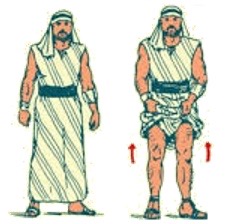
This second one is an ancient artwork, depicting someone serving with their loins girded:

So that’s what it MEANS to gird up your loins. But the real point is, how do we APPLY this? To “gird up your loins” means “get ready for action.” When you told someone to “gird up your loins,” they knew they were getting ready to do something active; to serve in some way.
So here in I Peter, God tells His people, literally, “Gird up the loins of your MIND.” In other words, get your mind ready to DO something! I think we’ve all been in the frame of mind, where we felt like we were just kind of “cruising along,” not really doing anything, whereas in other times in our lives we have said: “Ok, I need to get going.” It’s time for action. That’s what God is telling His people here: don’t just sit there on “cruise control,” get your mind ready to DO what I’ve called you to do!
This is a good word for many churches: “gird up the loins of your minds;” get ready to DO something. Too many Christians, in too many churches, are just in “cruise control.” We’re just “cruising” from one week to the next, but we’re not really doing anything significant for His kingdom. To all these churches, and to all of these individual Christians, God says “Gird up the loins of your minds! Get in an active mindset. Get ready to DO SOMETHING for My kingdom.
??? You might DISCUSS with your group: ??? What are some areas in our church/our community/in missions where God might be calling ME/US to “gird up our minds” and get ready to DO something???
(This is an important point of application. Try to lead your group to consider specific ways that God may be calling them personally — or your class, or your church — from inaction to specific action in serving Him. What’s God calling us to do? Seek to lead someone to Him? Go on a mission trip? Actively participate in a church emphasis your pastor is leading you in? Support some kingdom work our church partners with, like a Pregnancy Help Center, or Baptist Student Ministry? Encourage them from this scripture to “gird up their minds for action”: to get in the frame of mind to be ready to DO something God is calling them to do! This could be one of the important things that comes out of this lesson.)
— “keep sober in spirit” is literally just one word in Greek, “naphontes,” and it literally means to be free from intoxicants. But it was often used of being “clear minded.” Don’t be “groggy” and “fuzzy minded;” know who you are and what you’re supposed to be about as God’s child.
— “fix your hope completely on the grace to be brought to you at the revelation of Jesus Christ.” In other words, don’t live for this world. Everything in this world is going to be burned up. Everything. So don’t live for those things. Your ultimate home is not here; it is is heaven. So live for heaven. Make your decisions for heaven. Store up your treasures in heaven — where, if you remember from last week, our inheritance there is “imperishable, undefiled, will not fade away, kept” by God there for us.
— :14-15 don’t be conformed to the former lusts which were yours in your ignorance”: lost people live for whatever feels good; whatever they feel like doing. You don’t do that as God’s child.
Rather: “but like the Holy One who called you, be holy yourselves also in all your behavior, for it is written, ‘You shall be holy, for I am holy.’”
DOES THIS SOUND FAMILIAR? THIS IS RIGHT OUT OF LEVITICUS, the book we just finished! Remember how we saw the numerous times in Leviticus that God told Israel, “You shall be holy, for I am holy”? We saw there that Israel’s holiness stemmed out of the Atonement: because of the Atonement, they were to be holy. Now we see the same thing in the New Testament as well: because of the Atonement of Jesus, we are to be holy people. And again, make the point: we are NOT being holy because we are TRYING to be saved; we are to be holy BECAUSE we are saved. There is a huge difference!
But we ARE to be holy. Many so-called Christians today are missing this. They just want to supposedly receive the grace of God in Christ and continue to live however they desire. This is NOT Biblical Christianity. Biblical Christianity calls God’s people to be holy once they have received God’s grace in Christ, and our whole Christian life after the time of our salvation should be a pursuit of holiness. We are to be holy, for the God who saved us is holy, and we want to be as close to Him as we possibly can.
All the things we just talked about describe “Therefore Living”: the way that we should live as Christians, because we have been born again and have the inheritance in heaven that the first part of this chapter talked about.
II. Blood-Bought Living (:17-20)
17 If you address as Father the One who impartially judges according to each one’s work, conduct yourselves in fear during the time of your stay on earth; 18 knowing that you were not [h]redeemed with perishable things like silver or gold from your futile way of life inherited from your forefathers, 19 but with precious blood, as of a lamb unblemished and spotless, the blood of Christ. 20 For He was foreknown before the foundation of the world, but has appeared [i]in these last times for the sake of you 21 who through Him are believers in God, who raised Him from the dead and gave Him glory, so that your faith and hope are in God.
Verse 17 begins this section saying that if we call God “Father,” then we should “conduct ourselves in fear.” This is the general Greek word for fear, “phobos,” but here in context is doesn’t mean that we are to walk around fearing what might happen to us any second. Rather it explains that this “fear” is a realization that God is judging everything we do here on earth. That does, or should, bring a certain sober perspective to our lives. What we do is important: God is judging us!
Someone wrote on X (Twitter) last Sunday of the pope, who was on his death bed: “Pope Francis will soon wake up in eternal judgement. All his efforts. All his prayers …”.
But that’s true not only for Pope Francis; it’s true for all of us. It should be a sobering thought for us. This is just what II Corinthians 5:10 says: “For we must all appear before the judgment seat of Christ, so that each one may be recompensed for his deeds in the body, according to what he has done, whether good or bad.” Because of this, we should live with a “sober fear.” It should cause us to think. It should cause us to evaluate everything we think, say, and do. We are personally accountable to God! We should live like people who believe that!
Another illustration you can use here:
(President Andrew Jackson said to a group of men aboard a boat in New York harbor on day in 1833: “When the people, in their sovereign pleasure, elected me President of the United States, (my wife) said to me, “Don’t let your popularity turn your mind away from the duty you owe to God. Before Him we are all alike sinners, and to Him we must all alike give account. All these things will pass away, and you and I, and all of us, must stand before God.” I have never forgotten it, Doctor, and I never shall.’ Jackson wept at the memory.” (Jon Meacham, American Lion: Andrew Jackson in the White House, p. 262)
Jackson’s wife was exactly right. We shall all stand before God — and that should affect the way we live.
Make the point to your class: Do you ever wait until “no one is watching” until you do something? (That’s kind of a giveaway, isn’t it — that it’s something you shouldn’t be doing!) But the truth is, there is NEVER a time when “nobody is watching.” God is always watching. And that is how we are to live our lives.
Verses 18-19 give us an even more special reason for our accountability: “knowing that you were not redeemed with perishable things like silver or gold from your futile way of life inherited from your forefathers, 19 but with precious blood, as of a lamb unblemished and spotless, the blood of Christ”
+x I Corinthians 6:19-20: “Or do you not know that your body is a [k]temple of the Holy Spirit who is in you, whom you have from God, and that you are not your own? 20 For you have been bought with a price: therefore glorify God in your body.”
We have been “bought with a price,” Paul says. And that “price,” Peter explains, is not just “silver and gold,” but the blood of Christ.
ILLUSTRATION:
Before the final debates leading up to the Declaration of Independence, John Adams wrote to Archibald Bulloch, the new president of Georgia: “The object is great which we have in view, and we must expect a great expense of blood to obtain it. But we should always remember that a free constitution of civil government cannot be purchased at too dear a rate, as there is nothing on this side of Jerusalem of equal importance to mankind.” (David McCullough, John Adams, pp. 125-126)
Adams’ words should be a challenge to all Americans. Our freedoms were bought by the blood of the patriots who purchased them — and by the blood of all our heroes since who fought to keep them — so we should live like we understand that our freedoms cost precious blood.
But as Adams said: there is a greater blood: the blood of Jesus that was necessary in order to pay for our sins. Peter is saying here that we should live like we realize that great cost.
You might ask your class to help you all apply this truth:
??? What are some ways that being bought by the blood of Jesus should affect the way that we live today???
(Some answers could include:
— Walking in gratitude: thanking God every day for the forgiveness the blood of Jesus brought us.
— Hating sin, instead of dabbling in it, because we know it cost the blood of Jesus to pay for our forgiveness.
— Sharing the message of the blood of Jesus with others, so that they may know His forgiveness and the new life it brings.
You/your group can share what comes to your minds.
But the bottom line is: We have been bought by the blood of Christ! We should realize it, and live like it!
III. Love-Based Living (:22)
22 “Since you have in obedience to the truth purified your souls for a [j]sincere love of the brethren, fervently love one another from [k]the heart”
This is a fantastic verse, that refers to the importance of love in our lives as Christians, and how we are to grow in it:
— He says in :22, “Since you have in obedience to the truth purified your souls for a sincere love of the brethren.” This is part of our “Therefore living” — they are purifying themselves to love their Christian brothers. Significantly, the “sincere love of the brethren” here is the Greek word “philadelphia,” brotherly love.
— But that’s not enough. We are not to be content to have a “brotherly love” for our fellow Christians. We are to take it to another level. He says now, having achieved a genuine “brotherly love” for each other, now take it further: “fervently LOVE one another from the heart.” Now THIS word for love is the Greek word “agape”: selfless, godly love like Jesus showed for us when He sacrificed Himself for us.
This is undoubtedly a needed lesson for many of us in our churches today. I imagine there are many in our classes who would say, “I really love my brothers and sisters in the church. I have a great ‘philadelphia’ love for them.” That’s great; but as we see here, that’s not enough. God’s saying: “Take it to the next level.” KEEP working on your love for your brothers and sisters, until it is a real, Christlike “agape” love.
It would be good here to share an example of the difference between a “brotherly love,” and real “agape” Christlike love for brothers & sisters in the church:
(For example, we might enjoy seeing some of our fellow church members on Sunday morning; we smile and greet them. Maybe we enjoy sitting by them at a meal in the Fellowship Hall. We are “fond” of them. That’s “philadelphia” love. But real “agape” love takes it to another level. Here’s an instance: after my wife Cheryl had her stroke last fall, I needed to go to Oklahoma when my mom passed away. But at that time especially, I had to be with Cheryl almost 24/7, taking care of her needs. How could I leave? But a woman from our church volunteered to come and stay with Cheryl in my absence. She stayed all day and night with her; wheeled her to the bathroom, made her meals, took care of her every need for those 2-3 days. That kind of care is not just “philadelphia” “fondness;” that is “agape” Christian love. That is the kind of “taking it to the next level” kind of love that Peter is talking about here. (Feel free to share this example, or use one of your own — or ask your class to share some they know like this.)
But challenge your group: God wants us to be more than “fond of each other” in the church. He wants us to grow to real agape love/sacrifice for each other. Ask them: who in our church today might God be asking you to take your love for them to the next level: not just “fondness” or brotherly love, but to show them real, sacrificial, Christ-like love in some specific way? That is how God wants you to live, in light of what Jesus did for you: grow beyond “fondness,” to real, agape “love-based living” for your brothers and sisters in the church.
IV. Word-Based Living (:23-25)
23 “for you have been born again not of seed which is perishable but imperishable, that is, through the living and enduring word of God. 24 For, ‘All flesh is like grass, And all its glory like the flower of grass.The grass withers, And the flower falls off,
25 But the word of the Lord endures forever.’
And this is the word which was preached to you.” (NASB 1995)
Chapter 1 closes with another way we are to live because we belong to Christ: our lives are to be based on the word of God. Verse 23 says we have been born again “through the living and enduring word of God.” Our salvation is based on the word of God. Then :24-25a quotes Isaiah 40:6-8 from the Old Testament, on how God’s word endures forever. This enduring word of God is what our faith, and our Christian life, is built upon. We were saved by the message of the gospel from the word of God, and now we are to LIVE lives that are based on the word of God.
Tim Keller wrote in his great book on Prayer how in the mid-1900s British and Australian Christians produced a short booklet entitled Quiet Time: A Practical Guide for Daily Devotions, which shared a summary of some of the prayer practices of George Mueller (1805-98), a well-known German Baptist minister and founder of orphanages. Mueller had a series of questions that he asked when he would read the Bible:
Is there any example for me to follow?
Is there any command for me to obey?
Is there any error for me to avoid?
Is there any sin for me to forsake?
Is there any promise for me to claim?
Is there any new thought about God Himself?”
(pp. 242-243)
You might read this to your class, and then challenge them: THESE are the kinds of things we should get from our Bible reading every day. We aren’t just reading the Bible like we would a novel, or a biography. We should be looking for practical things like these that will direct the way that we live our lives.
You might consider printing these 6 questions on a small handout, and give it to your group members, and encourage them to use it as they read their Bibles this week. (And perhaps at the beginning of class next week, you could ask for volunteers to share an answer to one of these questions that they found in their reading this week).
But the bottom line is this: because we have been saved, our lives are now to be built on on the eternal word of God, the Bible! Our lives as Christians should be “Word-based Living.”
__________________________________________________
— If you’ll type your email in the “Follow blog via email” blank on my blog home page, WordPress will automatically send you next week’s video and you won’t have to search for it.
— And if you write something in the Comments below, I’ll be sure to pray for your and your group by name this week.
Per my licensing agreement with Lifeway:
— These weekly lessons are based on content from Explore the Bible Adult Resources. The presentation is my own and has not been reviewed by Lifeway.
— Lifeway resources are available at: goExploretheBible.com and: goexplorethebible.com/adults-training
— If you have questions about Explore the Bible resources you may send emails to explorethebible@lifeway.com


 shawnethomas
Shawn, I very much appreciate your weekly overviews and your comprehensive website! I utilize it everytime we are teaching out of the Lifeway material. I taught on Acts 16 yesterday and enjoyed showing the picture of you at the baptism location of Lydia. I shared with the class our relationship and your lifetime of work for the Lord. I hope you’re enjoying your retirement, and that Cheryl continues to improve! My next lesson I teach is on Acts 20 and I’m looking forward to utilizing your very helpful material! Jim Smith
Thank you Pastor Shawn for your heart, time and the lessons. This is such a help. I will be praying that all goes well for your new home and that The Lord would send someone to buy your old home quickly so you don’t have to worry or stress about it.
Thank you much.
Woody
thanks for the wonderful insights!
Shawn,
I do appreciate what you do. It helps me so much in preparing out weekly lesson. We are in a very small church with an total attendance of around 20 and a Sunday School of only 10. Please pray that we may expand our attendance and grow that we may be a blessing to others in our community.
Amen; that’s a great prayer Ben. I’ve been praying with you for that! “The Lord is not constrained to save by many or by few”! May He expand your outreach and ministry in your community as you are faithful to His word!
It is always encouraging and helpful to hear your insights from God.
May God continue to bless you on the new chapter in your life. Jeff
Thank you Jeff; I’m so glad the insights are helpful to you. Thank you for the blessing — and know that I’m praying for you this weekend too!
Our class is in a rural city in South Carolina. I’ve been using your information to make the learning more real world. Thanks for the work you do to help us teach the word of God to our Bible Study Class!
Ellen
I’m so thankful that you find the suggestions helpful to you, Ellen. And I appreciate you letting me know. I’ll be praying for you and your class this weekend! (And SC is special to us, as our son Michael and his wife live in Spartanburg!)
Thanks so much! I know where Spartanburg is. I’m in Walterboro, S.C., which is right on I-95. We’re about 50 minutes northwest of Charleston, SC.
Shawn we enjoy studying with you on your over view each week. Thank you for your service in the kingdom of God. We pray for you and your family and for continued recovery for your wife.
Vernon & Betty Rowe
Mount Moriah Church
Tucker, GA
Thank you both for your prayers — we need them! And know that I am praying for y’all this weekend too. God bless you as you share His word!