
An overview for Sunday School teachers and Bible study leaders, of Lifeway’s “Explore the Bible” lesson of Numbers 13:17-31, with the title “The Land, for Sunday, September 21, 2025. Includes a sample introduction to the lesson, text highlights and outline, illustrations you can use, discussion questions for your group, and spiritual life applications. A video version of this overview is available at:
INTRODUCTION:
Ignaz Semmelweis was a Hungarian obstetrician who lived in the 1800s. He was greatly concerned about the high rate of infection and resulting death in hospitals. He believed he knew the cause: the doctors themselves, who would often go from room to room — or even from autopsies in the morgue — without washing their hands. He speculated that if doctors would cleanse themselves it would cut down in the rate of infection. His colleagues did not believe him — they didn’t believe that THEY were the problem! He was widely ridiculed and was eventually put in a mental asylum, where he died at 47. But although Semmelweis was in the minority, he was absolutely right, as we now know, and today he is referred to as “the father of hand hygiene.” This is a good reminder to us, that the majority is not always right.
??? DISCUSSION QUESTION???
“Can you share a time from history or your own experience when the majority/popular opinion was wrong?”
In today’s lesson we’ll see that the majority is not always right — especially when they are acting in fear instead of faith in God’s word. This passage challenges us to be people of faith, who listen to God, and follow Him, even when He calls us to a difficult assignment.
CONTEXT:
We are continuing our study in the Book of Numbers, the 4th Book of the Law. We’ve seen how after the book opens with a numbering of Israel’s warriors (from which it gets its name) God gave various commands to the priests, and instructed His people to follow Him day by through the wilderness in the fire by day, and pillar of cloud by night. He also provided manna for them to eat — which the people grew tired of, and grumbled, displeasing God and causing great distress to Moses.
Chapter 12 tells of more complaining, this time by Aaron and Miriam, which caused her to have leprosy for a time — and ends with Israel camping in Paran.
You may want to use a map like this one to show where Israel is at this point:
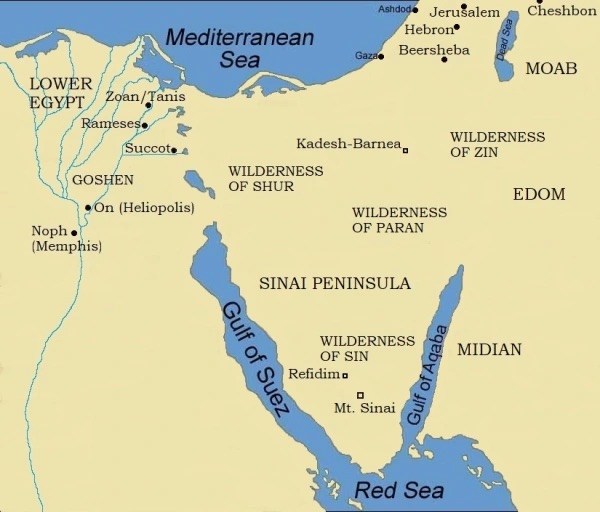
You might retrace Israel’s journey, as they left Egypt from Ramses (Num. 33:3), crossing the Red Sea — likely the northern part of what we now call the Gulf of Suez, and went southeast to Mt. Sinai. Now they’ve moved north to the wilderness of Paran, which you can see is just south of Kadesh-Barnea, often considered the southern part of Canaan. In fact :26 of Chapter 13 says the spies came back to the wilderness of Paran, at KADESH — so this is where Israel was in our passage for today in Numbers 13: just south Canaan, near Kadesh-Barnea, theoretically poised and ready to enter the Promised Land!
OUTLINE:
I. The Reconnaissance of the Spies (:17-24)
II. The Report of the Majority (:25-29)
III. The Reply of Faith (:30-31)
TEXT: Numbers 13:17-31
I. The Reconnaissance of the Spies (:17-24)
17 “When Moses sent them to spy out the land of Canaan, he said to them, “Go up there into the Negev; then go up into the hill country. 18 See what the land is like, and whether the people who live in it are strong or weak, whether they are few or many. 19 How is the land in which they live, is it good or bad? And how are the cities in which they live, are they like open camps or with fortifications? 20 How is the land, is it fat or lean? Are there trees in it or not? Make an effort then to get some of the fruit of the land.” Now the time was the time of the first ripe grapes.
21 So they went up and spied out the land from the wilderness of Zin as far as Rehob, at Lebo-hamath. 22 When they had gone up into the Negev, they came to Hebron where Ahiman, Sheshai and Talmai, the descendants of Anak were. (Now Hebron was built seven years before Zoan in Egypt.)
23 Then they came to the valley of Eshcol and from there cut down a branch with a single cluster of grapes; and they carried it on a pole between two men, with some of the pomegranates and the figs. 24 That place was called the valley of Eshcol, because of the cluster which the sons of Israel cut down from there.”
Numbers 13 opens with God telling Moses to send out spies into the land of Canaan, which He promised to give them. They are to send one man, a leader, from each of the tribes, to spy out the land.
Deuteronomy 1:22 actually gives us another “angle” on this story. Moses is reviewing the history for Israel and says: “Then all of you approached me and said, ‘Let us send men before us, that they may search out the land for us, and bring back to us word of the way by which we should go up and the cities which we shall enter.’”
So Deuteronomy says this idea of spying out the land first was Israel’s idea, not God’s. As Deuteronomy 1:23 says, Moses thought it was a good idea at first (“the thing pleased me”) and God allowed it — verse 1 here says He commanded Moses to send them out. But of course God knew what was in their hearts. The “seeds” of doubt were there. Since God had said “GO” they should just go! But they waffled: let’s look at it first. And this sense of God just ALLOWING it is actually reflected in the text here in Numbers 13:1-2, where the wording is: “Send out for YOURSELF men so that they may spy out the land …”. It doesn’t take that much to “read between the lines,” does it, that this is God’s “permissive will,” not His perfect will. He’s allowing them to do it — but He knows where it’s heading. They’re already showing their doubt instead of faith — which we will see even more clearly by the end of this passage.
So Moses sent the 12 spies out on what we could call a “recon” mission: short for “reconnaissance,” a French word which means to “recognize” or “survey.” They went to scout out the land.
WHERE were they to reconnoitre:
:17 Moses told them to go to the Negev, and the hill country. Again you might refer to a map here, and show the places that are mentioned: the Negev, Hebron, Hamath, and so on, so that your class members can envision where the spies were going.

So :21 says they spied out the land from the wilderness to Hamath (as we see on the map).
:22 says when they got to Hebron, they saw the descendants of Anak there. As you can see on the map, Hebron is in the south/central part of Canaan. And it says: “the descendants of Anak” were there — giants, also known as “Anakim.”
There are several references to the Anakim in Numbers, Deuteronomy, Joshua, and Judges. They are giants, as :33 says, “we became like grasshoppers in our own sight, and so we were in their sight.” Deuteronomy 2:10 says: “The Emim lived there formerly, a people as great, numerous, and tall as the Anakim.” So these people were tall — giants — likely the predecessors of Goliath that David faced, whom I Samuel 17:4 says was “six cubits and a span” or 9 feet, 9 inches tall.
The NIV Cultural Backgrounds Study Bible indicates that these giants may be referenced in ancient Egyptian texts: “The name (Anak) is associated with a people feared for their great size and military prowess; it may be … found among the Egyptian Execration Texts of the early second millennium B.C And an Egyptian letter from the thirteenth century BC describes warriors in Canaan that are 9 feet tall.”
So there were giants in the land — but it wasn’t all bad: :23 says when they came to the Valley of Eshcol (and :20 had said it was the time of the first ripe grapes) they “cut down a branch with a single cluster of grapes; and they carried it on a pole between two men, with some of the pomegranates and the figs.”
One of my first memories as a child was seeing a drawing in our big family Bible story book, of a huge cluster of grapes on pole between two men — a pictorial representation of this story. Now, I have read where some have speculated that the grapes were NOT particularly that big, that the branch was just the means of carrying them — and the text does indicate that they carried pomegranates and figs on it, too. But if you do an internet search on large grapes in Israel, you might get a picture like this, which shows how large some clusters are there today:

This gives suport to the idea that the grapes were indeed large and lush in Eshcol — which by the way, means “cluster” — so :24 says they named the place “The Valley of Eshcol,” or “clusters,” for the great clusters of grapes.
So that was the Reconnaissance: they went through the whole land of Canaan, and they found giant grapes — as well as giant MEN! So in our next point the 12 spies return, and give a report:
II. The Report of the Majority (:25-29)
25 “When they returned from spying out the land, at the end of forty days, 26 they proceeded to come to Moses and Aaron and to all the congregation of the sons of Israel [k]in the wilderness of Paran, at Kadesh; and they brought back word to them and to all the congregation and showed them the fruit of the land. 27 Thus they told him, and said, “We went in to the land where you sent us; and it certainly does flow with milk and honey, and this is its fruit. 28 Nevertheless, the people who live in the land are strong, and the cities are fortified and very large; and moreover, we saw the [l]descendants of Anak there. 29 Amalek is living in the land of the Negev and the Hittites and the Jebusites and the Amorites are living in the hill country, and the Canaanites are living by the sea and by the side of the Jordan.”
Verse 25 says they returned from their expedition after 40 days — that’s about 240 miles in 40 days, 6 miles a day; a very reasonable amount for them to have covered.
Then the spies give their report. There was a positive aspect to it, and a negative aspect:
— The POSITIVE aspect of the report is found in :27: “We went in to the land where you sent us; and it certainly does flow with milk and honey, and this is its fruit.” So they must have showed them the cluster of grapes, and figs and pomegranates. Impressive!
— The NEGATIVE aspect of it: :28-29 It starts with the word “Nevertheless …” — the first words is the Hebrew “epes,” it can mean “but,” “nevertheless,” etc., but it literally means “a ceasing,” “an end,” “no further.” In other words, “Put an END to your thoughts about going into this land. Don’t even think about it.”
Why? In :28 they indicate at least 3 reasons: the people, the cities, and the giants:
— “the people who live in the land are strong”
— “the cities are fortified”
— “we saw the descendants of Anak there.”
1) The PEOPLE: So this is not like “abandoned” land that they can just come in and take up a dwelling in. Notice :29 says:
— “Amalek is living in the land of the Negev” (that’s the south, by the desert)
— “the Hittites, and the Jebusites and the Amorites are living in the hill country” — that’s the central, hilly part of the land.
— “and the Canaanites are living by the sea and by the side of the Jordan” — “by the sea” is where Philistines lived (and where the “Palestinians” live now: Gaza, etc.) So all these people are there.
2. The CITIES: the cities that are there are “fortified.” The Hebrew word means “fenced/walled up.” It comes from a word (“batzar”) which means “to be cut off.” These cities were “cut off” from attack; you couldn’t get to them!
This is just how Jericho was, wasn’t it? There was a wall around the city, which prevented any army from attacking it. You’re not just going to go in and take this land — you’d somehow have to scale those walls to even attack it!
3) The GIANTS. All that is not to mention the Anakim, the giants we read about in the first point, 9 foot tall warriors — a whole TRIBE of “Goliaths” they would have to fight.
So from a human standpoint, you can see why they would be discouraged, right? There’s people, walled cities, giants! Without God, there was no way they could take this land.
We might tend to think that their situation was unique — we don’t face any literal “giants” today. But we do face “giants,” don’t we?
DISCUSSION/APPLICATION QUESTION:
“Israel faced some giants in Numbers 13. God is not calling us to fight any literal giants today, but what are some other ‘giants’ He may call us to face, in doing His will?”
(Of course there are many: “giants” of fear, or discouragement, or anxiety, or inadequacy; doubts; seeming lack of provision or resources, lack of ability/gifts, big problems that we don’t see how we can handle — and so on. You/your group can share many)
ILLUSTRATION:
In John Bunyan’s famous book, PILGRIM’S PROGRESS, he writes of how Christian and his companion Hopeful fall asleep, and are captured by the Giant Despair, who lives in the Doubting Castle. He throws them into the castle dungeon, where he beats them, and torments them, hoping to cause them to despair to the point of suicide. Christian and Hopeful finally remember that they have the key, “promise,” which opened all the doors of the dungeon, and they escaped.
Of course Bunyan’s book is a very clear allegory. Like Israel, we today also face “giants” like discouragement, despair, anxiety. But we need to remember that we have God’s promises, and we need to claim them, and move forward.
TESTIMONY that you can share:
One of our daughters-in-law has some chronic health issues, and that contributes to a spirit of anxiety in her life. Just last week, she had a certain activity to face one day, that was causing her a lot of anxiety. But she reported that: “I prayed that God would take it away for the day and He has come through.” Everything went very well — and most importantly, she saw how God helped her if she called on Him, and moved forward with what she had to do. God can slay the “giants” in our paths — whatever kind of “giants” they may be — if we will claim His promises and take the step of faith that He has called us to take.
III. The Reply of Faith (:30-31)
:30 “Then Caleb quieted the people before Moses and said, “We should by all means go up and take possession of it, for we will surely overcome it.” 31 But the men who had gone up with him said, “We are not able to go up against the people, for they are too strong for us.”
It’s interesting that :30 says Caleb “quieted” the people — evidently they were very upset and vocal in their response to the spies’ discouraging report! But Caleb “quieted” them — the Hebrew word is actually “has,” (pronounced almost like “hoss”) from “hasah,” which is very similar to our “HUSH”! So Caleb told everyone “HUSH!” Stop your fearful shouting!
(By the way, Numbers 14:6 tells us that it was not only Caleb, but also Joshua who stood against the majority report.)
Caleb gave a more positive report in the second part of :30:
“We should by all means go up and take possession of it, for we will surely overcome it.”
Matthew Henry and several other commentators make much of the fact that Caleb used the word “take possession” of — not “conquer” — the land. God has promised them this land, so they just needed to go “take possession” of what God has given them! God said it’s yours — just go get it!
“We will surely overcome it” — this is an expression of faith.
WHY did he believe they would be able to take the land? Because THEY were so strong and powerful? NO. Because God had promised them the land. This is important: genuine faith is always a response to a word from God.
We see this emphatically in Hebrews 11, where those who were in the “hall of faith” were lauded for having faith — but their faith was always a response to a word from God:
— by faith Noah, “being warned by God …” (:7) built an ark
— by faith Abraham, “when he was called” (:8) went out to the land God had promised.
— In :11 Sarah “considered Him faithful who had promised,” so again her faith was in response to God’s word/His promise.
And so on through the chapter. Biblical faith always responds to something God has first said. Importantly, Biblical faith is NOT us just “deciding to claim something” we want God to do for us. That is the modern “word faith” movement: “name it and claim it.” That is not Biblical faith. Biblical faith is always a response to something GOD has commanded us in His word to do, not just something we dreamed up to do. That’s a big difference isn’t it? Make sure your faith is in something God has said in His word.
So God had promised Israel this land, and Caleb had faith to take Him up on His word — despite the prominent obstacles.
Sadly, Caleb was NOT joined in his faith by the majority of his countrymen. Verse 31 indicates they completely negated what he said: ““We are not able to go up against the people, for they are too strong for us.” The Hebrew language here is the exact OPPOSITE, the negation of what Caleb just said:
— he said “We should by all means go up”!
— they said “We are NOT able to go up”!
Caleb had faith that God could give them the land, despite the difficulties that lay ahead. Most of the spies — and sadly, the people, we will see — did NOT have that faith.
???DISCUSSION/APPLICATION???
“As we apply this lesson: I’m going to ask you two easy questions, and then what is perhaps a more difficult one:
— Who here in Numbers 13 displeased God?”
(Of course the answer is the spies who did not believe they could take the land)
— “Who here in Numbers 13 pleased God?”
(That would be Caleb, who believed they could take the land)
— “NOW the more difficult question: which of these two are YOU more like today? Are you showing in some area of your life today that you really have faith and believe God? Or are you showing by your words, deeds, and attitudes, that you do NOT have faith in Him?”
Numbers 13 here is not just a history lesson. It challenges us all to remember what Hebrews 11:6 says: “Without faith it is impossible to please Him …”. If we want to be pleasing to God, we must show faith towards Him — especially faith in what He has clearly revealed to us in His word.
APPLICATION:
— In what area of my life today is God asking me to take a step forward in faith? (Maybe you’ve been asking to “scout it out,” or “get a fleece”, etc., like Israel did, instead of moving forward in faith?)
— In what area might God be calling our CHURCH to move forward in faith? Is there something we pretty much all know God wants us to do — maybe start a certain ministry, or move forward with a building, or take a difficult Biblical stand on something — but like Israel we’re fearful, doubting, hesitant to move forward?
Remember what Hebrews 10:38 says: “But My righteous one shall live by faith; and if he shrinks back, My soul takes no pleasure in him.”
This should be our greatest motivation to respond in faith: that we don’t want God to “take no pleasure in us” like He says in Hebrews 10. We don’t want Him to “loathe” us like He says loathed the faithless generation of Israel in Psalm 95. Let’s seek to please God, by believing Him, and stepping forward in faith — even when there are some difficult obstacles ahead.
_________________________________________________
— If you’ll type your email in the “Follow blog via email” blank on my blog home page, WordPress will automatically send you next week’s lesson and you won’t have to search for it.
— And if you write something in the Comments below, I’ll be sure to pray for your and your group by name this week.
Per my licensing agreement with Lifeway:
— These weekly lessons are based on content from Explore the Bible Adult Resources. The presentation is my own and has not been reviewed by Lifeway.
— Lifeway resources are available at: goExploretheBible.com and: goexplorethebible.com/adults-training
— If you have questions about Explore the Bible resources you may send emails to explorethebible@lifeway.com


 shawnethomas
I have been profoundly touched by your study and your life events. My Mom, Aiko Harris, passed away 11 October 2024. She was born in Japan in 1934. She came to America in 1957 and gave her life to Jesus in 1959 in Texas after being a Shinto Buddhist up to then.