
Includes a sample introduction to the lesson, suggested introduction to the lesson, text outline and highlights, illustrations you can share, discussion questions for your group, and spiritual life applications. A video version of this overview is available on YouTube at:
INTRODUCTION:
One time I asked someone why they thought God would let them into heaven. They told me: “Because I do my best to keep His commandments.” People who do these kind of surveys regularly tell us this is one of the most common answers to that question.
???DISCUSSION QUESTION???
“What do you think about that answer, and what might be wrong with it?”
(This answer is wrong because none of us can keep all of God’s commandments! Romans 3:23 makes it clear: “For all have sinned and fall short of the glory of God.” That’s why the only way of salvation for us is by God’s grace, through Jesus’ death on the cross.)
Then transition to the lesson by saying something like, “In this morning’s lesson from Deuteronomy 28, we will read about the blessings God promises for those who obey His word, and the curses that will come upon those who do not — and the details of those promises make it clear that our only hope of salvation is God’s grace in Christ!
(As an alternate introduction, you might also consider opening with the “cornucopia” illustration from Point I — or perhaps the Charles Lindbergh illustration that I chose to use as a conclusion to the lesson.)
CONTEXT:
As we continue our study in Deuteronomy this week, Israel is still on the plains of Moab, across the Jordan from Jericho. Moses is continuing his last messages to Israel before they enter the Promised Land. We saw last time in Chapter 12 how he commanded them to worship Yahweh ONLY, and to do it only as HE instructed them, not just in any way they please.
In Chapter 27 Moses commanded the elders of Israel (again) to keep ALL the commandments of the LORD (:1).
Then in :12 he commanded them, that when they cross the Jordan and enter the Promised Land, 6 of the tribes were to stand on Mount Gerazim to bless the people if they obey, and 6 were to stand on Mount Ebal to give a curse if they did not.
(You can use a MAP like this to show your class where Ebal and Gerazim were: Israel was still to the east (right) of the Jordan River, in the Plains of Moab).
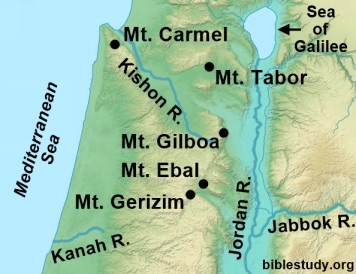
Now, as we come to Chapter 28, we will find what the specific blessings and curses were which they were to proclaim from those two mountains. Those blessings and curses are very convicting — and as we shall see, the most important role they serve is to cast us all upon the gospel of grace which would come in Christ Jesus!
OUTLINE:
I. The Blessings of Obedience (:1-6)
II. The Consequences of Disobedience (:15-19)
III. The Necessity of the Gospel of Grace
TEXT: Deuteronomy 28:1-6, 15-19
I. The Blessings of Obedience (:1-6)
“Now it shall be, if you diligently obey the LORD your God, being careful to do all His commandments which I command you today, the LORD your God will set you high above all the nations of the earth. 2 All these blessings will come upon you and overtake you if you obey the LORD your God:
3 “Blessed shall you be in the city, and blessed shall you be in the [c]country.
4 “Blessed shall be the offspring of your body and the produce of your ground and the offspring of your beasts, the increase of your herd and the young of your flock.
5 “Blessed shall be your basket and your kneading bowl.
6 “Blessed shall you be when you come in, and blessed shall you be when you go out.
Moses begins by sharing with Israel the blessings of obedience. He repeatedly (6 times) uses the word “blessed.” (Hebrew “barak” the same word used in Genesis 1:22, where it says God “Blessed them, and told them be fruitful and multiply.” It’s also used in Genesis 12:3+ of the blessing He gave Abram. It is a reminder that GOD is the source of blessing and every good thing.
ILLUSTRATION/DISCUSSION:
Do you know what this is called? And how it originated?

(Some of your members may know that this is what is called a “cornucopia.” But fewer likely know its origin. They might guess it came from the Pilgrims — but it actually originated in ancient Greek mythology: that the god Zeus as a child broke the horn of the great goat Amalthea, but then Zeus blessed the horn, and out of it came an endless supply of blessings: thus they called it the “horn of plenty,” or in Latin, “cornucopia.”)
So the ancient Greeks looked to Zeus as the giver of blessings.
???DISCUSSION QUESTION???
“What are some places where people today look for blessings/ prosperity/success?”
(Some look to “good luck” charms/horoscope/the occult; some to other false gods like Zeus, or Baal, or the Hindu gods of blessing; some look to their own hard work, or to prosperous relatives — or even to the government to give them the blessings they need.)
People look to many sources for blessings, but the Bible makes it clear that it is the One True GOD who is the ultimate source of all blessing. (James 1:17 says all blessings come from above). We should look to GOD for the blessings we desire. This Thanksgiving season we should spend time thanking God for all the blessings He’s given us. Deuteronomy 28 here shows that God does bless His people. HE is the source of all blessing.
The promises of blessing here in Deuteronomy 28 were specifically for the people of Israel as they entered the Promised Land. This passage repeats the word “blessed” 6 times, that God will indeed bless Israel in all these situations:
— :3 “in the city and in the country”: (“sadeh,” “field, countryside, open country.”) Most people say they’re either “city folk” or “country folk.” God says if you keep His word, it doesn’t matter if you’re “city folk” or “country folk,” you’ll be blessed wherever you live!
— :4-5 say that whatever you produce will be blessed: your children from your body, the produce of your ground, the animals from your flocks and herds — as well as “your basket and your kneading bowl.” “Basket” is “teneh,” a woven basket for carrying grain or crops; and the “kneading bowl” is the same word used in Exodus 12:34 of how Israel took the unleavened bread in their “kneading bowl/trough” as they left Egypt during the Exodus.
— :6 just sums it up: you’ll be blessed “coming or going”!
It is interesting that :2 says that all these blessings will “come upon you”: This Hebrew verb is “nasag.” It is used in:
— Genesis 44:4 of Joseph’s steward catching up to his brothers on their way back to Canaan.
— Exodus 14:9 of Pharaoh’s army catching up to Israel.
Although it is a different Hebrew word, it reminds me of how Psalm 23 says God’s “chesed” (“grace”) and mercy will “pursue” us! (That word is “radaph.”) The point is, God’s blessings will “chase you down” if you obey the Lord!
(You might note at some point in this section that this is NOT the modern “prosperity gospel,” though adherents of that movement might quote some verses like these out of context. First, as we noted, this promise is for Israel as they enter the Promised Land, not for all people of all time. Second, the prosperity gospel teaches that it is God’s will for every Christian to be healthy, wealthy and prosperous, and that every Christian is a “little god” and whatever we speak by faith we will receive. And it wrongly causes people to focus on present material prosperity, instead of the spiritual blessings God has for us in Christ.)
But all this sounds good, right? All these blessings will come upon them! BUT NOTICE THE CONDITION of these blessings:
God says in :1 “IF” — there’s the condition — ‘IF you diligently obey YHWH (LORD in all 4 caps).”
“Diligently obey” here is actually a Hebrew expression in which the word “shama” is used twice (this is the same Hebrew word used in the “Shema” of Deuteronomy 6:4, which means to “hear, observe, do.”) Repeating that verb twice is a way the Hebrews would emphasize something in their language. It would literally read something like “if observing you observe”; “if obeying you obey,” etc. It means something like “really obey.” So most English versions translate it something like: “if you diligently obey” (NASB), “hearken diligently,” (KJV) and so on.
The point is, God says the condition of the blessings He promises here is diligent obedience to His commandments — which has some profound consequences for the application of these verses. YES these were great promises for Israel. But they would only get them if they “diligently obey” His commands!
And WHICH of God’s commandment must they “really obey”?
“ALL His commandments” (:1) — this is a vital point. The Jews identified 613 commandments in the Law — that’s the “generally accepted” number. And Israel had to “diligently obey” “ALL” of them! So the blessings are great — but you need to “Read the fine print” of what God promises here!
???DISCUSSION QUESTION???
“Can you share a time when you saw a deal that looked good — until you saw the ‘fine print’?”
(For example, just south of us here in Norman is Kendall’s restaurant in Noble, Oklahoma, where they have a chicken fried steak challenge: eat it all, and you can have the $50 meal free! That sounds good — until you read the “fine print”: you must eat the entire meal in one hour. And the “meal” includes three large chicken fried steaks, two servings of mashed potatoes & gravy, two servings of green beans, a side salad, two biscuits, AND two cinnamon rolls! If you succeed, the meal is free, you get a t-shirt, and your photo is put on the restaurant’s “wall of fame.” NOT surprisingly, Kendall’s challenge has a 99% fail rate! It might look good — but read the fine print — it is likely impossible for you to actually do! (Though it might be fun trying!)
You can share that example, or one like it, and then point out:)
In the same way one might look at all the blessings here in Deuteronomy 28 and think, “Wow! That’s great — look at all those blessings; I want that!” But “read the fine print” — these blessings were only for those who “diligently obey”, “ALL” of God’s commandments! The problem is, obeying all of God’s commandments has more than a “99% fail rate” among us mere mortals — it’s 100%. None of us can do it! “All have sinned and fall short of the glory of God!” It is not “likely impossible” for us to do it; it IS impossible! If we have to live up to this standard in order for us to be blessed, then none of us will!
This truth is amplified even more in the next section, :15-19, where we find the cost of disobedience to God’s commands:
II. The Consequences of Disobedience (:15-19)
15 “But it shall come about, if you do not obey the LORD your God, to observe to do all His commandments and His statutes with which I charge you today, that all these curses will come upon you and overtake you:
16 “Cursed shall you be in the city, and cursed shall you be in the [b]country.
17 “Cursed shall be your basket and your kneading bowl.
18 “Cursed shall be the offspring of your body and the produce of your ground, the increase of your herd and the young of your flock.
19 “Cursed shall you be when you come in, and cursed shall you be when you go out.
So :15 begins this second section with the word “BUT”! This serves as an important transition to this second point. All those blessings of obedience sounded good — BUT! What will happen if they do NOT obey God diligently like He commanded?
If they don’t, then ALL the blessings of :3-6 will be absolutely reversed, as :16-19 spell out, in just a slightly different order:
— :16 they’ll be cursed whether they live in the city or in the country (You can’t avoid the curse by running away and hiding in the country, or you can’t lose it in the crowds of the city!)
— :17 “the basket and the kneading bowl” (this is the one that’s in a slightly different order than in :3-6, but it’s still the same things)
— :18 all your “fruit”: be it from your own body, your crops, your herd or flock, will be cursed.
— :19 you’ll be cursed “coming & going”!
So these verses point out the importance of keeping God’s commandments. These are not “suggestions;” they are commands — and there are consequences for those who do not keep them.
???DISCUSSION QUESTION???
“What are some of God’s commands, which if we break, we will experience a ‘curse’ or negative consequences in our lives?”
(— If we do not tithe as He commands, our finances will suffer
— If we do not follow His commands to bring up our children in His ways, or to discipline them with the rod, our children’s lives will suffer from lack of discipline and direction.
— If we do not follow His command to treat others the way we want to be treated, then we will experience broken relationships.)
There are many such examples that you/your group can think of. The Book of Proverbs is full of them. The point is, if you break God’s commands, you will pay for it. “You can’t sin and win.” Those who break God’s commands will be cursed for it. That is a general principle that applies to all people.
As we pointed out above: these particular commands and their consequences were specifically for Israel — these curses would come upon them if they do not obey all of God’s commands. And NOTICE HOW EMPHATIC this condition is:
Verse 15 says these curses will come about:
— “If you do not obey the LORD (YHWH) your God”
— “to observe to DO” again, a kind of “double emphasis”: He could have just said “if you do not observe,” or “if you do not do” — but instead He really emphasized the importance of diligent and total obedience: “to observe to do”!
And just what is it that they must “observe to do” or be cursed?
— “ALL His commandments and His statutes with which I charge you today.” It’s like, How many of these do we have to keep to avoid the curse? ALL of them. ALL of them!
My old Sunday School teacher at the First Baptist Church of Harrah repeatedly told us as kids: “All means all!” When God says “all,” He means “ALL”! So Moses is really emphasizing here: if Israel did not keep “ALL” of God’s commandments, they would not be blessed, but CURSED! This is a very convicting and sobering teaching. Who can live up to it?
The same is true for all who attempt to justify themselves before God by keeping His commandments. The New Testament helps interpret this for us, and makes it clear that no one can live up to that:
— Galatians 3:10 “For as many as are of the works of the Law are under a curse; for it is written, “Cursed is everyone who does not abide by all things written in the book of the law, to perform them.”
The word “ALL” is a key word here: you must abide by “ALL THINGS written n the book of the Law,” or you will be cursed.
And who can keep “all” the commands of the Law? NO ONE!
Romans 3:20 says, “By the works of the Law, NO FLESH will be justified in His sight.” So there we have it: NO ONE can keep all God’s commandments. NO ONE can inherit all the blessings and avoid all the curses that God promises here!
???DISCUSSION/APPLICATION QUESTION???
“If we just ended the lesson right here, how would you feel?”
(In light of the commands to keep ALL of God’s commands or be cursed, it might make a person feel hopeless — or maybe even like it’s not worthwhile to even try to keep God’s commands, since we can’t do it anyway; or like it is just inevitable that we will all be cursed!)
And you might point out that this is the inevitable result of the Law: it shows us how far we all fall short of God’s perfect standard, and how much we all need salvation by grace — which is the good news of our last point! (Make sure you save time to get to it!)
III. The Necessity of the Gospel of Grace
This last point is not found “written” anywhere in today’s text in Deuteronomy — but it is the inevitable lesson that comes out of it, especially in light of the further revelation that God has given us in the New Testament.
We’ve seen that we’ll be blessed if we keep God’s commandments, but cursed if we do not keep ALL of them. Like we talked about at the end of that last point, that should cause a sense of despair in us — and that’s actually the point of the Law: to show us how far short we fall, and how much we need Christ.
BOTH these sections in Deuteronomy 28, on the Blessings and the Curses, reveal our total inability to keep all of God’s Law — and show us our absolute necessity of putting our trust in Christ in order to be saved.
Moses had prophesied in Deuteronomy 18:15, ““The Lord your God will raise up for you a prophet like me from among you, from your countrymen, you shall listen to him.” This is one of the earliest prophecies of the Messiah God would send, who would come to save His people. Those prophecies were fulfilled when Jesus came in the New Testament. (Acts 3:22 and 7:37 tell us that Deuteronomy 18:15 was fulfilled by Christ.) Jesus was the One God raised up; Jesus is the One we should listen to. But Jesus was more than “just” a prophet or teacher who set God’s standards of obedience before us, like Moses did. He was and is God’s Son, God Himself, who came to earth to resolve the problem of our man’s hopeless disobedience. Jesus is the answer to our inability to inherit the blessings, or avoid the curses.
The very same Galatians 3 passage that said that as many as cannot perform all the Commandments of the Law are cursed, goes on to say in :13: “Christ redeemed us from the curse of the Law, having become a curse for us—for it is written, “Cursed is everyone who hangs on a tree”— 14 in order that in Christ Jesus the blessing of Abraham might come to the Gentiles, so that we would receive the promise of the Spirit through faith.”
Do you see what Galatians 3 tells us? NONE of us can keep the Law. NO ONE can “abide by all things written in the Book of the Law.” Like Romans 3 says, we have all fallen short of it. BUT Christ “REDEEMED” us from the curse of the Law, :13 says.
“Redeemed” is “ex-agoreo” (“ex” = “out of,” “agoreo” to “buy up.” The “agora” was the Greek marketplace.) Jesus “bought us back” from our sins. He took our curse on Himself, on the cross. — I Peter 2:24 says “He Himself bore our sins in His body on the cross.”
— II Corinthians 5:21 says “He made Him who knew no sin to be sin on our behalf, so that we might become the righteousness of God in Him.”
Jesus took our curse, for all our failings of obedience to God’s Law, so that if we put our faith in Him, He will give us HIS righteousness — in other words, if we are in Christ, it is as if WE had kept the Law as perfectly as Jesus did!
ILLUSTRATION:
Following Charles Lindbergh’s historic crossing of the Atlantic in 1927, “a list started circulating across the country: ‘Lindbergh’s Character Factors,’ fifty-nine personality traits in alphabetical order — from Altruism to Unselfishness — which Lindbergh allegedly marked each night with a red cross for those he had fulfilled satisfactorily and a black cross for those he had violated. Constant self-improvement was the obvious purpose, perfection the goal.” (A. Scott Berg, Lindbergh, p. 170)
Now, let me say first of all that Lindbergh said he never made that list. But this DID become very popular, and it is just how many people see religion: keep track of your “plusses and minuses,” and hope you come out well. The problem is, like Lindbergh’s biography states: “perfection is the goal” — and NONE of us can attain to it! We all fall short. If we were to keep such a list, every single one of us would have “black crosses” all over our pages — every single one of us, without exception —
Except for One! Jesus perfectly kept every command. His page was totally filled with “red crosses” — and on the cross the Perfect Son of God paid for all our “black crosses” with His red blood — and by faith in Him, HIS “perfect red crosses” are credited to us — like the old Baptist expression says, it is “just as if I’d never sinned”!
That is the good news of the Gospel — that we don’t have to worry about the impossible task of perfectly obeying every command of the Law in order to be saved: Jesus paid for all our failures on the cross, so now everyone who trusts in Him has His perfect righteousness credited to them.
But make it clear to your group: this is not just “a” way for us to be saved; it is the ONLY way. Because the Law of God is very explicit: you must keep it ALL in order to receive the blessing. We can’t do that — but thank God, Jesus did it for us! And passages like Deuteronomy 28 make it clear, that is the ONLY way that any of us will ever be saved!
— Just a reminder that there is now a “PRINT” button at the end of this article, that you can hit to print out the lesson in its entirety.
— If you’ll type your email address in the “Follow blog via email” blank on my blog home page, WordPress will automatically send you next week’s lesson and you won’t have to search for it.
— And if you write something in the Comments below, I’ll be sure to pray for your and your group by name this week.
Per my licensing agreement with Lifeway:
— These weekly lessons are based on content from Explore the Bible Adult Resources. The presentation is my own and has not been reviewed by Lifeway.
— Lifeway resources are available at: goExploretheBible.com and: goexplorethebible.com/adults-training
— If you have questions about Explore the Bible resources you may send emails to explorethebible@lifeway.com


 shawnethomas
Thank you Brother Shawn for your weekly Bible study. I am a new Sunday school teacher at First Baptist church Lafayette (Louisiana), and since finding your resources online I have become comfortable with my lessons and better at presenting them to my class. God bless and thank you again.
I am more of a facilitator than a lecturer and your lessons, with such great examples and questions, fit my teaching style perfectly. Thank you for your wisdom and experience. I look forward to your blog each week.
I am so thankful you continued your calling after you retired from the pastorate. God bless you and your family.
Thanks! Helpful info for the upcoming study this Sunday.
I am a Adult Ladies Sunday School teacher. your thought and resource really help me. Thank you for your lessons. Lord Father Please give this family mean Blessings .Let Shawn’s wife continue to recover. In Jesus Name Amen