
For teachers of Lifeway’s Explore the Bible lesson of Matthew 9, for January 25, 2026. Includes a sample introduction to the lesson, text outline and highlights, illustrations you can share, discussion questions for your group, and spiritual life applications that you can make. A video version of this overview is available on YouTube at:
INTRODUCTION:
During the Civil War, President Abraham Lincoln was asked by Senator John B. Henderson of Missouri to pardon a list of men from his state. Lincoln, who loved to sign pardons, and who always looked for the least ‘excuse’ to pardon anyone, told Henderson: “You know I am charged with making too many mistakes on the side of mercy.” Henderson said he was sure he was right — and said the President ought to sign out the whole batch.” And he did! (Carl Sandburg, Abraham Lincoln: The Prairie Years and the War Years, p. 670)
Jesus might be “accused” like Lincoln of showing “too much mercy,” where it was not “due.” But repeatedly in scripture we see how gracious and merciful He is to all.
You might add this question (or use it as an alternate intro.):
??? DISCUSSION QUESTION???
“Can you think of a time in scripture when The Lord/Jesus/God was merciful to someone who didn’t deserve it?”
(Of course there are many: Jesus’ mercy to the Adulterous Woman is a prominent example; His mercy to the thief on the cross; saying “Father forgive them” to those who were crucifying Him!
You/your group can think of many.)
Then transition to the lesson by saying: In today’s scripture from Matthew 9, we see how Jesus extended His mercy to a variety of people — often to people and in ways that we might not expect. The way Jesus showed mercy might surprise some of our “religious” expectations, but His example challenges us to show mercy today, just like He did.
CONTEXT:
We’ve been studying through the Book of Matthew, and have covered the different receptions to His birth in Chapter 2, the beginning of His ministry in Chapters 3 & 4, and then His famous Sermon on the Mount in chapters 5-6-7. Last time in Chapters 8 and the first part of Chapter 9 we saw how Jesus demonstrated His power over every aspect of life: sickness, time and space, creation, the spiritual world — and even sin. And as He did so, He also showed how much He loves every person, and how we should too.
In Matthew 9:9, Jesus encounters Matthew, the author of this book, sitting at his tax office, and calls him to follow Him, like He did Peter and Andrew, and James and John. And just like them, Matthew immediately “got up and followed Him.”
The “focus passage” that Lifeway assigned to us for this week continues right after that story in Matthew 9, beginning in :10, and it naturally breaks down into 3 distinct points:
OUTLINE:
I. A Ministry of Mercy to the “Down and Out” (9:10-13)
II. A Ministry that Differed From Expectations (9:14-17)
III. A Ministry of Mercy to the “Up and Out” (9:18-19, 23-26)
TEXT: Matthew 9:10-19, 23-36
I. A Ministry of Mercy to the “Down and Out” (9:10-13)
:10 “Then it happened that as Jesus was reclining at the table in the house, behold, many tax collectors and sinners came and began dining with Jesus and His disciples. 11 And when the Pharisees saw this, they said to His disciples, “Why is your Teacher eating with the tax collectors and sinners?” 12 But when Jesus heard this, He said, “It is not those who are healthy who need a physician, but those who are sick. 13 Now go and learn what this means: ‘I desire compassion, rather than sacrifice,’ for I did not come to call the righteous, but sinners.”
A. The Gathering of the Lost (:10)
The word “then” in :10 continues the thought from Jesus’ call of Matthew in :9. Matthew had followed Jesus, and now Jesus was having a meal with Matthew and his friends. Who were Matthew’s friends, that he had at the meal? Of course they were going to be other “tax collectors” and “sinners” like himself!
It says that Jesus was “reclining at the table.” This is how they ate in those days. They didn’t “sit” around a table like we do (yes Leonardo Da Vinci’s famous “Lord’s Supper” picture is not accurate!) Instead they reclined as they ate. Some translations say these “tax collectors and sinners” were “dining” with Him; well that’s the same word “reclining.” So they were all “reclining” around the low table, likely the Roman “triclinium,” which literally means “three couches” around a low table, eating together. You might share an image like this:
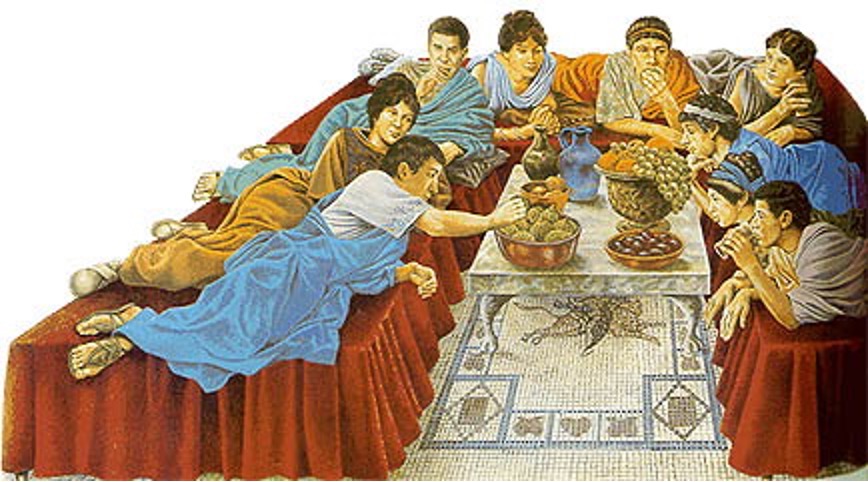
— and you can see how it is a rather intimate setting. One eating in this way was really “rubbing shoulders” with the other guests!
WORDS:
“tax collectors” Greek “telones”, literally: “collecting at the end,” referring to the toll houses where the Roman taxes were collected. These were Jews who collected taxes FROM the Jews, FOR the Romans! They were often men employed by what is called a “tax farmer,” who “farmed out” men to collect a certain amount of money in taxes for their region. Anything they collected on top of that, was theirs to keep. So this was a prime job for very greedy, cut-throat men who’d take advantage of their countrymen.
Can you imagine if America were taken over by a foreign country, and they imposed grievous taxes upon us — and they used some of OUR own people to collect those taxes? They would be seen as the worst kind of greedy turncoats. THAT is what these “tax collectors” were. They weren’t just legitimate “IRS employees,” they were considered collaborators with the enemy; as traitors to their own people.
Then the word “sinners” is literally “hamartoloi.” “Hamartia” is “sin,” “harmartoloi” (plural) is those who are sinning, or “sinners.”
Of course “all have sinned” as Romans 3 says, but these are people who were KNOWN for their sin. They had been “branded” as “sinners,” like the woman in Luke 7, of whom Simon said “she is a sinner” — literally “a woman which was a sinner in the city,” likely indicating that she was a prostitute or very immoral person, known publicly in the city for her sin.
???DISCUSSION QUESTION???
“Who are some people you/others might consider to be ‘traitors,’ ‘outcasts,’ or ‘sinners,’ in our country today?”
Then make the point: THIS is the kind of people that Jesus was having dinner with that day. This is how the Jews felt; that Jesus was “rubbing shoulders” very closely with these very undesirable people — and we see their objection in :11:
B. The Objection of the Legalists (:11)
Verse 11 says the Pharisees saw this, and protested to Jesus’ disciples: “Why is your teacher eating with the tax collectors and sinners?”
1. WHO were these Pharisees?
Moises Silva’s great dictionary of New Testament words tells us that the word “Pharisee” likely came from the Hebrew “parush,” or “parushim” (plural) which means “separate/separate ones.” That certainly seems to apply to these men. They always seemed to want to be “separate” from sinners, and looked down on them. Remember the Pharisee in Luke 18 prayed: “I thank You that I am not like other men …”. That was the Pharisees’ attitude.
2. WHERE were these Pharisees?
There is an interesting quote in the Cambridge Bible Commentary:
“The Pharisees were not guests, but came into the house,—a custom still prevalent in the East. A traveller writes from Damietta, “In the room where we were received, besides the divan on which we sat, there were seats all round the walls. Many came in and took their place on those side-seats, uninvited and yet unchallenged. They spoke to those at table on business, or the news of the day, and our host spoke freely to them. We afterwards saw this custom at Jerusalem … first one and then another stranger opened the door and came in, taking seats by the wall. They leaned forward and spoke to those at table.” (Scripture Manners and Customs, p. 185)”
So this may have been the case that day. The Pharisees, like many in that culture, just came in and observed the meal, and made comments!
And their comments were critical: “Why is your Teacher eating with the tax collectors and sinners?” He’s “rubbing shoulders” with these undesirable people around Matthew’s table!
C. The Heart of the Lord (:12-13)
12 “But when Jesus heard this, He said, ‘It is not those who are healthy who need a physician, but those who are sick. 13 Now go and learn what this means: “I desire compassion, rather than sacrifice,” for I did not come to call the righteous, but sinners.’”
Jesus uses a great illustration here: “it is not those who are healthy who need a physician, but those who are sick.” Doctors cure SICK people; that’s what they do! These people are “sick” spiritually with sin; and Jesus has come to “cure” them — and He has to be with them, to cure them! It’s a great analogy!
Then He tells them to “go and learn what this means, ‘I desire compassion rather than sacrifice.’” Jesus is being sarcastic, and is really deriding these religious men, who prided themselves on their knowledge of scripture. Jesus quoted that line from Hosea 6:6. The NASB translates it “I desire LOYALTY,” but the word is the Hebrew “chesed,” which is translated elsewhere as “lovingkindness, love, mercy — or perhaps best, “grace.” God says there, I want GRACE from you, not sacrifices. He didn’t need grace for Himself, of course — He was speaking of the grace that He wants us to show OTHERS! In other words, Jesus was telling these “holier than thou Bible scholars,” “don’t be so ‘religious,’ be gracious to people!” Jesus came to show GRACE to people — and aren’t we glad He did! — and He wants us to show the same grace that He showed US, to others we meet.
APPLICATION:
I think it’s scary how much like the Pharisees so many of us Baptists are. Many of us “good Baptist Bible scholars” need to go and learn the same thing Jesus told them! Just like them, many of us are much better at giving our regular tithes and offerings than we are at showing grace to sinners.
We too need to be careful of the accusation of “guilt by association.” Too often attacks are made upon individuals just like the Pharisees made upon Jesus here:
“They had dinner with so-and-so.”
“They spoke at a meeting where such-and-such were present.”
As if they are somehow “contaminated” by mere association.
Don’t fall for these kind of tactics when people try to use them; and don’t be found guilty of using them yourself.
We too need to beware the Pharisaical tendency to try to keep “separate from sinners.” The Apostle Paul wrote in I Corinthians 5:9-10, “I wrote to you in my letter not to associate with sexually immoral people; 10 I did not at all mean with the sexually immoral people of this world, or with the greedy and swindlers, or with idolaters, for then you would have to leave the world.“
This IS what the Pharisees tried to do: they strove to “leave” the world, to be “separate” from it, to not be “contaminated” by it.
Many evangelical Christians take this same tack today, too: Let’s not rub elbows with anyone who might be a “sinner.”
But if we keep ourselves entirely separate from the world, how then can our salt and light influence them? Remember in Jesus’ Sermon on the Mount in Matthew 5 He said that we are to be “the salt of the earth;” “the light of the world.” We saw that salt, in all its different uses, “enhances by contact.” But we have to CONTACT to be able to ENHANCE! In our fallen state we often tend to be more like the Pharisees — but it’s not much like Jesus.
ILLUSTRATION/APPLICATION
I’m going to share a story I’m not necessarily proud of, but I hope it helps make the point. You can share it if you’d like to, or you may have one like it to share. Like many of you I was brought up in a Baptist home and have tried to live a life that honors the Lord — but sometimes we can tend to be a bit too much like the Pharisees in our dealings with others. Not long ago when I was out on a walk I’d seen some neighbor kids playing, and they were using some very vile language and expressions. I thought, these are NOT nice kids! So, a few days ago our grandkids were at our house, playing outside. And these same neighbor kids came by, wanting to play with them at our house. I have to say, I did NOT want them playing with our grandkids. I told our son, I don’t think these kids ought to come over. He said, Dad, at some point we have to expose our kids to the world — and also let the world be touched by our kids. I didn’t like it, and I went out back and sat in a chair on the back porch and watched over them like a hawk the whole time, and you know what happened? They played tag. It was great. AND now I know their names and I have them on my prayer list, and hopefully we’ll have some opportunities to reach out to them. But I hate to say, that wasn’t my first inclination. My son was more like Jesus right then than I was.
Maybe there’s someone in your life life right now that you feel like that towards: they’re “sinners;” they’re “traitors” or whatever. But we need to realize that these are people that Jesus loves.
NO we are not to compromise with sin or put ourselves in places of temptation.
And NO we are not to leave our kids alone with ungodly people.
We do need to be careful: “Wise as serpents and innocent as doves” as Jesus said. (Matthew 10:16)
But at the same time, let’s be less like the Pharisees, always trying to keep “separate” from sinners; and more like Jesus, who was always trying to reach the “down and out.”
Challenge your group: what individuals or groups are in your own life right now, that you might be tempted to be “separate” from like the Pharisees would, but the Lord is calling you to “rub shoulders” with them like He did at that meal, to try to reach them for Him?
II. A Ministry That Differed From Expectations (9:14-17)
:14 Then the disciples of John *came to Him, asking, “Why do we and the Pharisees fast, but Your disciples do not fast?” 15 And Jesus said to them, “The attendants of the groom cannot mourn as long as the groom is with them, can they? But the days will come when the groom is taken away from them, and then they will fast. 16 But no one puts a patch of unshrunk cloth on an old garment; for the patch pulls away from the garment, and a worse tear results. 17 Nor do people put new wine into old wineskins; otherwise the wineskins burst, and the wine pours out and the wineskins are ruined; but they put new wine into fresh wineskins, and both are preserved.”
So Jesus’ ministry was NOT what the Jewish religious leaders expected — we’ve seen that in their responses to how He forgave sins and had mercy on the “down and outs.” In this section we again see how Jesus’ ministry differed from what was expected — this time even by the “good guys” — the disciples of John!
Verse 14 says the disciples of John asked Him His disciples were not fasting. Now to Baptists today, this might not seem like much of a question; we don’t fast! A few years ago a Christian from India visited a number of churches in the U.S. and he was treated to all kinds of fellowship meals, as per our custom. He said, these fellowships are great; but, he asked, “When do you fast?” Good question! The answer is, most of us do not.
For one, there is no direct New Testament command to fast, other than Jesus in the Sermon on the Mount saying “When you fast …”. But that’s something short of a direct “command.” At this point in His ministry, evidently Jesus was not having His disciples fast. But fasting was a BIG part of many religious programs. Remember that Pharisee in Luke 18 said “I fast twice a week …”. John’s disciples, following his asceticism, evidently fasted, too, but at this point Jesus’ followers didn’t. His ministry was not what John’s disciples expected.
So Jesus gives them an answer about fasting — but then He also gives them a larger principle: that His ministry would NOT always line up with their traditional expectations!
A. He answers the question on fasting in :15, “15 And Jesus said to them, “The attendants of the groom cannot mourn as long as the groom is with them, can they? But the days will come when the groom is taken away from them, and then they will fast.”
So He says, it’s not appropriate for My disciples to fast right now, just like it would be inappropriate for people attending a wedding to fast. “But,” He said, “the days will come … and then they will fast.” So He said, My disciples will eventually fast.
And as we see later in the New Testament, they did:
— Acts 13 says before the Church at Antioch appointed Paul & Silas as missionaries, they fasted and prayed.
— Acts 14:23 says Paul & Silas appointed elders in the new churches in Turkey, “having prayed with fasting.”
So Jesus’ disciples DID fast later, just as He said.
B. But secondly He makes the bigger point: My ministry is NOT going to live up to your preconceived expectations! And He again uses a masterful illustration, of the new wine and the old wineskins: you try to put new wine into old wineskins, then both the old skins will burst and the wine will be ruined. It’s bad all around.
Of course, JESUS IS NOT SPEAKING ABOUT WINE/SKINS. He is speaking about His ministry, this “new thing” that He was doing. His ministry was like the “new wine.” Their traditions and forms and expectations were like the “old wineskins.” He was telling them, what I am doing will not fit in your preconceived ideas of what the Messiah and His ministry should be. And it was not:
— His ministry didn’t line up exactly with John the Baptist’s ministry. He ate and drank things that John didn’t. He didn’t have His disciples fast like John did, etc.
— And His ministry certainly didn’t fit the expectations of the Pharisees, as we have seen. He was much too liberal with His mercy towards other for them!
— And His ministry didn’t fit the militant expectations of the radical Jews either, who wanted Him to overthrow the Roman oppressors as a military Messiah.
So Jesus concluded this analogy by saying at the end of :17, “they put new wine into fresh wineskins, and both are preserved.” His new ministry was not going to fit their expectations, or into their institutions. It was going to bring some new forms and expectations: no Temple at all — that was radical! No priests; every believer would be a priest. And so on.
So He was saying, get ready for this: what I am bringing will be completely different than your expectations.
So to apply this, in a way this was a “one-time” kind of thing, because we don’t have the same expectations today that the Jews did. We are on the other side of the cross and the start of the church. But people today still DO have expectations for Jesus and His church, don’t they?
???DISCUSSION/APPLICATION???
“What are some mistaken expectations that people today have about Jesus and His church?”
(— Just like the Jews expected Him to be a physical/military savior, so many today expect Him to be a material/financial savior — and sadly the “health/wealth/prosperity” preaches play into this.
— Others might expect compassion and help only, without any thought about changing their life to line up with God’s commands.
— Again, just like the Jews wanted a political savior, so many today want to see Him/His church be more of a worldly/political power, when Jesus said “My kingdom is not of this world.”
— Some expect Jesus to be “gentle/meek/mild” but are surprised how stern He/His word can be about sin/hypocrisy/ judgment and hell.
— Even many of us in the church may want to limit God by having Him put His ministry into our predetermined “wineskins” of institutions and methods.
You/your group can think of many.)
But the point Jesus was making is, He did not come to fit our “expectations.” The “wine” of His ministry would necessitate new “wineskins,” a new way of doing things; new expectations.
III. A Ministry of Mercy to the “Up and Out”! (9:18-19, 23-26)
:18 While He was saying these things to them, behold, a synagogue official came and bowed down before Him, and said, “My daughter has just died; but come and lay Your hand on her, and she will become alive again.” 19 Jesus got up from the table and began to accompany him, along with His disciples. …
:23 “When Jesus came into the official’s house and saw the flute players and the crowd in noisy disorder, 24 He said, “Leave; for the girl has not died, but is asleep.” And they began laughing at Him. 25 But when the crowd had been sent out, He entered and took her by the hand, and the girl got up. 26 And this news spread throughout that land.”
If the “sinners” at the meal in :10 were the “down and out,” this synagogue official might be the “up and out.”
“Synagogue official” here in the Greek is just literally “archon,” from “archos,” which means “rule.” So it is just a general word for “ruler” or “leader.” Mark 5:22 and Luke 8:41 tell is that his name is Jairus, and that he is a ruler of a synagogue — so somewhat like a pastor in a church today. Craig Blomberg in NAC says he’d be “a layman who is responsible for the order and progress of worship” in a local synagogue (p. 160). So this was no “down and out” person; this is a “leader/ruler” of a synagogue. But he still needed Jesus!
NOTICE several things here:
1) He “bowed down before Him” — so he humbled himself before Jesus. This is the critical attitude the Lord is looking for:
— “Blessed are the poor in spirit, for theirs is the kingdom of Heaven.” (Matthew 5:3)
— “The LORD is exalted, yet He regards the lowly.” (Psalm 138:6)
— “Humble yourselves in the presence of the Lord, and He will exalt you.” (James 4:10)
Jesus loves to bless those who bow before Him, but He resists the proud.
Sunday in our church our minister of music called for people who had a need, and just wanted someone to pray for them, to come forward and let people pray for them. I love that; it’s such a sweet time of church “body life,” ministering to each other.
But how often do we hesitate to go forward, wondering “what people might think,” etc. Instead we should be ready to humble ourselves, like this synagogue ruler. That’s the kind of person Jesus helps!
2) He had a grievous problem, but he believed that Jesus could help. He said at the end of :18, “my daughter has just died.” How many would have thought, well, if she’s dead, that’s it! Maybe if Jesus could have come earlier, but now it’s too late. But he didn’t think that way. He had faith. He said “Come and lay Your hand on her, and she will become alive again.” He believed that Jesus could do impossible things.
Some of our members this week may have “impossible situations” in their lives; maybe “impossible” prayer requests for loved ones who just won’t come back to the Lord, and so on. But if we believe, there is nothing that He can’t do! Encourage your members to have faith, and bring their “impossible” request to Him!
3) Then what does :19 says “Jesus got up …”. He was coming to help! Amazing; He cares for all. He responded to the request from this “up and out” man as well as the needs of the “down and out”!
After Jesus leaves, there’s an interlude while He travels to the leader’s daughter. In :20-22, evidently on the way, a woman who’d had a hemorrhage for 12 years touched His cloak, and was instantly healed!
Then :23 says Jesus arrived at the official’s house. It says He “saw the flute players and the crowd in noisy disorder.”
You might ask your group:
??? “Does this describe the scene of mourning at any home that you’ve been to?”???
(Probably not! Most of us have been to homes where people were quiet; perhaps some quiet tears, or people whisper polite condolences and prayers, etc.)
But this was NOT the typical Middle Eastern mourning. They mourn loudly, and even “professionally”:
ILLUSTRATION:
— John Lloyd Stevens traveled to Egypt and the Holy Land in the 1800s, and he attended a couple of mourning scenes there. He said at one “I could not help noticing that the cries became louder as I approached, and I had hardly seated myself at a little distance from the corpse before the women seemed to be completely carried away by their grief, with loud cries, tearing their hair and beating their breasts, threw out their arms towards the corpse, and prayed, and wept, and then turned away with shrieks piteous enough to touch the heart of the dead.” (p. 43)
— Stevens also wrote at an Egyptian funeral: “A group of (women) were standing near me, chattering and laughing until the procession came up, when all at once big tears started from their eyes, and their cries and lamentations rent the air as if their hearts were breaking.” (John Lloyd Stephens, Incidents of Travel in Egypt, Arabia Petraea, and the Holy Land, pp. 56-57)
— biblehub.com = “By the first century mourners hired at least two pipers and one wailing woman”.
So to say the least, the actual feeling of many of these people is to be doubted. Which is supported by :24, which says that when Jesus told them to leave because she was only asleep, “they laughed at Him”! The so-called “mourning” turned to laughing pretty quickly!
Significantly then, :25 says “after the crowd had been sent out” — “throw out” is the Greek “ek-ballo” “out/to throw” — they threw them out! (It doesn’t say He did it, but I could picture Jesus throwing them out like He did the money changers at the Temple!) Then it just simply says He took her by the hand, “and the girl got up”! Amazing. Jesus raised her from the dead. And :26 says “and this news spread throughout the land.” I bet it did!
But as wondrous a miracle as that was, it only foreshadows an even greater miracle: the miracle of eternal life that Jesus gives to all who trust Him. See, this young girl who was miraculously raised from the dead, would die again one day — just like Lazarus who Jesus raised in John 11. The biggest thing this shows us is that Jesus has power over life and death — and that He has the power of eternal life, which He gives to all who trust in Him.
If Jesus heals us like He healed her, that’s great; but the most important thing is to know that He has given you eternal life.
(SHARE THE GOSPEL with your group at this point)
As we’ve seen, if we will humble ourselves and ask Jesus to save us, He will not turn us away. He extends His mercy to all who ask Him: “For whoever will call upon the name of the Lord will be saved”! Encourage your group members this week: if you have never humbled yourself and admitted your sins, and asked Jesus to save you, do it today! If you will, you can be confident that He who ministered to the “down and out,” as well as the “up and out,” WILL extend His mercy to YOU as well!
____________________________________________
— Remember that there is now a “PRINT” button at the end of the lesson on my blog, that you can hit to print out the lesson in its entirety.
— If you’ll type your email address in the “Follow blog via email” blank on my blog home page, WordPress will automatically send you next week’s lesson and you won’t have to search for it each week.
— And if you write something in the Comments on my blog or YouTube, my commitment is to pray for your and your group and any special request you make, by name this week.
Per my licensing agreement with Lifeway:
— These weekly lessons are based on content from Explore the Bible Adult Resources. The presentation is my own and has not been reviewed by Lifeway.
— Lifeway resources are available at: goExploretheBible.com and: goexplorethebible.com/adults-training
— If you have questions about Explore the Bible resources you may send emails to explorethebible@lifeway.com


 shawnethomas
Thank you so much! I THOROUGHLY enjoy and benefit from your wonderful lessons.
In Christ,
Donnie Calvin
925 Elkins Lake
Huntsville, TX 77340
I don’t see a “Follow blog via email blank” so I can subscribe. I enjoy your lessons each week but sometimes they are hard to find.
Bob
bobdoloresmagee@gmail.com
Ok Bob, I just got a notification that you had subscribed to my site, so it looks like you found it! Please let me know if you have any difficulty receiving it. I sure want you to get it every week! Thanks and I will be praying for you this weekend!
A friend of mine told me about your site a few months ago and I have used it every week since. I can’t tell you how helpful it is to me as a teacher and also our class members. Thank you so much for your efforts to prepare and present this material week after week. God bless!
great presentation; right on
love the historical references!
God Bless!!!