
An overview for teachers of Lifeway’s “Explore the Bible” lesson of Matthew 11 for Sunday, February 8, 2026. Includes a sample introduction to the lesson, text outline and highlights, illustrations you can share, discussion questions for your group, and spiritual life applications you can make. A video version of this overview is available on YouTube at:
INTRODUCTION:
In Henry Adam’s autobiography, The Education of Henry Adams, he tells how when he was working in England, his sister was involved in a carriage accident in Italy. He rushed to her side, but tetanus had already set in, and he had to watch his sister, who had always been so full of life and personality, suffer an agonizing death. Although he was brought up in at least a nominally Christian home, he questioned God: why would He stand by and allow this kind of thing to happen? This difficult experience caused him to doubt God.
???INTRO/DISCUSSION QUESTION???
Can you share a time when you/someone you know experienced through a time of doubts?
You might share that most people have had times of doubt at some point in their lives (near the end of Point I I’ll share a quote from John Newton about that …) And say that in today’s lesson we’ll see how perhaps the greatest mere man who ever lived, John the Baptist, had doubts about Jesus at one point himself!
CONTEXT:
When we left off last time in our study of Matthew, Jesus was sending His apostles out on a mission trip in Chapter 10, and He gave them some very specific directions. We saw how many of these principles apply to us today, including the need to be on mission, and to confess Jesus publicly in the face of adversity.
The first verse of Matthew 11 then tells how Jesus “finished giving instructions” to the 12, which brings us to our focus passage for today, about the doubts of John the Baptist, the mistaken expectations that many of have about the Lord and His work, and the importance of our responding to Him when He gives us opportunities.
OUTLINE:
I. Encouraging the Doubters (11:1-6)
II. Defying the Expectations (:16-19)
III. Seizing the Opportunities (:20-24)
TEXT: Matthew 11:1-6, 16-24
I. Encouraging the Doubters (11:1-6)
:1 “When Jesus had finished giving instructions to His twelve disciples, He went on from there to teach and preach in their cities. 2 Now while in prison, John heard about the works of Christ, and he sent word by his disciples, 3 and said to Him, “Are You the Coming One, or are we to look for someone else?” 4 Jesus answered and said to them, “Go and report to John what you hear and see: 5 those who are blind receive sight and those who limp walk, those with leprosy are cleansed and those who are deaf hear, the dead are raised, and the poor have the gospel preached to them. 6 And blessed is any person who does not take offense at Me.”
So having sent His disciples out in Chapter 10, Chapter 11 now picks up the story, saying that Jesus had finished giving the apostles their instructions for the mission, and that He went on to preach. Then the emphasis shifts:
Verse 2 tells us that “while in prison, John …” This is John the Baptist, of course, whom Herod had thrown in prison for preaching against his adulterous relationship with his brother’s wife. (Matthew 4:12 had told us that John had been imprisoned, and Matthew 14 tells the whole story of his imprisonment, including his death by beheading.) So :2 says that John sent a message via his disciples, asking Jesus a strange question:
“Are You the Coming One, or are we to look for someone else?”
(The word “You” in the Greek text was a pronoun that really emphasizes “YOU,” AND it was put first in the sentence, doubly emphasizing” “YOU are the Coming One …?”)
??? Why would this be a strange question for John to ask?”
(Because he was the one who had been telling everyone that Jesus was the coming Messiah!
— John was the one who in Matthew 3 was the forerunner, coming in the spirit and power of Elijah to proclaim the way before Jesus. He was the one who in 3:14 said “I have need to be baptized by You, and do You come to me?”
— He was the one who in John 1 pointed out Jesus in :29 and proclaimed: “Behold, the Lamb of God, who takes away the sin of the world!”
So John had been so full of faith and certainty that Jesus was THE ONE — and now here he is, asking, “Are You the Coming One, or should we look for someone else?” It truly is an extraordinary turn of events!
???DISCUSSION QUESTION???
“Why do you think John seemed to doubt Jesus at this time?”
(Your discussion might include several things, like:
— John’s reduced physical and emotional circumstances. He was suffering deprivation and discouragement in prison. Such circumstances will cause doubts in the best of us. John may have been thinking: “If You’ve come to ‘set the prisoners free,” (Luke 4:18) then why am I still rotting here in prison?!”
I think John’s circumstances may very have been at the root of his doubts here. And that tells us that we should not be surprised for doubts to arise in our/our loved ones’ lives in times of sickness, pain, loss, depression, and so on. We are not “superhuman;” these kinds of things will wear on us, and drag us down into the valley of doubt and discouragement.
— Which also leads into this second thing: Jesus’ ministry was not what many expected: perhaps John expected Him to be different than He was as well.
Remember we saw a couple of weeks ago in Matthew 9:14 how John’s disciples asked why Jesus’ followers weren’t fasting. This kind of thing could have been the basis of John’s questioning too: “His ministry is not like mine; it’s not the standards I expected.”
In fact, in the next section, :16-19, Jesus talks about the expectations people had for him. Is that just a coincidence that this comes just after John’s questioning? Or perhaps John himself had some misconceptions about Jesus that led him to his doubts?
Whatever the source of John’s doubt was, here’s an important point: As we will see, Jesus said about John that “Of those born of women, there has arisen none greater than John …” SO THIS WAS PERHAPS THE GREATEST MAN WHO EVER LIVED, Jesus was saying — AND YET HE HAD THIS SEASON OF DOUBT!
This is a lesson to all of us: if John had a season like this in his life, then we are certainly not above it either! Expect it, don’t feel bad about it. Don’t be ashamed to talk about it and seek encouragement from other Christians about it too.
If we’re honest, most of us will admit to having some kinds of doubts, at some point in our life.
ILLUSTRATION:
John Newton, the former slave trader who got saved and wrote Amazing Grace, ended up having an amazing ministry of counseling through letter writing in England. To a Mrs. Gardiner who was doubting he wrote:
“The doubts and fears you speak of are, in a greater or less degree, the common experience of all the Lord’s people, at least for a time; whilst any unbelief remains in the heart, and Satan is permitted to tempt, we shall feel these things. In themselves they are groundless and evil; yet the Lord permits and overrules them for good. They tend to make us know more of the plague of our own hearts, and feel more sensibly the need of a Saviour, and make His rest (when we attain it) doubly sweet and sure. And they likewise qualify us for pitying and comforting others.”
(John Newton to Mrs. Gardiner, Letters of John Newton, Josiah Bull, ed., p. 285)
So John Newton comforted Mrs. Gardiner, by saying that all Christians have these kinds of doubts. Let them remind you how much you need Jesus, and also make you sympathetic towards others when they doubt.
I believe it is significant, and full of hope for us today, that Jesus never condemned John for his doubts here! He didn’t say “How could you say this, John?” He didn’t say “You need to get saved!” Jesus didn’t have a single word of condemnation of any kind for him!
Rather if you look at :7-15 which falls in between our focus passage) all Jesus said was that John was more than just a prophet, that he was the prophesied “Elijah” who was to come before the Messiah, and that of those born of women, there was none greater than John! That’s quite a tribute. BUT JESUS HAD NOT A WORD OF CONDEMNATION OF JOHN FOR HIS DOUBT!
So how DOES Jesus respond to him? He points John to what He has been doing, which fulfilled specific prophesies of the Messiah. In :4 He says, tell John what you hear and see:
— the blind receive sight and the lame walk, lepers are cleansed, deaf hear, dead are raised, poor have the gospel preached.
ALL of these things were prophesied of the coming Messiah:
(ACTIVITY: you might distribute these verses to class members and have them ready to read them):
— Isaiah 29:18 “On that day those who are deaf will hear words of a book, And out of their gloom and darkness the eyes of those who are blind will see.”
— Isaiah 35:5-6, “Then the eyes of those who are blind will be opened, And the ears of those who are deaf will be unstopped.
6 Then those who limp will leap like a deer,And the tongue of those who cannot speak will shout for joy.”
— Isaiah 61:1 “The Spirit of the Lord God is upon me, Because the Lord anointed me To bring good news to the humble; He has sent me to bind up the brokenhearted, To proclaim release to captives And freedom to prisoners.”
The point Jesus is making is, Isaiah had been written 600 years beforehand, prophesying that the Messiah would do these things, and ALL of these things had been done by Jesus — almost of them just previously in Matthew 8 & 9:
— “Blind receive sight” Matthew 9:27-30
— “Lame walk” Matthew 9:2-7
— “lepers are cleansed” Matthew 8:2-3
— “dead are raised” Matthew 9:23-35
— “poor have gospel preached” Matthew 11:1 etc.
So Jesus does NOT respond to John with condemnation; instead He points him back to the scriptures – a good remedy for us too!
This should give us all hope too, shouldn’t it? When we’re doubtful, discouraged, faithless, Jesus has nothing but compassion and encouragement towards us, just like He did John. AND that is the attitude that WE should have towards others, too! Don’t be critical; don’t condemn them; understand where they’re coming from, pray for them, and do your best to uplift and encourage them in what is obviously an extremely difficult time in their life which has brought about these feelings. And remember: you aren’t immune from doubts either! Treat other people in their doubts the way that you would want to be treated — it may indeed BE the you next time!
II. Defying the Expectations (11:16-19)
:16 “But to what shall I compare this generation? It is like children sitting in the marketplaces, who call out to the other children, 17 and say, ‘We played the flute for you, and you did not dance; we sang a song of mourning, and you did not mourn.’ 18 For John came neither eating nor drinking, and they say, ‘He has a demon!’ 19 The Son of Man came eating and drinking, and they say, ‘Behold, a gluttonous man and a heavy drinker, a friend of tax collectors and [c]sinners!’ And yet wisdom is vindicated by her deeds.”
As we mentioned, Jesus spoke some more regarding John in :7-15, and then He takes a new direction starting in :16,
“BUT” — making a contrast to what He had been saying about John — “But to what shall I compare this generation?” Jesus says, here is what the people of this day are like, and He uses an illustration. (I like Frederick Bruner’s translation: “People today …”
The illustration is of children in the marketplace — I’ve read that this is a common place for them to play, as that is where their parents were — calling out to other children, disappointed that they wouldn’t “play their game”: they wouldn’t dance when they played wedding music, and they wouldn’t sing when they sang funeral songs.
An old English nursery rhyme came about as a result of this text. You might want to share it:
A wedding song we played for you,
The dance you did but scorn.
A woeful dirge we chanted, too,
But then you would not mourn.
Then Jesus APPLIES His illustration (This is a good example for us as teachers, by the way. When I was in seminary, I learned that we should 1) explain the passage, 2) illustrate it, and 3) apply it to our lives. This is why I usually try to share not only explanations of these passages, but also pertinent illustrations you can use, and also life applications. We’ve got to apply it to life!) But we see Jesus do this here:
— He gives the ILLUSTRATION: this generation is “LIKE” children … “like” points to the fact that this is an illustration.
— Then He APPLIES his illustration to John the Baptist and Himself: John didn’t eat or drink (not that he literally didn’t eat or drink anything, but he ate very few things (locusts, wild honey), and he didn’t drink alcohol), and you said he has a demon! But Jesus said He came eating and drinking, regular food and drink, with people at parties like Matthew’s that we saw in chapter 10 — and they say He’s a glutton and a (literally) “oino-potes” = “oinos” is “wine,” “potes” is “drink.” So He was called a “wine-drinker” — much like we might say of people today, “Oh, he’s a DRINKER!”
In other words, Jesus was saying, John & I aren’t “dancing to your tunes.” You wanted John to be less “radical,” and you wanted Me to be less accepting. So Jesus is saying, you can’t win with “people today”! Whatever we do, we’re criticized for it.
To put it another way, you’re “darned if you do, and darned if you don’t.” In other words, you can’t please the crowd. If they don’t criticize you for one thing, they’ll criticize you for another.
ILLUSTRATION:
Benjamin Franklin ended his “Apology for Printers” with a fable about a father and son traveling with a donkey. When the father rode and made his son walk, they were criticized by those they met; likewise, they were criticized when the son rode and made the father walk, or when they both rode the donkey, or when neither did. So finally, they decided to throw the donkey off a bridge. The moral, according to Franklin, was that it is foolish to try to avoid all criticism. Despite his “despair of pleasing everybody,” Franklin concluded, “I shall not burn my press or melt my letters.” (Walter Isaacson, Benjamin Franklin: An American Life, pp. 67-68)
I think this illustration conveys just the point Jesus is getting at here in Matthew 11!
— Apply this to YOURSELF: don’t be afraid to do what God is commanding you to do, even though some may misunderstand your ministry. They misunderstood John’s ministry; they misunderstood Jesus’ ministry — and they may very well likely misunderstand yours. Don’t try to “dance to the tune” of the crowd, because “people today” will probably criticize it as being “too this” or “too that.” So like Benjamin Franklin, don’t “burn your press or melt your letters,” just do what God tells you! “Play for an audience of one” as the saying goes. Just please God; you’ll never please the crowd, no matter what you do.
— Apply this to OTHERS: determine that YOU will not be like those “people today” who criticize the pastor whether he preaches too much hellfire or not enough; whether he preaches too much topical or too much book-by-book; whether he doesn’t have enough friends in the church or has too many … don’t be “people today.” Accept the ministry of others for what God is doing in them, and don’t be endlessly critical, no matter what they do.
Jesus then closes this segment with this nugget: “Yet wisdom is vindicated by her deeds.” In other words, the long-term FRUIT will vindicate what a godly person is doing:
—John seemed too “radical” for some, but in the long run his deeds were shown to be just what they were meant to be, the “Elijah” who was to prepare the way for Christ.
— Jesus seemed too “liberal” for some, eating with sinners, but in the long run He bore the fruit of bringing millions to salvation; He came “to seek and to save that which was lost.” (Luke 19:10)
— Even so, let YOUR long-term fruit show the wisdom of your deeds
— AND let the long-term fruit of your pastor, or others in ministry, show if they were really from God or not. Time will tell. “You will know them by their fruit.”
III. Seizing the Opportunities (11:20-24)
20 Then He began to reprimand the cities in which most of His [d]miracles were done, because they did not repent. 21 “Woe to you, Chorazin! Woe to you, Bethsaida! For if the miracles that occurred in you had occurred in Tyre and Sidon, they would have repented long ago in sackcloth and ashes. 22 Nevertheless I say to you, it will be more tolerable for Tyre and Sidon on the day of judgment than for you. 23 And you, Capernaum, will not be exalted to heaven, will you? You will be brought down to Hades! For if the miracles that occurred in you had occurred in Sodom, it would have remained to this day. 24 Nevertheless I say to you that it will be more tolerable for the land of Sodom on the day of judgment, than for you.’”
Jesus shifts gears here, now pronouncing a series of “woes” upon the cities of Chorazin, Bethsaida, and Capernaum. You might show where these cities are on a MAP like this, and then talk about the three cities (as well as Tyre & Sidon, which we’ll refer to in a minute) Be familiar with where these cities are, and be able to point them out on the map:
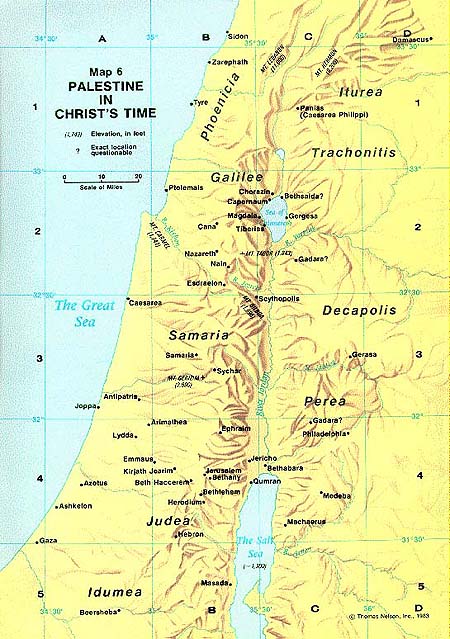
What is the significance of these three cities? As :20 says, these were “the cities in which most of His miracles were done,” around the Sea of Galilee, where Jesus spent much of His ministry:
— Bethsaida: the word means “house of fishing,” and it was nearby where Jesus fed the multitude with the 5 loaves and 2 fish, so they had had every reason to believe in Christ.
— Capernaum was the center of Jesus’ ministry when He left Nazareth, so they had a repeated and deep exposure to Him. He healed the centurions’ son there (Matthew 8:5); the nobleman’s son (John 4:46); Peter’s mother-in-law (Mark 1:31); the paralytic (Matthew 9:1) and so on. So these people had seen a LOT of miracles! They had no excuse for not putting their faith in Jesus — and yet obviously most of them did not, leading Jesus to pronounce this judgment upon them.
— Chorazin is actually only mentioned only this one time in scripture, here in this “woe” — but it’s obvious from what He said that Jesus had done a lot there.
So Jesus was saying, I did SO MUCH among you; all these miracles! You had so many opportunities to respond to Me — but most of them didn’t. So He pronounced judgment upon them.
He said “Woe” to you. The word “woe” comes from the Hebrew “oy” — in fact if you’ve heard of the Yiddish expression “oy vey” it’s related to that (“oh woe,” or “woe is me.”) Jesus says “woes”/judgments will be coming upon them, because they did not respond to Him when they had SO many opportunities.
In fact, Jesus makes a very sobering comparison here: He says in :21 if Tyre and Sidon (Gentile cities on the coast) had experienced the same miracles that these cities did, they would have repented! He says in :23 that if SODOM of all places, that infamously vile city, had seen all the miracles that Capernaum did from Jesus’ hand, they would have repented! That’s quite a statement to make!
First, this is an example of what theologians call “Middle Knowledge,” or “counterfactuals.” It means that God not only knows everything that is, or will be; He also knows what MIGHT have been in every situation: how people MIGHT have responded in a given situation. As humans we can only guess “if I had done this, would they have responded differently?” But God KNOWS! Jesus said, they would have repented if they had seen what you did!
Now, I’m certain that Jesus did not say these things to drive us into endless speculation on why He did and didn’t do what He did. The real point He’s making here, that we should apply, is: MAKE SURE YOU TAKE ADVANTAGE OF THE REVELATION AND THE OPPORTUNITIES GOD GIVES YOU. You are accountable for what you do with the opportunities He gives you.
Jesus told them: “it will be more tolerable for the land of Sodom in the day of judgment, than for you.” How could this be? Because JESUS HIMSELF walked among these cities. They saw His miracles; they heard the Sermon on the Mount, they ate the fish and the loaves. They had opportunities like no one else in history ever had! So they had no excuse. Like Jesus said in Luke 12:48, “To whom much is given, much is required.” When He gives us a lot, we are accountable to Him for that. (This also gives us an insight into His judgment when it comes: He will take into account how much revelation a person had, when He judges!)
But this is not just some inapplicable historical trivia is it? WE TODAY have unprecedented opportunities to hear and respond to the gospel, and to do God’s Kingdom work, don’t we?
???DISCUSSION/APPLICATION QUESTION???
“What are some advantages that WE have today, that we should not take for granted, but make sure we respond to, and take advantage of?
(Answers can include:
— the Gospel is preached in thousands of churches in our country, on virtually every street corner, on television, radio, internet, etc. Anyone who is seeking the Lord can surely find Him. There is no excuse for a person in America not to respond to the Gospel.
— And this applies to us as God’s people too. We have today unprecedented access to Bibles, books, commentaries, studies, resources to read/study/memorize/apply God’s word. We literally have today more opportunities today to learn scripture than any people in history, ever. Are we using them as we should?
— We have opportunities to watch videos, sermons, get training to serve.
— We have unparalleled opportunities to go on mission trips. In Jesus’ day it took them a whole day to travel about 20 miles; but we can do that in 20 minutes! We can literally be anywhere in the world in about 24 hours! Are we using these opportunities to go on mission and further God’s kingdom?
You/your group can discuss these and other opportunities and advantages that we have today. The point is, like Bethsaida and Capernaum, God has given us opportunities that most people in the world of all times only wish that they might have had. So we’d better take advantage of the multiple opportunities and privileges God has given us.
ILLUSTRATION
Anton Bruckner was an Austrian composer who lived in the 1800s. He had a very creative mind, but for years his musical creations were opposed and rejected. People wanted him to change what he was doing. “Yet Bruckner continued to compose, believing that his talent was a trust given by God. He once explained with deep emotion, ‘They want me to write in a different way. I could, but I must not. Out of thousands I was given this talent by God, only I. Sometime I will have to give an account of myself. How would the Father in Heaven judge me if I followed others and not Him?” (Patrick Kavanaugh, Spiritual Lives of the Great Composers, pp. 133-134)
Bruckner realized that he was accountable to God for the privilege that He had given him, so he was careful to use his gifts for His glory. As Jesus says here, we too will be accountable to Him for what we do with all the gifts and privileges He has given us. Let’s not take them for granted, but use them to further His kingdom, as long as He gives us life.
____________________________________________
— Remember there is now a “PRINT” button at the end of the lesson on my blog, that you can hit to print out the lesson in its entirety to read, study, or use to teach.
— If you’ll type your email in the “Follow blog via email” blank on my blog home page, WordPress will automatically send you next week’s lesson and you won’t have to search for it each week.
— And if you write something in the Comments section, my commitment is to pray for your and your group and any special request you make, by name this week.
Per my licensing agreement with Lifeway:
— These weekly lessons are based on content from Explore the Bible Adult Resources. The presentation is my own and has not been reviewed by Lifeway.
— Lifeway resources are available at: goExploretheBible.com and: goexplorethebible.com/adults-training
— If you have questions about Explore the Bible resources you may send emails to explorethebible@lifeway.com


 shawnethomas
Thanks.
Thank you for providing us with such solid lessons, Shawn. Please be in prayer for the Young Married Class @ First Baptist Church – College Station as we attempt to take these Biblical Truths and impart them into our lives particularly in the context of strengthening young marriages.
Sent from my iPhone
Thanks for the regular publishing the Bible study material for us.
Matthew 8 : 5- 13. Jesus heals the Roman Centurion’s servant, not his son.
Wow that is fantastic Donnie! I will sure be praying for you and your class this week! 👍❤️🙏
Shawn,
May I ask you to comment on Matthew 11:11 ?- – “Truly I tell you, among those born of women no one greater than John the Baptist has appeared, but the least in the kingdom of heaven is greater than he.” I understand why Jesus would say that he was great, but part b of this verse seems to indicate that those who come to faith under the New Covenant are greater than those of faith prior to Jesus’ death, burial, and resurrection. How is this verse to be understood? Donnie Calvin / Huntsville, TX
Yes sir, that’s a good question, and I thought some might wonder about it, but didn’t want to take too much time with it in the video since I felt like the doubt issue was the real focus. I do think Jesus is emphasizing the greatness of John the Baptist, that was the point He was making. But as a side-note, and perhaps almost like a foreshadow of things to come, He adds: “But the least in the kingdom … is greater.” I think He’s hinting to those who will listen, that as great as John was, those who will be born again into His Kingdom will have advantages that John never had: the personal relationship with Christ, the permanent indwelling of the Holy Spirit, “Christ in Us;” and so on. I don’t think He’s diminishing that John may have been the greatest mere man who ever lived – rather He’s just also emphasizing that something even greater is about to come; make sure you get in on it! Hope that helps! I’ll be praying for you and group this week Donnie!
Thank you, Shawn! Your insight is much appreciated. Even though Verse 11 is not part of our focal passage this week, I wanted to understand this and be able to give a good answer in case some of my “studious” Bible study folks honed in on that verse.
Absolutely! That’s part of good prep for a teacher: anticipate what questions/objections etc might arise, and be ready just in case. Good job on your part! Praying for you!
Dear Shawn, I have been teaching a SS class of 70 years old and older men for the last 5 years and using your commentary as one of my tools. I’m asking for prayer I am recently experiencing a decline in my vision and have had to step aside from teaching. Even this comment I am dictating to my wife who is helping me through it, all the specialist are stumped I know God’s will will be done. Thank you for the years of your commentary.
Mr. ThomasI do appreciate your lessons each week, I do read them each week along with our book. I am only a substitute, and probably only have to teach about 4 times a year but these studies are very helpful to me, and I appreciate you allowing us to quote you from time to time or use some of your illustrations.Thanks Again Barry