
(Sorry for the glitch in the original version of this post! Please let me know if you have any further difficulties with it!) An overview for teachers, including a suggested introduction to the lesson, text outline and highlights, illustrations to share, group discussion questions, and spiritual life applications. A video version of this overview is available on YouTube at:
INTRODUCTION:
???DISCUSSION QUESTION??? What do you think of this quote:
“To be a Christian means to give as much of myself as I can, to as much of Jesus Christ as I know.” (Sam Shoemaker, a well-known pastor in the early 1900s)
(It’s not the fullest definition of a Christian, but I do like the idea he expresses that we commit ourselves to “as much of Jesus Christ as I know.” Because who knows everything about Christ and salvation when they first accept Him? No one! How much did the thief on the cross know? What was OUR theology when we were saved?! We’ve learned a LOT since then right?)
In fact you might even ask: “What’s something you’ve learned about salvation since you were saved, that you didn’t understand at first?”
(There should be lots of answers to that: some might say they thought at first it was just “being forgiven and not going to hell,” but now they know it’s more about a relationship with God; maybe they didn’t understand “once saved always saved” at first, and so on. We learn more about our salvation after we put our initial faith in Christ — and the truth is, we will continue to learn, or we should — as long as we live.)
This week’s passage in Romans 5 is one that teaches us more about our salvation: about some of the blessings of salvation, just how much God loved us that led Him to save us, and what Christ did for us. Let’s pray that it will help each Christian appreciate their salvation more than ever before — and inspire those who don’t know the Lord, to give their life to Him today!
CONTEXT:
As we’ve mentioned, the Book of Romans contains the fullest explanation of the gospel of Christ. Paul told the Romans in Chapter 1 that he wanted to come to Rome to share the gospel, because it is God’s power to save — and then he showed in Chapters 1-3 why everyone needs to be saved: because we are all sinners! But in the second part of Chapter 3 he adds the good news: because of Christ’s death on the cross, anyone who believes in Him can be saved through faith. In Romans 4 he uses the example of Abraham to show how even Old Testament saints were saved by faith, not by their works. This brings us to our passage in Romans 5 this week, where Paul details some of the blessings of salvation through faith in Christ, as well as some more insights into that salvation.
OUTLINE:
I. The Numerous Benefits of Faith (:1-5)
II. The Unfathomable Love of God (:6-11)
III. The Redeeming Power of One (:18-21)
TEXT: Romans 5:1-11, 18-21
I. The Numerous Benefits of Faith (:1-5)
:1 “Therefore, having been justified by faith, we have peace with God through our Lord Jesus Christ, 2 through whom also we have obtained our introduction by faith into this grace in which we stand; and we exult in hope of the glory of God. 3 And not only this, but we also exult in our tribulations, knowing that tribulation brings about perseverance; 4 and perseverance, proven character; and proven character, hope; 5 and hope does not disappoint, because the love of God has been poured out within our hearts through the Holy Spirit who was given to us.”
(NASB 1995)
“Therefore” as always points us back to what he had written before: everything we talked about in the context, and especially how Chapter 4 talked about Abraham as an example of how he and all of us are justified by faith, and not by our works. And he even refers specifically to this: “Therefore, having been justified by faith” — so what happens as a result of this? What are some of the benefits we receive?
???DISCUSSION/EXERCISE???
You might ask your group to point out what blessings/benefits of salvation through faith in Christ they see as they look at :1-5:
(Answers can include:
A. PEACE WITH GOD. :1b “we have peace with God through our Lord Jesus Christ.” This is a great picture of what Jesus has done for us: He made peace for us with God. Were we at war with God? Yes we were. We had all rebelled against God, by our sin. Remember we quoted R.C. Sproul a couple of weeks ago: “Sin is cosmic treason.” Verse 10 below says “we were enemies” of God. And as we saw in Romans 3, we were unable to do anything about it ourselves. But Jesus came, dying on the cross for our sins, and as we saw, He “ransomed” us, “satisfied” God’s wrath against us; “justified” us — all those things — so now if we will repent of our rebellion against God and put our faith in Christ, we can have peace with God.
The word “peace” here is the Greek word “eirene,” which comes from a verb meaning “to join; tie together in a whole.” Those who were separated or estranged, are now brought together. This word is used regarding nations, and individuals — and also and especially, of man and God being brought together in Christ.
One of the great ILLUSTRATIONS of this is the GAP:

Man is separated from God by our sin. As we’ve seen, no good works or deeds on our part can bridge that gap — and that’s what all world religions attempt to do.
BUT GOD did for us what we couldn’t do for ourselves. HE BRIDGED THE GAP through Jesus’ death on the cross:
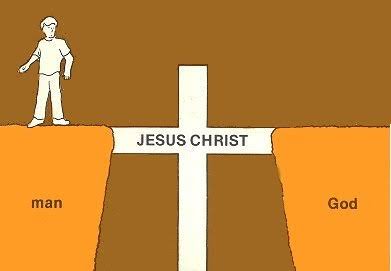
So now we have “peace” — we have been reconciled, brought back together to God. We are no longer enemies of God, but friends, even His children. God’s not against us, He’s for us (as hard as that is for some of us to realize; but it’s true in Christ!) And importantly, this only happens through Christ: “Through our Lord Jesus Christ,” as :1 says. It is only those who have come to God through Christ, that have this peace with God.
B) A STANDING IN GRACE. He says in the first part of :2, “through whom (Christ) also we have obtained our introduction by faith into this grace in which we stand.” This is a great picture: in Christ, we now “stand” (the Greek word “histemi,” just meaning “stand”) in grace. It’s like we’ve arrived in this new country, called “Grace,” which has all these benefits for us.
???DISCUSSION QUESTION??? “What are some of the rights and liberties we enjoy as American citizens?” (They are so many, right? The Bill of Rights: freedom of assembly, freedom of religion, freedom of speech, a citizenship and rights that can never be taken away from us. All because we have the “standing” of a citizen of this country.)
But we have an even greater standing as Christians. We “stand” in this GRACE of God: we have forgiveness of sin, peace with God, all the blessings we see here in Romans 5:1-5 and more — and they can never be taken away! “Nothing can separate us from the love of God which is in Christ Jesus our Lord” Romans 8 says, because “we stand” in this grace of God through faith in Christ!
C. HOPE OF GLORY “We exult in hope of the glory of God.”
REMEMBER in Romans 3:23, Paul had written, “For all have sinned and FALL SHORT OF THE GLORY OF GOD.” God’s glory is what we were all created to be fulfilled and satisfied by — but which we separated ourselves from by our sin.
BUT NOW, through faith in Christ, “We exult in hope of THE GLORY OF GOD” again! A couple of word definitions:
— “hope” here does not mean “I hope so …”; rather it means a confident expectation. We WILL see that glory we all long for! We have NOT missed out on it!
— So we “EXULT” in this hope. The Greek word for “exult” literally means “to live with your head up high.” We can “live with our head up high,” because we have the glory of God to look forward to!
ILLUSTRATION
I remember one time I had a really difficult and busy week of work ahead of me. I was NOT looking forward to it. But there was one thing that comforted me: after that week was over, we were going to Disney World! Something like that makes a difference, doesn’t it? You can endure all the drudgeries and hardships of the week ahead — because of the joyful anticipation of what you’re about to experience at Disney, or at the Grand Canyon, or that trip to Europe, or whatever you’ve been looking forward to. So you can “lift up your head,” because you know the great thing that’s coming!
That is the attitude we as Christians should have! “We exult in hope of the glory of God”! We’re going to experience that glory we were created to enjoy!
— As I John 3:2 says, “We shall behold Him, just as He is!”
— As Psalm 16:11 says, “In Your presence there is fullness of joy; in Your right hand there are pleasures forever.”
— Psalm 17:15 “As for me, I shall behold Your face in righteousness; I shall be satisfied with Your likeness when I awake.”
All of this is waiting for us!! So we can “exult in hope of the glory of God”!
D. HOPE IN TRIBULATIONS! Then he says in :3, “We also exult in our tribulations …”. WHAT? It’s one thing to exult in hope of glory; but we can “Exult in our tribulations?”
This is that same word “exult” that means “to live with your head up high.” “Tribulations” comes from a word that means “pressure,” being “hemmed in.” It means “persecution, tribulation, trouble.” How do we usually feel when we are “under pressure,” or in “persecution” or “trouble”? Well, it’s easy for us to bow our heads and sulk, or weep, or throw a fit.
But he says, through faith in Christ, we can “live with our head up high” even in our troubles! How? There’s a whole “chain” of things here in :3-5 that help us with this. He says:
— “knowing that tribulation brings about perseverance.” When we endure difficult times, it builds perseverance in us.
— “and perseverance proven character.” This perseverance builds our character.
— “and proven character hope.” If our character is improving, and we’re becoming more like Christ, that gives us even more hope that our faith is not in vain; this is yet another sign that we will indeed enter all the glories of the presence of God, just as we were promised.
So even in our tribulations, we can “live with our head up high,” because what happens in these times shows that God is working in us; it assures us even more of our salvation — and should make us even more excited about the glory we’re headed to!
E. GOD’S SPIRIT/LOVE :5 “the love of God has been poured out within our hearts through the Holy Spirit who was given to us.”
— the love of God in our hearts: As God’s children we experience His love for us that blesses and comforts us; and then that love “spills over” into love for our fellow Christians who become so precious to us, and even love for the lost, just as God loves them. This love of God in our hearts is a great blessing of faith in Christ.
— and how do we experience that love? “Through the Holy Spirit who was given to us”! One of the greatest blessings of salvation through faith in Christ is that His Spirit comes to dwell inside us! Ephesians 1:13 says “after listening to the message of truth, the gospel of your salvation—having also believed, you were sealed in Him with the Holy Spirit of promise.” The Holy Spirit of God Himself is in us, bringing the comfort of His presence with us, His love (as he mentions here) His peace, His conviction, His power, His gifts, on and on. And as Eph. 1:13 and other scriptures make clear, He comes in because we believed in Christ.
All these things are just some of the innumerable blessings and benefits of faith in Christ!
II. The Unfathomable Love of God (:6-11)
:6 “For while we were still helpless, at the right time Christ died for the ungodly. 7 For one will hardly die for a righteous man; though perhaps for the good man someone would dare even to die. 8 But God demonstrates His own love toward us, in that while we were yet sinners, Christ died for us. 9 Much more then, having now been justified by His blood, we shall be saved from the wrath of God through Him. 10 For if while we were enemies we were reconciled to God through the death of His Son, much more, having been reconciled, we shall be saved by His life. 11 And not only this, but we also exult in God through our Lord Jesus Christ, through whom we have now received the reconciliation.” (NASB 1995)
I think another good participation EXERCISE would be to ask:
“What terms do you see in :6-10 which describe us before Christ?”
(Before we look at these first two words, let me give you a little “grammar lesson.” There is something called the “alpha privative.” It’s when you put an “a” in front of something to mean “not.” ??? Can you think of some examples of these??? (“A-theist (NOT-God, does not believe in God; “A-typical” means it’s NOT typical, etc.)
The reason I give this is because it helps us understand the first two terms here in :6:
(— :6 “helpless” “A-sthenes,” literally, NOT strong.
— :6b “ungodly” is “a-sebes.” Sebomai means to “respect or worship,” so a-sebes means NOT respectful of God; NOT worshiping Him.
— :8 “sinners” from the word “hamartia,” “To miss the mark.”
— :10 “enemies” = “someone openly hostile”
— You could add :9, the “wrath of God” was coming upon us!
You get the picture! It’s an ugly picture, of who we were before Christ: helpless and without strength to save ourselves, not respecting or worshiping God, sinners missing the mark, openly hostile enemies of God, with the deserved wrath of God coming upon us!
But amazingly it says “Christ died for the ungodly … Christ died for us.” Not for His friends or for some nice people, but for disrespectful, hostile enemies!
It’s an amazing thing whenever a person gives their life for someone else. When that happens, we admire, celebrate and award it.
ILLUSTRATION:
In 1941 Father Maximillian Kolbe, was a Polish priest, at the Auschwitz German concentration camp. A prisoner had tried to escape, so the German commander ordered that ten men must die as a punishment to deter any further escape attempts. He selected 10 men at random. One of the men cried out that he was a father and a husband — so Father Kolbe asked if he could die in the man’s place. The commander made a jeering remark to him using a derogatory term about priests, but he nodded and let him take the man’s place. I’ve used that story before, as an example of how Christ took our place, dying for us on the cross. And it IS a good example of what Christ did, to a certain extent.
But according to Romans 5 here, Christ’s love runs much deeper even than that! It says “while we were yet sinners” Christ died for us; “while we were yet enemies” we were reconciled through His death. The better example of what Christ did, would NOT be the priest volunteering to die for the weeping husband, but for him to die for the vicious, sadistic German commander! THAT would be unfathomable. Who in the world would that THAT? And yet that is exactly what the Bible tells us here that Christ did for us! Jesus did not die for His friends, which would be commendable; rather He died for His enemies, which is unfathomable!
But thank God He has that kind of love for us, because it’s the only way that any of us could be saved — because Christ died for us “while we were yet sinners;” “while we were yet enemies.”
Think of the worst sin you ever committed (this is NOT a group discussion question!) — but then realize: when you were THAT kind of sinner, that is when God loved you, and sent Christ for you: in your worst sin, in your worst tirade, in your most selfish act or most despicable thought — that is when God loved you, and Christ came to die for you! “Amazing love, how can it be.”
A couple of APPLICATIONS here:
— I don’t think many of us as God’s people realize the depths of our situation before we came to Christ. We often think of ourselves as “pretty good people,” not really “sinners” and “enemies.” But we’re looking at ourselves on the other side of the cross. Most of us need a better understanding of just what our lost state was without Christ. For one, it will make us appreciate so much more the extent of Jesus’ sacrifice for us. And it will also make us more considerate and compassionate towards others who do not know Him yet. That’s where WE TOO were headed, before we came to Christ!
— And that leads to a second application: since God has demonstrated this kind of unfathomable, undeserved love to us, we should ask for His grace to help us show this same kind of love to others who “don’t deserve it.” In fact, you and your group might consider:
“Is there someone in my life/neighborhood/work/school, who ‘doesn’t deserve’ my loving actions — but that God might lead me to show His gracious love to, as a witness of the kind of unfathomable love that He has shown me?”
God showed me someone specific this week — perhaps He will nudge your heart about someone like that in your life this week as well.
III. The Redeeming Power of One (:18-21)
:18 “So then as through one transgression there resulted condemnation to all men, even so through one act of righteousness there resulted justification of life to all men. 19 For as through the one man’s disobedience the many were made sinners, even so through the obedience of the One the many will be made righteous. 20 The Law came in so that the transgression would increase; but where sin increased, grace abounded all the more, 21 so that, as sin reigned in death, even so grace would reign through righteousness to eternal life through Jesus Christ our Lord.” (NASB 1995)
The picture here is that what one man messed up, another Man made right: through Adam sin came into the world, but through one Perfect God-Man, sin was forgiven and many were made right with God.
:19 says “through the one man’s disobedience the many were made sinners.” How is this? Because Adam sinned, he passed down to every person who came after him a sin nature, which predisposes each of us to sin.
We don’t arrive on earth as a “tabula rasa,” a “blank slate.” (This is the mistake many educators and politicians make!) Human beings are NOT by nature “good.” As we saw in Romans 3, “There is none good.” WE ALL HAVE A SIN NATURE. We inherited this sin nature from Adam. Genesis tells us that Adam and Eve chose to sin, and they brought sin into the world. So now everyone descended from them inherits a sin nature, and this affects everything we do.
This is why we don’t need to teach our kids how to sin. Did anyone teach your kids to disobey, or to fight with their siblings, or to lie? Nope. Despite our best efforts to raise them in the right way, they come up with this all on their own. (Someone has said that anyone who’s raised a child should have no trouble believing in a sin nature!)
Having a sin nature doesn’t excuse us; for when we come to an age where we know the difference between right and wrong, we all personally choose to sin, so we aren’t just condemned for Adam’s sin; we have plenty of sins we’ve chosen to commit personally!
So how can this be reversed? God sent Jesus to be a “second Adam,” to UN-DO the damage that Adam had done.
???DISCUSSION QUESTION???
“Can you share a time when you messed something up, and had to have someone else come and fix it?”
(For example, in 1994, Cheryl & I bought our first home in Tulsa when I took a pastorate there. I’m not real handy, but I tried to be a responsible homeowner and do some projects around the house. At one point, Cheryl told me our outdoor faucet was leaking, so I thought I’d just try to fix it myself. I located the pipe in our bedroom closet, and I thought, I can just tighten that —but man, I twisted that wrong and water started shooting out everywhere. I had to run outside and turn the water off — and call the plumber. He had to fix what I messed up!
We all have stories like that: we messed it up, and someone else had to come and fix it.
And this is the basic story of mankind: Adam messed it up (and we all followed in his steps), but God sent Christ to fix what he messed up. One sinful man, Adam, caused the problem — and another Perfect Man, Jesus, came to make it right.
— Paul talks about this extensively here in Romans 5
— I Cor. 15:22 “For as in Adam all die, so also in Christ all shall be made alive.”
Now, there is an important point here that might be overlooked, but which is very important. EVERYTHING PAUL SAYS ABOUT SIN NATURE HERE IN ROMANS 5 IS BASED ON THE HISTORICITY OF THE MAN ADAM, that there was a literal man, “Adam,” who started this. This is important, because a number of people — sometimes even well-meaning Christians — teach that Genesis 1 & 2 is just a myth: a symbolic (but fictitious) story which communicates a deeper truth; that there was no real “Adam” per se, but that he was just a “symbol” of how mankind has sinned against God. They assert that we don’t need Genesis to be literally true to learn the lesson of sin. They usually do this in order to help “reconcile” the Bible with popular views on evolution, which precludes a literal “first man,” Adam.
BUT WHAT WE HAVE TO UNDERSTAND IS THAT THIS IS NOT HOW THE BIBLE TREATS GENESIS! Scripture repeatedly refers to Adam as a historical man who committed a real act. And our present passage in Romans 5 is one of those. It says:
— :19a “through the ONE MAN’S disobedience the many were made sinners.” This speaks of Adam as a real individual who brought lasting effects into the world. There are other passages like that:
— Luke 3:38 traces Jesus’ genealogy back to a real man, Adam.
— I Cor. 15:45 speaks of “THE FIRST MAN, Adam”
— Acts 17:26 Paul says “He made from ONE MAN every nation of mankind …”
And so on. The New Testament clearly teaches that Adam was a real individual, not just a “mythical symbol.”
So be careful about compromising the Bible’s teaching about a “real Adam.” You’re “giving away the store” of our faith in the reliability of scripture, in order to compromise with an unproven and flawed scientific theory.
So Romans 5 teaches that Christ came to restore what Adam lost. Verse 19 says: “Through the one man’s disobedience, the many were made sinners — even so through the obedience of the One the many will be made righteous.” Adam’s sin had a devastating effect on everyone descended from him. But Christ opened the door for salvation for everyone who came after Him.
The phrase “the many” doesn’t mean that everyone is saved. That is the doctrine that is called “Universalism,” that every person will be saved. It is God’s desire for all to be saved (II Peter 3:9) but sadly that will not happen, because they reject God’s offer in Christ. Rather :18 says: “through one act of righteousness there resulted justification of life to all men.” In other words, through what Christ did, anyone now CAN be saved: God can now be “just and the justifier” as Romans 3:26 says, but it adds that it is “of the one who has faith in Jesus.” The New Testament clearly teaches that an individual must have personal repentance and faith in Christ in order to be saved.
But that salvation is available for all. The term “the many” that Paul uses here is the Greek term “hoi polloi.” You may have heard someone use the derogatory term “hoi polloi” to refer to the “common people.” This expression comes from that Greek term.
ILLUSTRATION
There was an Irish writer and tv producer (Nuala O’Faolain, NEW-la O FWAY len) who had a distinctive face, so people would often stop and ask her in public places, “Are you somebody?” Of course what they meant was: was she someone famous; someone important — as opposed to “hoi polloi,” some “common person”!
But the Bible tells us that God loves the “hoi polloi,” the “common people.” Isaiah 53:11 uses a related expression in its description of the Suffering Servant, predicting of the Messiah: “He will justify the many, as He will bear their iniquities.” The Greek translation of that phrase “the many”? The “polloi.” Jesus came to die for “hoi polloi,” the many; the common people. (“For consider your calling brethren, that there were not many wise according to the flesh; not many mighty; not many noble.” I Cor. 1:26)
Thank God you don’t have to “be somebody” in order to be saved. You don’t have to “do anything” impressive to gain salvation. All you have to do is believe the message, that “Christ died for our sins according to the scriptures” (I Cor. 15:3), that Jesus Paid It All” when He died on the cross for you; repent of our sins, put your faith in Him, and you will be saved.
I’m not “anybody;” I’m just “hoi polloi.” But Jesus came to die for “hoi polloi,” He came to save the common man who was lost. And He will save forever, every “hoi polloi” who puts their faith in Him. Thank God that’s the gospel this great Book of Romans proclaims.
— Remember there is now a “PRINT” button at the end of the lesson on my blog, that you can hit to print out the lesson in its entirety.
— If you’ll type your email address in the “Follow blog via email” blank on my blog home page, WordPress will automatically send you next week’s lesson and you won’t have to search for it each week.
— And if you write something in the Comments on my blog or YouTube, my commitment is to pray for your and your group and any special request you make, by name this week.
Per my licensing agreement with Lifeway:
— These weekly lessons are based on content from Explore the Bible Adult Resources. The presentation is my own and has not been reviewed by Lifeway.
— Lifeway resources are available at: goExploretheBible.com and: goexplorethebible.com/adults-training
— If you have questions about Explore the Bible resources you may send emails to explorethebible@lifeway.com


Thank you!
Sent from AOL on Android
Thank you so much! It worked perfectly
Sent from my Verizon, Samsung Galaxy smartphone Get Outlook for Androidhttps://aka.ms/AAb9ysg ________________________________
Thanks 🙏
Yes sir; you’re welcome. Praying for you this weekend!
Shawne,
Thank you for sending this lesson. I’ve come to count on your lessons each week in your perspective and use them unashamedly in our school class. It works perfect for those that are filling in while I’m out so again thank you for what you do and for the dedication to keep this up each week, I know you guys have a life, but thank you.
Sent from my iPhone
Paul Hylan
318-927-7703
paulhylan1@outlook.com
I’m glad that it’s helpful to you and to your subs Paul. Thank you for letting me know! I prayed for you all this morning and will be praying tomorrow as well.
My dad used to say “hoi polloi”. Now it makes sense,
Amen! Praying for you and your class this weekend Creston!
Please add my email to your weekly list.
It looks like you are added Angela! I’m praying for you this weekend!
Thank you!
Sent from AT&T Yahoo Mail for iPhone
I looked up “the many” in my Blue Letter Bible app to hear the pronunciation of “hoi polloi”. It was different. I found g4183 polys. Please explain the difference and where you got your Greek word from.
I enjoy going back to the original language and let scripture explain scripture.
My husband and I found you a few months ago and you are truly a blessing.
Thank you for preparing these messages of explanation for us.
Debbie the pronunciation he gave there is for “polus,” which is the singular root form. “Hoi polloi” is the plural form of it which is used in Romans 5:19. (I did notice while looking at the Greek text that “polloi” actually has the accent at the end there in Romans 5:19, so it should be pronounced “Hoi pollOY” like it is commonly used. (Of course however we say it, the point we really need to focus on is that Christ died for us common folks!) Hope that helps! I’m grateful that the overviews are helpful to you, and I’ll praying for you two this weekend!