
An overview for teachers, members, and group leaders of Lifeway’s Explore the Bible lesson of Romans 3:21-4:5, “Saving Faith,” for September 20, 2026. Includes a suggested introduction to the lesson, text outline and highlights, illustrations to share, discussion questions, and spiritual life applications. A video version of this overview is available at:
INTRODUCTION:
Jonathan Aitken writes that former slave trader John Newton was declining greatly in his last days, at 82 years old. He was blind, and his mind, once formerly so sharp and studious, was now cloudy and forgetful. One of Newton’s many minister friends, William Jay, visited him near the end of his life. He said Newton was hardly able to talk but he did say: “My memory is nearly gone, but I remember two things: That I am a great sinner and that Christ is a great Savior.” (p. 347)
Newton’s words have gone down as one of the most famous and beloved testimonies in history — and our passage for this week covers both of these vital truths of the Gospel: that we are all great sinners, but that Christ is a great Savior!
CONTEXT:
Romans contains the fullest explanation of the gospel of salvation by grace through faith in all the word of God. Paul tells the Romans in Chapter 1 that he wants to come and preach the gospel to them — and then he begins to demonstrate why the gospel is needed. He explains how God’s existence is known to all through the General Revelation of His creation, but man chose to exchange cheap substitutes for God’s glory, in the form of various idols. In Chapter 2 he then shows how it’s not only idolaters who have sinned, but also the supposedly “moral” Jews and Gentiles who self-righteously condemn others while committing the same basic sins. Thus both Jews and Gentiles are all under His righteous judgment.
It’s a dark picture, and in Chapter 3 it gets even darker: it shows us that there are actually “none who does good, not even one.” This brings us to our focus passage for today, which clearly shows us God’s way of salvation, not by any good works on our part, but only through faith in Christ, which should keep us all absolutely humble about our salvation!
OUTLINE:
I. Salvation For All Through Faith (:21-26)
II. Humility For All Through Faith (:27-31)
III. An Example For All Of Faith (4:1-5)
TEXT: Romans 3:21-4:5
I. Salvation For All Through Faith (:21-26)
“21 “But now apart from the Law the righteousness of God has been manifested, being witnessed by the Law and the Prophets, 22 even the righteousness of God through faith in Jesus Christ for all those who believe; for there is no distinction; 23 for all have sinned and fall short of the glory of God, 24 being justified as a gift by His grace through the redemption which is in Christ Jesus; 25 whom God displayed publicly as a propitiation in His blood through faith. This was to demonstrate His righteousness, because in the forbearance of God He passed over the sins previously committed; 26 for the demonstration, I say, of His righteousness at the present time, so that He would be just and the justifier of the one who has faith in Jesus.
The opening words, “But now” are similar to a “therefore.” They point back to what came before in the first part of Chapter 3, so we need to make sure we recognize that context. Paul used a number of verses earlier in Romans 3, pointing out how ALL humanity has sinned, and stands guilty before God. It summarizes and re-emphasizes what Romans 1 & 2 taught about how guilty all mankind is before God. Verses 10-12 proclaim: “There is none righteous, not even one; 11 There is none who understands, There is none who seeks for God; 12 All have turned aside, together they have become useless; There is none who does good, There is not even one.”
Verse 23 in our focus passage famously sums this up: “For all have sinned and fall short of the glory of God.” The scripture could not be more clear: all humanity has sinned before God, and we all fall short of His holy standard.
ILLUSTRATION:
Imagine the whole human race lining up on the Pacific shore of California, to see who could swim to Hawaii. How would that turn out? Well, some people, who are very weak or who can’t swim, would take a few steps in, and fail almost immediately. Many people can swim a bit, so they might go out a few yards, perhaps even a quarter of a mile, but they would eventually tire and fail as well. A few might be marathon swimmers, who could swim 20 or 30 or even 50 miles — but eventually they too would fall short. Who among us could swim to Hawaii? Absolutely NO ONE. Not one. Some might swim farther than others, but none of us would make it to Hawaii. We’d all fall short.
That’s just the picture God gives us in Romans 3 of mankind’s righteousness. NONE of us live up to His holy standard. NONE of us would make it to heaven, based on our own personal performance of righteousness. Yes, some may be a bit more righteous than others, but every single one of us falls way short.
So Romans 3:23 here is the low point of this first part of Romans: everyone has sinned. No one is righteous before God. But this low point is also the turning point, for :24 immediately says: “Being justified as a gift by His grace, according to the redemption which is in Christ Jesus.”
Thankfully God did not leave us all falling short of His glory that He made us to enjoy — though we would have deserved it if He had! But amazingly, God loved us, as Romans 5:8 says, and He gave us the greatest gift: the gift of His Son Jesus, who died on the cross to pay for our sins.
Several terms here describe what God did for us in Christ:
(You could do this as a GROUP EXERCISE Question: “What all terms do you see in this section that describe what God did for us in Christ?”
— :22 He gave us the “righteousness of God” This is the Greek “dikaiosune,” which is God’s “judicial approval.”
— :24 “justified” (and :26 “justifier”) (in Greek these are actually just different forms of “righteousness” that we saw in :22. It’s like:
— “righteousness” is “right standing”
— “justified” is “made right”
— “justifier” is “the One who made us right”
So these are all different forms of the same Greek word. But how significant that this word is used so repeatedly in this passage! God is really emphasizing here just how much we are made RIGHT with Him through what He did for us in Christ!
— :24b “redemption” “apolutreo,” “redeemed, ransomed, bought back what was previously lost.” F.F. Bruce writes that it refers to “the buying of a slave out of bondage, in order to set him free.” (We used a historical illustration of that in the 2nd lesson on Ruth)
— :25 “propitiation” “hilasterion,” from a verb meaning “to appease” the Divine Wrath against our sins, or to “make atonement” for our sins (it’s the word used for “mercy seat” in Hebrews). F.F. Bruce writes: “The death of Christ, then, is the means by which God does away with His people’s sin — not symbolically, as in the ritual of Leviticus 16 … but really. And REALLY in a two-fold sense; the sin has been removed not only from the believer’s conscience … but also from the presence of God”! (p.100)
— :24 we might include: “gift.” God GAVE us all this in Christ. It’s not something we have to earn or could ever deserve.
All of these terms together describe for us in a multi-faceted, and powerful way, how God saved us in Christ: not by our works, but by what HE did for us.
ILLUSTRATION:
Martin Luther King is famous for his “I Have A Dream” speech in which he said: “I have a dream that my four children will one day live in a nation where they will not be judged by the color of their skin, but by the content of their character.” That is indeed a good goal for us to work towards in this world!
But a few years ago R.C. Sproul Jr. wrote a Twitter post regarding our relationship with God, in which he said: “I thank God that I am not judged by the content of MY character, but by the content of HIS character.” (1/15/18)
That is exactly what happens when we get saved. II Corinthians 5:21 says: “(God) made Him who knew no sin, to be sin on our behalf, that we might become the righteousness of God in Him.” We are unrighteous — all of us. Jesus is perfectly righteous. But on the cross, Jesus took our unrighteousness, GIVES His perfect righteousness to everyone who believes in Him. So now, you will not be judged by the content of YOUR character, but by the content of JESUS’ character! You are made “right with God,” and now the doors of heaven will open to you, not because of anything YOU accomplished, but because of what Jesus accomplished for you!
And only Jesus could do this. Paul makes an incredibly important statement in :26: “That God might be just and the justifier of the one who has faith in Jesus.” Those two terms, “JUST,” and “JUSTIFIER” are vital. God made us to know Him, but we sinned and deserve His wrath. He wants to forgive us, to justify us, but He is a holy God who must punish sin. How can this possibly be reconciled?
This calls for something only God could do. F.F. Bruce quotes the ancient Roman poet Horace, who criticized those playwrights who too quickly introduce deus ex machina (the work of God) to solve the knotty problems that arise in a play. Horace writes: “Do not bring a god on to the stage, unless the problem is one that deserve a god to solve it.” (p. 96)
Interesting advice, but of no case ever was God’s intervention ever more needed than of the real case of our salvation: how could God be both “just” and “justify” us at the same time? He solved this in the Person of Jesus Christ, God Himself, who came to earth, propitiating, ransoming, redeeming, paying— all those words we just studied — for our sins on the cross. So now our sin IS both paid for, AND God is “just”to forgive us. So He is “both just and the justifier” as :26 indicates. (And this also reinforces why Jesus is the only true way to God. No other religion has truly solved this problem of “just” and “justifier.” God solved it one way, the only way it could be solved, and that was through Jesus.)
And Romans says here that all this happens BY FAITH!
NOTICE how many times the word “FAITH” is used in this passage:
— :22 that righteousness of God is “through FAITH in Jesus Christ”
— :22b “for all those who BELIEVE”
— :25 “a propitiation in His blood through FAITH”
— :26b “just and the justifier of the one who has FAITH in Jesus.”
Over and over we see that FAITH as the agency of our salvation is emphasized here. Like John 3:16 says, “Whoever believes in Him may have eternal life.” Now, we need to emphasize, “believe” here does not just mean “believe a historical fact,” like “I believe there was a person named George Washington.” James 2 says “the demons ‘believe’” that way! They know very well the facts about Jesus. But what the demons have NOT done is put their faith, their TRUST in Jesus as their own personal Lord & Savior.
ILLUSTRATION
The difference between “mental assent” and saving faith may be compared to the difference between someone pointing at a chair and saying, “I believe that chair can hold me up,” and the person who actually goes and SITS in the chair! It’s one thing to say “I believe that Jesus is the Savior.” It’s another thing entirely to TRUST HIM PERSONALLY TO SAVE YOU; to “rest your faith in Him.” That is saving faith.
???DISCUSSION QUESTION???
“What is something that you trust every day, maybe sometimes without even thinking about it?”
(There are all kinds of examples, aren’t there: like in that illustration we trust the chair we sit in; we trust our car; we trust the system of stop lights!; we trust the electricity to come on without understanding all about it, yet we trust it enough to switch it on — and on and on.)
In the same way, we need to “trust Jesus” — believe in Him, rely on Him; “put our weight on Him” to save us and be the Lord of our life. When we do that, then our sins are truly forgiven, and we are saved. And it’s not because of our works, but just by this faith in Jesus. (Our next two points will emphasize this further.)
And this gift of salvation is available to ALL! Verse 23 had said “All have sinned …” and then it goes on to say, “being justified as a gift by His grace.” The same “all” who had sinned (all of us) can be saved by His grace if they will put their faith in Christ. Verse 26 says “the one who has faith in Jesus.” It’s just like John 3:16 says, “Whoever believes in Him shall not perish.” It’s like Romans 10:13 says, “Whoever will call upon the name of the Lord will be saved.” Thank God that there is salvation available for anyone who will believe, through faith in God’s gift of Christ Jesus!
II. Humility For All Through Faith (:27-31)
:27 “Where then is boasting? It is excluded. By what kind of law? Of works? No, but by a law of faith. 28 For we maintain that a man is justified by faith apart from works of the Law. 29 Or is God the God of Jews only? Is He not the God of Gentiles also? Yes, of Gentiles also, 30 since indeed God who will justify the circumcised by faith and the uncircumcised through faith is one. 31 Do we then nullify the Law through faith? May it never be! On the contrary, we establish the Law.”
Verse 27 follows up the vital verses on salvation by grace through faith by asking, “Where then is boasting?” This Greek word means “boasting, glorying, pride.”
Unfortunately, “boasting” or “pride” too often plays a major role in people’s religious attitudes. They do “religious things” in order to be noticed and respected by others.
We have only to look at Matthew 6 in Jesus’ Sermon on the Mount to see this. He warned His disciples, using the “bad example” of the religious hypocrites of their day, not to practice their righteousness to be noticed by others (:1); not to give in order to be seen giving (:2-4); not to pray where everyone can watch you (:5), and not to fast noticeably (:16).
The reason Jesus shared these examples was because they were common in His day; this is what people were doing.
— Jesus said of the Pharisees in Matthew 23:5 “But they do all their deeds to be noticed by men; for they broaden their phylacteries and lengthen the tassels of their garments.”
— Remember the Pharisee in the Temple in Luke 18 proudly compared himself to the tax collector, saying “I fast twice a week; I pay tithes of all I get.” He was proud of the self-righteousness that he felt he had accomplished.
And the desire to be noticed and respected for one’s religious works has not diminished in our day either! People in many religions secretly enjoy being respected for their religious accomplishments. This is so prevalent in all the world religions, because they are virtually all based entirely on human works.
ILLUSTRATION:
Muslims believe in the “5 Pillars” of Islam which will give them a chance at Paradise — though they have no certainty until Allah actually weighs their good and bad deeds, to see if the good outweigh the bad, which would allow them to enter. Thus the one who is “saved” in their system could boast that he prays five times a day towards Mecca, gives alms to the poor, fasts during Ramadan, and has taken a “haj” or pilgrimage to Mecca: “I’ve DONE these things; I’ve earned a spot in Paradise,” and so on. And that’s just an example. Virtually every world religion has works that a person could be “proud” of.
Where then, Paul says here in :27, is this kind of “boasting” or pride in the gospel? He says, “It is EXCLUDED.” The Greek word literally means, “shut out.” It’s not let inside the room. There’s no place for it.
As we’ve seen, people love to glory in their religious accomplishments, but there is NO PLACE FOR IT among the people of God in Christ! How can we have any kind of “religious pride” when all we did was sin and condemn ourselves, and the only righteousness we have was GIVEN to us by Christ, because HE did it all for us on the cross?! There’s literally “no place” for Christians to boast. We should be the most humble religious people in all the world. We literally did nothing to earn our salvation. God did it all for us in Christ.
ILLUSTRATION
In 1944, to-be President George H.W. Bush was shot down by Japanese anti-aircraft fire, and he was drifting in the ocean by the island of Chichi Jima. Here he was, one man, drifting alone, in that vast ocean, where many other aviators had been killed, or captured by the enemy and then killed. But as Bush floated helplessly there, the U.S. submarine Finback surfaced, saw him, and pulled his little lifeboat towards them. Crew members reached out their hands and grabbed him and brought him in (as you can see in this picture from the Bush Library).
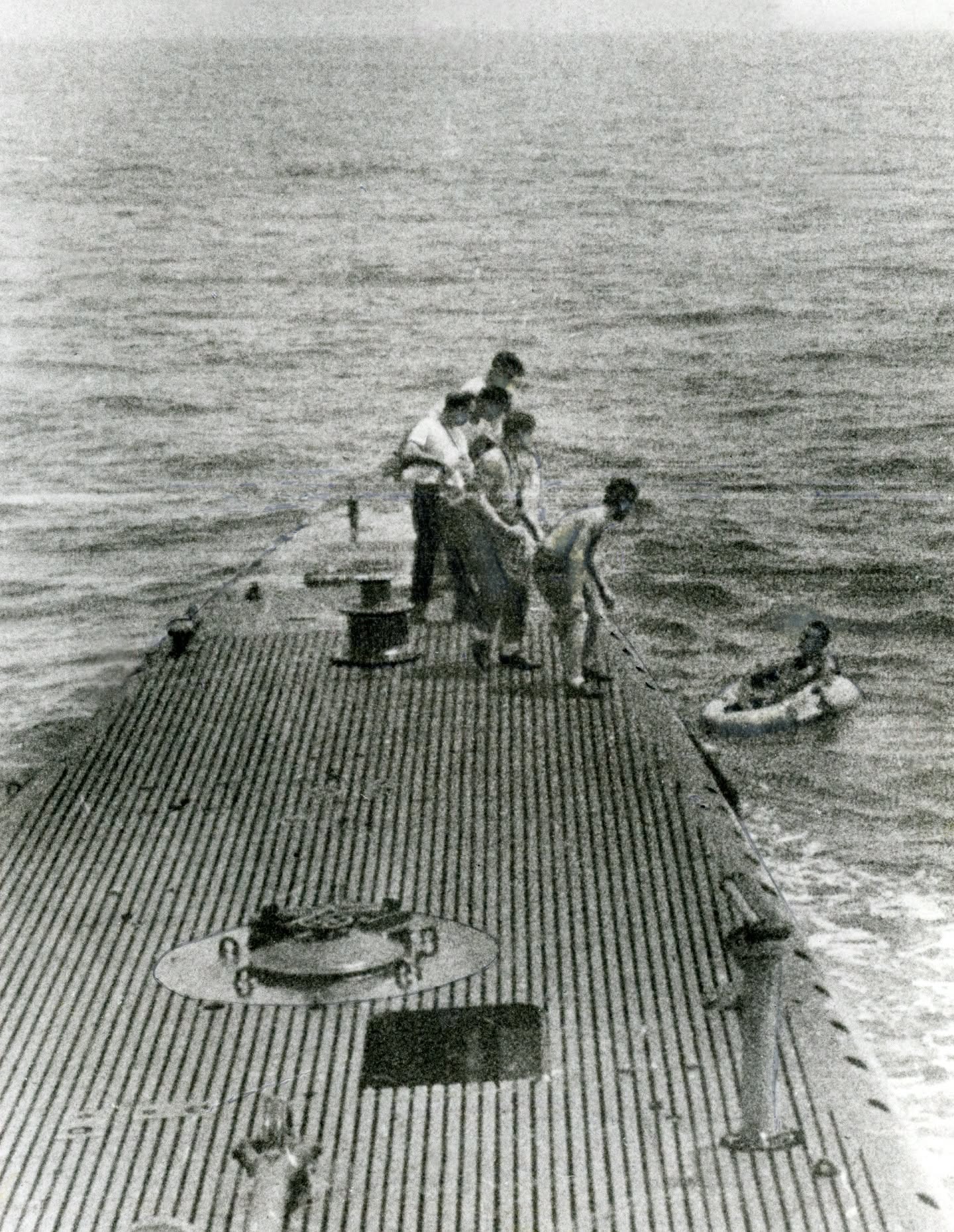
Bush received a medal for this action, although they tell us that he was very humble about it. And I can see why. He didn’t do anything to save himself. It’s not like he swam 1000 miles or climbed a huge cliff or anything like that. He floated there until they came and rescued him. There’s no way he could boast and say: “I rescued myself.” There’s no place boasting when someone else has rescued you!
That’s how it should be with us as Christians, too, isn’t it? We can’t “boast” about our salvation, as if we did anything. Jesus did it all! HE’s the One who cried “It is finished” and paid for our sins on the cross. All we’ve done is trust what He did for us. So “Where then is boasting? It is excluded.” There is literally no place for pride and boasting among Christians. You can’t be proud and brag about your salvation when Someone else did it all for you!
We need this reminder today, because unfortunately, many people have tried to bring the world’s view of “religious works” and accomplishment into the church. People think: “I go to church, I try to do good; so I am a ‘good Christian’ and I hope to go to heaven.” But this is not Christianity at all. In fact it is absolutely contrary to the Christian faith. As we have seen repeatedly, Christian salvation is NOT based on what we do for God, but on what GOD did for US in Christ! Let’s remind our members: we are only saved by Christ’s work, and there is “no place” for boasting for any of us as Christians.
The only place for boasting or pride in a Christian’s life, should be in JESUS and what He did for us. Paul says in Galatians 6:14, “But may it never be that I would boast, except in the cross of our Lord Jesus Christ.” Like President Bush, let’s be humble, because Someone else rescued us, and let our pride only be in HIM and what He did. I read on Facebook where a relative of one of the men who rescued President Bush said that he always expressed so much gratitude towards her grandfather because he helped rescue him. That’s how we should be towards God: humble, and grateful, boasting only in Him!
And again, this is true for “all.” Verse 29 and 30 mention both Jews and Gentiles. There’s no place for anyone to boast in Christ. Jews and Gentiles alike are condemned before God, and those who are saved, Jews and Gentiles, are saved only by God’s grace through faith. There’s “no place” for boasting among any us. Let’s be sure to live that way, talk that way, and remain humble, because we are only saved by faith in Christ.
III. An Example For All Of Faith (4:1-5)
4:1 “What then shall we say that Abraham, our forefather according to the flesh, has found? 2 For if Abraham was justified by works, he has something to boast about, but not before God. 3 For what does the Scripture say? “Abraham believed God, and it was credited to him as righteousness.” 4 Now to the one who works, his wage is not credited as a favor, but as what is due. 5 But to the one who does not work, but believes in Him who justifies the ungodly, his faith is credited as righteousness,” (NASB 1995)
So having made all those points about salvation by grace through faith in Romans 3, Chapter 4 now opens with an example: “What then shall we say that Abraham, our forefather according to the flesh, has found?” Why does Paul use the example of Abraham?
For one, some might have questioned him, saying: “Where did this ‘strange new’ teaching of salvation by faith come from? We thought salvation came from the works of the Law?” So Paul’s going to show them that even Old Testament saints, like Abraham, were not saved by works, but by faith.
And then he chose Abraham specifically because Abraham was, Paul said, “our forefather.” And not just “any” forefather, but “THE” forefather. Abraham was the one God called in Genesis 12 to leave his country and be the father of this new people, through whom God would bless the world. Abraham was the “first Jew,” the first of God’s “chosen people.”
ILLUSTRATION
George Washington has been called “the first ‘American,’” or “the father of his country.” If someone wants to justify their position today they’ll often use George Washington’s words or example as proof of their point. In the same way, Paul here points back to Abraham as “our forefather according to the flesh” and asks, “What’s HIS example? How was HE saved?” Abraham’s example is important and applicable to all of us as God’s people.
Paul says in :2, “if Abraham was justified by works, he has something to boast about.” If you’re saved by your works, then the glory for your salvation is YOURS:
— If George Bush had been able to swim 2000 miles to shore, he could have boasted in his own rescue.
— If the Muslim got into Paradise because his good deeds outweighed his bad, he could boast about his salvation.
— If John Newton had gotten into heaven because “he was a great sinner, but now he was an even greater Christian,” then he could have boasted in his own salvation.
“But not before God,” Paul says. No one will be saved by their works, as the scripture repeatedly makes so clear:
— “By the works of the Law, no flesh will be justified in His sight” (Romans 3:20)
— “By grace you have been saved through faith, and that not of yourselves, it is the gift of God, not as a result of works, so that no one may boast.” (Ephesians 2:8-9)
So Abraham was not saved by his works. No one is saved by their works, the scripture makes very clear.
So how WAS Abraham justified before God? Paul asks: “What does the scripture say?” This is such a great example for us today. If we want to know the answer to something, ask “What does the scripture say?” Find that, and you will have your answer. “Show me scripture,” as Martin Luther asked his Roman Catholic interrogators.
“What does the scripture say” about how Abraham was justified? Paul then quotes one of the most significant scriptures in the whole Old Testament, Genesis 15:6, “Then he believed in the LORD, and He reckoned it to him as righteousness.” Genesis 15:6 is quoted directly at least FOUR TIMES in the New Testament: Romans 4:3, Romans 4:22, Galatians 3:6, and James 2:23. It was one of the apostle’s most-used “proof texts” from the Old Testament for salvation by grace through faith, and not of works.
So Paul says, the scripture shows us that Abraham was saved by FAITH — “he believed … and it was reckoned to him as righteousness” — not by his works. So he shows them that this salvation by grace through faith is not some “new fangled teaching.” This is how even the Old Testament saints were saved — even Abraham, the great “father of their faith” was not saved by his works, but by faith. And that’s how we must all be saved as well.
This passage also contradicts the assertion of some that if a person puts their faith in Christ, then that choice is a “work” that saves them. But :5 here clearly contradicts that. Verse 5 actually CONTRASTS “faith” and “work,” saying: “But to the one who DOES NOT WORK, but BELIEVES.” So “believing,” the scripture teaches here, is NOT considered a “work” that accomplishes our salvation. Romans 4:5 clearly teaches that faith is the opposite of work. It is salvation by grace through faith, and putting your faith in Christ is not a work. And it’s the only thing that can save us.
ILLUSTRATION:
In the 1800s, when Charles Spurgeon lived, the Niagara Falls were known worldwide — and tales of those swept away to their deaths on those Falls were also widespread! In fact, Spurgeon once used an illustration from a real incident at the Niagara Falls. He said two men were on a boat on the Falls that got carried away by the current, and they would soon be swept over and dashed to pieces. Some people on the shore saw this, and sent a rope out to the two men. One of the men saw a log floating by, and he grabbed it, hoping it might save him. Of course it did not, and he was carried away to his death. But the second man did grab hold of the rope, and they pulled him in and brought him safely to the shore. (Spurgeon’s Illustration Collection, 1870)
Spurgeon said trusting in our works to save us, is like that man who grabbed the floating log. There’s no hope in our works; it will only carry us to eternal destruction, and sadly that’s the end result of all man-made religions. But saving faith is like the rope from the shore — it is firmly anchored in Jesus, who will save everyone who takes hold of it.
And Romans 4 clearly shows us here that “taking hold of the saving rope” is not a “work” that saves us, rather it’s just trust in the One who holds it out to us. George Bush would never say, because he took the hand of a sailor on the Finback, that he by any means “saved himself”! And no one who’s put their faith in Jesus would ever think that was somehow a “work” that saved them. We’re saved only by God’s grace, through faith. That’s the good news of Romans 3 & 4. Yes “all have sinned and fall short of the glory of God “ — but we can be “justified as a gift, by His grace, through the redemption which is in Christ Jesus.”
___________________________________________
— Remember there is now a “PRINT” button at the end of the lesson on my blog, that you can hit to print out the lesson in its entirety.
— If you’ll type your email address in the “Follow blog via email” blank on the top right section of my blog home page, WordPress will automatically send you next week’s lesson and you won’t have to search for it each week.
— And if you write something in the Comments on my blog or YouTube, my commitment is to pray for your and your group and any special request you make, by name this week.
Per my licensing agreement with Lifeway:
— These weekly lessons are based on content from Explore the Bible Adult Resources. The presentation is my own and has not been reviewed by Lifeway.
— Lifeway resources are available at: goExploretheBible.com and: goexplorethebible.com/adults-training
— If you have questions about Explore the Bible resources you may send emails to explorethebible@lifeway.com


Shawn:
I teach senior adults and use your commentary every Sunday as your perspective is so very helpful.
Thank you for your faithfulness.
Chuck
Hey Shawn I teach Women’s Sunday School, at New Hope Baptist In Greshamville, Ga. I love your commentary every week. It is so informative and easy to teach. Thank you and please don’t stop. Diane Akins
great lesson, one of your you best , super illustration.
Brother Shawn I have not received your printable lesson for September 27 Restored Relationship. I always receive it on Saturday a week early. Please send to jlnoel54@gmail.com .
I have not received your printable lesson for September 27.