
Includes a suggested introduction to the lesson, text outline and highlights, illustrations to share, discussion questions for your group, and spiritual life applications. A video version of this overview, that you can read/study/print to use, is available on YouTube at:
INTRODUCTION/???DISCUSSION QUESTION???
“What’s something you to do remind you about something you don’t want to forget?”
(— I keep a detailed list of things that I need to do every day of the upcoming week. If I don’t have it on that list, it likely will not get done! So I’ve learned to constantly check that list, so I don’t forget.
— Since I’m retired, I don’t always set my alarm like I used to. I have my prayer & Bible time as soon as I get up — but that can be whenever I wake up now! But if I need to be up early for men’s accountability group, or to take someone to the airport, or for church on Sunday, I still set an alarm.
— Sometimes I’ll also tell my wife Cheryl: “Don’t let me forget to get that crockpot meal going” or whatever. (And sometimes I’ll say: “If you remind about this, I won’t count it as ‘nagging’!”)
You and your group can share things you do when you need a reminder. Then note that in today’s lesson, the Apostle Paul tells the Romans that he has written to them “to remind you again” of some important things. Among those things, we see today, is our need to share the gospel with the world — a fitting emphasis for this time of year, as many of our churches focus on missions, and the Lottie Moon Christmas Offering!
CONTEXT:
We’ve come to our last lesson in this quarter’s study of Romans.
This great book includes a detailed explanation of the doctrine of salvation by grace through faith in chapters 1-11, then starting in chapter 12 Paul began to explain some “practical outworkings” of our salvation in our lives: including the need to be holy, to use our spiritual gifts, and to represent our faith well by being good citizens. In Chapter 14 he also taught that we shouldn’t impose our opinions on other Christians on minor issues of conscience.
Now as we come to Romans 15, Paul starts to wrap the letter up. In the first part of the chapter he continues the teaching of chapter 14, re-emphasizing that we should accept each others’ differences (:7), and live in unity with each other in the church (:6). Then in :8 he returns to his earlier theme about the Gentiles. He quotes several Old Testament scriptures about how it was always God’s plan to include the Gentiles in His family of faith. This brings us to our Lifeway “focus passage” for today, in which Paul gives them a “reminder” of our need to work together to evangelize the lost in the world.
OUTLINE:
I. Our Need of Reminders (:14-15a)
II. Our Mission to the World (:15b-21)
III. Our Co-laboring in Prayer (:30-33)
TEXT: Romans 15:14-21, 30-33
I. Our Need of Reminders (:14-15a)
:14 “And concerning you, my brethren, I myself also am convinced that you yourselves are full of goodness, filled with all knowledge and able also to admonish one another. 15 But I have written very boldly to you on some points so as to remind you again …”
After sharing God’s plan to reach the Gentiles with the Gospel in the previous verses, as we mentioned in the introduction, Paul turns his attention to his Roman church readers. He says in :14 that he knows they’re filled with goodness and knowledge, and are “able to admonish one another.” In other words, he believes they are spiritually mature, and can preach and teach these truths for themselves. But then he says in :15, that he has written to them — “boldly on some points” he says — “so as to remind you again.” In other words, he says, I know you know the truth. But I’m just telling you some of these things as a reminder.
And that’s a good word. If you’ve been a Christian for a number of years, like many of us have there’s not that much we’re going to hear in preaching or teaching that is “totally new” to you. As someone has said, if you hear some teaching that’s totally “new” after 2000 years of Christianity, it’s almost certainly wrong! (This is a challenge in our age, when so many things are “new”: we get new cars, and new innovations, and new technologies — and we can subtly develop a desire to have that “newness” in the church. If we aren’t careful, we’ll adopt some “new” doctrine or practice that is unhealthy or even heretical, out of our desire for something “new.” Beware of that! Paul says in II Thess. 2:15, “So then, brethren, stand firm and hold to the traditions which you were taught, whether by word of mouth or by letter from us.” Hold to the Biblical doctrines and godly practices, and don’t get an unhealthy continual desire for something “new.” That will get you in trouble!)
But we do need reminders. Paul says here, I’ve written to you very boldly on some points, so as to REMIND you again. The word “remind” in Greek is an intensive word (ep-ana-mimnesko) meaning to “remind again.” The word “mimnesko” would have worked; it means “remind.” But “ana” means “again”, and “ep” intensifies it. So it means something like: “I REALLY want to remind you again!” You need these reminders! And we do as Christians need reminders, don’t we?
Peter recognized the importance of this role of “reminding”:
— II Peter 1:12-13, “Therefore, I will always be ready to remind you of these things, even though you already know them, and have been established in the truth which is present with you. I consider it right, as long as I am in this earthly dwelling, to stir you up by way of reminder.”
Peter had just been talking in the first part of that chapter about the importance of spiritual growth, and making sure you were truly saved. He said, I know you know this; but I’m just reminding you about it, because it’s so important.
— II Peter 3:1, “This is now, beloved, the second letter I am writing to you in which I am stirring up your sincere mind by way of reminder” — and he went on to tell them about how both Jesus and the apostles warned them of the mockers who would come, asking “Where is the promise of His coming?”
They knew this; they’d heard about it; but he was just writing to remind them again.
Peter knew how important it was for God’s people to have reminders. It’s easy to just along on your Christian walk, and kind of “drift” one way or another; or gradually lose a good habit or practice — and it’s good to get a reminder to get you “back on track” again. It’s not some “new teaching;” you just need a reminder!
???DISCUSSION/APPLICATION???
“What’s a teaching or practice that many Christians probably ‘know,’ but may need to be reminded of?”
(— We need to be reminded that there’s a real devil, and that we’re in a spiritual battle every day. We all “know” that; but we need to be reminded about it, like Peter wrote in I Peter 5, about how the devil goes about like a roaring lion.
— We need to be reminded of the importance of walking with God daily in His word & prayer. Don’t we all “know” this? And yet we need to be constantly reminded how important it is, because the enemy is so good about distracting us from it.
— And in the aftermath of Thanksgiving, how important it is to remember “in everything give thanks.” Again, we all “know” it’s important to “count your blessings.” But it’s easy to lose that focus. So we need to be reminded to keep on actually doing it.)
And on and on. You/your group can share your own suggestions.
But this is a good “reminder” that a good part of our preaching, teaching, and encouraging ministries with each other, isn’t necessarily sharing some “new, earth-shattering teaching,” but rather just consists of reminding each other of important truths that we already know. And that leads us to our second point — a great truth that we all know, but need to be reminded of:
II. Our Mission to the World (:15b-21)
“… because of the grace that was given me from God, 16 to be a minister of Christ Jesus to the Gentiles, ministering as a priest the gospel of God, so that my offering of the Gentiles may become acceptable, sanctified by the Holy Spirit. 17 Therefore in Christ Jesus I have found reason for boasting in things pertaining to God. 18 For I will not presume to speak of anything except what Christ has accomplished through me, resulting in the obedience of the Gentiles by word and deed, 19 in the power of signs and wonders, in the power of the Spirit; so that from Jerusalem and round about as far as Illyricum I have fully preached the gospel of Christ. 20 And thus I aspired to preach the gospel, not where Christ was already named, so that I would not build on another man’s foundation; 21 but as it is written,
“They who had no news of Him shall see,
And they who have not heard shall understand.”
One of the things that Paul reminds the Romans of, was the importance of the mission Jesus gave us to reach the world with the gospel. He says in :15-16 that God gave him grace to minister the gospel to the Gentiles (remember “Gentiles” is the Greek word “ethne,” we get our word “ethnic” from it; it means “nations.” So he says, God’s sent me as an apostle to the “nations” — as opposed to working primarily among the Jewish people from whom the gospel originally came.
Then Paul begins to describe the work of his mission to the “nations”:
— He says in :18 that Christ used him to bring about “the obedience of the Gentiles in word and deed.” He describes this in I Thessalonians 1: that the gospel didn’t just come to them in “word only, but also in power and the Holy Spirit and full conviction” (:5). He said, hey, I didn’t just go on there and get a bunch of “decisions” that didn’t mean anything. Their lives were changed: “You became imitators of us and the Lord” (:6), and that even other people were telling Paul how the Thessalonians had “turned to God from idols” after his ministry there.
— He said in :19 that God gave “power of signs and wonders, in the power of the Spirit.” Acts is full of accounts of this. Hebrews 2:3-4 says “After it was at the first spoken through the Lord, it was confirmed to us by those who heard, 4 God also testifying with them, both by signs and wonders and by various miracles and by gifts of the Holy Spirit according to His own will.” Paul spoke of his ministry in II Cor. 12:12, “The signs of a true apostle were performed among you with all perseverance, by signs and wonders and miracles.
— So Paul was an “apostle,” as he indicated in Romans 1:1, “called as an apostle, set apart for the gospel of God.” The word “apostle” is actually a transliteration of the Greek word “apostolos,” which literally means “one who has been sent away,” or “sent one.” And he was “sent,” he says in :19, “from Jerusalem as far as Illyricum.” We all know where Jerusalem is; where is Illyricum? You can use a MAP like this one to show:
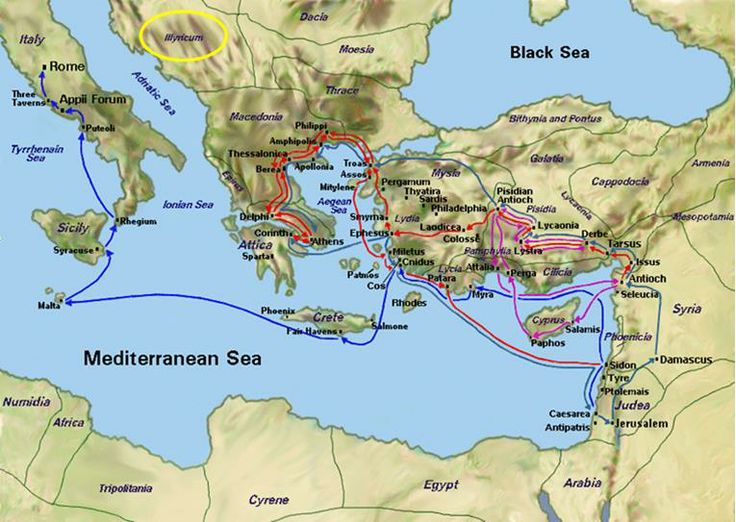
Paul says, from Jerusalem to Illyricum, north of what we’d call “Greece” today on the Adriatic Sea, he has “fully preached” the gospel of Christ. You can see from this map that he really did that! He shared it everywhere in between!
But what does it mean when he says he “fully preached” it?
— For one I think it means that everywhere he went, he shared the gospel (except where God specifically shut the door for Asia in Acts 16:6).
— But secondly, it means he didn’t compromise the message he preached; he shared the “full gospel” — as he told the Ephesians elders in Acts 20:21 “how I did not shrink from declaring to you anything that was profitable, and teaching you publicly and from house to house, 21 solemnly testifying to both Jews and Greeks of repentance toward God and faith in our Lord Jesus Christ.”
Paul says, I didn’t hold back; I shared the full gospel, including both repentance of our sins, and faith in Christ. (Many ministers today cannot say the same thing, as they have virtually eliminated “sin” or “repentance” from their preaching vocabulary!) We need to make sure that we too “fully preach” the gospel of both repentance and faith when we share.
— One more thing about his ministry, Paul says in :20-21, is that he specifically wanted to share Christ where He had not already been named — in other words, he wanted to go to what we would call today “unreached people groups,” people who had not yet heard of Christ. He wanted to share so that “they who have not heard shall understand.”
All this describes Paul’s “apostolic”/“sent out” ministry to the world with the gospel.
But make sure you don’t present this as MERELY A HISTORY LESSON! This applies to US! Jesus Great Commission of Matthew 28:18-20 and the Acts 1:8 command are still for His people today.
Acts 13 describes how Paul & Barnabas were sent out from the church at Antioch. We still “send out” people on mission with the gospel today: we call them “missionaries”! But in a sense they are “little a” apostles: they aren’t eyewitnesses to the resurrection of Christ, and perform apostolic miracles, etc, like Paul did, but like him they still go to places where Christ is not named, so that “they who have not heard shall understand.”
ILLUSTRATION:
Over thirty five years ago, my sister was called to full-time missions. This verse from Romans 15:20 was one the Lord used this verse to speak to her: “And thus I aspired to preach the gospel, not where Christ was already named …”. That gave her God’s direction for her ministry: she specifically wanted to go to a previously unreached people group, and and did, and she spent her adult life sharing the gospel with there. 35 years later there are now churches and pastors in that previously unreached people groups. But this verse was instrumental in that: she said right at the beginning: I want to go somewhere where the gospel has not yet been shared. And she did.
This was Paul’s call as well. And we need to be all about sending missionaries out with the gospel to the nations, just like Paul.
There are three “classic” means of supporting missions: “Giving, Praying, and Going”:
— Some GO on mission, like Paul, like my sister. Some of us need to hear and respond to God’s call to go. But to balance that, we also need to understand that is NOT everyone’s call. In Acts 13 there were FIVE “prophets and teachers” in the church there; after prayer and fasting, God called only TWO of them to out on the mission to the Gentiles: Paul & Barnabas. So it is today. Don’t succumb to a “guilt trip” just because you’re not a full-time foreign missionary. Not everyone should be. But we should all do our part in the mission to the world.
Those of us who are not called to go should:
— GIVE to support missions. As Southern Baptists, we support almost 4000 international missionaries. About half of their support comes from our SBC Cooperative Program, which every church sets their own amount from their budget. The other half comes from the Lottie Moon Missions Offering that we take at Christmas time. This would be a great place to emphasize that offering in your class, as many of our churches are kicking off that offering this weekend. Talk about how important this is.
ILLUSTRATION:
When my sister was on the mission field, there were people of several denominations there, and Christians overseas like that tend to see themselves as being more on “the same team” than we do here, so they were very close. But she said sometimes those other missionaries would say, “We’re low on funds; I have to go back to the States to raise support.” She never had to do that, because of our Cooperative Program and Lottie Moon Offering. Southern Baptists have our flaws, but we have a great thing going with our International Mission Board, and we need to give generously to support the gospel all over the world.
But we don’t have to be full-time missionaries to share in this kind of ministry. With the wealth and transportation we have these days, there are so many opportunities to go on short-term mission trips these days. As a pastor, I’ve had the opportunity to see many people saved and baptized during my ministry here in the U.S. But I may have seen more people saved on ONE mission trip to India, than in all my pastoral ministry put together.
On mission in Bulgaria a few years ago, in a predominantly traditionally Muslim area, I was able to share the story of the Prodigal Son with a couple of Bulgarians after a meal we shared together. It was amazing, telling that story to someone who heard it for the very first time!
Any of us who go on mission today can have that great privilege. But I know not all of us are able to go. If you can’t, then give generously. And we can all contribute in prayer — as we will see in our last section.
(You’ll notice the Lifeway “focus passage” skips from :21 to :30. In between Paul writes about how he still hopes to come and visit them in Rome, but first he is going to visit Jerusalem and bring the offering that he has been gathering from the Gentile churches to help the poor in the church in Jerusalem. He says then I hope to “stop by and see you” in Rome, on the way to evangelize Spain. He then encourages them to pray for him, as we see in :30 and following:
III. Our Co-laboring in Prayer (:30-33)
:30 “Now I urge you, brethren, by our Lord Jesus Christ and by the love of the Spirit, to strive together with me in your prayers to God for me, 31 that I may be rescued from those who are disobedient in Judea, and that my service for Jerusalem may prove acceptable to the saints; 32 so that I may come to you in joy by the will of God and find refreshing rest in your company. 33 Now the God of peace be with you all. Amen.”
Now Paul encourages the Romans to pray for him: “strive together with me in your prayers.” The English phrase “strive together with me” is actually one “50-cent” Greek word: “sun-agonizomai.” “Sun” means “together,” and our word “agony” comes from “agonizomai.” It means to fight together; strive together, labor together. The intense nature of it is conveyed by “agonizomai” that we get our word “agony” from.
HOW do we do this “striving’? The key phrase tells us: “IN YOUR PRAYERS.” We can labor and strive together with those on mission, through our prayers. It’s one of the most important things we can do.
Remember Paul wrote in Ephesians 6 that “our struggle is not against flesh and blood …” and he adjured believers in that chapter to put on their spiritual armor, and pray! He wrote in II Corinthians 10:3 “Though we walk in the flesh, we don’t war according to the flesh.” We Christians don’t fight with swords or guns; rather we do battle in PRAYER! Prayer is how we fight; prayer is how we win our battles.
ILLUSTRATION
“(1800s Andover seminary president) Austin Phelps … tells of Ethelfrith, the pagan Saxon king of Northumbria, who had invaded Wales and was about to give battle. The Welsh were Christians, and as Ethelfrith was observing the army of his opponents spread out before him, he noticed a host of unarmed men. When he asked who they were, he was told that they were the Christian monks of Bangor, praying for the success of their army. Ethelfrith immediately realized the seriousness of the situation. ‘Attack them first,’ he ordered.” (Timothy Keller, Prayer, p. 225)
That pagan king recognized the importance of prayer for winning our battles. We as Christians need to realize that too, and commit ourselves to be “co-laborers” with God’s kingdom and mission work, through our prayers. So Paul tells the Romans (and us!) here, that although we can’t be present with those who are away on mission, in a very real way we can work together with them in that ministry when we pray for them. It’s vital for them that we pray for them, because that’s how spiritual battles are won. And it’s important for us, because there is a great reward possible when we do!
Jesus said in Matthew 10:41, “He who receives a prophet in the name of a prophet shall receive a prophet’s reward.” In other words, when you support a minister/ministry, you receive a portion of the reward for whatever that ministry accomplishes. As we see here in Romans 15, prayer is a vital part of mission support. When you support a mission work, or a specific missionary in prayer, YOU will receive a portion of the reward for whatever comes out of that mission, because you were “working together” with it, through your prayers! That should be a great incentive for us to pray for missions and missionaries! You may be elderly, or ill, or unable for various reasons to travel — yet you can have a great impact on missions, and receive a great reward for missions work, if you will really labor with them in prayer!
NOTICE that after encouraging them to be co-laborers with him in prayer, Paul shared three specific requests with the Romans:
1) In :31 he writes: “THAT” (this indicates the request) he might be delivered from his enemies in Judea
2) “AND THAT” (:31b) his service for Jerusalem would be acceptable (remember he was going about on his mission trips, raising funds to help the poor in the church at Jerusalem. He was asking them to pray for that.)
3) Then in :32 he says: “SO THAT” he might be able to come and visit them in Rome, and share the gospel there, like he expressed a desire to do in Chapter 1.
So he gave these specific requests that he asked them to pray for. This is a good model for us: let’s don’t just pray “God bless all the missionaries” — but let’s pray as specifically as we can for their real needs. Find specific missionaries to pray for; keep up with their newsletters and pray for those needs regularly.
DISCUSSION/APPLICATION ACTIVITY:
“Share some ways that different ones of you are praying for missions/missionaries”:
(— For example, I have different missions/missionaries that I pray for regularly, each day of the week: for example, I pray for Romania and Bulgarian missions on Monday, our local Trinity Chinese Fellowship and its leaders on Tuesday, India missions, pastors and leaders on Wednesday, and so on. I pray for missionaries and leaders in these places by name, and keep updated on their prayer requests so I can pray specifically.
If you have missions/missionaries you pray for regularly, share what your plan is — and you/your group can share ideas of ways you could pray. If you have missionaries from your church, or that your church specifically supports, share about them, and encourage your class members to pray for them regularly, and specifically. We can do this all kinds of different ways. But let’s make sure that in some way we are “striving together” with our missionaries in prayer. Don’t just spend this lesson teaching how Paul told the Romans to pray! Let’s APPLY this and challenge our group members to DO what the scripture here says, and support out missionaries specifically in prayer. They’ll all tell you, it’s the single most important thing you can do for them.
CONCLUSION:
As you wrap up this lesson, you might review those 3 classic ways to support missions: “giving/praying/going.” Talk about specific opportunities your church may have: the Lottie Moon Offering, upcoming mission trips they can sign up for, specific missionaries to pray for and email updates they can keep up with. Ask every member to consider their own personal application of the scripture this week: “What is God calling ME to do differently, in my giving, in my praying, in my going, to help bring the gospel to the nations?”
___________________________________________
— Remember there is now a “PRINT” button at the end of the lesson on my blog, that you can hit to print out the lesson in its entirety.
— If you’ll type your email in the “Follow blog via email” blank at the upper right corner of my blog home page, WordPress will automatically send you next week’s lesson and you won’t have to search for it each time.
— And if you post something in the Comments on my blog or YouTube, my commitment is to pray for your and your group and any special request you make, by name this week.
Per my licensing agreement with Lifeway:
— These weekly lessons are based on content from Explore the Bible Adult Resources. The presentation is my own and has not been reviewed by Lifeway.
— Lifeway resources are available at: goExploretheBible.com and: goexplorethebible.com/adults-training
— If you have questions about Explore the Bible resources you may send emails to explorethebible@lifeway.com


