
Includes a sample introduction to the lesson, text highlights and outline, illustrations you can share, discussions for your group, and spiritual life applications. A video version of this overview is available on YouTube at:
INTRODUCTION:
You could begin the lesson this week with this quote from former U.S. President Woodrow Wilson:
“… a boy never gets over his boyhood, and never can change those subtle influences which have become a part of him, that were bred in him when he was a child.” (A. Scott Berg, Wilson, p. 38)
And/or you can use the following ???DISCUSSION QUESTION???
“What’s something that your mom or dad ‘always said’ to you when you were growing up?”
(EXAMPLE: My dad always used to say: “Play with the bull, you get the horn!” — in other words, you mess with somebody/something dangerous, don’t be surprised when you get hurt.
You/your group can share your own experiences.
Then transition: in today’s lesson in Deuteronomy 6, Moses tells Israel some important things that God wanted them not only to apply to their lives but also to pass down to their children and grandchildren. And we should do the same with His word today.
CONTEXT:
As we mentioned last time, Moses and Israel are in the Plains of Moab, just east of Jericho, across the Jordan, ready to enter the Promised Land. Moses will not be allowed to enter, so he’s giving Israel his last messages, which comprise this book.
After Moses’ first message to Israel in Chapter 4, that we studied last week, he then set aside 3 “cities of refuge” east of the Jordan (where people accused of a crime could go for safety until guilt was determined). Then in Chapter 5 he begins a new, second message: in which he basically goes over the Ten Commandments again (thus “Deutero-nomos,” or “2nd Law,” he goes over it again). He ends Chapter 5 encouraging Israel that if they KEEP this Law, it will be well with them. This brings us to Chapter 6, our focus passage for today, where Moses continues his second message to Israel as they prepare to enter the Promised Land.
OUTLINE:
I. The Commands to Obey (:1-3)
II. The God to Love (:4-9)
III. The Message to Share (:20-25)
TEXT: Deuteronomy 6:1-9, 20-25
I. The Commands to Obey (:1-3)
:1 “Now this is the commandment, the statutes and the judgments which the LORD your God has commanded me to teach you, that you might do them in the land where you are going over to possess it, 2 so that you and your son and your grandson might fear the LORD your God, to keep all His statutes and His commandments which I command you, all the days of your life, and that your days may be prolonged. 3 O Israel, you should listen and be careful to do it, that it may be well with you and that you may multiply greatly, just as the LORD, the God of your fathers, has promised you, in a land flowing with milk and honey.”
A. The authority (WHO gave the commands).
Moses gave the message here, but it wasn’t just him giving these commands. He said in :1, ““Now this is the commandment, the statutes and the judgments which the LORD your God has commanded me to teach you.” These are GOD’S commands.
We need to remember this today. People may challenge us when we speak God’s truth, and say things like: “Well, that’s just your opinion.” But it isn’t — if we are sharing scripture. Remember I Timothy 3:16, “All scripture is inspired by God.” GOD breathed His word, is literally the meaning of that phrase. These are not the words of men but the words of God.
B. The recipients (Who did God give them TO?) (:1b-2a)
“to teach you …. so that you and your son and your grandson might fear the LORD your God …”
NOTICE that several times this text mentions these RELATIONSHIPS:
— :2 “so that you and your son and your grandson might fear the Lord your God”
— :7 “You shall teach them diligently to your sons”
— :20 “When your son asks you in time to come …”
“you and your son and grandson;” “your sons;” “your son.” Three times in this text it mentions those family relationships, emphasizing that our faith is not just a “personal” thing; it is absolutely vital that we pass God’s word on to our children and grandchildren.
ILLUSTRATION:
When my wife Cheryl was in college, she had an oriental roommate. When Cheryl talked with her about her faith, this young lady said, My father was a Buddhist, and my mother was a Christian, so they decided not to instruct me either way. She said, so now I have nothing. Cheryl witnessed to her and still prays for her — but that can be hard to overcome. It just emphasizes to us the importance of a godly upbringing and spiritual influence we need to have on our children.
Challenge your group to think: WHO in my family specifically can I share God’s word with? Am I doing it? How can I more purposefully do it in the future? (And maybe some outside your family as well). God doesn’t want us to keep His word to ourselves, but share it in our relationships.
C. The Response. (What should we DO with His word?)
He wants us to OBEY/KEEP His word. We see this several times in this passage:
— :1 “that you might DO them”
— :2 “KEEP all His statutes and His commandments”
— :3 “listen and be careful to DO it”
In every one of the first three verses, God emphasizes the importance of DOING His word; of KEEPING His commandments. You may recognize that this is about the third week in a row where we have emphasized the importance of OBEYING God’s word. God’s commands are not given for information, entertainment, to just listen to, study, or memorize — but to DO, to OBEY, to PRACTICE.
ILLUSTRATION:
Some years ago a friend/fellow church member of ours, was working in a Crisis Pregnancy Center, and she was counseling a young expecting mother not to have an abortion, but to deliver her baby and give it up for adoption. After some time the young woman was convinced, and she said: “I will give up my baby for adoption — if YOU will adopt it!” That got real, really quick, didn’t it? Is this just something you just vaguely say you “believe” — or is this something you will practice in your life? And to her credit and to the glory of God’s grace, she and her husband did adopt that baby. They didn’t just “learn” or study or memorize God’s word, but they practiced it, in a very costly and meaningful way.
This text should confront all us with the question: Is there any instruction in God’s word that I am not really applying to my life in a real and specific way? If so, we need to take it seriously, and obey it, put it into practice in our life.
(Let me just say to you as a Sunday School teacher, that this is one of the reasons why I always try to have an “application” segment in these Sunday School lesson overviews. If all we do in our classes is just study ancient Middle Eastern history and archeology and religious concepts, we have missed the point. God gave us His word to DO, to obey! So every week we should ask ourselves and our group members: what are we to DO with this word? If we aren’t doing that, we’re falling short of God’s purpose for His word.)
As we see here in Deuteronomy 6:1-3, God Himself, has given US and those with whom we have relationships, this word, to OBEY!
D. The Promise (What will happen if we do)
The second part of :2 says “THAT (here’s the purpose) THAT your days may be prolonged.”
The second part of :3 says: “THAT (purpose again): THAT it may be well with you and that you may multiply greatly, just as the LORD, the God of your fathers, has promised you, in a land flowing with milk and honey.”
Now, we need to understand the context here, that this was a very specific promise for a very specific people, at a very specific time: this was for Israel as they enter the Promised Land. If they keep God’s commands, they will be blessed there.
HOWEVER, there ARE many general promises of blessing for all people who keep God’s word, scriptures like:
— Psalm 1, which promises that the person who delights in the Law of the LORD and meditates in His word, that they will be like a flourishing tree, bearing fruit, and prosper in whatever they do.
— II Timothy 3:16, which we often quote, says that scripture will be “profitable” for us, and equip us for every good work.
The bottom line is that God will bless us as we hear and obey His word, and apply it regularly in our lives.
II. The God to Love (:4-9)
4 “Hear, O Israel! The LORD is our God, the LORD is one! 5 You shall love the LORD your God with all your heart and with all your soul and with all your might. 6 These words, which I am commanding you today, shall be on your heart. 7 You shall teach them diligently to your sons and shall talk of them when you sit in your house and when you walk by the way and when you lie down and when you rise up. 8 You shall bind them as a sign on your hand and they shall be as frontals on your forehead. 9 You shall write them on the doorposts of your house and on your gates.”
This section begins with one of the classic passage in the whole Bible, the “Shema,” (pronounced “shu-MAH”, NOT “SHEE-mah”) which begins, “Hear, O Israel …”. “Shema” is the Hebrew word for “hear,” the first word of this section. This “Shema” became something like Israel’s “profession of faith,” the brief summary of what they believe: “The LORD our God, the LORD is one.” This is one of the most important passages every Hebrew would know and share.
There seem to be two main “sub-points” here:
A. Love the One True God (:4-5)
1. Who is the One True God?
This is a key verse for one of the primary doctrines of our faith: MONOTHEISM — that there is ONE true God. Moses famously tells Israel here: “Hear O Israel, the LORD is our God; the LORD is ONE.” There is ONE true God, Moses tells Israel — as opposed to the numerous gods that the peoples of the land worshiped: the Baals, Asherah, Milcom, etc. But Israel was to be different: they were to believe that only Yahweh is the One True God. (And it IS Yahweh that Moses is talking about here: again you see that the word “LORD” in this verse is in all caps, and we know that when we see that, it means that in the Hebrew text it is not “Adonai,” or “lord,” but YHWH/Yahweh/Jehovah, the personal name of God. So Moses is making it very clear here: ONLY YHWH, the God who redeemed them and brought them out of Egypt, is the One True God.
We live in a similar day, in which people worship all kinds of different gods. Hindus believe in perhaps 100 million different gods. Many believe all the gods and religions are equally true, which really is to denigrate them all. They can’t all be true, as they all teach different things. To say “they’re all true” is to say that none of them are really true.
But in this cultural climate, we like Israel are called to be God’s set apart people, and affirm contrary to the world that there is ONE TRUE GOD, the God of the Bible; Yahweh of the Old Testament, who revealed Himself as Jesus Christ. We are “monotheists” who believe that there is one true God.
(You may want to add a note on the TRINITY here: This passage clearly teaches “monotheism,” that there is one true God. But even here, in this cornerstone passage on monotheism, there is hint of the Triune nature of the One True God.
Matthew Henry wrote: “The three-fold mention of the Divine names, and the plural number of the word translated God, seem plainly to intimate a Trinity of persons, even in this express declaration of the unity of the Godhead.” So :4-5 repeat the name YHWH, YHWH, YHWH, three times, and even the Hebrew word for God, “Elohim,” is plural — Henry says these are clues that this One God is Triune God: Father, Son, & Holy Spirit.)
??? DISCUSSION QUESTION???
“Have you personally ever come in contact with a person who believed in another god/gods? How did that conversation go?”
(For EX: when I was in India, I had a good conversation with an Indian man who said he believed that Jesus was “a” god, but not THE ONLY God.)
You/your group can share your experiences. Then remind your members that as children of God, we are called to believe in “monotheism,” that the God of the Bible is the one and only true God, and that Jesus is the only way to Him.
2. How are we to relate to the One True God?
Verse 5 says we are to “LOVE” YHWH our God. This is the Hebrew word “ahab,” which is just the normal word for “love.”
???DISCUSSION QUESTION???
“Why do you think God used the word ‘love’ for the way that we should relate to Him? Why not some other word: believe/serve/etc.?”
(It is true that we should believe in God, and serve Him, and relate to Him in a number of ways. But that He uses the word “love” here indicates that we are to have a RELATIONSHIP with Him. We don’t primarily call Him “Baal” (the Canaanite word for “master” and slavishly serve Him in fear). Instead we walk with Him in a relationship of LOVE. There is a huge difference. Our God doesn’t merely want our “service,” but our LOVE!
??? DISCUSSION/APPLICATION QUESTION???
“What are some ways we might show that we actually LOVE God, instead of just legalistically “serve” Him?”
(Or vice-versa: what might be “giveaway” signs that we are being “legalistic” and not really “loving” God)
(When you LOVE someone, you delight in them, you don’t “time” how long we spend with them, or “count” what you do for them. You look for opportunities to be with them more, etc. But when you are serving legalistically, you only do what you “have” to do, in services, so much Bible reading, prayer, etc. There is a huge difference in “loving” someone, and merely “serving” them without love.
You/your group can share your thoughts/insights about it. But re-emphasize the point: God calls us here in this classic passage Deuteronomy 6:4 to LOVE Him.
And it expands on that by saying that we are to love Yahweh “with all your heart, and all your soul, and all your strength.”
— “heart” is the Hebrew “lab,” the typical word for the inner man. Genesis 6:5 talks about “every intent of the thoughts of his HEART.” So it’s the inner man. We’re not just to love God with mere outward service, but with our inner man, our heart.
— “soul” is “nephesh,” sometimes it means a “living soul,” a whole person. It is everything you are. So you are to love God with everything you are: mind, will, and emotions.
— Interestingly, “might” is “meod,” which is literally “muchness, greatness.” With everything you can muster, you are to love God.
But Deuteronomy 6 says there is one special way we can demonstrate our love for God:
B. Demonstrate our Love for God With Love For His Word (:6-8)
Right after telling them to love God with all their heart and soul in :4-5, Moses follows in :6, “These words, which I am commanding you today, shall be on your heart.” So he moves right from loving God, to how we relate to His word. This is no accident. We show our love for God, by how we treat His word.
Psalm 138:2b says “You have magnified Your word according to all Your name.” God loves and magnifies His word. If we love God, we will love His word.
He shows us several ways in :6-9 that we should be devoted to His word. (You can just expound these — OR ask your group to SHARE:
??? “What ways do you see in :6-9 that God commands us to love His word? How are we to show it?”
(We see several here:
— He says in :6 that they “shall be on your heart.” You might ask your group:
??? “What does it mean for God’s word to be ‘on our heart’?”
(It can mean several things:
— If you say someone is “on your heart,” it means that you are thinking about them. So I think this also means that we are thinking about God’s word.
— It also means that we have memorized His word. I think it means more than just mere “memorization,” which can be legalistic, but if we are really going to think about it and meditate on it and share it with others, we do have to memorize it. Having His word on your heart means more than “just” memorizing, but it certainly INCLUDES memorizing it.
You/your group can share your thoughts.
— :7a says “You shall teach them diligently to your sons.” So we are to share God’s word with our children. (We’re going to talk about this some more in Point III)
— The second part of :7 says “talk of them when you sit in your house and when you walk by the way and when you lie down and when you rise up.” Now, you “could” pick this verse apart, and talk about the times God wants you to talk about His word: when you sit, when you walk, whenever you lie down, and when you rise up. But that would be really legalistic, right? What He’s saying is, Talk about My word ALL THE TIME — whether you’re sitting or walking or getting up or laying down — let My word constantly be in your conversation.
Many of us need to think about this, by the way: how often is God’s word a part of our conversation? Do we talk with our spouse about it? Our kids? Our friends? At work, etc.? This is what God intends. Truth be known, many of us are a lot better at talking about our favorite sports team, or at sharing witty movie quotes, than we are injecting God’s word into our conversations.
As I’ve mentioned before, my wife Cheryl is so good at this: in everyday conversations with me and others, at the hairdressers, or rehab, she’ll just say, “This morning in my Bible reading I read how …”. This is the kind of thing we should be doing all the time.
— Then :8-9 continue this theme, talking about how God wanted them to “bind them … as frontals on your forehead … write them on the doorposts of your house.” How should we obey this command?
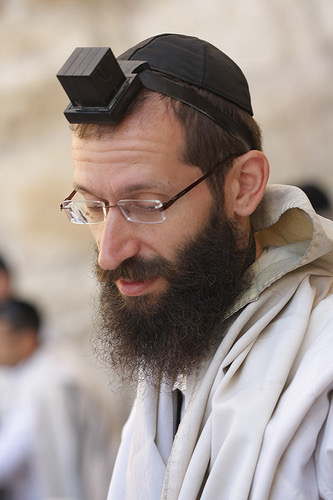
Historically, Israel tried to obey this command with “phylacteries” and “mezuzah”:
— A “phylactery” is a little leather pouch which Hebrew men literally tie on their forehead, as :8 says. Here’s a picture of one:
— A “mezuzah” is a little metal box the Hebrews put on the front of their house, with a little roll of scriptures in it. I have one here in my home office:

Again, I think they were being legalistic here. Jesus Himself actually criticized the Pharisees in Matthew 23:5, saying: “they broaden their phylacteries.” In other words, they made their phylacteries big so they’d look very “religious” to others. But the real point God is making here is: Make My word prominent in your life and in home, in very real and specific ways.
??? DISCUSSION QUESTION???
“What are some practical ways that WE can make God’s word prominent in our lives and homes.”
(LOTS of practical ways:
— Have Bibles near and handy
— Read and study the Bible daily
— Have a family scripture/prayer time
— Memorize verses so that they are always “on your mind”!
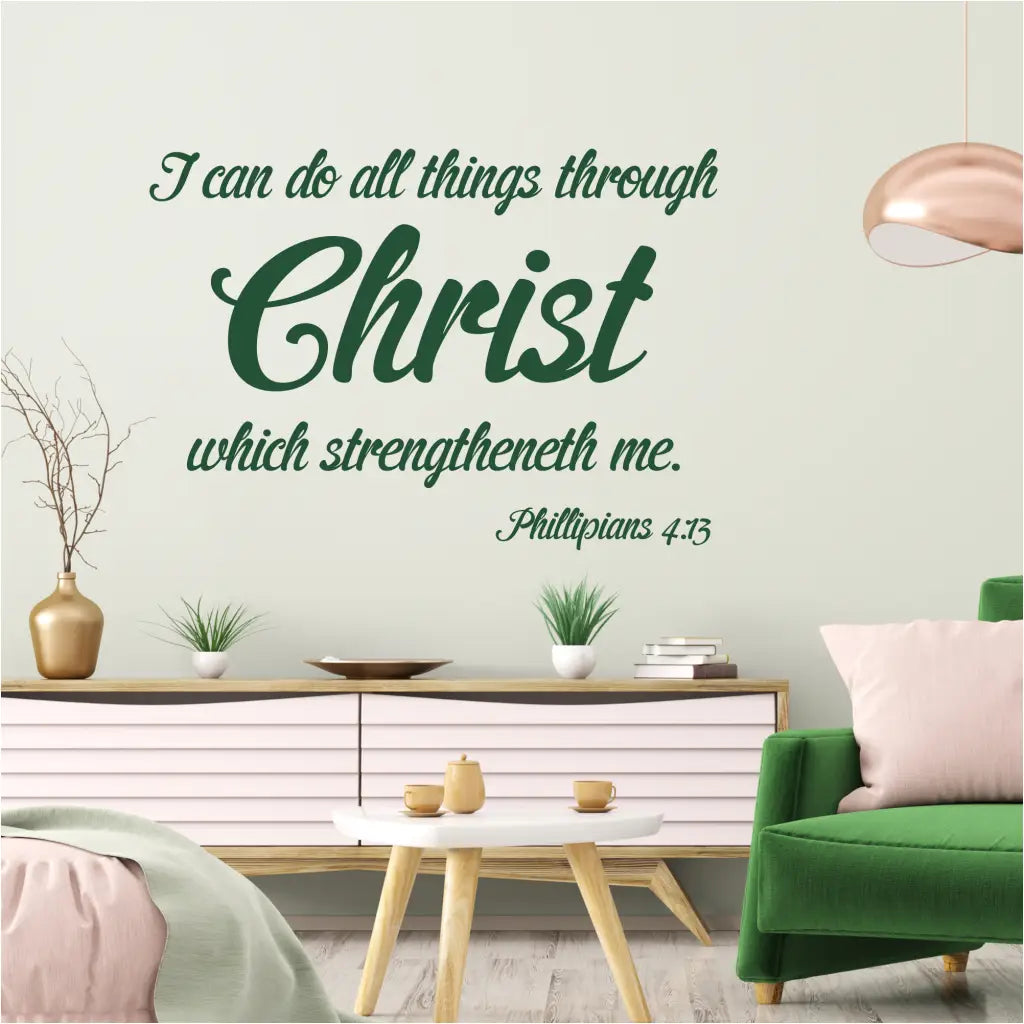
— I think there IS room for some “literal” application here: Frame verses and use them for decorations in your home. Some people literally stencil verses on their walls, like this:
— put verses on your phone, cards in your pocket to memorize
— post the Ten Commandments in your home so that all can see
You/your group can think of many specific applications of this. We don’t have to apply this legalistically the way the Jews did; but rather the point is: let’s make sure that we take specific steps to make God’s word prominent in our life and our family’s lives.
And remember the context here: God wants us to LOVE Him. And one of the ways we will demonstrate that we love Him, is by the way we relate to His word. We should LOVE His word — not just “do legalistic rituals” with it. As Psalm 138:2 says, God’s word reflect His own name, so we should love His word, just as we love Him.
III. The Message to Share (:20-25)
:20 “When your son asks you in time to come, saying, ‘What do the testimonies and the statutes and the judgments mean which the LORD our God commanded you?’ 21 then you shall say to your son, ‘We were slaves to Pharaoh in Egypt, and the LORD brought us from Egypt with a mighty hand. 22 Moreover, the LORD showed great and distressing signs and wonders before our eyes against Egypt, Pharaoh and all his household; 23 He brought us out from there in order to bring us in, to give us the land which He had sworn to our fathers.’ 24 So the LORD commanded us to observe all these statutes, to fear the Lord our God for our good always and for our survival, as it is today. 25 It will be righteousness for us if we are careful to observe all this commandment before the LORD our God, just as He commanded us.”
A. The Opportunity
Verse 20 begins: “When your son asks you …”
FOR ONE: this reminds us that some of the best witnessing opportunities you will ever have, will be “spur of the moment” opportunities you get to share with your kids, when they ask you questions.”
??? DISCUSSION QUESTION???
“Can you share a time when your child (or someone else) asked you a question that gave you a chance to share God’s truth?”
(EX: One summer I had taken our preschool son David with me to Falls Creek, the great youth camp in Oklahoma where so many have been saved and called to ministry. One afternoon we’d had such a fun time, watching softball games, and we were standing on the bridge that crosses the creek, drinking an orange soda, and David suddenly said, “Dad, is this heaven?” I chuckled to myself, and said, “No, it’s not heaven.” But it did give me a good chance to tell him what we know about the real heaven, and how we get there.
Many of us can share about such times.
But the point is: be sure you are ready for these times. First of all, make sure you are in a mindset to TAKE THE TIME that you need to respond to them rightly. Especially in our homes that can be hard to do. Things can be so hectic. Make sure you don’t see these kinds of questions as a “nuisance,” but rather as a valuable “teachable moment.”
God tells us here: these “teachable moments” will arise in your home. Be ready for them, and use them to instruct your children/grandchildren/others in God’s word.
NOTE: This is not only true for our kids/home, but also in other relationships as well. As friends, neighbors, co-workers, and others see you live out different aspects of your faith, they are going to ask: “Why do you do ___?”
As I Peter 3:15 says: “but sanctify Christ as Lord in your hearts, always being ready to make a defense to everyone who asks you to give an account for the hope that is in you, yet with gentleness and reverence.”
BE READY!, he says. Be ready! Your kids are going to ask; your grandkids are going to ask; your friends are going to ask; your work associates are going to ask. So BE READY when they do! First of all be willing to take the time to thoughtfully respond, and then like Colossians 4:5-6 says, “Conduct yourselves with wisdom toward outsiders, making the most of the opportunity. 6 Let your speech always be with grace, as though seasoned with salt, so that you will know how you should respond to each person.” Watch for those opportunities that will come, and then share God’s word when they do.
B. The Content
Verse 21 begins: “Then you shall say to your son …”. So when they had those opportunities to share with their children and others, God tells them: here is what they were to say, beginning in :21 and going on through :25. And He tells them to say that they were slaves in Egypt, but that God brought them out, and gave us this land, and told us to keep His commandments. And as :25 says “It will be righteousness for us if we are careful to observe all this commandment …”. So God tells them, THIS is what you are to say to your sons when they ask you. This is the content of the message. (One of the scriptures they would store in the phylactery or mezuzah: Exodus 13:1-3, the story of the Passover and how God redeemed Israel.)
So how do we apply this? God commanded His redeemed people Israel to share the story of their redemption. We are God’s people today, and He has commanded US to share with our children and others the story of OUR redemption.
DISCUSSION QUESTION:
??? What is different about Israel’s story, and the story that we Christians have to share today???
— they were slaves to Egypt/we are slaves to sin
— God gave them the land of Canaan/God gives us heaven/New Jerusalem
— They were redeemed by a Passover Lamb, we are redeemed by the blood of THE Lamb, God’s Son Jesus Christ.
— IMPORTANTLY: :25 says “it will be righteousness for us if we are careful to observe this commandment.” In other words, their righteousness was to come from their obedience to the Law. We know now that none of us can be justified by the Law, but only through faith in Jesus and what He did for us. As II Corinthians 5:21 says, “He made Him who knew no sin, to be sin on our behalf, that we might become the righteousness of God in Him.”
So the story we share today is different: ours is not the story of the “Passover Lamb,” but like John said, it is about “The Lamb of God who takes away the sin of the world.”
???DISCUSSION QUESTION???
“If the ‘Shema’ of Deuteronomy 6:4 was Israel’s most famous confession of faith, what verse might be OUR most famous as Christians today?”
(Scholars tell us that Philippians 2:9-11 served as an early Christian “confession of faith”: at the name of Jesus every knee will bow … “Jesus is Lord.” “Jesus is Lord” did become the “slogan” of the early church. Rome said “Caesar is Lord,” but Christians proclaimed “Jesus is Lord.” Others might suggest John 3:16 is our “Shema.” You/your group can share your ideas.
But you might close with the point that today the message God wants us to share is the Gospel of Jesus. And if we truly love the Lord, and are thankful for what He has done for us, we will show it by sharing His word, starting with our own children, and then with anyone else He gives us the opportunity to tell.
_________________________________________________
— If you’ll type your email address in the “Follow blog via email” blank on my blog home page, WordPress will automatically send you next week’s lesson and you won’t have to search for it.
— And if you write something in the Comments below, I’ll be sure to pray for your and your group by name this week.
Per my licensing agreement with Lifeway:
— These weekly lessons are based on content from Explore the Bible Adult Resources. The presentation is my own and has not been reviewed by Lifeway.
— Lifeway resources are available at: goExploretheBible.com and: goexplorethebible.com/adults-training
— If you have questions about Explore the Bible resources you may send emails to explorethebible@lifeway.com


 shawnethomas
Thank you for your help with these lessons each week. I am new to teaching adult ladies and I’m having fun.
How is Cheryl doing? I pray that God is healing her body and each day is easier for her and for you and your family.
Please pray for my husband, Walter. He broke the meniscus in his right knee the 12th of August. Then he got planta facieses and a heel spur in his left foot. So he is in a brace on his right knee and a boot on his left foot. Now he needs a brace for the left foot because it is developing drop foot. He was in rehab for his knee for two weeks. He ended up getting 2 units of blood and they found a spot on his kidney and enlarged lymph nodes, also low kidney function and low blood pressure. The swelling has gone down very little in his leg and foot. I’m praying that his referrals are called in quickly for answers. Whatever the answers, I know God is with me.
But Walter has never been saved. When his family was baptized, he didn’t understand what was going on and I’m not sure he does yet. He attends church with me on special occasions. Pray for his salvation also please.
May God continue to bless your family and your life.
thank you again
oh how I enjoyed studying your thorough lesson overview and exhortation of our scriptures for this Sunday November 2, lesson 9. I found it very interesting but very convicting also with the truths of God Holy Words shared!! Oh if only I could have been taught this as a younger mother so I could have been more diligently teaching my children God’s word. I have taught alot to my grandchildren. I have shared my salvation and witnessed to each of them.