
An overview for for teachers and Bible study leaders of Lifeway’s Explore the Bible series. Includes a sample introduction to the lesson, text outline and highlights, illustrations you can share, discussion questions for your group, and spiritual life applications. A video version of this overview is available on YouTube at:
INTRODUCTION:
A few years ago they asked some kindergarteners in Great Britain about the Christmas story of the visit of the Magi, and the kids had some interesting insights on it: one young boy said that the three wise men brought Jesus some gold stuff “but,” he said, “Legos would have been better”!
You could open with that, or with a story like it, and then say that today we are going to look at the Bible story of the visit of the Magi to Jesus, and how the responses of the people in this story to the news about Jesus challenge us about the way that WE respond to Him today.
CONTEXT:
We’re continuing our study in Matthew this week. Lifeway has us going back to Matthew 2 for a Christmas season story since this will be the Sunday before Christmas. Matthew 1 had shared the genealogy of Jesus, showing that He did indeed have the lineage to be the prophesied “Son of David/Son of Abraham” that the Messiah was to be. Then the rest of Chapter 1 tells how Joseph by faith accepted Jesus as God’s Son through His espoused wife Mary, and how the angel told him that this One would “save His people from their sins.”
This brings us to Chapter 2, which tells of an amazing visit to the child Jesus —and in it we see several different responses which people had to Him — the same kinds of responses we see from people to Jesus today! We should all ask ourselves this week: which of these responses most closely describes ME? What is MY response to the birth of Jesus?
OUTLINE:
I. The Announcement of the King (:1-3)
II. The Intellectual Response (:4-6)
III. The Hypocritical Response (:7-8)
IV. The Sincere Response (:9-12)
TEXT: Matthew 2:1-12
I. The Announcement of the King (:1-3)
:1 “Now after Jesus was born in Bethlehem of Judea in the days of Herod the king, magi from the east arrived in Jerusalem, saying, 2 “Where is He who has been born King of the Jews? For we saw His star in the east and have come to worship Him.” 3 When Herod the king heard this, he was troubled, and all Jerusalem with him.”
We’re introduced to a couple sets of characters here who will be important in this story:
A. Herod The Great
The Bible doesn’t tell us exactly WHEN this account happened. It says it was “in the days of Herod the king.” There were several Herods in Bible time, all related to him. This particular man was “Herod the Great,” known for building the Second Temple (after the original was destroyed by Babylon) — the temple that existed in Jesus day, and the Western Wall of which still stands today! And he built the port of Caesarea because there was no good port in the Holy Land. But Herod was also a ruthless tyrant, who would do anything to keep power. He had his own wife and three of his sons killed because he thought they might be a threat to him— and of course he displayed his ultimate ruthlessness by slaughtering the children of Bethlehem in his attempt to kill Jesus and secure his reign.
ILLUSTRATION
The Roman writer Macrobius wrote that Caesar Augustus, Emperor of Rome during Herod’s time, said “I would rather be Herod’s pig than his son.” (This is a play on words; the Greek for pig is “choiros,” and the word for son is “huios.”) Of course the Jews — and Herod was “nominally” a Jew — didn’t eat pigs, so a pig probably did have a better chance to live than one of Herod’s sons, of whom he killed several! But this just exemplifies Herod’s ruthless, wicked rule.
We do get a hint as to the timing later on in Matthew 2:16 when Herod commands all the children two years old and younger to be slaughtered. So it could have been as much as two years since the birth of Jesus had taken place. (OR Herod could have just been very diligent in his wickedness, making sure he killed the child). But it may help date the visit a little bit.
B. The Magi
The old King James called them the “wise men.” The Greek word is “magoi,” or we have “transliterated” that into “magi.” We don’t really know a lot about them.
Thayers Lexicon says the word comes from “a magus; the name given by the Babylonians (Chaldaeans), Medes, Persians, and others, to the wise men, teachers, priests, physicians, astrologers, seers, interpreters of dreams, augurs, soothsayers, sorcerers etc.” This is all the Bible tells us about them, although you know how people like to “fill in the blanks,” so a lot of speculation has arisen concerning them, such as:
— “There were 3 wise men.” But the Bible does not indicate that. It says there were 3 gifts, but it does not say how many magi there were. Two magi or 20 could have brought gold, frankincense, and myrrh.
— “They visited the ‘baby Jesus’ in the manger – many of our Christmas “manger scenes” portray this, but :16 says Herod killed all the children 2 and younger, according to the time magi gave him, so Jesus was likely not a newborn baby when He was visited by the magi.
— Then :11 says the magi came into the “house” (oikos) to worship Jesus – so it was not the manger the magi visited, but a house, some time after Jesus’ birth in the manger.
The magi told Herod “we saw His star in the east and have come to worship Him.” There has been a lot of speculation about what this “star” was (the Greek word is “aster,” just the regular word for “star.”) I’ve seen where people speculated about it being a comet, or some other natural phenomenon, but again I think we need to careful about “filling in the blanks” too much. Where scripture is silent, we should be content with what God has given us, and take it as a fact by faith.
So these are the main “characters,” if you would, in the first part of the story: Herod and the magi. They came to see him, and asked about where the “King of the Jews” was, which sadly aroused wicked Herod’s jealousy and wrath. Verse 3 says he was “troubled,” (Greek “tarasso,” “disturbed, troubled, agitated.” Thayers calls it “inward commotion.” We’ve all experienced this kind of feeling, when we’re all upset inside.) But this visit also brought out several revealing responses from different groups in this story — which mirror the kind of responses that people today make as well.
II. The Intellectual Response (:4-6)
:4 “Gathering together all the chief priests and scribes of the people, he inquired of them where the Messiah was to be born. 5 They said to him, “In Bethlehem of Judea; for this is what has been written by the prophet:
6 ‘And you, Bethlehem, land of Judah,
Are by no means least among the leaders of Judah;
For out of you shall come forth a Ruler
Who will shepherd My people Israel.’”
:4 says that when Herod heard from the magi that the Christ had been born, he gathered together the Jewish religious leaders and asked them where the Messiah was to be born. (This is the Greek word “Christos,” which we often translate “Christ.” It is the Greek version of the Hebrew “meshihach,” or “Messiah,” which means “Anointed One,” the Hebrew name for the Savior that God promised His people since Genesis 3 and throughout the Old Testament).
Significantly, the Jewish religious leaders knew the answer right off: verse 5 says “They said to him, ‘In Bethlehem of Judea; for this is what has been written by the prophet, ‘And you, Bethlehem, land of Judah, are by no means least among the leaders of Judah; for out of you shall come forth a ruler who will shepherd My people Israel.” The verse they quoted here was from Micah 5:2, right out of the Old Testament. So they knew just where Christ was to be born. This is important for a couple of reasons:
1) The Jews long knew that the Messiah was to be born in Bethlehem. This isn’t something the Christians made up afterwards. It points, again, to the truthfulness of the claim of Jesus, backed up by Old Testament prophecy.
2) But secondly, these guys just “whipped” this prophecy off the top of their heads. They didn’t have to research it, or look it up; they knew it. Historians tell us that many of the Pharisees had the entire Old Testament Law memorized. These men KNEW the right answers. They knew that the Christ was to be born in Bethlehem.
But think about this: do you see ANY verse that says anything about the Jewish leaders going to Bethlehem? There is nothing about it. These men knew the right answer from the Bible – when the word got around that the Messiah was born, and they were asked where, they were able to give the “right answer” — but notice that they didn’t DO anything about it themselves! There is no record that they rejoiced, or that they went to visit Him and worship Him, or anything like that! In fact, many of these same men were likely the same ones who, a little over 30 years later, would become jealous of Jesus, and reject Him, and put Him to death. They “knew” the right answers about Him; but that intellectual knowledge wasn’t enough. It’s just like Jesus said in Matthew 23, “you tie up heavy burdens and lay them on men’s shoulders, but you yourselves are unwilling to move them with so much as a finger.” They knew the right things to do to worship Jesus: they knew where the Christ was to be born – but they didn’t DO it. Their so-called “religion” was just an intellectual “game” – and their intellectual knowledge didn’t lead them to worship Him from their heart.
This is just where many people today fall short too, isn’t it? Many life-long Baptists, and life-long church members need to be careful, lest we respond to Jesus with merely the same kind of “intellectual response” as these Jewish religious leaders. Just like them, many of us have heard “all the right answers” for almost all of our lives – and it is easy to think that because you know the right answers that you are right with God. You aren’t! “Knowing” the truth doesn’t save you. The Bible tells us in James Chapter 2 that the demons “know” the right things about God: “You believe that God is one; you do well – the demons also believe and shudder.” Satan and the demons themselves know the right answers – in fact, they undoubtedly have better theology than many of us do! — but they aren’t saved despite what they “know.” And the same thing is true for many today.
ILLUSTRATION
Once a couple of friends and I had gotten a ride from some other guys from our high school. One of my friends boldly shared the gospel with these guys, and I remember he told him: “Jesus died on the cross for me.” And then he said, “But that’s not all …”. And this guy from our school said with the most sarcastic voice, “Yeah, yeah, I know; He died for us all.” This guy had the facts. He knew: Jesus died for us all. He died for HIM! But having that intellectual knowledge didn’t saved him.
Some of our people need to hear this today. Our intellectual knowledge alone will not save us, either. You aren’t right with God just because you “adhere to the Baptist Faith & Message (2000 ed.),” or nod in agreement with the Apostles’ Creed, or can quote the “5 Solas” or know all the historically accurate details of the Christmas story. The Jewish leaders of Herod’s day “knew” the facts about the Messiah – but there’s no evidence in scripture that they truly worshipped Jesus.
It’s been said that many people are going to miss heaven by 18 inches — the distance from their head to their heart! There’s several different images like this on the internet you could use at this point, like this one:
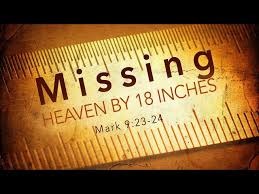
You could even choose to use it as a ???DISCUSSION/APPLICATION question???
“What do you think about this quote: ‘You can miss heaven by 18” — the distance from your head to your heart.’?”
(In your answers emphasize: the most important question for us today is not “do you know the right things about the birth of Jesus”, but have you repented of your sins and trusted this Jesus who was born, as YOUR OWN Lord & Savior? Are you worshipping and serving Him? Make sure that your response to Jesus is not like those Jewish religious leaders: merely an “intellectual response” to the birth of Jesus.
III. The Hypocritical Response (:7-8)
7 “Then Herod secretly called the magi and determined from them the exact time the star appeared. 8 And he sent them to Bethlehem and said, “Go and search carefully for the Child; and when you have found Him, report to me, so that I too may come and worship Him.”
How did Herod respond to the news of the birth of Jesus? Verse 8 says that he sent the magi to Bethlehem and said, “Go and search carefully for the Child; and when you have found Him, report to me, so that I too may come and worship Him.” It sounded, for all outward purposes, as though Herod was responding well to the birth of Jesus. He told them that he too wanted to “come and worship Him.” But we know that in reality, he had something much more sinister in mind. The rest of Matthew 2 tells the story: after the magi found Jesus and worshipped Him, the angel warned them not to return to Herod, and they left by another way. And :16 relates that Herod sent and killed all the male children who were in and around Bethlehem. Herod acted outwardly as though he would be a worshipper of Jesus. But in actuality he just wanted to find the Child for his own selfish and evil purposes: he really wanted to kill Him, and solidify his hold on the throne. His so-called “worship” was hypocritical.
We might think that surely we would not do anything like this, but the truth is we do need to guard against hypocritical worship too. None of us may be as overtly wicked as Herod, who would literally KILL anyone who was in his way — but we can still be like him in essence: we too can put up a facade of worship, when the truth is we’re more concerned with our own personal “agenda” — whatever it is — than worshiping God in church.
For, example, many years ago, Cheryl & I went to a class reunion, and visited with a number of people there, one of whom was a politician. I asked him where he went to church and he told me, and then he added: “You have to go to church to get elected to anything in this town.” That told me a whole lot right there! It sounded like he was more concerned with votes than worship!
Now, let me make it clear: there is nothing wrong with a Christian running for office, or being involved in numerous other things. But let’s make sure that we are not going to church for the purpose of getting votes, or any other substitute agenda, other than worshiping the Lord.
???DISCUSSION QUESTION???
“What are some ‘hidden agendas’ people might have behind their outward ‘worship’ of God?”
(Political influence, like in my story. Also making connections for business purposes is a very popular motive for many to come to church; it’s a good “sales pool”! Or maybe to make themselves “look good” to others: “There’s an upstanding person, a ‘church-goer,’” and so on. You/your group can think of many.
Each one of us needs to ask ourselves from time to time: “Why am I really here?” In my heart of hearts, what have I come to church for today? Am I really here to worship Jesus — or am I here for some other selfish reason? Make sure that you aren’t just using the church as a cover for your own personal agenda; that’s just like the “hypocritical response” of the wicked Herod!
IV. The Sincere Response (:9-12)
:9 “After hearing the king, they went their way; and the star, which they had seen in the east, went on before them until it came and stood over the place where the Child was. 10 When they saw the star, they rejoiced exceedingly with great joy. 11 After coming into the house they saw the Child with Mary His mother; and they [e]fell to the ground and worshiped Him. Then, opening their treasures, they presented to Him gifts of gold, frankincense, and myrrh. 12 And having been warned by God in a dream not to return to Herod, the magi left for their own country by another way.”
It does appear from :9 that the star was moving/guiding the magi, as it says it “went on before them.” How exactly this worked we don’t know. God’s in the miracle business. There is much we don’t know about the magi and the star. But these unknown details aren’t nearly as important as what we DO know: that these “magi” had a heartfelt, worshipful response to Jesus. How do we know that? We see several evidences of their genuine worship in this passage:
PARTICIPATION EXERCISE: (or you could just point out these indicators) Have your group call out indications they see in this passage that the magi were sincere in their worship of the Lord:
(Answers should include the following:
A. Heart-felt joy.
:10 “When they saw the star, they rejoiced with exceeding great joy.” In Greek, it is literally “exceeding, MEGA joy”! This was no “religious ritual”; this was no “I’m going to church because I have to.” This was worship from the HEART!
ALL real worship comes from the heart. Christianity is NOT a religion of ritual; it is NOT a matter of just “doing the right things.” Jesus said in John 4, “Those who worship the Father must worship in spirit and in truth.” Real worship must come from the heart. You see that in Psalm 100, which says; “Shout JOYFULLY to the Lord all the earth; serve the Lord with GLADNESS.” See, “joyfully,” “gladness” – these are heart attitudes, which are indispensable to genuine worship.
You might ask your group:
“Think for a moment about something you really enjoy in life:” maybe your grandkids, or football, or hunting — something you really delight in. No one has to “make” you do those things, do they? You “delight” in them; you “rejoice” to do them. No one has to “make” you think about it; you don’t have to put it on your calendar, or schedule it; you almost have to schedule NOT to! That is way it is with something you really “rejoice” or “delight” in.
THIS is the way that genuine religion is! When we truly love God, worshipping Him is NOT something we “have” to do; it is something we WANT to do. We “rejoice” in it!
Whatever other things accompany it, real worship must begin in our hearts. To apply this, we should each ask ourselves: am I just “going through the motions” in church, or am I really worshipping the Lord from my heart?
B. Humility
:11 “After coming into the house they saw the Child with Mary His mother, and they fell to the ground and worshipped Him.” This happened often in scripture: when people would worship the Lord, they would fall to the ground before Him. In fact, this action of “falling to the ground” is an integral part of the Bible word for worship here. “Proskuneo” literally means “towards,” “to kiss.” It means to bow and “kiss towards” the one you are worshipping, like a servant paying homage to a king.
So the very Bible word for “worship” involves humbling ones’s self towards the object of worship. Real worship involves humbling ourselves before God. When Isaiah was confronted with the holiness of God in Isaiah 6, he humbled himself before Him, crying: “Woe is me, for I am undone …”.
Humbling ourselves is a vital part of our worship too. If we are really going to worship the Lord, we must humble ourselves. We cannot let our pride remain enthroned, and worship God at the same time. Real worship humbles our pride before the Lord. The problem with too many of us is that we are trying to play it both ways: we are trying to worship God on the one hand, and all the while keep our pride intact on the other. But we can’t do that – you can’t “ride the fence” and really worship. You can either keep your pride intact, or you can worship God – but you can’t do both. Jesus said “No man can serve two masters” – you have to choose whom you are going to serve in your worship: you want to keep your pride, or you want to worship God? You can’t do both.
So a good question for many of us is, “When is the last time I humbled myself in worship?” When’s the last time you got down on your knees? When is the last time you went to the altar at the invitation? When is the last time you raised your hand/s before God when we were singing? I’m not saying you have to do any of these all the time – but these are SOME ways that you can humble yourself in worship. The important question is: how am I humbling myself before God when you worship? Because genuine worship involves humbling one’s self before their King!
C. Giving
:11b “Then, opening their treasures, they presented to Him gifts of gold, frankincense, and myrrh.”
This is a famous part of the story: the magi gave gifts to the Christ child. This is what our giving of Christmas presents is supposedly based on. But it shows us that giving is a part of genuine worship. When you really love someone, you want to give them gifts. Likewise, when you worship God, you want to give to Him. In the very beginning in Genesis, Cain and Abel offered gifts to the Lord. In Deuteronomy 16:16 God commanded Israel to gather before Him three times a year, and He says, “They shall not appear before the LORD empty-handed.” Giving is an integral part of worship. When you love, you want to give.
I remember when we first had our grandkids, Cheryl & I went shopping for them at Toys R Us. It was so fun! Cheryl later said, “If you want to get in the Christmas spirit, go shopping in a toy store for kids!” Nobody held a gun to our head to make us do it; we wanted to. And it wasn’t a matter of “we have to spend X amount”; we had to restrain ourselves from spending too much!
When you really love, and delight in someone or something, you want to give. That is why when we don’t give to the Lord, it’s a real spiritual warning sign. Genesis says that when Jacob had his experience with God, he said that the LORD would be his God, and that of all He gave him, he would give a tenth to Him. For Jacob, the tithe was a very significant part of his worship of God: it was a sign that He really was his Lord.
I believe it’s the same for us too. When our hearts are right with God, we WANT to tithe. We want to show that He’s our Lord by giving Him that 10%. And if our hearts are right with God, we won’t be legalistic about it — we’ll want to give above & beyond that: to the Lottie Moon offering for our missionaries (this could be a good place to promote that offering in your class this Sunday) and all kinds of other good causes, because we want everyone, everywhere to come to know the Lord like we do.
Christianity is not all about money, as many accuse churches and ministers of – but the truth is that money IS a “thermometer” – a tool that reveals our “spiritual temperature.” What does your attitude about giving say about your “spiritual temperature”? Giving is an integral part of genuine worship.
D. Obedience
:12 says, “And having been warned by God in a dream not to return to Herod, the magi left for their own country by another way.”
This last sign of worship is perhaps the best and most important of all: they DID what God told them to do! They performed their acts of worship in the house for Jesus – and then when it came time to leave, they left and obeyed. They were warned by God in a dream NOT to return to Herod – so they didn’t! They went home another way. They DID exactly what God told them to do. This is important: the magi showed their real worship for God by the way that they OBEYED Him when they left the place of worship.
When we genuinely love the Lord, we will do the same thing. Jesus said “If you love Me, you will keep My commandments.” (John 14:15) He said in Luke 6:46, “Why do you call Me, ‘Lord, Lord’, but do not DO what I say?” You show how much you really worship the Lord by your obedience to Him.
ILLUSTRATION
Augustine of Hippo (North Africa) wrote in the 300s A.D.:
“A girl might say to her lover, ‘Don’t wear that sort of cloak’: he won’t. If she tells him in winter: ‘I like you best in your short tunic,’ he would rather shiver than offend her.” (Augustine, Brown, p. 243). The point Augustine was making is that you want to please the one you love.
It should be that way between us and the Lord as well. If we really love Him; if we really worship Him, then we will demonstrate it by doing what pleases Him: “If you love Me, you will keep My commandments.” In a very real way, we don’t show how much we really worship God by what we do in church as much as in the way that we obey Him when we leave the church! We can come to church, give our money, kneel and pray, and sing as loud as we can – but if we leave and don’t go DO what He tells us to do, we don’t really worship Him!
We all want to say that we worship God – but what does our obedience say about how much we really worship Him?
— Is there is a sin or blatant area of disobedience in your life right now?
— Are you forgiving the people He told you to forgive, or are you holding grudges?
— Are you serving Him in the ministry He called you to, or do you keep putting Him off?
— Is there anything God has laid on your heart to do, that you are not doing?
When God told the magi to go home by another way, they DID it! And of course it was vital that they did – the life of the Christ Child could have been endangered; so they obeyed God. But it’s always important for each of us to obey God, because it’s one of the most important signs of real worship: that we will leave our worship time, and go out and obey!
CONCLUSION:
As we conclude this lesson from Matthew 2, you might ask your group, “Which one of these characters — and which of the qualities of genuine worship — challenges you the most?”
Let your group discuss that — then close with prayer, asking God to help you show that you truly worship Him, just like the magi did.
I know a lot of churches will not have Sunday School on Dec. 28, but if you will be teaching, I DO plan on doing an overview for that week — so I hope to see you then! And I hope you have a Merry Christmas, and a Happy New Year!
_________________________________________________
— Remember there is now a “PRINT” button at the end of the lesson on my blog, that you can hit to print out the lesson in its entirety.
— If you’ll type your email in the “Follow blog via email” blank on my blog home page, WordPress will automatically send you next week’s lesson and you won’t have to search for it each week.
— And if you write something in the Comments on my blog or YouTube, my commitment is to pray for your and your group and any special request you make, by name this week.
Per my licensing agreement with Lifeway:
— These weekly lessons are based on content from Explore the Bible Adult Resources. The presentation is my own and has not been reviewed by Lifeway.
— Lifeway resources are available at: goExploretheBible.com and: goexplorethebible.com/adults-training
— If you have questions about Explore the Bible resources you may send emails to explorethebible@lifeway.com


 shawnethomas
THANK YOU, brother Shawn for this fabulous ministry you are providing!
What a blessing!
Rod Bond
Thank you Rod; I really appreciate the encouraging words — and am so thankful that it is a help to you as you prepare to teach. I was praying for you this morning!
I want to thank you again for being so faithful in sharing the lessons with us. This lesson about “Worship the King” was so encouraging and convicting to me. Every week I listen to you but I don’t always comment. I really appreciate your gift of teaching. Merry Christmas to you and your family. I know God will continue to bless and keep you.
I just love this passage Carolyn! I’m grateful the Lord spoke to you through it — and I was praying for you as you shared with your class this morning. Merry Christmas to you and all yours as well! Thank you for commenting today!
Your comments and insights on our lessons are such a blessing to me as I prepare to teach our senior ladies class. Thank you for your time and effort to study, prepare, and share these lessons each week.
Wishing you and your family a Blessed Christmas and a Happy and Healthy New Year!
Thank you Wanda;I was praying for you and your ladies this morning! And I’m so thankful that the overview is helpful to you. Merry Christmas to you and yours too! God bless you as you prepare and share His word in 2026!
Thank you. Your insights are helpful to me as as a substitute adult teacher.
Oh, I’m so thankful that it helped you, Janie! I was sure praying with you this week. I hope it went well for you this morning!
Pastor Thomas,Thank you so much for your weekly insight. We use portions of your commentary every week
Well I am so grateful to hear that, William; thank you for letting me know! I was praying for you and our group this morning!