
Includes a suggested introduction to the lesson, text outline and highlights, illustrations you can share, discussion questions for your group, and spiritual life applications to make. A video version of this overview is available on YouTube at:
INTRODUCTION:
???DISCUSSION QUESTION???
“Can you share something in your life that it felt like you waited so long for — and it finally came?”
(Some might say they just couldn’t wait until they got their first car, or until they graduated, or until they were finally able to marry that person they had waited for, or for retirement, or to have their first grandchild. Or maybe that upcoming Disney trip or other vacation they’ve been counting the days for, for so long, or for something to come in the mail. We all know that feeling of waiting and waiting — and then finally it comes!)
There is a sense in which all of us as Christians should feel this way about the return of Christ. Many of us have heard about it all our lives — and sometimes we might be tempted to think “it will never come!” But Jesus promised that it will, and we need to be faithful to Him and what He’s called us to do in the meantime.
CONTEXT:
We’re nearing the end of our study in Matthew. As we’ve seen, Jesus is in Jerusalem (going back and forth to Bethany to stay the night) and last time we saw that He’s been debating the scribes, Pharisees, and Sadducees. In Chapter 23, which the Lifeway lessons do not cover this time, Jesus really lets the scribes & Pharisees have it, with the strongest words of condemnation He had for anyone: “Woe to you, scribes and Pharisees, hypocrites …” and He lambasts them for the whole chapter. Jesus had no patience for religious hypocrites — which should be a warning for us today, too!
This brings us to Matthew 24, which contains today’s Lifeway focus passage. Matthew 24 begins by telling us that Jesus came out from the Temple (after His message against the hypocrites) and was going away (likely back to Bethany to stay the night) when the disciples pointed out the Temple buildings to Him. It’s a beautiful sight! But Jesus warns them that “not one stone here shall be left upon another which will not be torn down,” foretelling the Temple’s destruction. Verse 3 says as He was sitting on the Mt. of Olives, His disciples asked Him “When will these things happen, and what will be the sign of Your coming, and of the end of the age?” (You can see from this MAP how the Mount of Olives was on the way back to Bethany — and they could see the Temple from that height)
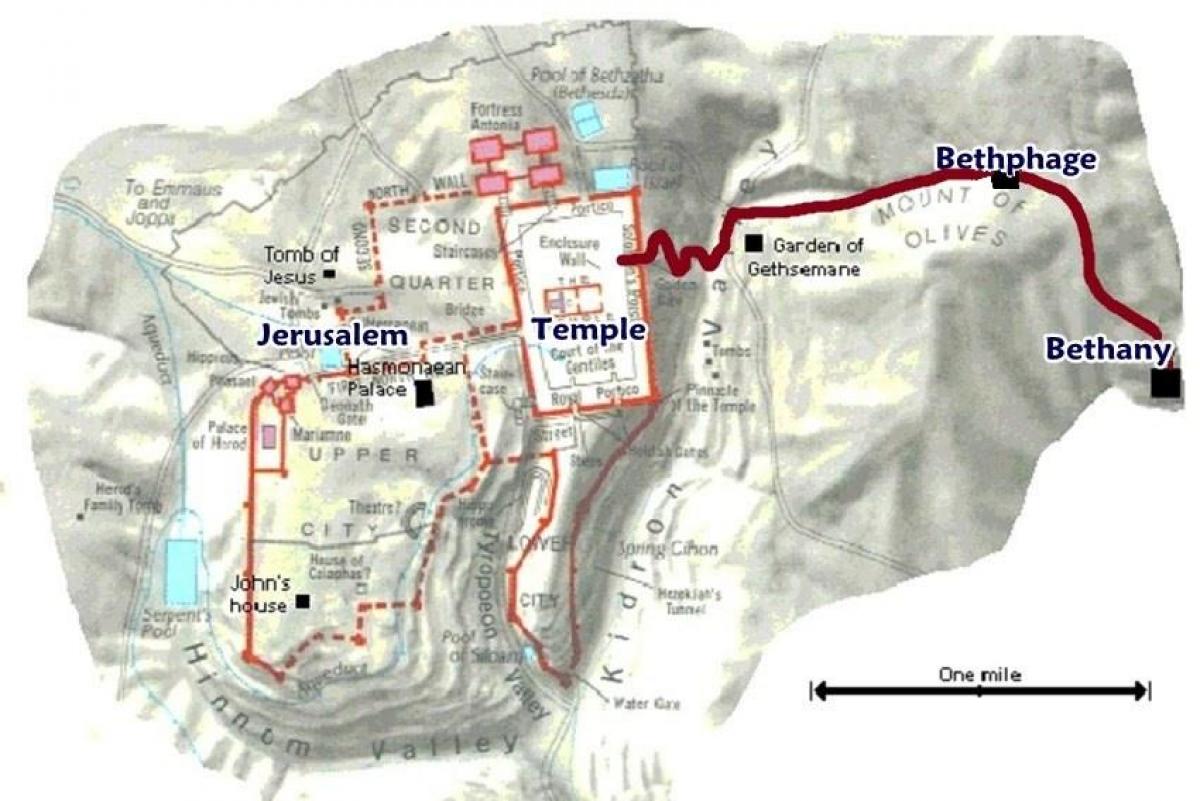
Then Jesus begins what Bible students call the “Olivet Discourse,” the message He gave about the end times from the Mt. of Olives. This message comprises BOTH Matthew Chapters 24 and also Chapter 25, which we will refer to some this week, and study a passage from next week.
In the first verses of His message in Matthew 24, Jesus warns His disciples about being misled by false Christs and false prophets. He talks about how they will be persecuted and put to death, and how when the “Abomination of Desolation” will be put in the holy place of the Temple, they need to flee, because a great tribulation will follow. Some believe this was fulfilled with the destruction of the Temple in 70 A.D., when the Romans did defile the Temple; others believe this foreshadows another final end times “Abomination of Desolation” by the Antichrist — because Jesus said in :29 immediately AFTER the tribulation of those days, the Son of Man would “come on the clouds of glory” and gather His people from all over the earth. That brings us to our focus passage for this week, where Jesus tells us how we need to be ready for His return, and how we’ll be rewarded if we are faithful to Him in the meantime.
OUTLINE:
I. The Unexpected Time of His Return (:36-41)
II. The Need For Readiness for His Return (:42-44)
III. The Reward For Faithfulness at His Return (:45-51)
TEXT: Matthew 24:36-51
I. The Unexpected Time of His Return (:35-41)
36 “But of that day and hour no one knows, not even the angels of heaven, nor the Son, but the Father alone. 37 For the coming of the Son of Man will be just like the days of Noah. 38 For as in those days before the flood they were eating and drinking, marrying and giving in marriage, until the day that Noah entered the ark, 39 and they did not understand until the flood came and took them all away; so will the coming of the Son of Man be. 40 Then there will be two men in the field; one will be taken and one will be left. 41 Two women will be grinding at the mill; one will be taken and one will be left.”
As in many issues in the Bible, there is an important balance to be kept here:
— On the one hand, Jesus is very clear: “Of that day and hour, NO ONE KNOWS” — not the angels, not even “the Son” in His earthly incarnation, only God the Father. (By the way, this is an oft-discussed verse regarding the Incarnation: how could Jesus, if God, not know the time of His return? Some have even used this as proof that He was NOT God. But the Bible clearly, in so many passages, teaches Jesus’ divinity. This is just one of example of the “kenosis,” Jesus’ voluntary “emptying” of Himself that Philippians 2:7 talks about. It shows how much He humbled Himself when He became a man in the Incarnation.)
But what this also makes clear, is that anybody who sets “dates” for the return of Christ is wrong!
The Apostle Paul writes about this in I Thessalonians 5:1-4:
“Now as to the times and the epochs, brethren, you have no need of anything to be written to you. 2 For you yourselves know full well that the day of the Lord will come just like a thief in the night. 3 While they are saying, ‘Peace and safety!’ then destruction will come upon them suddenly like labor pains upon a woman with child, and they will not escape.”
So the Lord’s coming will be unexpected.
But on the other side of that “balance,” discerning Christians may be able to sense that “the time is ripe”:
— Noah and his family (to quote the example Jesus used here) may not have known the exact day of the flood, but they likely knew it was close!
— Paul wrote in I Thess. 5:4, “But YOU brethren, are not in the darkness, that the day should overtake you like a thief.”
— In II Thess. 2, he also responded to some believers there who were worried, because some were teaching that the Lord had already returned. Paul wrote: in :3, “Let no one in any way deceive you, for it will not come unless the apostasy comes first, and the man of lawlessness is revealed, the son of destruction.” He describes him for a bit, then says in :8, “Then that lawless one will be revealed whom the Lord will slay with the breath of His mouth and bring to an end by the appearance of His coming.” So he’s telling them, Christ won’t return until you see these things happen, and these things haven’t happened, so He hasn’t returned!
So here’s the balance: there are some “signs” which discerning Christians can observe, that might indicate that the time may be near — but on the other hand, Jesus makes it clear that NO ONE KNOWS the day or the hour. We should never consider that we or anyone else knows that. It will be unexpected.
???DISCUSSION QUESTION???
“Can you share about a time during your lifetime when someone predicted that the Lord would come back?”
(Many of us can:
— I remember as a pastor receiving in the mail the book “88 Reasons Why the Rapture Will Be in 1988” at my first church. It said that since Israel was founded in 1948, 40 years, or a “generation” later would be 1988 — and the author, Edward Wisenant (thought to be bolstered by his credentials as a former NASA engineer) actually set the date for the Lord’s return as Sept. 11-13 1988, during Rosh Hashanah, the Jewish holiday. Of course it did not happen.
— Back in 2014-2015 there was a furor over the “Blood Moons.” popular tv preacher John Hagee came out with a book, “Four Blood Moons,” about how there would be 4 total lunar eclipses during Passover and the Feast of the Tabernacles in 2014 and 2015, and these would presage key end time events. Of course these came and went, with no major happenings. I actually heard a minister mention “blood moons” again earlier this year. I thought, are you kidding me? Aren’t we tired of hearing about blood moons? “Blood moons” are NOT RARE! Astronomers tell us that “blood moons” happen roughly EVERY 2.5 years! Every 2.5 years since the time of Christ there have been blood moons! So please don’t be taken in by any more “blood moon” talk — and by all means don’t teach it!)
You can use these examples if you’d like, and you/your group can share your own experiences. Then make the point: all these experiences serve to prove Jesus’ words: “of that day and hour no one knows”! STOP setting dates. Stop listening to people who are setting dates. They do not know. If JESUS Himself did not know when He walked the earth, these people certainly do not!
Jesus emphasizes here that His coming will be UNEXPECTED. He said in :37, “For the coming of the Son of Man will be just like the days of Noah.” (Hopefully we all know that “The Son of Man” is Jesus’ favorite name for Himself, coming from Daniel 7:13, which predicts the coming of “one like a Son of Man” on clouds of glory.) But what does that mean, that it will be “just like the days of Noah”? He explains that in :38-39: He says in the days before the Flood they were “eating and drinking, marrying and giving in marriage” — in other words, they were just carrying on with “life as usual,” with no clue that something cataclysmic was about to end their world.
ILLUSTRATION
In 79 A.D. Mount Vesuvius, on the southwestern coast of Italy, suddenly erupted, destroying the cities of Pompeii and Herculaneum and burying thousands of people in lava and volcanic ash. The excavation is of great value to archeologists, because the inhabitants were all going about their “normal” daily business, when that mountain exploded. So they’ve uncovered snack stands, which reveal that they ate snacks of snails, fish, and wine; the remains show how their houses were decorated, what gods they had on their mantle; their work tools, jewelry, clothing, etc. It shows the people and the city living life “as it was,” because they were caught so much off guard. No one was prepared for anything sinister to happen.
Jesus says that is just how it will be when He returns. He said people will be “eating and drinking, marrying and giving in marriage” — just going about their normal, every day lives — when He returns, and life as they know it, will end forever!
(Verses 40-41 emphasize how sudden this will be: two people will be standing together, and one will be taken and one left. Some people believe the “taken” are raptured; others that they are “taken” for judgment. But emphasize that the point here really is the suddenness of His return.)
So the Scripture makes it clear: Jesus’ return will catch many off-guard — especially for those who like in the days of Noah, do not believe the word of God. It will be an unexpected return.
II. The Need For Readiness for His Return (:42-44)
42 “Therefore be on the alert, for you do not know which day your Lord is coming. 43 But be sure of this, that if the head of the house had known at what time of the night the thief was coming, he would have been on the alert and would not have allowed his house to be broken into. 44 For this reason you also must be ready; for the Son of Man is coming at an hour when you do not think He will.
This section begins with the word, “Therefore …”, which always points us back to what was just said. “Therefore” — because Jesus’ return will be unexpected, we need to be ready. The primary emphasis of this section is the need for readiness. We see this emphasis several times here, once in each verse:
— :42 “be on the alert” (the Greek word literally means to “stay awake”!)
— :43 “he would have been on the alert” (same word)
— :44 “you also must be ready” (this word means “prepared,” like the wedding feast that was prepared for the guests in 22:4, 8)
So the repeated emphasis here is on our being prepared for Jesus’ return.
A good scriptural cross-reference is the Parable of the Virgins in the next chapter, Matthew 25. Jesus continues the theme of His return in Matthew 25 (remember there were no “chapter divisions” in the original scriptures; in reality this is not a “new” section; Jesus is just continuing His “Olivet Discourse” on the end times, which comprises both Matthew 24 and 25. He continues this by telling this parable as an example of how we need to be ready. He says “the Kingdom of Heaven is like” (that same formula we’ve seen before) ten virgins (unmarried maidens) who took their lamps with them to go out and meet the bridegroom.
In Jewish culture, it wasn’t the bride who “came down the aisle,” but the Bridegroom would go off to “prepare a place” for his bride — either a new home, or a room on his father’s house — and then he would come back for his bride — often at night, and sometimes unexpected. Then their friends would attend them back by lamplight to their new home.
So Jesus said these ten maidens went out to meet the bridegroom. He said that 5 took extra oil in flasks, but 5 did not. Verse 5 says “while the bridegroom was delaying” (perhaps that should have been a hint to those in the first century that Jesus’ return would not be immediate for them!) they all got sleepy. But :6 says at midnight the call came: “Behold the Bridegroom!” and they all woke up. The 5 wise maidens got their lamps going, but the foolish ones didn’t have any oil. While they ran off to get some oil, they missed the wedding feast, and were locked out. And Jesus ends the parable with the concluding point in :13, “Be on the alert then, for you do not know the day nor the hour.”
So Jesus is really emphasizing this point: we need to be READY!
???DISCUSSION/ILLUSTRATION QUESTION???
“Does anyone know what a ‘prepper’ is?”
(Merriam-Webster Dictionary says a “prepper” in modern culture is “a person who gathers materials and makes plans in preparation for surviving a major disaster or cataclysm.”
You might ask, “What are some of the kinds of things people do to get ready for an emergency like that?”
(Answers might include: storing up food and water, batteries, flashlights, and so on, to be ready for an emergency. Many people are “preppers” to a greater or lesser extent.)
But then we can apply this to our passage:
??? What are some things we might need to do, to prepare for the return of Jesus???
— Most importantly, be certain that He is your Lord & Savior. Make sure that He won’t say to you, “I never knew you!” Share the gospel here: encourage them to admit that they are a sinner, believe that Jesus died on the cross for them, and encourage them to trust Jesus as their Lord & Savior today!
— Some may need to be baptized and confess Jesus publicly.
— Others may be holding on to some specific sin, that they really need to repent of before Christ returns. You don’t want to be found wallowing in that sin when He comes!
— Be sure that you have forgiven everyone, and have no broken relationships.
— And as we’re going to see in the next point, we need to be faithful in the ministry He has given us, when He returns.
You/your group may think of other things.
Encourage your class: if there’s anything in your life that needs to be done before Jesus returns, you need to do it NOW!
1) As Jesus mentions here, you don’t know when He will return, &
2) You don’t know how long you will live! We’re a “vapor” as James 4 says, “You do not know what your life will be like tomorrow.”
So admonish your group this week: if there’s ANYTHING you need to have done before Jesus returns, do it NOW. Remember II Cor. 6:2, “NOW is the acceptable time; today is the day …”. Make sure you’re prepared and ready for Christ’s return.
III. The Reward For Faithfulness at His Return (:45-51)
45 “Who then is the faithful and sensible slave whom his master put in charge of his household to give them their food at the proper time? 46 Blessed is that slave whom his [k]master finds so doing when he comes. 47 Truly I say to you that he will put him in charge of all his possessions. 48 But if that evil slave says in his heart, ‘My [l]master [m]is not coming for a long time,’ 49 and begins to beat his fellow slaves and eat and drink with drunkards; 50 the [n]master of that slave will come on a day when he does not expect him and at an hour which he does not know, 51 and will cut him in pieces and assign him a place with the hypocrites; in that place there will be weeping and gnashing of teeth.”
I LOVE verses 45 & 46. They are God’s charge to each of us as followers of Christ, but there is a special sense in which it applies to those of us who minister God’s word to His people: “Who then is the faithful and sensible slave whom his master put in charge of his household to give them their food at the proper time?” This describes a “steward,” a slave yes, but a highly ranked slave, whom his master thought enough of to entrust his concerns to him while he was gone. He was in charge of making sure that everyone was fed and taken care of during the master’s absence. — In a way this describes each of us as believers: our Master has left, and has left us in charge of His work.
— But in a special sense, it relates to those of us who preach and teach His word: we are in charge of giving His people their “spiritual food” at the “proper times”: on Sundays and other scheduled times. This is a vital task, and it calls for our utmost effort and diligence.
And notice what Jesus says in :46-47, “Blessed is that slave whom his master finds so doing when He comes. Truly I say to you, he will put him in charge of all his possessions.”
We should be found FAITHFUL in doing the job Jesus left us to do, when He comes.
BUT also notice the flip side of that: :48-51 says that the “wicked slave” is marked by how he doesn’t think the master is coming back for a long time, so he “beats” his fellow slaves, and “eats and drinks with drunkards.” Notice the fruit of wickedness is demonstrated in several ways:
— He doesn’t think the Master is coming soon.
— He mistreats others
— He is personally dissolute, engaging in vices.
Jesus said this slave will be surprised by his master’s return, and will be punished. In fact, the language Jesus uses seems to switch here from a “parable,” to real-life spiritual fact: “assign him a place with the hypocrites” where “there will be weeping and gnashing of teeth.” Significantly, Jesus uses this expression “weeping and gnashing of teeth” SIX TIMES in Matthew: 8:12, 13:42, 13:50, 22:13, 24:51, and 25:30.
EXERCISE:
To get your group involved, you might have them read those 6 verses (either from their Bibles or to ensure consistency of the translation, have them printed on a slip beforehand for them to read from).
Then EMPHASIZE: ALL SIX of these verses refer to how some will be cast away into hell, where “weeping and gnashing of teeth” will be. So this isn’t just some “little punishment” that God’s people will get; rather the lack of faith, the mistreatment of others, and the personal vices demonstrate that this person is not truly saved at all (he is “wicked” as Jesus indicates) and will be cast into hell.
This challenges each of us to demonstrate that we really are His servants. Don’t be a compromiser. Until He comes, let’s be faithful and proclaim:
— That scripture is “God-breathed” and is totally true and trustworthy, no matter how many question it.
— That our universe is NOT a cosmic chance, but that God made the heavens and the earth
— That He purposefully created us as “male” and “female,” and that design is good! And that He designed marriage to be between one man and one woman for a lifetime.
— That we are not “basically good” but that “all have sinned” and need a Savior.
— That Jesus is the only way we can be reconciled to God, through His death on the cross. (John 14:6)
— That YES He is returning, no matter how long it’s been, or how foolish it seems.
Let’s be faithful to teach, and to believe, what His word says, and to give His people their spiritual food at the “proper time.”
More and more people are giving in to compromise today. Jesus Himself said in Luke 18:8, “When the Son of Man comes, will He find faith on the earth?” Will He find people believing? Will He find His people sharing His word in the world unashamedly? Most importantly for us: will He find you and me, faithfully teaching His word, without compromise, no matter what everyone else is doing? Will He find us faithful?
If He does, Jesus says there will be a great reward for us. He said in :46, “Blessed is that slave …”. He said in :47, “He will put him in charge of all His possessions.” The word “possessions” is just part of the picturesque language of the parable, but it does indicate that there is a great reward for those whom Jesus finds faithful when He comes. A couple of weeks ago we shared some verses on the individual judgments and rewards we will receive:
— II Cor. 5:10, “For we must all appear before the judgment seat of Christ, so that each one may be recompensed for his deeds in the body, according to what he has done, whether good or bad.”
— I Cor. 3:13-14 “the fire itself will test the quality of each man’s work. 14 If any man’s work which he has built on it remains, he will receive a reward.”
— Revelation 22:12, ““Behold, I am coming quickly, and My reward is with Me, to render to every man according to what he has done.”
ILLUSTRATION
If you’ve listened to my previews very long, you are familiar with how John Newton, the slave trader who got saved and wrote “Amazing Grace,” had a ministry of counseling people all over England through letter writing. Once he wrote to a Mr. & Mrs. Coffin:
“Religion does not consist in doing great things, for which few of us have frequent opportunities, but in doing the little necessary things of daily occurrence with a cheerful spirit, as to the Lord.”
(Letters of John Newton, Josiah Bull, ed., p. 393)
That’s a good word for many of us in light of the Lord’s return. Maybe we’d think, “I wish I could do some ‘great thing’ for God before Jesus returns. But truly as Newton said, few of us have either the gifts or the opportunity to do some “great thing.” But every single one of us has the opportunity to be FAITHFUL in what our Master has given us to do, until He comes. So let’s do it!
— Teach His word faithfully until He comes
— Share His gospel faithfully until He comes
— Take care of your spouse, or your children, faithfully until He comes. Don’t underestimate the importance of what some may consider this “small” thing; it’s important to Him that we’re faithful to our family assignments until He comes.
— Hold to the truths of His word faithfully in this skeptical world until He comes.
— Keep serving in that place of ministry He’s given you, with the gifts He’s given you, faithfully, week after week, until He returns.
You don’t have to do some “great thing.” If you’ll just be faithful to do what the Master has seen fit to give you, then you will receive a great reward. So just be faithful, keep at it, until He returns.
CONCLUSION:
When I was in 5th grade, one of my first football games to watch on tv was the classic Oklahoma/Nebraska game in 1971, “The Game of the Century.” I fell in love with OU football. So my dad told me, “I’ll take you to a game in Norman some time.” I looked forward to that, and every so often Dad & I would talk about it, and he’d say “I’ll have to take you to a game some time.” One day my Dad took me out to eat to a local favorite restaurant, and we got to talking about OU football, and once again he said, “I’ll have to take you to a game some time.” I said, “Yeah, you keep saying that, but you never do!” Just then my dad reached into his shirt pocket, and pulled out two tickets, and put them on the table! The time had finally come, and I was so excited. But I will say that I have always wished that I hadn’t doubted my dad like I did. I wish I would have been confident in his promise, until that day came.
The reason I share that, is because some of us today may be tempted to be that same way with the Lord, and His Second Coming. Yes, many of us have heard about His Return all our lives. Yes, there have been many “false prophets” who set errant dates. And yes, the whole world thinks it’s all nothing but foolishness. And maybe deep down in our hearts we’re tempted to think, like I did that day with my dad, “Lord, You keep saying You’re going to return, but You never do.” Don’t be tempted to do that. Hebrews says “It is impossible for God to lie.” Jesus is coming. And if we run out of patience, we will only regret one day that we weren’t more faithful to believe His word, when He comes. So let’s hold fast our confidence. And let’s be faithful to serve Him with our whole heart, in whatever He’s given us to do, until He calls us home — or until that day when we meet Him in the air! He is coming!
___________________________________________
— Remember there is now a “PRINT” button at the end of the lesson on my blog, that you can hit to print out the lesson in its entirety.
— If you’ll type your email address in the “Follow blog via email” blank on my blog home page, WordPress will automatically send you next week’s lesson and you won’t have to search for it each week.
— And if you write something in the Comments on my blog or YouTube, my commitment is to pray for your and your group and any special request you make, by name this week.
Per my licensing agreement with Lifeway:
— These weekly lessons are based on content from Explore the Bible Adult Resources. The presentation is my own and has not been reviewed by Lifeway.
— Lifeway resources are available at: goExploretheBible.com and: goexplorethebible.com/adults-training
— If you have questions about Explore the Bible resources you may send emails to explorethebible@lifeway.com


I feel so inadequate to teach. Please pray for me.
You are actually in a good place to feel inadequate, as none of us are adequate for these things. But God gives grace to the humble. Let those feelings of inadequacy drive you to fervent prayer, and study, and total dependence upon the Lord — and I believe He will bless and use you in a great way! Know that I’m praying for you today, and will continue throughout this week!
Thank you again from South Dakota – – your lesson plans are extremely helpful.
Thank you for the explanation of the maidens and the bridegroom.
please pray for my son who is addicted to drugs.