
Includes a sample introduction to the lesson, text highlights and outline, illustrations you can use, discussion questions you can share, and spiritual life applications you can make. A video version of this overview is available on YouTube at:
INTRODUCTION/ILLUSTRATION
“Caesar awoke on the famous day, the Ides of March, 44 BCE, not feeling well. His wife had a bad dream, in which he had been murdered. She begged him to stay home. He sent word to the Senate that he was ill and would not be in attendance at the day’s meeting. He was scheduled to embark on a military campaign the next The Senators panicked; this was to be the day they struck Caesar down. Miss this day and Caesar would march off on campaign, and cloak himself in more martial glory. This was their last chance.
Desperate, they sent someone Caesar would trust: Decimus Brutus, a distant cousin of Caesar, as well as the famous Marcus Brutus, one of Caesar’s trusted lieutenants. Caesar’s patronage had brought Decimus military appointments and political offices alike. Caesar loved Decimus like a son, and said so in public on many occasions. When Decimus arrived to talk Caesar into attendance at the Senate meeting, Caesar listened. Off they went, arm in arm.”
(Phillip Barlag, The History of Rome in 12 Buildings, p. 54-55)
(You could also choose to include the question on betrayal from later Point II in the introduction)
The betrayal and assassination of Julius Caesar is one of the most famous in history — surpassed only by the one we will study in today’s lesson in Matthew 26, the betrayal of Jesus by Judas after the Last Supper.
CONTEXT:
This is our next-to-last lesson in our study of the Book of Matthew the past six months. The last few weeks we’ve studied Jesus’ activities in His last week before His crucifixion. In Matthew 24 & 25 He shared His Olivet Discourse with His disciples, about the events attending His return, and then told several parables about being ready, and good stewards of what He’s given us, before His return. As Matthew 26 opens, Jesus tells His disciples that in two days He’ll be handed over to crucifixion. Then :3-5 “cut over” almost like in a tv scene change, to show how the Jews were meeting at that very time, planning to arrest Him and put Him to death.
Verse 6 says what while Jesus was in Bethany He is anointed for His burial.
Then verses 14-16 then describe how Judas went to the Jews, asking them what they would give him to hand Jesus over to them, and they gave him the infamous 30 pieces of silver, and it says he began looking for an opportunity to betray Jesus.
This brings us to our focus passage for this week, in Matthew 26:17-30.
OUTLINE:
I. The Preparation (:17-19)
II. The Betrayal (:20-25)
III. The Symbolic Supper (:26-30)
TEXT: Matthew 26:17-30
I. The Preparation (:17-19)
17 Now on the first day of Unleavened Bread the disciples came to Jesus and asked, “Where do You want us to prepare for You to eat the Passover?” 18 And He said, “Go into the city to a certain man, and say to him, ‘The Teacher says, “My time is near; I am to keep the Passover at your house with My disciples.”’” 19 The disciples did as Jesus had directed them; and they prepared the Passover.”
So the Passover was coming up, one of the most important days on the Jewish calendar, celebrating their release from Egypt and God’s “passing over” their firstborn with the death angel. Jesus’ disciples knew He wouldn’t want to miss that. So they asked Him where He wanted them to prepare it.
In :18 Jesus gave them some surprising instructions: “Go into the city to a certain man, and say to him, ‘The Teacher says, “My time is near; I am to keep the Passover at your house with My disciples.”
Luke gives us a little more detail (Here’s a good principle, by the way, when we’re studying one of the Gospels: look at what the other Gospel accounts say about the same event. Often they give a little more detail, or some information from a different “angle.” That’s what we see here).
Luke 22:8-13 says: “Jesus sent Peter and John, saying, “Go and prepare the Passover for us, so that we may eat it.” 9 They said to Him, “Where do You want us to prepare it?” 10 And He said to them, “When you have entered the city, a man will meet you carrying a pitcher of water; follow him into the house that he enters. 11 And you shall say to the owner of the house, ‘The Teacher says to you, “Where is the guest room in which I may eat the Passover with My disciples?”’ 12 And he will show you a large, furnished upper room; prepare it there.” 13 And they left and found everything just as He had told them; and they prepared the Passover.”
This was a “surprising” answer from Jesus as to how they were to set up the Passover. He didn’t give them much information in advance, just “go into the city and ‘A MAN’ will meet you with a pitcher of water,” etc. WHY such mystery? That’s a good question. Previously I’ve just assumed that Jesus was testing their faith: I’m not going to give you the details, just go in faith and do this. And I do believe there IS that element to it.
But Larry Helyer in his great little book, The Life and Witness of Peter, suggests another angle. He posits the idea that Jesus was keeping the location of their Passover meal a secret, so that Judas couldn’t betray Jesus there. Remember the verses just before our focus passage show Judas agreeing with the Jews to betray Jesus. Is it a coincidence that now in the very next verse He tells Peter & John to prepare the Passover in such a “secretive” way? In Luke 22:15 Jesus had said “I have earnestly desired to eat this Passover with you,” and by doing it this way, and not telling Peter & John verbally where it would be, Judas wouldn’t able to hear in advance where it would be, and betray Jesus before the Last Supper and the crucial night of prayer in Gethsemane. I’d never considered that before I read Helyer’s book, but it has a lot to commend it — especially as it comes in the context of Judas’ plan to betray Him!
So :19 says Peter & John “did as Jesus directed them, and they prepared the Passover.”
A couple of APPLICATIONS here:
— Serving Jesus often involves “menial” things.
Remember He had previously told them in Matthew 20:25-38, “Whoever wishes to be great among you shall be your servant.”
We might think it was a “great privilege” to prepare the Passover for Jesus & His disciples — and indeed it would be! But think of it from their immediate perspective: Peter & John had to go to the city by themselves, and do all the prep work to get that meal ready for all 13 of them. Why did THEY have to do it? It was really just a bunch of work! But Jesus calls us as His followers today, to do what we might consider “menial” things to serve Him as well.
???DISCUSSION/APPLICATION QUESTION???
“What are some ‘menial tasks’ the Lord might ask US to do today, that might be similar to what He asked Peter & John to do here?”
(— Cooking a meal for a group at church, like Peter & John did here: maybe for a church fellowship — or maybe for a week at camp, like Falls Creek youth camp, or Kids Camp.
— Working in the nursery/extended session child care can be a “menial” task. I know it’s not easy serving in there. But it’s such a great and needed ministry; it allows many other people to worship and hear God’s word!
— Keeping up the building and grounds can be a demanding physical task. Blessed are those people of God who give time and effort to honoring God by presenting a pleasing background for ministry at the church plant!
You/your group can think of other “menial” things like this that the Lord might call us to do to serve Him.)
ALSO consider this APPLICATION: Is God asking YOU to “take a step of faith” in some area of your life; to go out not knowing who you’re going to meet, or where exactly you will be going — just like Peter & John did when they left to set up that Passover meal? Many of us like to have all the details spelled out before we do anything — and it’s good to get those when we can. But on the other hand, sometimes the Lord asks us just to take a step of faith and go, and please Him by our obedience in faith.
ILLUSTRATION:
There’s a family in our church right now, the husband is battling cancer. And yet he, his wife, and three of their kids have signed up to go on a mission trip in June. I know they can’t afford it. And he really doesn’t know how he’s going to be feeling then, as he’s been taking chemo treatments and will add radiation when school gets out. But they feel like the Lord is calling them to do this, and they want to go and serve Him together as a family. I think that’s so commendable; it’s an amazing step of faith for them to take, and I believe the Lord will bless that.
You/your group could share some steps of faith the Lord is calling YOU to take today, or perhaps that He called you to take in the past.
This is what Jesus did with Peter and John here: He told them to just go, and then see how what He called them to do will unfold. When God calls us to do things like this, we need to take those steps. Remember Hebrews 11:6 says, “Without faith, it is impossible to please Him.” Peter & John went out and took that step of faith. Let’s follow their example when God calls us today!
II. The Betrayal (:20-25)
:20 “Now when evening came, Jesus was reclining at the table with the twelve disciples. 21 As they were eating, He said, “Truly I say to you that one of you will betray Me.” 22 Being deeply grieved, they each one began to say to Him, “Surely not I, Lord?” 23 And He answered, “He who dipped his hand with Me in the bowl is the one who will betray Me. 24 The Son of Man is to go, just as it is written of Him; but woe to that man by whom the Son of Man is betrayed! It would have been good for that man if he had not been born.” 25 And Judas, who was betraying Him, said, “Surely it is not I, Rabbi?” Jesus *said to him, “You have said it yourself.”
Verse 20 finds Jesus and His disciples sharing that Passover together. The Greek actually just says He was “reclining” (no word for “table”). We shared once before how the custom was not to sit a “table” like in DaVinci’s Lord’s Supper,

but rather they “reclined” (as this text says) on couches, at the “triclinium,” a three-sided “couch” with the meal in the middle.
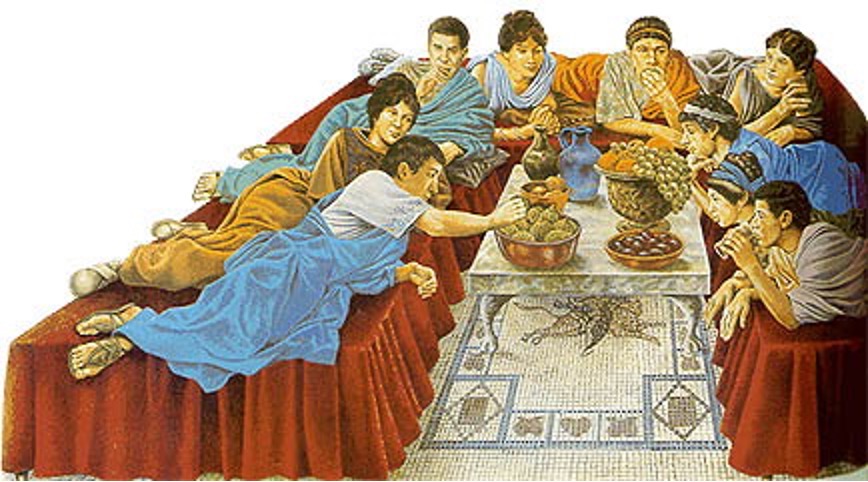
So from this reclined position, Jesus told His disciples that one of them would betray Him. It’s not hard to imagine their shock and grief. Verse 22 says that each of them said to Him, “Surely not I, Lord?” And Jesus says that one who dipped his hand in the bowl with Him will betray Him — and He refers to the Scripture that predicts that He would be betrayed in this way.
You might share the Old Testament prophecies of Jesus’ betrayal that He was referring to:
— Psalm 41:9 “Even my close friend in whom I trusted,
Who ate my bread, has lifted up his heel against me.”
— Psalm 55:12-14 “For it is not an enemy who reproaches me,
Then I could bear it; Nor is it one who hates me who has exalted himself against me, Then I could hide myself from him. 13 But it is you, a man my equal, My companion and my [b]familiar friend;
14 We who had sweet [c]fellowship together, Walked in the house of God in the throng.’”
— Zechariah 11:12-13 “I said to them, “If it is good in your sight, give me my wages; but if not, never mind!” So they weighed out thirty shekels of silver as my wages. 13 Then the Lord said to me, “Throw it to the potter, that magnificent price at which I was valued by them.” So I took the thirty shekels of silver and threw them to the potter in the house of the Lord.”
ILLUSTRATION
If you don’t use the Julius Caesar illustration for an introduction, you could use it here in this point. OR you might share another example of betrayal, like Benedict Arnold, who plotted to surrender the U.S. fort at West Point to the British, and whose name has gone down in history along with Judas as a betrayer; or one of the more recent U.S. spies, like Aldrich Ames, who worked for the CIA, but who sold secrets to the Soviet Union, compromising over 100 U.S. spy operations, and leading to the death of 10 Russians who were cooperating with the CIA.
??? DISCUSSION/APPLICATION QUESTION???
“Can anyone share a time when you/someone you know was betrayed?”
— a work associate
— sadly it can happen in a marriage
— someone you trusted with money might have abused that
— even church staff members/church members can betray each other/pastor/church members
Many of us have experienced betrayal of one kind or another, and we know how painful that can be. But we are not alone in that. Hebrews 4:15 says Jesus was “tempted in all things as we are.” He experienced betrayal, just as many of us have.
One thing that Jesus understood, was that His betrayal was not “out of His control,” but was actually was part of God’s plan for Jesus’ crucifixion. Jesus shared how His betrayal was predicted (“as it is written”). BUT He then added, “Woe to that man” by whom He was betrayed.
Verse 24 is a good example of an important theological balance, between the Sovereignty of God, and the Responsibility of Man:
— Jesus said “The Son of Man is to go, just as is written of Him.” It was prophesied, years ago, that the Messiah would be betrayed and crucified, as we’ve seen in those Old Testament scriptures. God in His sovereignty had ordained it.
— But the fact that it was in God’s plan does not negate the personal responsibility of Judas for his own personal decision: “Woe to that man by whom the Son of Man is betrayed!” Judas is still responsible for what he freely decided to do. God did not “make” him do it; he made his own choice and will be held accountable for it.
It can be difficult sometimes to keep that important theological tension between the Sovereignty of God and the Responsibility of Man. But it is important that we recognize both of them:
— God is Sovereign. He has ordained things that are going to happen.
— But in His sovereignty God has also given us a freedom to choose, and we are each responsible for the choices we make. Never blame God, or “fate” or “predestination” for your bad choices. Even when He uses our poor choices or makes them work together for some good in His plan, we are still each responsible for the choices we make, and are accountable to God for them.
NOTE: Judas response here. He did not say “Surely not I, LORD” as the other 11 disciples did. Instead he said: “Surely it is not I, RABBI.” “Rabbi,” of course, means “teacher,” and was a common term. Many people addressed Jesus as “Rabbi,” even some of Jesus’ disciples — but it was usually early on:
— When two of the disciples first met Jesus in John 1:38 they called Him “Rabbi.”
— When Nicodemus came to Jesus by night he called Him “Rabbi.”
— In John 6 6he crowd asked Jesus how He got to the other side of the sea, and used the term “Rabbi, when did You get here?”
So all in all it’s just a little more “distant” of a term, especially than “Lord,” and may have been a “giveaway” sign of the distance of Judas’ heart from the Lord.
And also UNDERSTAND THIS about Jesus’ response: “You have said it yourself” was an idiom in their language for “YES.” It’s like when we’ll ask someone, “Are you going to the game tonight?”, and they say, “You said it!” — that means, yes, they are going. That was how they used this expression in Jesus’ day. “You have said it yourself,” clearly means “yes.”
We see another example of this a bit further down in Matthew 26:63-65, when Jesus is on trial:
“And the high priest said to Him, “I adjure You by the living God, that You tell us whether You are the Christ, the Son of God.” 64 Jesus *said to him, “You have said it yourself; nevertheless I tell you, hereafter you will see the Son of Man sitting at the right hand of Power, and coming on the clouds of heaven.” 65 Then the high priest tore his robes and said, “He has blasphemed! What further need do we have of witnesses? Behold, you have now heard the blasphemy”
Why did the high priest tear his robe when Jesus said that? Because “you have said it yourself” means “YES!” They knew Jesus was saying that “Yes” indeed He was the Son of God. (And then He quoted Daniel 7, how the Son of Man will come on the clouds of heaven, about Himself, which was a recognized Messianic prophecy. That’s why the priest tore his robe, because Jesus was clearly claiming to be the Son of God, which was blasphemy to the Jews. So don’t ever let anyone tell you that Jesus never claimed to be the Son of God; He absolutely does that here.
So in this passage is, Jesus was telling Judas, YES it is you. You know it. And as He tells him in John 13:27, Do what you do quickly.” It’s time for this climactic moment. Let’s get this done. Now everything all set in motion for the most important event in history.
III. The Symbolic Supper (:26-30)
:26 “While they were eating, Jesus took some bread, and after a blessing, He broke it and gave it to the disciples, and said, ‘Take, eat; this is My body.’ 27 And when He had taken a cup and given thanks, He gave it to them, saying, ‘Drink from it, all of you; 28 for this is My blood of the covenant, which is poured out for many for forgiveness of sins. 29 But I say to you, I will not drink of this fruit of the vine from now on until that day when I drink it new with you in My Father’s kingdom.’ 30 After singing a hymn, they went out to the Mount of Olives.”
But before they went out to the Garden of Gethsemane, Jesus would institute an important ordinance for His church: The Lord’s Supper. We Baptists call it an “ordinance,” not a “sacrament,” like many other groups do, because the word “sacrament” implies that it has something “saving” about it. We do not believe that. We believe that the Lord’s Supper is an “ordinance” — something Jesus commanded us to do — but that it does NOT convey saving power in any way.
You might share our Baptist Faith & Message statement on the Lord’s Supper:
“The Lord’s Supper is a symbolic act of obedience whereby members of the church, through partaking of the bread and the fruit of the vine, memorialize the death of the Redeemer and anticipate His second coming.” (from BFM 2000, Article VII)
???DISCUSSION ACTIVITY???
You could post or hand out copies of this statement to each group member and ask them to share some highlight they see in it. (It’s not a bad idea from time to time to make sure every class/church member has a copy of our Baptist Faith & Message)
(Answers can include:
— It is a “symbolic” act. It is not literally the body and blood of the Lord Jesus.
— It is not a saving “sacrament,” but an “act of obedience,” an “ordinance.”
— “members of the church” — many churches require baptism and/or church membership to participate. You might share your own church’s practice about participation.
— “fruit of the vine” — it doesn’t say “wine.” You could discuss WHY Baptists don’t use wine. Answers can include that the wine of Jesus’ day was watered down, not like our wine today (this is not a myth, by the way; I have read in ancient Greek literature where they “mixed the wine with water” before they served it.); also there may be dangers to some in serving alcoholic beverages, some may be alcoholics, etc. Because the Lord’s Supper is symbolic and not literal, there is no harm in using grape juice instead of wine.
— “memorialize” — that is, we are “remembering” Jesus’ death; like Jesus says twice in I Corinthians 11:24 & 25, “Do this in REMEMBRANCE of Me.” It is not a saving act; it is a “memorial;” a “remembrance.”
You/your group can share what all you see in the statement. But I believe it is a good, succinct statement.)
Of course, not every group believes what we do about the Lord’s Supper. Many do call it a “sacrament,” or the “mass,” a literal sharing in the sacrifice of Jesus and a literal eating of His body.
A Catholic friend of mine posted an article about the Lord’s Supper on social media recently. It went like this:
“If Jesus says “this is my body,” why insist on saying “this is only a symbol”?
Catholics believe:
– The Eucharist is not just a sign
– It is the real presence of Christ
– The same Jesus truly present under the appearance of bread and wine
Because Jesus didn’t say, “think about me.”
He said: “Take and eat.”
And we take Him at His word.”
That may sound good right off: “We take Him at His word.” But it doesn’t hold up under scrutiny.
— It doesn’t hold up to scriptural parallel: in other places in the Bible, Jesus says “I am the door.” We don’t say, “We really believe Jesus is a wooden door; we take Him at His word.” That’s absurd. That’s not what He’s saying. We know He’s speaking metaphorically. Here in Matthew 26 Jesus says “This is My body.” HIS BODY IS RIGHT THERE SITTING ACROSS THE TABLE FROM THEM! So He’s obviously speaking metaphorically here. The elements are not literally His “body” and “blood,” but help us remember His body and blood, which He would shed for us.
— Other scriptures help us understand this: Jesus said in I Corinthians 11:24-25 to do this in “remembrance” of Him; not to “partake” of Him. Verse 26 says by doing it we “PROCLAIM the Lord’s death until He comes.” The Catholic meme said, “Jesus didn’t say, ‘think about Me.” This I Cor. 11 passage essentially says, YES, He DID tell us to “think about Him”: to “remember Him” until He comes! So there is every reason to take the Lord’s Supper as a symbol.
And the personal nature of how each one must take his own part in the Lord’s Supper points us to how we must each personally receive Jesus as our Lord & Savior.
ILLUSTRATION:
John R.W. Stott, in his classic book, The Cross of Christ (p. 70) writes that through the Lord’s Supper, Jesus was teaching His disciples the need for each of us to appropriate His death personally:
“They can hardly have failed to get the message. Just as it was not enough for the bread to be broken and the wine to be poured out, but they had to eat and drink, so it was not enough for Him to die, but they had to appropriate the benefits of his death personally. The eating and drinking were, and still are, a vivid acted parable of receiving Christ as our crucified Saviour and of feeding on Him in our hearts by faith.”
The way that each one must personally choose to take the Lord’s Supper, reminds us that each of us must personally receive what Jesus did for us. So encourage your class members this week: make sure that you personally have put your trust in Jesus’ death on the cross as the one-and-only, full payment for your salvation. It’s not enough that He died; you must personally receive what He did. And when you take the Lord’s Supper, it is a symbol that you personally understand, and have received, what He did for you.
___________________________________________
— Remember there is now a “PRINT” button at the end of the lesson on my blog, that you can hit to print out the lesson in its entirety.
— If you’ll type your email address in the “Follow blog via email” box on my blog home age, WordPress will automatically send you next week’s lesson and you won’t have to search for it each week.
— And if you write something in the Comments on my blog or YouTube, my commitment is to pray for your and your group and any special request you make, by name this week.
Per my licensing agreement with Lifeway:
— These weekly lessons are based on content from Explore the Bible Adult Resources. The presentation is my own and has not been reviewed by Lifeway.
— Lifeway resources are available at: goExploretheBible.com and: goexplorethebible.com/adults-training
— If you have questions about Explore the Bible resources you may send emails to explorethebible@lifeway.com


Thanks for all you do. Your lessons are very enlightening and useful.
I just listened to your teaching exposition on the Lifeway lesson for May 24, 2026. You really opened up the scripture to me and blessed me in so doing. Thank you!