
For teachers of Lifeway’s Explore the Bible lesson of Matthew 22 for May 3, 2026. Includes a sample introduction to the lesson, text outline and highlights, illustrations you can share, discussion questions for your group, and spiritual life applications you can make. A video version of this overview is available on YouTube at:
INTRODUCTION:
I like one of the activities the Leader’s Guide suggests — they don’t have it as an introduction, but I think it would work well for one. Have each class member look at a quarter (or better yet, maybe a dollar bill — it’s easier to read! It really could be almost any U.S. coin or bill). Ask them what they see. They will likely point out that there are symbols of the United States government on it — as well as the words “In God We Trust.” So both our national government, and our God, are referred to on this coin.
Then you might point out that sometimes it can be difficult to navigate our allegiance between both God and country — especially when their commands conflict — but in our passage for today, Jesus shows us how He wants us as His followers to navigate those situations.
CONTEXT:
We’re moving along in our study of Matthew this quarter. Last time we saw how Jesus had come to Jerusalem in the Triumphal Entry, cleansed the Temple, and now He has a series of teaching moments, and conflicts with the Jewish religious leaders. Last time we saw how He told the story of the two sons, one of whom repented and did His father’s will, but the other said he would obey, but did not.
As we come to Matthew 22, Jesus is still in Jerusalem, and He will remain in that area until His crucifixion and resurrection. The chapter opens with Jesus sharing the Parable of the Wedding Feast, and how the invited guests didn’t come, so the King told his servants to go out into the highways and the hedges to get people to come in. The Jewish religious leaders, knowing this parable was about them (as the invited guests) now come to Jesus to try to get Him to stumble. Scholars have identified 5 different “controversies” that Jesus had with various individuals and groups on what was Tuesday of His final week here on earth. Our focus passage, starting in Matthew 22:15, includes a couple of these conflicts.
OUTLINE:
I. Beware the Trap of Flattery (:15-16)
II. Adopt the Wisest Attitude (:17-22)
III. Render the Highest Obedience (:34-40)
TEXT: Matthew 22:15-22, 34-40
I. Beware The Trap of Flattery (:15-16)
:15 “Then the Pharisees went and plotted how to trap Him by what He said. 16 They sent their disciples to Him, with the Herodians. “Teacher,” they said, “we know that You are truthful and teach truthfully the way of God. You defer to no one, for You don’t show partiality.” (NASB)
Right off it’s odd that the Pharisees, who were conservative Jews, allied themselves here with the Herodians, supporters of King Herod of Galilee and his Roman rule over northern Israel — usually despised by other Jews — but “politics makes strange bedfellows.” But actually when you see what they asked Him, you can see why: the Jews hated the Roman tax, but the Herodians would favor Rome. So Jesus couldn’t “say one thing to one group and another thing to the other here.” They were both right there together. He would offend one or the other. So they worked together to trap Him.
We should be instructed by the “trap” they employed, which included the “bait” of flattery. The Oxford dictionary says flattery is: “Excessive and insincere praise, given especially to further one’s own interests.”
Someone has said that “gossip is saying behind someone’s back, what you wouldn’t say to their face. Flattery is saying something to their face, that you wouldn’t say behind their back.”
I think that’s a pretty good description of those terms. That’s exactly what the Pharisees & Herodians were doing here, right? “We know that You are truthful” (no they didn’t think He was truthful!) “and teach truthfully the way of God” (They did NOT think that!) “You defer to no one, for You don’t show partiality.” These are NOT the kinds of things they really believed. This was “insincere praise” they were giving Him “to further their own interests” — to lure Him into a “trap” as :15 says.
The Bible gives several warnings against flattery:
— Psalm 5:9 says the wicked “flatter with their tongues.” It is NOT a quality of a righteous person. It is a mark of the wicked.
— Three times Proverbs tells us that the adulteress or “strange woman” flatters her targets, to get them to succumb to her temptations (2:16, 7:5, 7:21)
— Proverbs 29:5 says “A man who flatters his neighbor Is spreading a net for his steps.”
So it’s a trap. Flattery, in one sense or another, is always a trap. They’re saying things to you that they don’t really mean, as a means of gaining some kind of advantage for themselves, as we will see. The Pharisees were attempting that with Jesus here.
ILLUSTRATION:
Mark Twain tells the story in his book The Innocents Abroad, of how he and some of his fellow passengers visited a shop in Gibraltar on their steamboat voyage to the Holy Land. He said they went to a shop where a pretty sales lady told him that with hands like his, he needed an expensive set of kid leather gloves. He said the ones she gave him didn’t quite fit, but she flattered him and said, “I see you are accustomed to wearing kid gloves, some gentlemen are so awkward about putting them on.” Twain said “I was much too flattered” to tell her they didn’t fit, and give them back to her. He said he did notice a certain gleam in her eye after he had paid for them and left. Of course, her flattery was a trap, to get him to buy something that really didn’t fit. (You can read Twain’s whole entertaining story on pp. 55-56 of Innocents Abroad.)
But the lesson is: Flattery is always a trap. So we need to both:
1) guard ourselves against flattery
???DISCUSSION/APPLICATION QUESTION???
“What do you think people hope to gain from us through their flattery?”
(Jude 16 says that the ungodly are “flattering people for the sake of gaining an advantage.” This tells us that people flatter others in order to gain an advantage over them. Maybe like in Mark Twain’s case, it’s to make a sale, or maybe it is to catch someone off guard; perhaps to neutralize them as an enemy; or to get them to treat them in a favorable way, etc. Sometimes it is literally a trap, like it was for Jesus here, to lure them into a bad business decision, or into an illicit relationship, like Proverbs speaks about. In various ways, flattery is always a trap. They’re seeking some kind of advantage over you. So as God’s people we should beware of flattery. Don’t let people “lure” you into their traps, manipulate you, or gain some advantage of you, through their insincere flattery.
2) Commit not to BE flatterers ourselves!
As God’s people, we should certainly give sincere compliments. Christians should be very encouraging to each other; in fact we are commanded to do that (I Thess. 5:11, Heb. 3:13, etc.) — but as a matter of integrity we should make sure that what we are saying to them is true, and that it is something that we would also say to others when that person was not present. I try to make it a matter of personal integrity: if I give a pastor, or a speaker, or anyone, a compliment, it must be absolutely true — and something I would also say to others about them. If not then we are being “slithering flatterers,” just like these Pharisees.
So let’s both avoid falling into the trap of others’ flattery, and also avoid being flatterers ourselves.
II. Adopt the Wisest Attitude (:17-22)
17 Tell us, therefore, what You think. Is it lawful to pay taxes to Caesar or not?” 18 But perceiving their malice, Jesus said, “Why are you testing Me, hypocrites? 19 Show Me the coin used for the tax.” So they brought Him a denarius. 20 “Whose image and inscription is this?” He asked them. 21 “Caesar’s,” they said to Him. Then He said to them, “Therefore give back to Caesar the things that are Caesar’s, and to God the things that are God’s.” 22 When they heard this, they were amazed. So they left Him and went away.” (NASB)
So here was “the trap,” the end game of their flattery. They asked Jesus if it was lawful to pay taxes to Caesar, and the Roman Empire. You can see how it was a dangerous question:
— If He says “yes,” then all the Jews would hate Him, for saying they had to pay taxes to their oppressors.
— But if He tried to please the crowd and say “No!” then the Romans could arrest Him as a subversive.
It looked like they had Him.
But of course they didn’t. Jesus just amazes us with His wisdom.
Sometimes a politician will come up a witty answer, like when President Ronald Reagan, at age 73, was asked about his age during the 1984 Presidential debate with Walter Mondale, who was 56. Reagan’s response has gone down in history: “I will not make age an issue of this campaign. I am not going to exploit, for political purposes, my opponent’s youth and inexperience.” That answer silenced the critics, and Reagan was re-elected handily.
But no one was ever better at this than Jesus. He was the Master of these situations. Over and over the scribes, Pharisees, and Sadducees thought they “had Him” in a trap, but they never did. And this present instance may be one of His best. How was He going to get out of this?
We see in :19. Jesus asked them to show Him the coin used in the tax. I pulled an image of the coin off the internet. The coin they used was a silver denarius. (You remember that a denarius was one day’s wage for a common worker, as we saw in Matthew 20.)
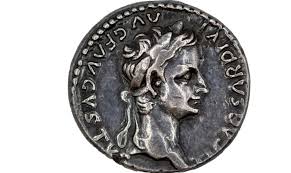
It features an image of the Roman Emperor Tiberias on the front. (You might be able to see the “TI” in the bottom right that stands for “Tiberius,” then Caesar, then Divi “divine” and the “Augustus” coming down the left side. On the reverse it speaks of him as “God and High Priest,” which of course was highly offensive to the Jews!)
So they showed this to Jesus. And He asked them “Whose image is this?” That seems like a good question — but Jesus wasn’t asking for “information”! He was turning the tables on them, and was about to catch them in HIS trap!
They told Him: “Caesar’s.” Then He closed the trap with one of the greatest responses of all time: “Therefore give back to Caesar the things that are Caesar’s, and to God the things that are God’s.”
Jesus’ statement here sets out for us as Christians a defining principle about how we are to live the Christian life in regard to the government in which we live and serve: how we deal with “church/state” issues. He gives us the perfect balance: God’s sovereignty is supreme over all — but there is a place for submission to government, which we must acknowledge as good Christian citizens.
First of all, He sets out the principle that whenever possible, Christians should be good citizens of the nation they inhabit. “Render to Caesar what belongs to Caesar.”
— Romans 13 makes clear that Christians aren’t “rebels” who are out to overthrow our society, but we are to be committed to be good citizens within the framework of our society. Romans 13:1 opens: “Every person is to be in subjection to the governing authorities.” We are to submit to “Caesar” (or whoever our government is) as far as our conscience as Christians allows.
— Romans 13:6-7 then gets even more specific: “For because of this you also pay taxes, for rulers are servants of God, devoting themselves to this very thing. 7 Render to all what is due them: tax to whom tax is due; custom to whom custom; fear to whom fear; honor to whom honor.” Whatever tax, custom, honor, etc., is due to legitimate authorities in our society, we are to give it. Christians should be the very best citizens in our society, both to honor God and to be a good witness to men. “Render to Caesar the things that are Caesar’s.”
NOW: the second part of this is that we are to render only to GOD the things that are God’s. Sometimes “Caesar” asks us to render to him things that are only due to God. For example, in the early days of Christianity the Romans asked the Christians to burn a pinch of incense and say “Caesar is Lord.” To that Christians say: “No, you are asking me to render to Caesar what only belongs to God. I cannot do that. I will render to Caesar what belongs to Caesar — and only to God the things which are God’s!” When the state asks us to compromise what the word of God commands, then like the Apostles in Acts, we say, “We must obey God rather than men.” But if it’s not immoral, illegal, or unethical, we should submit to our governing authorities, and “render to Caesar the things that are Caesar’s.”
???DISCUSSION/APPLICATION QUESTION???
“What are some things that the government has asked (or might ask) Christians to do, that we might refuse to obey?”
(— For example, if the government said pastors were required to perform same-sex marriages, that would be a step too far. We should say, I cannot do that, it violates the word of God, and I must obey God rather than men. (Some bakers and florists in our country have already faced this.)
— Another example might be from the COVID crisis in 2020, when the State of California tried to regulate the number of Christians who could meet for worship to 100 or 25% of building capacity — and then mandated that they could not SING or chant when they met! (CNN online article July 3, 2020) I was furious! The government has no business dictating to the church what they can and cannot do inside their own house of worship. That’s rendering to Caesar what only belongs to God.
You/your group may think of other examples.)
We see more about what we are “render to God” in our next point:
III. Render the Highest Obedience (:34-40)
:34 “When the Pharisees heard that He had silenced the Sadducees, they came together. 35 And one of them, an expert in the law, asked a question to test Him: 36 “Teacher, which command in the law is the greatest?” 37 He said to him, “Love the Lord your God with all your heart, with all your soul, and with all your mind. 38 This is the greatest and most important[c] command. 39 The second is like it: Love your neighbor as yourself.[d] 40 All the Law and the Prophets depend[e] on these two commands.” (NASB)
In between our two focus passages, in :23-34, the Sadducees took their turn at a “trick question” for Jesus. The Sadducees were religious “liberals” who didn’t believe in the resurrection and eternal life, so they asked a ridiculous question about a man with seven brothers who got married and died, and all seven brothers married this woman, so which man would her husband b in the resurrection. Jesus flat out said these men were wrong, because they didn’t take the scriptures seriously — a good word for religious liberals, and all of God’s people today.
So when the Pharisees heard that Jesus had beaten the Sadducees, they thought they would give Him another try, and came back and asked Him which is the greatest commandment. (Again, notice, this was NOT a sincere question; it specifically says he asked it “to test Him.”) And Jesus gave His famous answer: love God with all your heart, and love your neighbor as yourself.
We’re going to look at both of those for just a moment, but notice that He added in :40, “All the Law and the Prophets depend on these two commands.” The word “depend” there is the Greek word “kremmanumi,” which means “hang.” Every command of the Old Testament “hangs” on these two in the sense that they all are summed up in these two: all those other commands just describe specifically HOW we are to love God, and love people. But it can really be summed up in those two things. Like Romans 13 says, if we really keep these two commands, we will keep all the others. So our responsibility towards God and others are summed up very neatly in these two: just Love God, and Love People. So let’s look at each of these for just a moment:
A. The Great Commandment: Love God
Jesus said in :37 that the great command of the Law was “Love the Lord your God with all your heart, with all your soul, and with all your mind.”
This is of course not a “new” command, but comes from Deuteronomy 6:5 (the famous “Shema”, “shema” means “Hear,” “Hear O Israel …” which Jews repeated twice every day and hung on their doorposts). Sometimes people try to break it down, and explain the differences in loving Him with our “heart,” “soul,” and “mind,” and there may be some real distinctions there: love Him with your mind by studying hard, or love Him with your heart by loving Him with your emotions in worship, and so on. There may be some validity to that. But I also think in a sense He’s just saying, “Love God with everything you have!” Heart, soul, mind, and “might” as He adds in Mark 12:30. Love Him with everything you’ve got!
???DISCUSSION/APPLICATION QUESTION???
“What are some practical ways that we can demonstrate that we really LOVE God?”
(Go to church to worship Him; sing to Him with all our heart; get up early and spend time with Him in prayer; talk to Him all day long; read His word — and as Jesus said, DO what He tells us to do (“If you love Me, you will keep My commandments.” John 14:14); I John 4:21 says if we love God we will love our brothers; if we love Him we will serve Him, go on mission; tell others about Him (because we talk about what we love) and so on.)
And if we do really love Him with all our being, then we won’t have a problem keeping all the other commands we are given regarding God: if we really love Him, then we’ll get up and spend time with Him first thing. If we really love Him, then we’ll give of our money to His kingdom causes. If we really love Him, then we won’t take His name in vain, and so on. If we really love Him, then we’ll do everything else that we are commanded to do for Him. Everything that the scripture commands us to do for Him, we will do, if we really just love Him with all our heart. That’s what it means that “All the Law and the prophets depend on these two commands.”
We need to remember: this is why we are here on earth, to love God. This is what He created us for, for eternity, is to love Him forever! (Like the old Westminster Shorter Catechism says, “Man’s chief end is to glorify God and to enjoy Him forever.”)
Loving God really is the most important thing
ILLUSTRATION
Years ago when my sisters and I were small, my dad would take our baby sister Hope in his lap, and he’d cuddle her, and teasingly ask: “What are you good for, Hopie?” And she’d often just shrug, or say something like, “I don’t know.” But one day Dad picked Hope up and put her in his lap, and he asked, “What are you good for, Hopie?” And she said, “I’m good for love!”
What we need to realize as Christians, is that THIS is what God wants from us, more than anything else. More than our service, more than our “outstanding achievements,” more than anything else, He wants us to LOVE HIM!
We really need to grasp this:
— The greatest achievement life is NOT winning an Olympic gold medal.
— The greatest thing achievement in life is NOT winning the Nobel Prize.
— The greatest achievement in life is NOT becoming the President of the United States.
Literally THE greatest thing you can do with your life, is LOVE GOD! That’s it! If you truly do that, you are doing the single most important thing there is to be done. And the thing is, that is within the grasp of every one of us. Not everyone has the physical ability to be an Olympian. Not everyone has the brains to be a Nobel winner. Those things are just entirely unachievable for the vast majority of us. BUT EVERY SINGLE ONE OF US HAS THE CAPACITY TO LOVE GOD, and to love Him greatly! There is no one who cannot do this most important thing: the physically handicapped can love God; the homebound adult can love God; the autistic child can love God; the poor can love God; minorities can love God. There are no limits. Any one of us can achieve the greatest accomplishment in all of life, and receive the greatest rewards there are to be had, because we can all love God. It’s what He made us for.
This is what Jesus commended in Mary in Luke 10:38-42. Martha thought she was outdoing Mary towards Jesus, with all her busy-ness on His behalf. But Jesus said, no, Mary has the most important thing, the only thing that really matters. She just loved Jesus and sat at His feet. Loving Him is truly is the greatest thing that any of us can do. You will accomplish no greater thing in all your life, than just developing a great love for God. Some of us need to understand that our children can have no greater accomplishment than loving God! You have no more important task today (or any day!) than just loving God. It truly is THE Great Commandment.
B. The Second Like it: Love Your Neighbor
Jesus said in :39 that “The second is like it, ‘You shall love your neighbor as yourself.’”
Like “Love the LORD your God” from Deuteronomy 6, this command is another Old Testament quote, this time from Leviticus 19:18. So neither of these saying were original with Jesus in His earthly life — but He was the first to put them together like this, as the first and second great commands.
— Romans 14:8-10 explains the importance of this command, and especially how “the Law and the Prophets hang” on it: “Owe nothing to anyone except to love one another” (A lot of people like to quote this regarding financial debt, but in context it’s really speaking about what we “owe” each other in love.) “For he who loves his neighbor has fulfilled the law. 9 For this, “You shall not commit adultery, You shall not murder, You shall not steal, You shall not covet,” and if there is any other commandment, it is summed up in this saying, “You shall love your neighbor as yourself.” 10 Love does no wrong to a neighbor; therefore love is the fulfillment of the law.”
See what he’s saying there? If you really love someone — your neighbor or whoever — then in a sense you don’t really “need” any other commands regarding them — because if you love them, you won’t murder them, or commit adultery with their spouse, or steal from them, etc. So just love them, and if you really do, you will treat them rightly. It’s like the Golden Rule from Matthew 7:12, “In everything, therefore, treat people the same way you want them to treat you, for this is the Law and the Prophets.” In other words, if you treat people the way you’d want to be treated, you’re going to do everything the Old Testament tells you to do for them.
NOW, we might also want to be reminded here of the question, “And who is my neighbor?” If you remember, Luke 10 tells us that a “lawyer” (“nomikos,” expert in the Mosaic Law) asked Jesus, after He’d told him to love your neighbor as yourself, “And who is my neighbor?”
This of course was a dodge; :29 tells us that he said it “wishing to justify himself.” It’s like, I know I’m not doing this for everyone I should, but I can limit the meaning of “neighbor” here, then maybe I’ll come off a little better.
???DISCUSSION/APPLICATION QUESTION???
“Who are some people today that like that lawyer, we might not want to think of as our ‘neighbor’?”
(An enemy/someone who has treated us poorly; an illegal immigrant; people of other races; people of other religious backgrounds; rich people/poor people/people different from us! You/your group can think of all kinds of people we might wish to be excused from loving as our “neighbor.”
But of course we know that Jesus’ answer to this Law expert undercut all those: because it was in answer to him in Luke 10 that Jesus told the story we call the Good Samaritan, which ends saying that the Samaritan proved to BE a neighbor to the man who’d been beaten on the road. So Jesus’ answer is, your “neighbor” is ANYONE whom God in His providence brings across your path. There is no one we have a right not to love. Anyone who comes across your path, Jesus says, is your “neighbor” — and we owe this “debt of love” to them: “Love your neighbor” — yes “that” person — as yourself. “Do for them, what you’d want them to do for you in those circumstances.
It’s so simple; if we would just do that in every situation and circumstance, we wouldn’t need any laws. Just live by the “Royal Law” of love as James says (2:8) and you will always do the right thing by everyone.
___________________________________________
— Remember there is now a “PRINT” button at the end of the lesson on my blog, that you can hit to print out the lesson in its entirety.
— If you’ll type your email address in the “Follow blog via email” blank on my blog home page, WordPress will automatically send you next week’s lesson and you won’t have to search for it each week.
— And if you write something in the Comments on my blog or YouTube, my commitment is to pray for your and your group and any special request you make, by name this week.
Per my licensing agreement with Lifeway:
— These weekly lessons are based on content from Explore the Bible Adult Resources. The presentation is my own and has not been reviewed by Lifeway.
— Lifeway resources are available at: goExploretheBible.com and: goexplorethebible.com/adults-training
— If you have questions about Explore the Bible resources you may send emails to explorethebible@lifeway.com


Praise God for your continuing ministry!! Marilyn in Mobile, AL
Thank you Marilyn; please know that I’m praying for you and your class in Mobile this weekend!
Great stuff! I borrow much gems from your lessons as I am just a substitute Sunday School teacher in S. Florida. Much of your material adds so much to the Baptist workbooks, especially the one the students use
craig@computermagic.net
Craig, I’m grateful that you can use some of what I share in your lessons! Thank you for letting me know. I’m praying the Lord will use you in a great way tomorrow! God bless you as you share!
Pastor, I started leading the most “seasoned” ladies of our church in 2014. Through the years you have helped as I have prepared for class. I am having reverse shoulder surgery on the 14th and will be away from teaching for several months. Please pray for my class and for me during this time. Thank you for this important ministry that you do. Linda in TN