
Includes a sample introduction to the lesson, text outline and highlights, illustrations to share, discussion questions for your group, and spiritual life applications. A video version of this overview is available on YouTube at:
INTRODUCTION:
???DISCUSSION QUESTION???
“Is compromise good or bad?”
(That’s kind of a loaded question, isn’t it? Actually not all compromise is bad:
— Compromise is often necessary in politics, to get things done.
“The Great Compromise” of 1787 at the American Constitutional Convention broke the deadlock between large states who wanted representation based on population, and smaller states who wanted equal representation. The Compromise provided for BOTH: there would be representation by population in the House of Representatives, and equal representation (2 senators each state) in the Senate. This is an example of how compromise can be helpful in achieving an outcome that is satisfactory to both parties.
— Compromise in relationships is almost always essential; one person can’t always have their own way. Each one gives a little, for example, in marriage: “Should we go to the war museum, or go shopping?” Compromise says lets go to the museum for 2 hours, then shop for two hours! Compromise is helpful for a good marriage and other relationships.
But understanding all that: we need to realize that compromise with SIN is always harmful — and this is what our lesson today from Judges 16 powerfully reminds us.
CONTEXT:
This is our last lesson in our brief study of the Book of Judges. We’ve seen how Israel had come into the Promised Land, but they did not drive out all the peoples — and God actually allowed this, to test them and see if they would compromise with the gods of the peoples, or continue to serve Him. Sadly, they began to worship the foreign gods, and they paid the price for it when God allowed them to be subjugated by other nations. Then Israel got into this sad cycle which is repeated throughout the Book of Judges, in which they would sin with the false gods, get punished, then cry out to God for help, and He would raise up a “Judge” (for which this book is named; the Hebrew word can also mean “Leader”) whom He would use to deliver them — but then they would fall into even worse sin the next time.
The last couple of weeks we saw how God called Gideon to deliver Israel from the Midianites, but sadly, after He did, they began to sin again — and the downward spiral just continued.
Then Judges 13-15 share the story of Samson, who would be a Nazarite (dedicated to God) from birth, and would begin to deliver Israel from their enemies (this time the Philistines). God gave the young Samson great power — but as the old saying goes, with great privilege or power comes great responsibility, and Samson never seemed to take his gifts and calling seriously, as he toyed with sin and compromise repeatedly.
This brings us to Judges 16:4, which says that Samson “loved a woman in the valley of Sorek, whose name was Delilah.”
The Valley of Sorek was on the border of Israel and Philistia, as we see on this MAP:

Delilah may have been a Philistine, which wouldn’t be surprising, since Samson had loved Philistine women before — and she lived right on the border, and she was influenced by the lords of the Philistines, so it makes sense that perhaps she was a Philistine — although it does not specifically say that. Interestingly, the name “Delilah” may be related to an Arabic word, “dalla,” that means “to flirt”! It would be appropriate if so!
Judges 16:5 says the lords of the Philistines enlisted Delilah to act as their agent, and get Samson to divulge the source of his strength. In fact, :5 says each of the 5 lords of the Philistines offereed her 1100 silver coins if she could deliver him to them — a huge amount: compare it to the 30 shekels that a slave was valued in Exodus 21:32; the 50 David paid for Araunah’s oxen and threshing floor, the 400 that Abraham paid for the land and cave of Machpelah to bury Sarah. So this was an extraordinary amount. But for the Philistines it was worth it: he was their #1 enemy, and it was worth whatever they could pay to get rid of him. Delilah would eventually succeed, as we will see in today’s passage, and the sad story of spiritual compromise will unfold.
OUTLINE:
I. Toying with Compromise (:16-19a)
II. The Cost of Compromise (:19b-24)
III. God’s Grace and Compromise (:25-31)
TEXT: Judges 16:16-31
I. Toying With Compromise (:16-19a)
Verse 16: “It came about when she pressed him daily with her words and urged him, that his soul was [a]annoyed to death. 17 So he told her all that was in his heart and said to her, “A razor has never come on my head, for I have been a Nazirite to God from my mother’s womb. If I am shaved, then my strength will leave me and I will become weak and be like any other man.”
18 When Delilah saw that he had told her all that was in his heart, she sent and called the lords of the Philistines, saying, “Come up once more, for he has told me all that is in his heart.” Then the lords of the Philistines came up to her and brought the money in their hands. 19 She made him sleep on her knees, and called for a man and had him shave off the seven locks of his [b]hair.”
As we mentioned, Samson had previously compromised with Philistine women, despite God’s command not to love ungodly women from the Canaanites. Chapter 14 says he married a Philistine woman; Chapter 16:1 says he loved a harlot in Gaza, which is Philistine; and now 16:4 says he loved this woman from the Valley of Sorek, named Delilah. So this was a pattern in his life, of compromising with these Philistine women. Delilah was his latest “fling.”
In the verses before our focus passage, Delilah asks Samson the secret of his great strength. And he “flirts” with the truth:
—first telling her if he’s tied with 7 undried cords he’d become weak (:7) (Keil & Delitzsch = the Hebrew word is used in Psalm 11:2 of a bowstring. So possibly undried animal sinews.
— then in 16:11 he tells her to tie him with new ropes that had not been used,
— and in 16:13-14, he tells her to weave the 7 locks of his hair and fasten it with a pin.
Of course none of these things worked. So then she uses every trick in her book. This brings us to our “focus passage” in :16, where the NASB says she “pressed him daily” and “urged him” until “his soul was annoyed to death.”
— “pressed him”: the word means to “pressure” (Have you ever been “pressured” by someone? Most of can relate to an experience like that; that’s what she was doing to Samson; really “pressuring” him.)
— “urged him” is used only here in the Old Testament, but it means to “urge” or “importune,” and significantly, it is a Hebrew Piel verb, which indicates intensity. My old Hebrew professor used to say we could translate a Piel verb with the word “REALLY.” She “REALLY” urged him; “REALLY importuned him,” and so on. So she was “REALLY” pressuring Samson. And she kept out of it until it says he was:
— “annoyed to death,” which is actually a pretty good English translation of the Hebrew, which means “depressed the soul to death.” (As Daniel Block points out in his commentary on Judges, that reference to “death” was ominous, because Samson’s compromise would indeed lead not only to humiliation and harm, but literally to his own death.)
This relentless urging of Delilah for Samson to give her the secret is a very good picture of what the devil does to us. He is relentless. We may feel good because we defeat a temptation once, but be assured, he will be back! Even after the temptation of Jesus, Luke 4:13 says the devil only departed “until an opportune time.” He is relentless. Rosaria Butterfield wrote in her book, Openness Unhindered, “Sin never takes a Sabbath rest.” (p. 68)
This is why we must always keep our guard up. This is why we can’t miss a quiet time. This is why every day we need to pray for ourselves and our loved one: “Lead us not into temptation.” Because the devil’s temptation is relentless.
Because of Delilah’s relentless urging, the text tells us Samson told her (literally in Hebrew) “everything of his heart.” The secret of his power was out, and for all purposes, the game was now over.
But it all started with Samsons’ compromises:
— He compromised with ungodly foreign women that God had forbidden in the first place
— He compromised by eating honey out of the corpse of a lion (14:8-9) (his Nazirite vow prohibited contact with a dead body)
— He compromised by “flirting” with telling Delilah half-truths that got closer and closer to the source of his power.
He just continued to “toy” with compromise and disobedience to God, and it ended up destroying him.
???DISCUSSION/APPLICATION QUESTION???
“What are some ways that people can ‘toy’ with compromise today?”
— By reading books or other materials that are not of good moral content or have a questionable spiritual perspective
— Visiting tempting sites on the internet; as well as watching ungodly shows on tv/movies/streaming sites.
— Just like Samson, having inappropriate relationships with people of the opposite sex
— As a married person, flirting with someone of the opposite sex can be a dangerous toying with sin.
— experimenting with drugs/alcohol is a very dangerous compromise
— “blurring the lines” of right and wrong in money/business dealings
— toying with other religious beliefs/liberal churches can lure you into compromise
— any dabbling in the occult, demonism, witchcraft, is an extremely dangerous step of compromise.
— even “window shopping” for things you know you don’t need/can’t afford to buy, can “draw you in” to purchases you can’t afford, or a lifestyle that is not what God has planned for you.
You/your group can think of many others. We need to be careful, just a small compromise can lead to great sin and destruction:
ILLUSTRATION:
In 1867 Mark Twain took a steamboat tour of Europe and the Holy Land. Near the end of the trip he arrived at Banias castle, in the wilderness south of Damascus. Twain said the walls of the castle were massive: 60 feet tall. He speculated they would be impervious even to an earthquake. But the walls were deteriorating; many of them were becoming rubble. What could have caused that? Twain wrote, “When we found the culprit, our wonder was increased ten fold: seeds had fallen in the crevices in the vast walls … they grew larger and larger, and by a steady, imperceptible pressure, forced the great stones apart.” (The Innocents Abroad, p. 434)
That’s a picture of what happened to Samson, isn’t it? Delilah by her “steady imperceptible pressure” got him to do something he never should have. But the “seeds” of his demise began with his compromise with the Philistine women — and eventually grew to destroy his entire life.
This should cause every one of us to ask ourselves:
“What ‘little seeds’ of compromise might I be tolerating in my life right now, that could ‘grow’ to become very destructive later?” Whatever that is, you need to commit that thing to God right now, and ask Him to help you turn from it today, before it grows and gets out of control, and leads to unimaginably destructive consequences — as we see in our next point:
II. The Consequences of Compromise (:19b-24)
:19b “Then she began to afflict him, and his strength left him. 20 She said, “The Philistines are upon you, Samson!” And he awoke from his sleep and said, “I will go out as at other times and shake myself free.” But he did not know that the Lord had departed from him.
21 Then the Philistines seized him and gouged out his eyes; and they brought him down to Gaza and bound him with bronze chains, and he was a grinder in the prison. 22 However, the hair of his head began to grow again after it was shaved off.
23 Now the lords of the Philistines assembled to offer a great sacrifice to Dagon their god, and to rejoice, for they said,
“Our god has given Samson our enemy into our hands.”
24 When the people saw him, they praised their god, for they said, “Our god has given our enemy into our hands, Even the destroyer of our country, Who has slain many of us.”
So after Samson gave in to compromise and his hair was cut, he awoke as the Philistines came, and his response is very instructive: “I will go out as at other times, and shake myself free.” He thought, I’ll just go and do what I’ve always done. He totally took God’s Spirit and power for granted. He thought HE would just do it.
This is actually a good lesson for many of us. Don’t take God’s presence and power for granted. Don’t think: I’ll just preach another powerful sermon, or teach another great lesson, or lead another great worship time, or whatever — not realizing that it’s only GOD who makes those things great. We need HIM! Jesus said “Without Me, you can do NOTHING!” (John 15:5) We must seek Him and depend upon Him for everything we do. Do not take His presence and power for granted. Don’t think, “I’ll just go and do that … like I always do.” God has a way of letting us fall flat, to remind us how much we need Him!
So :21 says the Philistines seized Samson, and he began to see the consequences of his compromise with sin.
??? GROUP DISCUSSION ACTIVITY???
“What consequences of Samson’s sin do you see in :19-24?”
(Answers can include the following:
A. LOSS OF ABILITY/GIFTS. :19b “his strength left him” — the powerful gift of God that gave him the ability to uproot and carry the city gates of Gaza, and kill a thousand men with the jawbone of a donkey, was gone. Now he was as weak as any man. When we compromise with sin it leaves us powerless. It ruins the gifts God gave us to serve Him with.
But it wasn’t only his strength that had left him. A worse consequence we see is:
B. FELLOWSHIP WITH GOD HARMED. :20b “he did not know that the LORD had departed from him”
This is the worst consequence of sin: it always affects our fellowship with God. God is a holy God. I John 1:5-6 says, “God is light, and in Him is no darkness at all. If we say that we have fellowship with Him, and walk in the darkness, we lie and do not practice the truth.” Because God is holy, if we want to walk with Him, we must be holy. Whenever we sin, it comes between us and God. Isaiah 59:2 says: “Your iniquities have caused a separation between you and your God.”
It started in the Garden of Eden — when after Adam’s sin God called out, “Adam, where are you?” Of course God knew where he was, but it was indicative of the fellowship that had been broken. No longer could they walk with God in the cool of the day as they had before. And that sad consequence continues to this day. The worst result of sin is that it harms our relationship with God.
Now today, if we are a Christian, sin does not make us “lost” again. God’s Spirit is in us, and nothing can take us from Him. But even as a Christian, our sin will put a “cloud” if you would, between us and God, and hinder our relationship with Him.
There may be some of us today who don’t “feel close” to God. If there is unrepented sin in your life, you don’t need to look any further for the cause of that. We can’t walk in the darkness and have fellowship with God, who is perfect light!
C. IRREPARABLE PHYSICAL HARM. :21 “they gouged out his eyes.” People in the Middle East often did this to their enemies. There are numerous examples of it in the Byzantine Empire. This is a particularly devastating punishment, because ones eyes are so vital. Without them you can’t see to do anything; you can’t read the faces and discern the intentions of those around you. And the thing is, it is irreparable. Our eyes can never be replaced in this lifetime. So this brought permanent physical harm to Samson, that could never be “fixed” in his lifetime.
Sin does that, doesn’t it? Even in cases when there can be forgiveness for sins, there still often remain permanent “scars” that will never heal as long as a person lives: sometimes physical damage is done; sometimes legal consequences that can’t be reversed; or relationships that will never be the same. We can all think of examples of permanent scars of sin like that.
D. CAPTIVITY. :21b “they took him to Gaza” — they took him from his home country and brought him captive to a foreign land. (You can see, again on the previous MAP, where Gaza was — and yes, this is the same Gaza that’s been in the news. Gaza is on the coast of the Mediterranean Sea. Samson was taken from Israel, and was now a prisoner, deep in Philistine territory, far from home.
E. SLAVERY. :21b “they bound him with chains, and he was a grinder in the prison.”
Samson’s compromise with sin made a slave out of him. That’s what sin does. In John 8:34 Jesus said, “Everyone who commits sin is a slave of sin.” Proud, powerful Samson became a humble slave, in chains — like this IMAGE portrays.
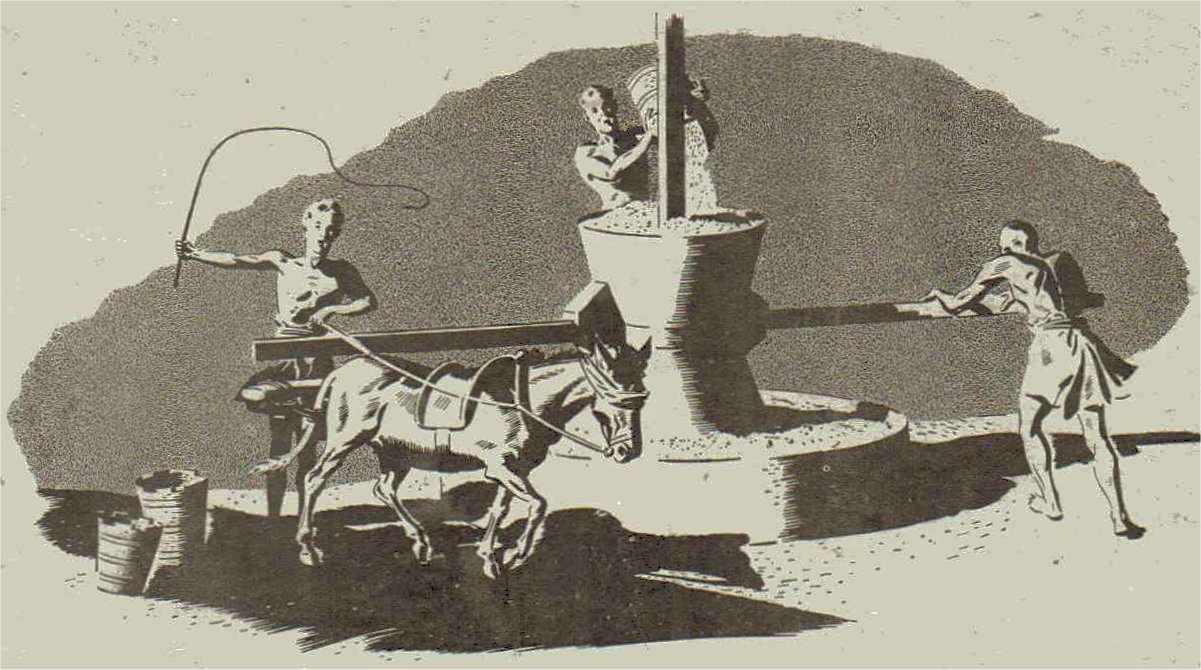
It’s a powerful reminder that compromise brings slavery.
And haven’t we all seen this? Sin brings slavery:
— that “little compromise” with the computer brings addiction to pornography.
— that “little experiment” with drugs leads to a powerful addiction by which the person is now enslaved.
That story is repeated by the millions. Satan takes people whom God created in His image — and through temptation to sin, he makes pathetic slaves out of them, making them grovel for drugs, alcohol, sex, or money.
F. But the very worst is found in :23-24, where it tells us that GOD WAS DISHONORED: It says the Philistines made “a great sacrifice to Dagon their god … they praised their god … ‘our god has given Samson into our hands’ … ‘our god has given our enemy into our hands’ …”. The form of these words in Hebrew is similar to what we would call a “poem.” It was “an ode of praise to Dagon.” They made basically a “psalm” or victory song to their false god, because of Samson’s defeat.
This is what happens when God’s people fall into compromise and sin. God is dishonored and blasphemers revel in the humiliation of God’s people:
— In II Samuel 12:14 Nathan said to David after his adultery with Bathsheba: “by this deed you have given occasion to the enemies of the Lord to blaspheme.”
We’ve seen this too often in our days too, haven’t we? Some pastor, staff member, or well-known Christian servant, is revealed to be immoral or unethical, and it gives God’s enemies an opportunity to gloat.
ILLUSTRATION
Charles Spurgeon has a powerful reference about this in his book, Lectures to My Students, that he wrote for young men in his pastor school. He said we must guard ourselves from sin, lest we fall, and the devil mock us and revile Christ:
“He will glory against Jesus Christ Himself, and say, ‘These are Thy champions! I can make Thy chiefest servants to abuse Thee; I can make the stewards of Thy house unfaithful.’” Spurgeon says: “O do not so far gratify Satan; do not make him so much sport.”
This is exactly what the Philistines were doing to Samson — they made him “sport” for their taunts. And this is what others — and the devil — will say of us if we stumble. It should be our greatest motivation against sin, not to dishonor God.
All of the things are examples of the sad consequences of sin. This is why we need to take sin seriously, and never “toy” with it, or think lightly of making “little compromises” with it, as Samson does here, because the consequences of compromise and sin are devastating.
Yet as devastating as sin is, we can be very thankful for God’s grace, which we see a taste of in our last point:
III. God’s Grace and Compromise (:25-31)
:25 “It so happened when they were in high spirits, that they said, “Call for Samson, that he may amuse us.” So they called for Samson from the prison, and he entertained them. And they made him stand between the pillars.
26 Then Samson said to the boy who was holding his hand, “Let me feel the pillars on which the house rests, that I may lean against them.” 27 Now the house was full of men and women, and all the lords of the Philistines were there. And about 3,000 men and women were on the roof looking on while Samson was amusing them.”
:28 “Then Samson called to the Lord and said, “O Lord GOD, please remember me and please strengthen me just this time, O God, that I may at once be avenged of the Philistines for my two eyes.” 29 Samson grasped the two middle pillars on which the house rested, and braced himself against them, the one with his right hand and the other with his left. 30 And Samson said, “Let me die with the Philistines!” And he bent with all his might so that the house fell on the lords and all the people who were in it. So the dead whom he killed at his death were more than those whom he killed in his life. 31 Then his brothers and all his father’s household came down, took him, brought him up and buried him between Zorah and Eshtaol in the tomb of Manoah his father. Thus he had judged Israel twenty years.”
So the Philistines were enjoying their victory and mocking Samson, and in the process they made him stand between the pillars of the Temple of Dagon their god. Thousands were present. Verse 27 says there were 3000 watching from the roof alone!
Then :28 says Samson called on the Lord: “O Lord GOD” — “GOD” is in all capital letters, which means that in Hebrew it’s literally “Lord Yahweh” — the personal name of God. This gives us hope that Samson may have truly known the Lord personally. He’d just lost a lot of battles with sin.
There are people like that, aren’t there? You probably know someone like that: they suffered a lot of defeats in life, maybe got addicted to something that kept afflicting them — maybe like Samson it even led to their death — but you still felt like in their heart they really did know the Lord.
ILLUSTRATION
I know a minister in another state who had a dear friend in ministry who suffered a lifelong battle with depression. One day the battle overwhelmed him, and he took his own life. His friend said, I believe he really did know the Lord; he just lost the battle that day. But his battles are now over, and he’s with the Lord.
You may know someone like that. Samson may have been that way too. He left a lot of hurt and devastation — but perhaps deep down he really did know the Lord. It’s certainly possible.
And it’s also a good reminder to ALL of us, that NONE of us are saved by our works, anyway. We are all only saved by God’s grace, through faith in Christ (Eph. 2:8-9). I remember hearing about a prisoner who claimed to have come to faith in Christ in prison. People were skeptical. Some said, He doesn’t “deserve” to be in heaven! But here’s the thing: WHO “DESERVES TO BE IN HEAVEN? NONE of us, right? We can’t point to anyone and say, “They don’t deserve to be in heaven?” — because WE don’t deserve to be there either! We’re only there by God’s grace! Stories like this just remind us how much we all depend on God’s grace.
And Samson’s prayer to the Lord reflected the kind of humility and faith that God loves to answer with grace. Samson prayed in :28, “please remember me and please strengthen me, just this time O God.” It was a humble plea: the word “please” that is repeated twice here is a Hebrew particle, “na,” which is called a “particle of entreaty.” It means “I pray, (like “hear me, I pray”) or “please” like the NASB has it here. It’s a very humble plea: “I pray/please, remember me; I pray/please strengthen me.”
The amazing thing about the Lord, is that when we humbly call on Him, He loves to answer. “God is opposed to the proud, but gives grace to the humble,” I Peter 5:5 says (quoting Prov. 3:34).
God didn’t have to do answer Samson — He could have said, No, you got what’s coming to you — but He did hear and answer. It’s just a classic example of His undeserved, unmerited grace. And we can all be grateful for that!
Samson didn’t get to live his life over. But God did allow him a measure of “redemption” in the end: his suffering on earth was ended, and he was able to get revenge on his enemies. And God showed that He will still hear us, even when we have failed. He didn’t have to in this case with Samson, but He did. God is gracious. He so often treats us better than we deserve. And that is His grace.
Now applying this to today, we can be thankful that we have what Hebrews 8:6 calls “a better covenant, with better promises” than Samson had. Now, because of Christ’s death on the cross and His Spirit in us, with with the promises of the new covenant, we can have assurance of things Samson could not:
— We can claim I John 1:9, that God WILL be faithful and even righteous to forgive us our sins, and cleanse us from all unrighteousness!
— We can claim I John 5:14, that if we ask anything according to His will, that He WILL hear us!
— We can claim John 3:16, that we “will never perish” through faith in Christ.
Samson could only hope for God’s grace; we can boldly claim it by faith in the promises He has given us. Let’s be sure we do that. Make sure that you have repented of your sins and put your trust in Jesus as your Lord & Savior, and that His Spirit is indeed in your life to stay, and that you can confidently claim all of promises of God by faith.
Now, as we see in Samson’s story, God’s grace and forgiveness does not negate the fact that there are often irreversible consequences on earth for our sins:
— Samson did not get his eyes restored
— He lost his life and all the potential he had was squandered, never to be recovered.
In the same way, we can suffer many consequences of sin that cannot be reversed in this lifetime, even when we receive God’s grace and are forgiven today.
So this should serve as a sober warning for us: let’s not be fools who don’t learn the lessons of history. Let’s heed the example of Samson, and steer clear of dangerous compromises with sin that can bring lasting harm on ourselves and others — while at the same time thanking God for the certainty of His forgiveness and the grace in Christ that He promises us now when we do fail.
___________________________________________
— Remember there is now a “PRINT” button at the end of the lesson on my blog, that you can hit to print out the lesson in its entirety.
— If you’ll type your email address in the “Follow blog via email” blank on my blog home page, WordPresst will automatically send you next week’s lesson and you won’t have to search for it each week.
— And if you write something in the Comments on my blog or YouTube, my commitment is to pray for your and your group and any special request you make, by name this week.
Per my licensing agreement with Lifeway:
— These weekly lessons are based on content from Explore the Bible Adult Resources. The presentation is my own and has not been reviewed by Lifeway.
— Lifeway resources are available at: goExploretheBible.com and: goexplorethebible.com/adults-training
— If you have questions about Explore the Bible resources you may send emails to explorethebible@lifeway.com


Sent from my iPadOn Aug 8, 2026,
Thanks!
You’re welcome Jeff! I’m praying for you this weekend! 👍🙏
I can see in the lives of friends, family members, and MYSELF that compromising with sin can lead to consequences we never wanted or anticipated. Thankfully, if we confess and repent we can turn around and return to relationship with God.
Sadly, I see a lot of Christians of my generation compromising in various ways and then seeing the consequences in the lives of our children/grandchildren.
Amen; praying for you this morning as you share that challenging message!
As to your point, “This gives us hope that Samson may have truly known the Lord personally. He’d just lost a lot of battles with sin.”
Hebrews 11:32-33 says, “ And what more shall I say? For time will fail me if I tell of Gideon, Barak, SAMSON, Jephthah, of David and Samuel and the prophets, who by faith conquered kingdoms, performed acts of righteousness, obtained promises, shut the mouths of lions…” You make a very valid point, God’s grace, it seems, was extended to Samson, despite his failures. That gives us all hope. Thanks, Pastor Thomas.
Fantastic cross reference Mark; I hope many see and use that! Praying for you and your group this morning!