
Includes a suggested introduction to the lesson, text highlights and outline, discussion questions for your group, illustrations you can share, and spiritual life applications to make. A video version of this overview is available on YouTube at:
INTRODUCTORY ??? DISCUSSION QUESTION???
“Can you share one of the hardest things someone ever asked you to do?”
(As a pastor I have been asked to do some difficult things over the years: visit a hardened lost person, or someone who was about to die, or who had just lost a loved one, etc., but perhaps the hardest for me was as an 18-year-old, I was asked to go the home of a man I didn’t know, and ask him to make a commitment to our church building campaign. I was just filled with anxiety and dread about making that visit. It so happened that a deacon from our church saw me with that card in my hand — and I think he could read my face — and he said “Hey, I’ll go with you to make that visit.” I was never so happy to have someone with me in my life! He took over that visit, and it went great. But it made all the difference that he was with me!
Last time in our study of Judges we saw how God told Gideon to do something very difficult — to rescue Israel from Midian — and GIdeon was very hesitant about it. But as we left off, we saw that God promised Gideon that HE WOULD BE WITH HIM, and that made all the difference for him.
Today we continue that story in Judges 7 as God again asks Gideon to do something extremely challenging — but the way it unfold would make it absolutely clear that only GOD HIMSELF brought about the victory.
CONTEXT:
We continue our study this week in the Book of Judges. Joshua had led to take most of the Promised Land, but as years went by, they settled into compromise with the people of Canaan, and worshiped their false gods. They got into a repeated cycle which we see in this book, where God would judge them for their sin, by allowing other nations to oppress them; then Israel would cry out to Him for help, and He would send a “Judge” (or “leader” as the word can mean) to deliver them. (This Book of Judges is names for these leaders.) But then once Israel was delivered, they would go back to worse sins than they had previously.
In Judges 6 & & 7 Israel is in one of those stages of that repeated cycle; this time it was Midian who was oppressing them. And as we saw last time, God called Gideon, an unlikely character, to be Israel’s next “Judge” to deliver them from. Having been called by God, in the second part of Judges 6 Gideon then asks the Lord to show him a sign, to demonstrate that He was really with him — which God graciously did. Then He sent Gideon on a mission to tear down the altar of Baal (which we’ll refer to again momentarily). Then Gideon gathers the people of Israel to fight the Midianites, and he famously asks God to show him two more signs that He would really give them the victory This brings us to Judges 7, today’s passage, where we see how God prepares Gideon’s army of deliverance in a very unusual way, which called for a real step of faith from both Gideon and his people.
OUTLINE:
I. The Battle’s Setting (:1)
II. The Unusual Command (:2-8)
III. The LORD’s Victory (:19-23)
TEXT: Judges 7:1-8, 19-23
I. The Battle’s Setting (:1)
:1 “Then Jerubbaal (that is, Gideon) and all the people who were with him, rose early and camped beside the spring of Harod; and the camp of Midian was on the north side of them by the hill of Moreh in the valley.” (NASB 1995)
So with all the preliminaries of God’s call of Gideon, and his tests of the Lord, out of the way, Gideon gathers his army, and verse 1 describes the setting of the battle:
— Verse 1 opens, “Then Jerubbaal (that is, Gideon).” One of the very first things a person might ask is, “Where does this name ‘Jerubbaal’ come from for Gideon?” Sometimes we don’t know answers to questions like this in scripture, and we may just speculate. But in this case, the Bible GIVES us the answer: it is found in Judges 6, from a portion just outside our “Lifeway focus passage” for last week.
As we mentioned in the introduction, after God called Gideon and he asked God to show him a sign, God sent him on a mission: take a couple of oxen and go tear down the altar to Baal that your father (of all people!) has up, and the altar to the Asherah beside it. (You remember we showed pictures of those two images last time.) Gideon did that — and somehow word got out that he was the one who had done it. So the people were going to kill him for desecrating the altar. But Gideon’s father Joash told them: “Will you contend for Baal?” He said in :31, “If he is a god, let him contend for himself.” So they agreed to leave it at that, and let Baal take care of his own revenge! But :32 says “Therefore on that day he named him ‘Jerubbaal,’ that is to say, ‘Let Baal contend against him.” (From the Hebrew: “rub” = “contend”; and “Baal”)
So “Jerubbaal” was a “nickname” Gideon’s father him, after his attack on the altar of Baal.
People get “nicknames” like that, for their actions or attitudes:
— Jesus named James & John “sons of thunder,” perhaps for their zeal, like when they wanted to call down fire from heaven on the Samaritans.
???A good DISCUSSION/APPLICATION QUESTION for us might be???
“If I were to be given a nickname based on my faith and service for God, what would it be?”
(— would it be like the apostle James, who according to the ancient historian Eusebius was given the nickname “camel knees,” because of the callouses his knees had developed from hours of prayer?
— or might we be given a name like Bunyan gave some of his characters in Pilgrim’s Progress, like “Obstinate” or “Pliable”?)
We saw last time that Gideon’s name technically means “hewer,” one who cuts down the enemy. But we see here that he was so known for his zeal for the Lord against the altar of Baal, that he was nicknamed for it. What might MY spiritual life be known for? It’s worth thinking about! And may we so serve God that we are given a name that reflects our service and zeal for Him!
Then Verse 1 goes on to say that Gideon/Jerubbaal and the people of Israel he had gathered, “camped by the spring of Harod” and Midian was north of them, by the hill of Moreh.
You can use a MAP like this of the area (you can download this one off my blog) to show several of these locations in today’s lesson:
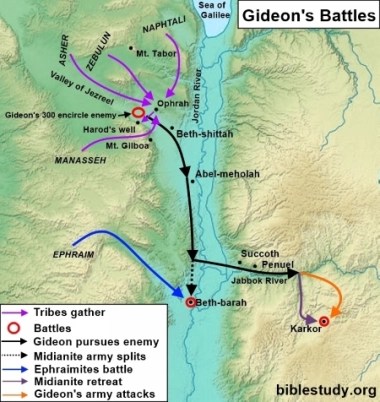
— You can see the Jordan River, which cuts down the middle of the area, flowing down to the Dead Sea. Midian had crossed the Jordan from the east to invade Israel, as we saw last time.
— Ophrah, where the LORD originally appeared to Gideon
— The well of Harod (Hebrew for “trembling”, which will be important later!)
— You can see the Valley of Jezreel, which cuts northwest to southeast across Northern Israel.
This Valley of Jezreel is significant. MANY famous battles have been fought in the Valley of Jezreel, as it is basically the “highway” between Asia & Africa. Every invading army comes through there. Famous battles there include:
— the Battle of Megiddo, considered the first reliably recorded battle in history, between Egypt & Canaanites
— an earlier battle in Judges, with Deborah & Barak
— Napoleon fought a famous battle with the Turks here in 1799,
— and there is prophesied to be at least one more: at Har-Megiddo, “the Mount of Megiddo” (from which we get the word “Armageddon”) where the great battle of the Book of Revelation will be fought. Mount Megiddo overlooks the Valley of Jezreel.
So this always has been, is now, and will be one day in the future, a strategic and decisive spot in world history.
— THIS is where the battle in today’s lesson will take place: in this strategic Valley of Jezreel! Hopefully a map like this will help you envision where these locations are.
So having described who it was, and where they were, verse 1 also adds that Gideon/Jerubbaal and his people “rose early and camped by the spring of Harod.” It may be a little detail, but it is significant that it says they “rose early.” This was a big day. Their lives, prosperity, and freedom were on the line. So they “rose early.” That just makes sense, right? You never read where on crucial days like this that “they slept in late and had a big breakfast”! No, it’s always “early,” isn’t it?
???DISCUSSION/APPLICATION QUESTION???
“What are some times we make sure to get up early?”
(— Many of us get up early when we have a big day at work
— Hunters get up early to get their prey
— Shoppers get up early on Black Friday to get their treasures
and so on.)
And significantly, God’s people get up early to meet HIM:
— Mark 1:35 “In the early morning, while it was still dark, Jesus got up, left the house, and went away to a secluded place, and was praying there.”
— David says in Psalm 5:3, “In the morning O LORD, You will hear my voice. In the morning I will order my prayer to You, and watch.”
— He says in Psalm 63:1, “O God, You are my God; I will seek You earnestly” — and the Hebrew word for “earnestly” literally means “early.”
Just like it was vital for Gideon and his army to get up early to meet the challenge of their day, so God’s people need to get up early and seek Him, first thing, to meet the challenges of our days.
II. The Unusual Command (:2-8)
:2 “The LORD said to Gideon, “The people who are with you are too many for Me to give Midian into their hands, for Israel would become boastful, saying, ‘My own power has delivered me.’ 3 Now therefore come, proclaim in the hearing of the people, saying, ‘Whoever is afraid and trembling, let him return and depart from Mount Gilead.’” So 22,000 people returned, but 10,000 remained.
4 Then the LORD said to Gideon, “The people are still too many; bring them down to the water and I will test them for you there. Therefore it shall be that he of whom I say to you, ‘This one shall go with you,’ he shall go with you; but everyone of whom I say to you, ‘This one shall not go with you,’ he shall not go.” 5 So he brought the people down to the water. And the LORD said to Gideon, “You shall separate everyone who laps the water with his tongue as a dog laps, as well as everyone who kneels to drink.” 6 Now the number of those who lapped, putting their hand to their mouth, was 300 men; but all the rest of the people kneeled to drink water. 7 The LORD said to Gideon, “I will deliver you with the 300 men who lapped and will give the Midianites into your hands; so let all the other people go, each man to his [f]home.” 8 So the 300 men took the people’s provisions and their trumpets into their hands. And Gideon sent all the other men of Israel, each to his tent, but retained the 300 men; and the camp of Midian was below him in the valley.” (NASB 1995)
Verse 2 begins with God telling Gideon: “The people who are with you are too many for Me to give Midian into your hands.”
Gideon had to be surprised to hear this statement from the Lord!
ILLUSTRATION:
Indeed, any military man would be surprised to hear a command like this! Take for example the United States “Powell Doctrine” of war. One of its key tenets is that we seek to employ “overwhelming force” to swamp an enemy. In a sense that’s not really a “new” doctrine; it’s what military leaders always seek to do if they can: having more forces than your enemy is a key element to traditional strategy.
That’s what makes God’s command to Gideon here so unusual. Verse 3 indicates that there were about 32,000 people in Gideon’s army. But according to Judges 8:10, the Midianite army numbered 135,000. So Gideon’s army was already outnumbered over 4 to 1! But God told him: “The people who are with you are too many”?! Not too many military strategists would agree with that!
But “the foolishness of God is wiser than men, and the weakness of God is stronger than men.” (I Cor. 1:25). God rarely does things the “conventional, human way” (which we need to consider more than we often do when we are planning and doing His work!) God’s ways are higher than ours. (Isaiah 55:9)
NOTICE WHY God said Israel had too many people in the army. The second half of :2 tells us: “FOR …” (this indicates the reason) “FOR Israel would become boastful, saying, ‘My own power has delivered me.’” God’s point is: if Israel won this victory with their army, they would’ve thought “Wow, we must be really great warriors, to defeat a larger army like that! Let’s build a monument to our great victory.” So instead He wanted to make their army SO small, that if they won, it would be absolutely clear that ONLY GOD could have done it, and only HE would be glorified (as we will see in the last point).
So God wanted to “thin the group out.” How was He going to do that? He did it in two ways, which we see in :3, and then in :4-7:
A) In :3, God tells Gideon to send home everyone who is “afraid and trembling.” Do you really want to tell your army that everyone who is afraid can go home? Again, no military man would say that. How many people do you think would go home under a command like that? In this case, 22,000 of Israel’s 32,000 went home! How do you think you’d feel, if you were Gideon, and saw 2/3 of your undermanned army leave? But that’s what happened.
??? DISCUSSION QUESTION???
“Why do you think God told Gideon to tell everyone who was afraid to go home?”
(The bottom line is, they should do it because God commanded it! But is it possible that there was also a practical reason behind it?
It’s like, we should obey God’s command to be faithful to our spouse, just because He commanded us to, whether we understand the reason for it or not. But we can also see practical reasons WHY he would command that: because marriage is a picture of Christ and the church; because it makes for stronger families and churches and communities. Although He is the King, He is a good King, and there’s a reason for what He commands.
So it could be that way here too. Maybe there was a specific reason why God commanded those afraid to leave. Remember the name of the well of “Harod” meant “trembling.” (Interestingly, God used the same word for “trembling” here!) Undoubtedly many of the people of Israel were fearful before this battle. And fear is often contagious, isn’t it? A fearful person, or a terrified group, can cause panic among others who were not initially fearful. In the Civil War, they often reported that when one two soldiers began to run, it caused the whole unit to panic and turn their backs to the enemy. Sometimes it’s better if the fearful person/people left. So there may indeed have been a very practical reason why God gave this command to thin out the army.)
There’s some application for this in our churches too: fear and dissension can be contagious, and ruin the health of a church. When those people leave a church, the church, though smaller, is often actually healthier than it was when they were there, and can now begin to experience health and growth. Some have called this “blessed subtractions”! It can be better to move forward with a smaller group of people of faithfulness & courage, than with a larger group of people who are contentious and fearful! Something for some of us to think about.
B) But God said in :4, “The people are still too many!” The army had shrunk from 32,000 to 10,000, vs. Midian’s 135,000 — but that was “too many”? It was for the purpose of God. He wanted to make sure people knew it was only HE who could have done this. So He gave a second order to thin the army out.
He told Gideon to take the army down to the water to get a drink. And He told him in :5-6 to separate them into two groups:
— everyone who knelt to drink in one group
— everyone who lapped the water in one hand in another group.
AGAIN we might ask: was there some “purpose” in this separation? Was it just a way God wanted to use to get rid of most of them? Or was there some “method” to what seemed like God’s “madness”?
Some have suggested there was indeed “method”:
— That those who knelt before the water basically abandoned themselves to it; “knelt” before it like a god. Perhaps also setting aside their guard to throw themselves “all in” to the water, without considering the enemy.
— But those who lapped with one hand were more prepared for the enemy.
I’ve seen ART LIKE THIS portraying how they perhaps held their spear in one hand, and lapped the water with the other:
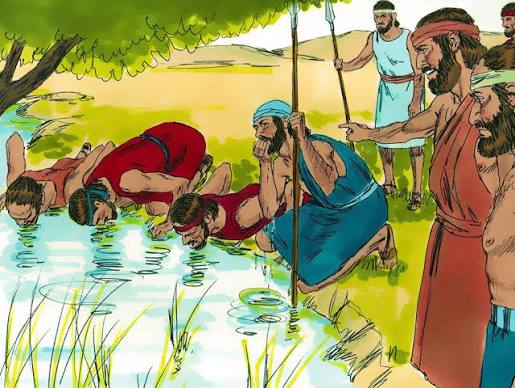
To be clear, the Bible does not specifically indicate this was the reason God chose them. But it’s certainly reasonable that God might have a reason for what He commanded; that perhaps he wanted not only those who were not afraid, but those who were diligent and watchful.
Whatever the reason, this is what God commanded. And how did it turn out? Of the 10,000 who were left, 9,700 knelt before the water! Only THREE HUNDRED lapped the water in their hand. You could picture Gideon saying, Seriously Lord? 32,000 vs. 135,000 was bad enough — but THREE HUNDRED vs. 32,000?
Yet this is exactly what God wanted: when this battle was over, for people to say “With men this is impossible — but with GOD all things are possible.” (Matt. 19:26) Now, it did take a big step of FAITH on Gideon’s part to move forward with the few. He had to really TRUST GOD — like the title of this lesson indicates.
One of my favorite Old Testament verses is when Saul’s son Jonathan wants to go up alone with his armor bearer against the whole Philistine line. And he says to his armor bearer: “God is not constrained to save by many or by few.” (I Samuel 14:6). Sometimes God purposefully uses small numbers, or what the world would consider “insignificant” people, so that only He is glorified when He acts.
Some of us need to apply this word today. It’s not the size, or the numbers that matter. Just like with Jonathan or here with Gideon, “God is not constrained to save by many or by few.” Like them we too show our trust in God today, when we move forward with our class, with our project, with our prayers — even if it’s just with a “faithful few.” Because as we see here in Judges 7, God can use those faithful few to do some big things!
God can do much with little. Don’t despise the day of small things:
— Don’t think, our church is too small; we can’t do anything
— Never look at your resources as insufficient
— Never think, our little prayer group can’t change anything
— NEVER think, my power is too weak; I can’t change this.
BUT GOD CAN! Like Jonathan said, He is “not constrained to save by many or by few”!
He can use ONE brave warrior to turn the tide of a whole battle
He can use ONE person, one small group who stands up, to turn the tide of public opinion
He can hear ONE person’s prayer to overturn a nation, or turn the heart of a king
He can use 5 loaves and two small fish to feed 5000!
He can use ONE small church to impact a community
He can use one little mission team to reach a people group.
God can do much with little. Never say, we’re too small; we’re too poor; we’re too weak. GOD is big; GOD is rich; GOD is omnipotent; and He can do much with little. Like Gideon and his brave few here, just make yourself available to God, listen for His leadership, and trust Him enough to obey Him. And He can do much with YOU!
III. The LORD’s Victory (:19-23)
:19 “So Gideon and the three hundred men who were with him came to the outskirts of the camp at the beginning of the middle watch, when they had just posted the watch; and they blew the trumpets and smashed the pitchers that were in their hands. 20 When the three [a]companies blew the trumpets and broke the pitchers, they held the torches in their left hands and the trumpets in their right hands for blowing, and cried, “A sword for the LORD and for Gideon!” 21 Each stood in his place around the camp; and all the army ran, crying out as they fled. 22 When they blew 300 trumpets, the LORD set the sword of one against another even throughout the whole army; and the army fled as far as Beth-shittah toward Zererah, as far as the edge of Abel-meholah, by Tabbath. 23 The men of Israel were summoned from Naphtali and Asher and all Manasseh, and they pursued Midian.” (NASB 1995)
So Gideon and his men went to the enemy’s camp, and again he broke a cardinal military tenet: he divided his forces in the face of a superior enemy (as if 300 was not small enough!). But their tactics were different. The three companies “surrounded” the Midianites, and they suddenly blew their trumpets and smashed their pitchers, and cried out — and when they did, :22 says “THE LORD set the sword of one against another.” The Midianite army began to fight each other, and they were put to flight. Then :23 says “the men of Israel were summoned” — likely including some of those who’d been dismissed earlier — but they slew and chased the Midianites out of the country.
It’s an amazing story. But the main point is, because God was with them, and they trusted and obeyed what He told them to do — even though it was very unusual — He gave them the victory against all odds. But they had to take the step of faith:
— Gideon had to take that step as a leader
— AND don’t miss the fact that those 300 (and those who followed later) also had to trust that this was God’s will, and step out in faith, and He was with them and gave them the unlikely victory.
And it surely was GOD’s victory. 300 against 135,000? Only God could’ve done that. And that’s exactly why He commanded them to do it that way. He was trying to teach them (and us) to trust Him, and know that He can do anything! When God does things like this, that only He can do, we need to make sure that we give HIM ALONE the praise for it.
ILLUSTRATION:
Last week we shared the story of the Battle of Agincourt, where King Henry V’s English army was outnumbered by 4-1 (or perhaps as many as 10-1) by the French army that blocked their way back to England. We saw how King Henry told a fearful follower, “We’re in God’s hands, brother, not theirs.” And in the end, the English, outnumbered by so many, defeated the French, in one of the great “upsets” in military history.
To follow up on that: when the news of this victory came to King Henry, they told him how the French had lost over 10,000 men, but the English only TWENTY-NINE — and they had won this great victory. Shakespeare records King Henry as saying: “Praised be God, and not our strength for it.” He went on to say, “be it death proclaimèd through our host, to boast of this or take that praise from God, Which is His only.”
Outnumbered in such a way, with such an overwhelming victory and so little loss, Henry said only GOD should receive the credit for such a victory as Agincourt.
It was the same way with Gideon’s victory over Midian. If Israel had 100,000 men — or perhaps even only the 32,000 — it might be said that Israel won the battle because they were so brave, or so skilled. But 300 against 135,000? Only God could do that. And that’s what the Lord wanted to make clear. Because more important to God than just the victory itself, is that HE WANTED THE HEARTS OF HIS PEOPLE TO TURN BACK TO HIM! He wanted them to know that HE did this for them; and that they should come back to Him and serve Him as their Lord & God. It was God and God alone who did this, and who should be glorified for it.
???DISCUSSION/APPLICATION QUESTION???
??? Who are some people who often get ‘credit’ today for what God does???
(The pastor often gets credit for what God does in a church. (And conversely he often gets too much of the blame when things go wrong!) Or a staff member; a rich promoter or fundraiser; a political leader, and so on.)
And make no mistake, God does USE people, as we see here. God used Gideon and those 300 — as well as those Israelites who joined the battle later. We should seek to be the kind of people that God uses, like Gideon was. Let’s make sure we listen to Him, and trust Him enough to step forward and obey Him — even if we don’t understand everything.
But at the same time, let’s also make sure that when God gives us victories, we give HIM ALONE the credit and glory that He deserves for it. Let’s proclaim like Psalm 115:1: “Not to us, O LORD, not to us, but to Thy name give glory …”.
ILLUSTRATION
At the end of Johann Sebastian Bach’s musical scores, he would often write 3 letters, SDG. What were they there for? “Soli Deo Gloria,” is Latin for “to God alone be the glory”! This was Bach’s way of making sure that God was glorified for this music, because only the gifts God gave him, allowed him to be able to do it.
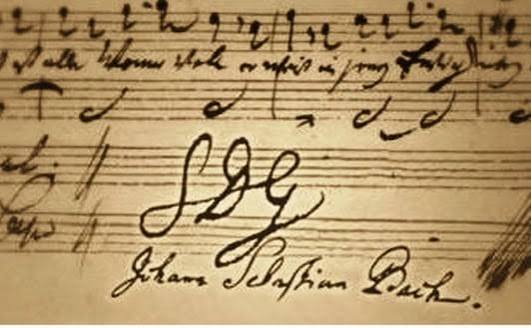
We should have the same attitude today. Whatever we have, whatever we do, let’s make sure we always give God the glory for it. Whether or not we write “SDG” on our papers, it should be the constant theme of our lives, our attitudes, our words, and our song: to God alone be the glory!
___________________________________________
— Remember there is now a “PRINT” button at the end of the lesson on my blog, that you can hit to print out the lesson in its entirety.
— If you’ll type your email address in the “Follow blog via email” blank on my blog home page, WordPress will automatically send you next week’s lesson and you won’t have to search for it each week.
— And if you write something in the Comments on my blog or YouTube, my commitment is to pray for your and your group and any special request you make, by name this week.
Per my licensing agreement with Lifeway:
— These weekly lessons are based on content from Explore the Bible Adult Resources. The presentation is my own and has not been reviewed by Lifeway.
— Lifeway resources are available at: goExploretheBible.com and: goexplorethebible.com/adults-training
— If you have questions about Explore the Bible resources you may send emails to explorethebible@lifeway.com


