
Includes a suggested introduction to the lesson, text outline and highlights, illustrations to share, discussion questions for your group, and spiritual life applications. A video version of this overview is available on YouTube at:
INTRODUCTION:
???DISCUSSION QUESTION???
“Can you share a time when you prayed for a baby: either for yourself or someone else to have a baby; or for a newborn baby in NICU, etc.?”
(After Cheryl & I had our first two sons, I specifically asked the Lord to give us a girl — and it took a bit longer than it did our first two, but He finally answered — and He did give us a girl, our daughter Libby. So she claims the privilege of being the only one of our children we specifically asked for!
I can also think of many babies in our churches that I have prayed fervently for in NICU — especially a pair of twins in Texas who were born prematurely and had a really rocky road at first; like many I was praying for them day and night! But God answered, and they are growing and healthy today.
You and your group can share your experiences like that, which leads to our lesson for today, about a woman who desperately prayed for a child, and how the Lord answered her. There are several great lessons and applications for us today in this passage!
CONTEXT:
We’re starting a new book study beginning this week: the Book of I Samuel in the Old Testament. After the story of Creation and the call of the Patriarchs and the establishment of Israel in the Torah (the first 5 books of the Old Testament) Joshua describes how Israel took the Promised Land, and Judges shows how they fell away in their obedience to God and continually suffered for it, but were delivered when they turned back to Him. We saw that Ruth relates how even foreigners (Gentiles/“nations”) could become part of God’s people — and Ruth became part of the line of King David and the coming Messiah.
This brings us to the next book of Scripture, I Samuel. Like Joshua, Judges, and Ruth, it is a book of history, specifically detailing the rise of the David as the great king of Israel. I Samuel could have been written to a great extent by Samuel the prophet, as I Chronicles 29:29 says: “Now the acts of King David, from first to last, are written in the chronicles of Samuel the seer, in the chronicles of Nathan the prophet and in the chronicles of Gad the seer,” so evidently Samuel did write history during his time. And Samuel does not die until Chapter 25:1 of I Samuel.
You should know that in Hebrew, there is just one “Book of Samuel,” “Sepher Sh:muel” (“Book of Samuel”, which was later divided into “I & II Samuel” in the Septuagint (the Greek translation of the Old Testament that many used in Jesus’ day) and this has carried over to our Bibles today.
I Samuel divides up naturally into three sections or topics, which detail how Israel transitioned from the leadership of the Judges, to being ruled by Kings:
I. The Leadership of the Prophet Samuel (1-7) (He continued to minister past this point but relinquished rule to Saul)
II. The Anointing and Reign of King Saul (8-15)
III. The Trials that Led to King David (16-31)
This section ends with Saul’s death, and the Book of II Samuel describes how David was made King of first Judah, then all Israel, and details most of his ministry. I Kings tells of his death and the transition to King Solomon.
As does the whole Old Testament, I Samuel points us to the Messiah, the “ultimate King David,” Jesus, who is the perfect ruler, our “Prophet, Priest, and King.”
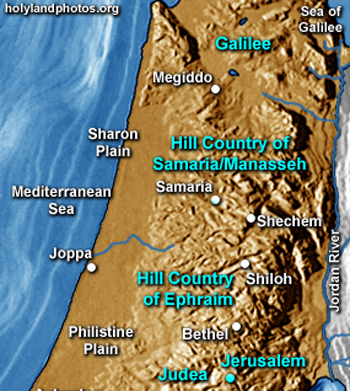
I Samuel 1 opens by telling about the man Elkanah, who lived in the hill country of Ephraim (just north of Jerusalem in the land that had been allotted to the tribe of Ephraim.) You can see on this MAP how it is a hilly, mountainous region:
The first verses relate how Elkanah had two wives, Peninnah, who had borne him children, but Hannah (whose name means “grace”) had not. It goes on to describe how Elkanah loved Hannah, and gave her great gifts, but it says “The LORD closed her womb.” And Peninnah tormented Hannah, whom :6 describes as her “rival.” This brings us to our focus passage for this week, which describes how the birth of Samuel, the prophet who is the focus of the first part of this book, takes place.
OUTLINE:
I. The Desperate Request (:9-11)
II. The Faith Encounter (:12-18)
III. The Glorious Answer (:24-28)
TEXT: I Samuel 1:9-18, 24-28
I. The Desperate Request (:9-11)
:9 “Then Hannah rose after eating and drinking in Shiloh. Now Eli the priest was sitting on the seat by the doorpost of the temple of the Lord. 10 She, [a]greatly distressed, prayed to the Lord and wept bitterly. 11 She made a vow and said, “O Lord of hosts, if You will indeed look on the affliction of Your maidservant and remember me, and not forget Your maidservant, but will give Your maidservant a [b]son, then I will give him to the Lord all the days of his life, and a razor shall never come on his head.”
Both because of the premium that ancient peoples placed on the bearing of children, and Peninnah’s tormenting, Hannah was desperate to have a child. We see that reflected in this section.
Verse 9 says “after eating and drinking in Shiloh”:
Shiloh was in Ephraim (as you can see on the MAP), right in the mountainous area. Joshua 18:1 says when they settled the Promised Land, Israel set up the Tabernacle tent there for worship. So Israel had continued to worship there. They had evidently built it up some, because there were “doorposts” and sleeping quarters (3:3).
Verse 3 says Elkanah went up to Shiloh every year — possibly for the Passover Feast, when Israelites were commanded to come and appear before the Lord. So they ate the meal — thus, “after eating and drinking in Shiloh” — after sharing the meal, Hannah got up and prayed.
The main focus here is on Hannah’s desperate state before God. Verses 10-11 describe her desperation:
— First, it says she was “greatly distressed.” This is “marath nephesh,” literally “bitter of soul.” (Remember Naomi said call me “marah,” which means “bitter.” “Marath” here is from that same word. She was “bitter of soul.”)
— It also adds that she “wept bitterly.” In Hebrew this is literally “weeping, she wept.” This is a typical Hebrew expression: when they want to emphasize the intensity of something, they’ll use the participle with a verb like that: “weeping, she wept,” “loving, he loved,” and so on. One of the most famous examples in scripture is Genesis 2:17, where God told Adam not to eat of the fruit of the tree, or “dying you shall die” — often translated, “You shall surely die.” It’s an emphatic phrase. So it says here of Hannah, “weeping, she wept.” That means she didn’t just “tear up” a little; it was emphasizing that she was really crying!
— Then Verse 11 says “she made a vow.” A vow is a solemn promise to God. Numbers 30 gives instructions about vows. Significantly, it doesn’t command God’s people to make vows, but it says if they do, it says, they are not to violate their word.
The New Testament does not call on God’s people to make vows to Him. In fact in Matthew 5:34 Jesus said not to make vows at all, so we don’t need to apply this passage to make vows today. I think the real point of Hannah’s vow in context here is that it shows just how strongly she felt about this situation: she wanted a child so desperately, that she promised God if He would grant her one, she would give him back to Him.
The emphasis is on the desperate nature of her prayer.
ILLUSTRATION
“Houston, we have a problem.” Most of us are familiar with those words of distress from the Apollo 13 mission. Gene Kranz was part of the Mission Control team he was talking to. Kranz writes how the memory of the deaths of the three astronauts in 1967, only three years earlier, was still very much on their minds. Kranz wrote:
“Now, three equally brave men were far beyond us in distance, far out in the vast absolute zero world of space, the most deadly and unforgiving environment ever experienced by man. We could measure the distances in miles. But with so many miles, the number was an abstraction, albeit one we had become used to dealing with in matter-of-fact fashion. We could reach them only with our voices, and they could speak to us only through the tenuous link of radio signals from precisely directional radio antennas. This time they were truly beyond our reach. Time and distance. So close were we in the Apollo fire that claimed the first three Americans to be killed in a spacecraft. Now we were so far, so very far, away.” (Gene Kranz, Failure Is Not An Option, pp. 11-12)
You can tell feeling of helplessness that Kranz and others experienced that day in 1970. If some of them were men of prayer, they were likely praying desperate prayers for their astronauts.
???DISCUSSION/APPLICATION???
“Can you share a prayer request you have, that is perhaps very close to your heart, or that you have been praying for a long time?”
(For example, of course one of the closest requests to my heart is my wife Cheryl as she continues to strive to gain more function on her left side from her stroke. And let me thank many of you for your continued prayers that you’ve indicated for her.
I can also share, as many of you can, people whose salvation I’m continuing to pray for.
We all have things we can share. You might just take time right here to pray — or perhaps close class with a time of prayer for these requests.
Note also before we leave this point, TO WHOM Hannah’s request was made? She addressed Him, “O LORD of hosts.” This is one of the most powerful names of God in the Old Testament, literally “YHWH Tsabbaoth” in Hebrews, “YHWH of armies.” It’s used about 250 times in the Bible; scores of times by Isaiah (62) Jeremiah (79), and Zechariah (53) (Bergen, NAC). James even uses it once in the New Testament) It reminds us of the power of the One we are asking in prayer. There is nothing He cannot do — as we will see in Hannah’s situation!
II. The Faith Encounter (:12-18)
12 Now it came about, as she [c]continued praying before the LORD, that Eli was watching her mouth. 13 As for Hannah, she was speaking in her heart, only her lips were moving, but her voice was not heard. So Eli thought she was drunk. 14 Then Eli said to her, “How long will you make yourself drunk? Put away your wine from you.” 15 But Hannah replied, “No, my lord, I am a woman [d]oppressed in spirit; I have drunk neither wine nor strong drink, but I have poured out my soul before the LORD. 16 Do not [e]consider your maidservant as a worthless woman, for I have spoken until now out of my great concern and [f]provocation.” 17 Then Eli answered and said, “Go in peace; and may the God of Israel grant your petition that you have asked of Him.” 18 She said, “Let your maidservant find favor in your sight.” So the woman went her way and ate, and her face was no longer sad.”
I see at least a couple of main points in this section:
A. The Misunderstood Judgment
This is a very convicting part of the story: Verse 12 says as Hannah “continued praying” — the Hebrew here is literally that “she caused to MULTIPLY (“rabah,” “many, multiply”) “praying” before the LORD. Verse 13 says “she was speaking in her heart” but “her lips were moving.”
One application of this is that God hears us when we pray, whether we speak it out loud or not:
— Now, in early Christianity and Judaism, prayer was mostly spoken out loud. If you prayed, you prayed out loud to God; that’s just what they did. I read a story of an old Puritan who would go out to his barn and pray out loud, and people could hear him “wrangling with God” loudly in prayer!
— But even here in ancient Israel we see an example in Hannah of one who prayed silently in her heart, though she was so “into it” that her lips were moving.
???DISCUSSION/APPLICATION QUESTION???
“How many of you primarily pray silently or primarily pray out loud?” (or both!)
(I do some of both, but I’d more of my prayers are silent than out loud. When you live in a house with other people it might lean us more that way. But I do some of both.
There’s no “right answer” to this, by the way. God hears prayer, both spoken, or in our heart. Remember Psalm 139 says “Even before there is a word on my tongue, O LORD, You know it all,” and Jesus said in Matthew 6 “Your Father knows what you need, before you ask”! )
But Eli seemingly did not understand this. Verses 13-14 say he thought she was drunk. This was a grave misjudgment. Here was this woman, broken in heart — and he accuses her of being drunk!
This is somewhat revealing about Eli in light of God’s command to His people in Joshua 1:9 to meditate on His word. The Hebrew word for “meditate” literally means “to murmur”: to move your lips while you’re reviewing and thinking about a scripture that you’ve memorized. Surely faithful Israelites did this. Surely Eli as a priest should have practiced this. Why didn’t Eli think she was praying or meditating on scripture? Why did he judge her as a drunkard instead?
But EIi’s not the only one ever to misjudge, right?
???DISCUSSION/APPLICATION QUESTION???
“Anyone want to share a story where you/someone you know ‘misjudged’ an apparent situation?”
(To my shame I misjudged Cheryl once while we were dating. I was playing church basketball and at one point I looked over and saw her smiling and talking to a guy in the bleachers. I was a bit jealous and said something to her about it afterwards. She said, I was telling him how pretty your hair is when it bounces as you run up & down the court!” Ooops. I badly misjudged that one!)
This why we need to be careful about passing judgments until we get all the facts about a situation. Better yet, as Jesus says in Matthew 7:1, don’t judge at all about certain things. We don’t have all the facts; we don’t know hearts. That’s why judgments are best left to God. Maybe this applies to someone or something you’re dealing with today?
B. The Assurance of Faith
In :15 Hannah explains to Eli what the true situation is, how she was praying and not drunk as he misjudged. And Eli tells her in :17, “Go in peace, and may the God of Israel grant your petition.” And significantly, the last part of :18 says that Hannah “went her way and ate, and her face was no longer sad.”
???DISCUSSION QUESTION???
“Why do you think that Hannah’s face was ‘no longer sad’ like :18 says?”
(Because she believed and was assured that God was finally going to hear her prayer.
To me, this is one of the best living illustrations of Hebrews 11:1, “Now faith is the assurance of things hoped for, the conviction of things unseen.”
Hannah’s reaction here was really poignant, if you think about it:
— Had anything changed in her life right now?
— Had she had a baby yet?
— Was Peninnah all of the sudden being nice to her?
NO! None of those things was true! NOTHING IN HER LIFE HAD CHANGED OUTWARDLY. But something huge had indeed happened: all of the sudden she had that inward assurance that God was going to hear her prayer. Eli said, “May God grant your petition,” and she believed that He would. It’s just like Hebrews 11 says: she had “assurance of that thing she hoped for; she was convicted that something ‘unseen’ was indeed going to happen.”
One application of this passage is this:
— There is a time for ongoing, perseverance in a long-term prayer request. Remember :12 says that Hannah was “multiplying her praying” before God. Luke 18:1 opens saying: “Now He was telling them a parable to show that at all times they ought to pray and not to lose heart.” And He tells the parable of the woman who sought justice from the judge, and “continually came” until she “wore him out.” The point of that parable is not that God is unwilling like that human judge, but rather that we should have that kind of perseverance in prayer to God for our requests. Keep on praying for that long-term request that you have. “Pray and do not lose heart” — Hannah’s a great example of that: she kept on praying and praying and praying.
ILLUSTRATION:
I once had a man tell me that he only prayed for things once. He said something like, “I figure God heard me the first time, so I don’t need to repeat it again.”
I know what he’s saying, but that just doesn’t line up with scriptures like Luke 18, where Jesus tells us to persevere in prayer. And passages like Matthew 7, where the verbs are all in the present tense: “keep on asking, keep on seeking, keep on knocking.” Like the woman in that story, we should keep on bringing our requests to God. To casually fail to persevere in prayer can become a kind of “spiritual laziness” — we’re not going to do the hard, daily work of persevering prayer.
— But this passage shows us that there is also a time when God gives us that assurance that our request has been heard, and that He is going to do it, and that like Hannah we should go forward from that day in faith, “assured of the thing hoped for.”
???DISCUSSION/APPLICATION QUESTION???
“Can anyone share a time like this in your own life/someone you know — when God gave you/them assurance like He did Hannah here, that the request had been heard?”
(You/your group can share any experiences of this you may have had/known about …
And a very common manifestation of this you might not think of right off, is regarding our salvation! Many of us can testify how our hearts were relieved when we called on God to save us, and felt “the burden of my heart rolled away,” like the great hymn says! Or even as a Christian, when you ask God to forgive a sin in your life, and you claim I John 1:9, that “if we confess our sins, He is faithful and righteous to forgive us our sins, and cleanse us from all unrighteousness,” and you go your way, assured that you are now forgiven and right with Him. That’s actually one of the very best applications of this principle of trusting that God has truly heard our prayer!)
III. The Glorious Answer (:24-28)
:24 “Now when she had weaned him, she took him up with her, with a three-year-old bull and one ephah of flour and a jug of wine, and brought him to the house of the LORD in Shiloh, although the child was young. 25 Then they slaughtered the bull, and brought the boy to Eli. 26 She said, “Oh, my lord! As your soul lives, my lord, I am the woman who stood here beside you, praying to the LORD. 27 For this boy I prayed, and the LORD has given me my petition which I asked of Him. 28 So I have also dedicated him to the LORD; as long as he lives he is dedicated to the LORD.” And he worshiped the LORD there.”
In between the Lifeway “focus passages,” Hannah has the baby the LORD promised her through Eli. The next year, Elkanah wanted to take Hannah and her baby up to Shiloh with him, but she said no, let me wean him, then I will take him up. And so they waited. Historical evidence tells us that Hebrews often weaned their children at about 3 (In II Maccabees 7:27 a mother asks her son to have pity on her for carrying him for 9 months, and nursing him for three years. Whatever the time was, :24 picks up the story: he’s now weaned, so Hannah brings him, with an offering (the bull and the flour and the wine) and took him to the Lord’s house in Shiloh. She then tells Eli, I am the woman who was asking for a child — and here he is!
What a testimony that was! She sought the Lord in tears, God spoke through the man of God (as imperfect as he evidently was; God is gracious like that!) and gave Hannah assurance — and now He had answered, and here was this child. To her credit, Hannah did not try to “back out” of her vow; she said “He is dedicated to the LORD.” (The word “dedicated” is the Hebrew “sha-al,” to “ask.” She has “asked” him from the Lord, and He gave him; so now this “child of the asking” is being given to back to the Lord, as she promised. The verb “sha-al” is actually used 4 times in the two verses, :27-28:
— YHWH “gave” my petition, that I “asked/requested” of Him
— So I have “given” him to YHWH, he shall be “given”/dedicated all his days.
So all four of these words are from the same root, “sha-al,” “ask, request.” She asked God in prayer — and now here is the child she asked for!
ILLUSTRATION:
I’ve shared with some of you before how I prayed for the husband of a woman in our church in North Carolina to be saved for several years after I left there — only to see on Facebook one day a picture of him being baptized! I was like, “This is the guy I’ve been praying for!”
That’s how Hannah & Eli were here: “This is the child I was praying for!”
???DISCUSSION/APPLICATION???
“Can anyone share a testimony of a long-time prayer request, or a prayer close to your heart, like we’ve been talking about, in years past?”
It will be encouraging for others to hear of those answers, and help build faith in their hearts that God can still hear and answer their own special prayers as well.
NOTICE ALSO in :26-28, the repeated use of the term “LORD.” (Remember when you see “LORD” in all caps in the Old Testament, in Hebrew this is not “Adonai,” or “Lord,” but YHWH, the personal name of God.— FIVE TIMES in :26-28, the word “LORD” is used: “LORD … LORD … LORD … LORD … LORD” She prayed to the “LORD;” the “LORD” gave her petition; so she’s dedicated him to the “LORD;” he worshiped the “LORD.” The focus of attention here is not on Hannah, or the baby Samuel, or Eli, but on Yahweh, the LORD. GOD did it! GOD HIMSELF is the central character of this episode. We need to make sure we give HIM the credit and glory for all He does.
And note specifically how it says at the end of :28, “And he worshiped the LORD there.” WHO “worshiped the LORD there?” To me it seems natural in the flow of the text that it is referring to I Eli, who, when he heard this testimony from Hannah, worshiped God in wonder and amazement at His answer to Hannah’s prayer. But when I went to check the commentaries, they were all over the board: one said, this obviously refers to the boy Samuel. Several said this was Elkanah who worshiped God. Another said, like I thought, this was Eli. So evidently it’s far from unanimous just who it’s referring to.
??? DISCUSSION QUESTION???
You might discuss among your group: “Who YOU think ‘he worshiped the Lord there’ referred to?”
Whoever it referred to, the important thing is that this episode ends in worship. Because ultimately, everything we do as Christians should lead to, and end, in worship. As Christians, we aren’t just about “doing religious things” or learning “religious” things. It’s all about learning to worship and serve God. If our “religious practice” doesn’t lead us to worship and serve God, it’s totally missing the mark!
J.I. Packer wrote a book, entitled Knowing God, that’s become a modern Christian classic. As he begins to address some of the attributes of God he lays out this important foundation: he says, it is important that we ask ourselves at the outset, “What am I going to DO with this knowledge of God?” That’s a question that often probably goes unasked — we just assume it’s good to learn about God — but actually the answer to that question is pretty important, isn’t it? What am I going to DO with the knowledge of God that I get? Share it with others? Become proud of what I know? What will my knowledge of God lead me to? This passage shows us that our experiences and knowledge of God should end in worship. It should lead us to worship Him.
“Theology” (the study of God) should lead to “doxology” (the worship of God (many of us are familiar with the hymn “Doxology”: “Praise God from whom all blessings flow.” The word “doxology” comes from the Greek word “doxa,” which means “glory.” So “theology should lead to doxology.” Our study and experiences of God should always lead us to worship Him. If it doesn’t it’s just legalistic Phariseeism, leading to pride over what we’ve “learned” and “accomplished” but not leading us to a closer worship of Him. (“Theology without doxology is dead orthodoxy.”)
This should challenge all of us today: make sure that what you’re learning and experiencing about God, doesn’t just “puff you up” in knowledge and pride. Truly godly learning will humble you, as you realize that you have so much more of God to learn and experience. It’ll cause you to fall at His feet in worship and adoration for His mercy and grace towards you. So like this passage tells us, let’s come away today worshiping and praising God for His goodness and grace towards us.
___________________________________________
— Remember there is now a “PRINT” button at the end of the lesson on my blog, that you can hit to print out the lesson in its entirety.
— If you’ll type your email address in the “Follow blog via email” blank at the top right of my blog home page, WordPress will automatically send you next week’s lesson and you won’t have to search for it each time.
— And if you post something in the Comments on my blog or YouTube, my commitment is to pray for your and your group and any special request you make, by name this week.
Per my licensing agreement with Lifeway:
— These weekly lessons are based on content from Explore the Bible Adult Resources. The presentation is my own and has not been reviewed by Lifeway.
— Lifeway resources are available at: goExploretheBible.com and: goexplorethebible.com/adults-training
— If you have questions about Explore the Bible resources you may send emails to explorethebible@lifeway.com


