
A brief overview for Sunday School teachers and Bible study leaders, of Lifeway’s “Explore the Bible” lesson of Mark 15:24-38 for Sunday, November 19, 2023, “Sacrificed.” A video version of this overview is available on YouTube at:
INTRO: One simple way to start this week’s lesson would be to ask your group: ??? Does anyone have a favorite song about the cross, or Jesus dying on the cross???
(One of my personal favorites is the hymn “At Calvary.” “Mercy there was great, and grace was free, pardon there was multiplied to me. There my burdened soul found liberty, at Calvary.” I can picture the Thief on the cross singing that! And I need that same mercy and grace that he found, too!
You/your group can share your favorites …
Then = “Today we are going to look at the events surrounding the death of Jesus on the cross, from Mark 15.”
CONTEXT
Last time we saw how Jesus prayed in the Garden of Gethsemane in Mark 14, wrestling with the weight of the sin He would bear — but He committed Himself to do God’s will.
After that, the chapter tells us that Judas came with the crowd from the Jewish religious leaders and arrested Him. He was put on trial before the Jews, and admitted to be The Son of Man that Daniel prophesies will come on the clouds of glory, so Chapter 15 opens with them bringing Jesus to the Romans to be crucified. Verses 16-19 describe how they dress Him up like a king, put a crown of thorns on Him, and mock Him, and a beat Him — and led Him away to crucify Him.
This brings us to our focus passage, :24-39.
OUTLINE: because this passage is very familiar to many of our class members, I plan to use a more of a “topical” outline this week, something like this:
I. The Scriptures Fulfilled (:24, 28, 34, 36)
II. The Characters’ Responses (:24-39)
III. The Access Gained! (:37-38)
I. Notice the SCRIPTURES FULFILLED that we see in this passage:
(Now what I plan to do here, is print 4 of the fulfilled scriptures in this passage and give each of them to a class member to read. Then I will also print the Old Testament prophecy and give that to another class member. So when Fulfilled Prophecy #1 is read, I’ll ask: “Who has the Old Testament prediction of that?”, and have them read it. You can either do that, or just read the Old Testament prophecy and its fulfillment in this text, and/or write it on your dry erase board, etc.:
— FULFILLMENT #1: :24 “divided up His garments among themselves, casting lots for them to decide what each man should take.”
PROPHECY: +x Psalm 22:18 “They divide my garments among them, And for my clothing they cast lots.”
— FULFILLMENT #2 :28 “And the scripture was fulfilled which says, ‘And He was numbered with transgressors’”
PROPHECY: +x Isaiah 53:12 Therefore, I will allot Him a portion with the great, And He will divide the booty with the strong; Because He poured out Himself to death, And was numbered with the transgressors; Yet He Himself bore the sin of many, And interceded for the transgressors.”
— FULFILLMENT #3 :34 “My God, My God, why have You forsaken Me?”
PROPHECY: +x Psalm 22:1 “My God, My God, why have You forsaken Me?”
FULFILLMENT #4 :36 “Someone ran and filled a sponge with sour wine, put it on a reed, and gave Him a drink …”
PROPHECY: +x Psalm 69:21b “And for my thirst they gave me vinegar to drink”
??? Why do you think it is important in this story that these scriptures were fulfilled in Jesus’ crucifixion??? Why even mention these things?
(— It validates what the Bible says. When it says something is going to happen and it does, it shows that this is REAL! This isn’t just some “religious book” that some people threw together; this is truth. It really did predict, hundreds of years in advance, what Jesus would do, and they came to pass. He did them! It shows us how real and powerful the Bible is. This is not just somebody’s “opinion;” this book is TRUTH!
— ALSO: it shows that JESUS is the true Messiah. People are always saying things like, “Well, how do we know which is the one true religion?”, as if there’s just no way to tell. But these fulfilled prophecies are a powerful testimony that Jesus is the True Way. All of these prophecies were made, hundreds of years in advance regarding what the Messiah would be like, and what He would do. And Jesus DID them! And no one else did.
— Of all the religious leaders in the world and those claiming to be Christs and Messiahs, who else was from Nazareth, born in Bethlehem, and went down to Egypt?
— Who else had His hands and feet pierced and cried out “My God, My God, why have You forsaken Me”?”, like Psalm 22 says and which Jesus did?
— Who else predicted that He would be crucified and rise again on the 3rd day, and DID IT!No one else has come close to fulfilling all those prophecies!
All of these prophecies demonstrate that Jesus really IS the Messiah, the Son of God, our Savior, the Way, the Truth, and the Life, whom we should follow.
II. THE CHARACTERS’ RESPONSES: the different people in this text and their responses to Jesus’ crucifixion:
??? You might ask your group to scan the passage and call out all the different characters they see here, and write them on the board. Then when you have them all written down, talk about the different responses each of them had to Jesus here:
— :24 the Romans soldiers: took His clothes, splitting them up among themselves (selfish)
— :29-30 “those passing by” mocked Him: “… save Yourself, come down from the cross”
— :31 the religious leaders = “He saved others, He cannot save Himself … come down from the cross that we may see and believe”
— :35 “bystanders” said “He is calling for Elijah” (:36) and gave Him a drink (misunderstood; He wasn’t calling for Elijah!)
— :39 The centurion “Truly this man was the Son of God.”
THEN I would ask: ??? What does all this tell us about how people will respond to Jesus TODAY???
(There will be all these same kinds of responses:
— some will just be selfish: what do I get out of this; if it helps ME, I’ll follow Him; if not, I won’t. It’s all a selfish response.
— some will mock: we see this all the time. People mock Who Jesus is. This started early:
“… a graffito from the second century, discovered on the Palatine Hill in Rome, on the wall of a house considered by some scholars to have been used as a school for imperial pages. It is the first surviving picture of the crucifixion, and is a caricature.
(I PULLED THIS IMAGE OFF THE INTERNET🙂
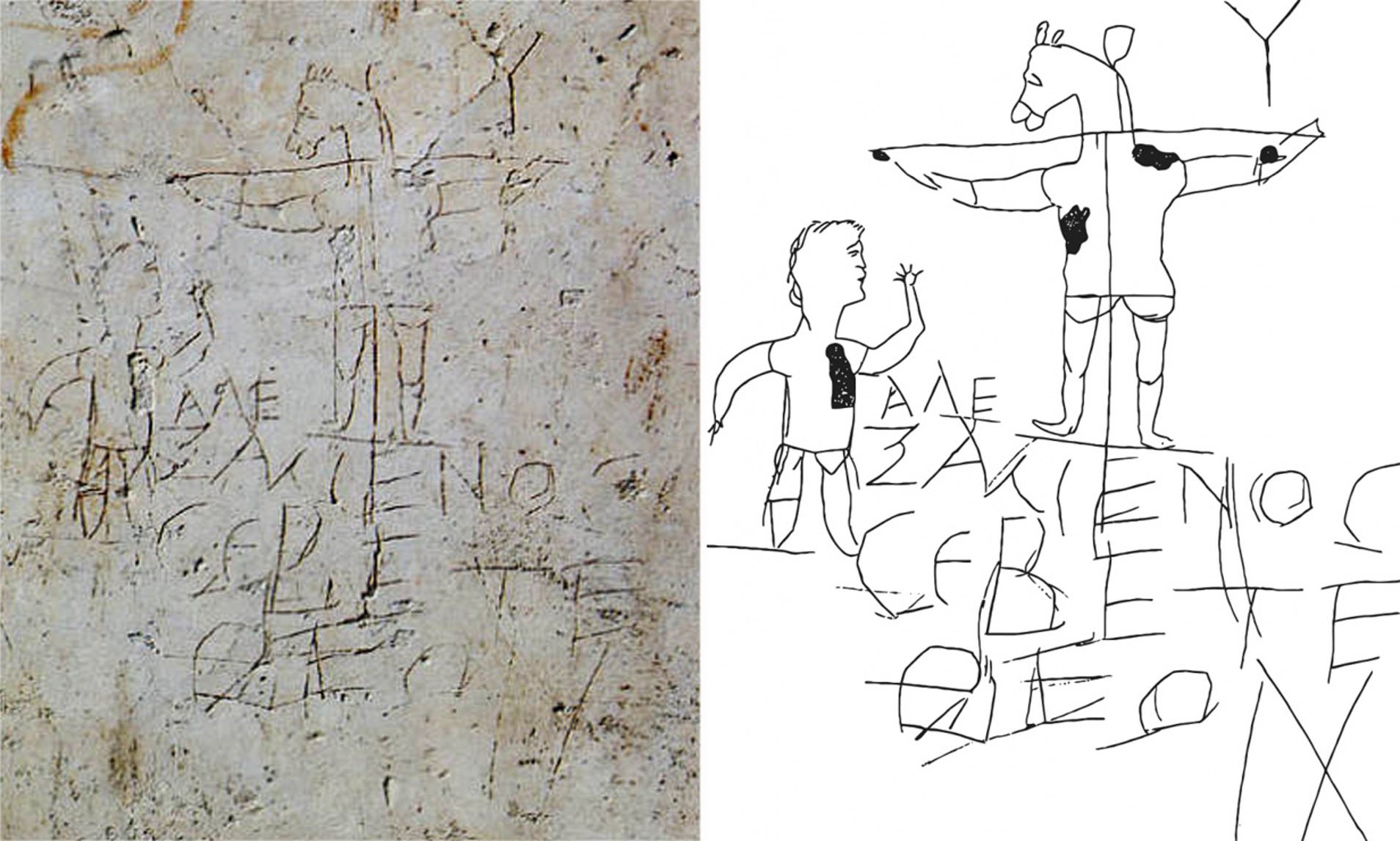
A crude drawing depicts, stretched on a cross, a man with the head of a donkey. To the left stands another man, with one arm raised in worship. Unevenly scribbled underneath are the words ALEXAMENÓS CEBETĖ THEON, ‘Alexamenos worships God’. The cartoon is now in the Kircherian Museum in Rome. … the concept of worshipping a crucified man which was being held up to derision.” (John R.W. Stott, The Cross of Christ, p. 25)
Many people still mock Jesus and those who follow Him today. Just look at any Twitter feed or public comment board. Say anything about God/Jesus they will mock you. It hasn’t changed since Mark 15!
— And just like Mark 15, even other religious leaders/members will mock and oppose also.
— some will misunderstand what it is all about, just like those misunderstood who thought Jesus was calling for Elijah.
— some will truly see and respond from their heart, like the Centurion did.
In John Lloyd Stephens’ book, Incidents of Travel in Egypt, Arabia Petraea and the Holy Land, tells of a trip he took there in the early 1800s. At one point Stephens was in Jerusalem, and he was observing the ceremony of the crucifixion:
“I could not behold this scene unmoved. Every attendant (character) upon the crucifixion was represented; for the Governor of Jerusalem was present, with a smile of scorn upon his handsome features, and Turkish and Mussulman soldiers, breaking the stillness of the scene with loud laughs of derision; and I could almost imagine that I heard the unbelieving Jews, with gibes and sneers, crying out, “If he be the King of Israel, let him come down from the cross.’” (p. 403)
Stephens was saying, there were the SAME basic characters there that day in the 1800s, as there were in 33 A.D. in Mark 15.
So one application for us is that we will have these same characters TODAY, giving the same kinds of responses to the word about Christ.
+x It’s just like The Parable of the Sower from earlier in Mark 4. (You may want to review the Parable with your class): Jesus said a sower went out to sow seed, and some fell by the road and the birds snatched it up; some seeds fell on rocky soil and sprang up, but didn’t last because it didn’t have soil to grow in; some the thorns choked out; and some found good soil and yielded a good crop! Many try to figure out “Who is saved and lost here?” But the real point of the Parable is that there will always be a mixed response to the Word. Some will not respond; some will seem to respond but will not last; and some will respond and bear fruit. People will always respond in these same ways to the Gospel and the word of God. We certainly we see it here in the responses to Jesus’ crucifixion, and we can know it will be the same for us today whenever we share God’s word.
(A word for SS teachers: sometimes we feel bad when people don’t respond to God’s word through us. I know this; I feel it too, as a pastor. And we should try to do the best we can, to present His word in the most effective way. I applaud you for watching these videos or studying these overviews; you are doing all you can to be the best teacher of the Word that you can. But Jesus shows us in the Parable that no matter how hard we try, there will ALWAYS be these mixed responses to the Word when it is shared. So when someone doesn’t receive it well, don’t feel badly, as if you have failed. There will always be mixed responses to God’s word. That is the point of the Parable of the Sower. You are not personally failing just because someone doesn’t respond to God’s word. It is always that way. I hope that might be an encouragement to you as a teacher! Keep on “sowing the word”! And encourage your group members to keep sharing the word too — and to expect the same kinds of responses from people TODAY, that these characters had at the cross in Mark 15.
III. :37-38 THE ACCESS GAINED: the veil of the Temple torn.
Through Jesus’ death on the cross, we now have access to God through Him, and the incident of the veil in the Temple being torn in this story emphasizes that in a dramatic way.
— OT background: In Exodus 26:31,33, the Lord commanded them “You shall make a veil of blue and purple and scarlet material and fine twisted linen; it shall be made with cherubim, the work of a skillful workman … and the veil shall serve for you as a partition between the holy place and the holy of holies.”
In Exodus that was the Tabernacle, but the succeeding Temples had the same thing: “the veil of the Temple” here was the dividing mark between the holy place and the holy of holies, where only the high priest could go, and then only once a year, to make atonement for sin.
— the incident: So here Mark says in :37 “And Jesus uttered a loud cry, and breathed His last. (:38) “And the veil of the Temple was torn in two from to to bottom.”
Mark doesn’t say here what the “loud cry” was that Jesus made; perhaps it was John 19:30, “It is finished.” If it was, it would make sense. He had finished His work. He had borne our sins in His body, and was about to die. It was done. And He breathed His last.
And the moment He did that, the Bible says, “the veil of the Temple was torn in two from top to bottom.”
??? Why do you think it makes the point to say, “from top to bottom”???
(because if a man did it, it would have been from the bottom up; this could only have been an act of GOD!)
— And of course, even more important is the MEANING of this act. There are generally two views of the meaning of the symbolism here:
First, that it marks the end of the sacrificial system and the need for the Temple. Jesus had taught through the Gospels that it was not all about the Temple and the old system anymore, and the tearing of the veil is the culmination of that. (And in A.D. 70, the Temple would actually be destroyed.)
Second, many others believe it symbolizes that through the death of Jesus on the cross for our sins, the “veil,” the separation between God and man has now come down, and now ALL believers have access to God through faith in Christ.
+x Ephesians 3:12 says: “in whom (Christ) we have boldness and confident access through faith in Him.”
+x Hebrews 10:19-22 “Therefore, brethren, since we have confidence to enter the holy place by the blood of Jesus, (:20) by a new and living way which He inaugurated for us through the veil, that is, His flesh, (:21) and since we have a great priest over the house of God, (:22) let us draw near with a sincere heart in full assurance of faith.”
I lean more towards this second interpretation, though I think there is a sense in which both are true. The old sacrificial system IS being done away with, as Jesus has made a way for us “through the veil” into the presence of God.
Sometimes people ask, is there any historical evidence that the veil of the Temple was really torn? There is not anything in ancient non-Biblical literature regarding it, but it is of interest that Rob Plummer, Professor at SBTS in Louisville, wrote an evangelical theological society paper back in 2005, “Something awry in the Temple.” In it he writes that in the Jerusalem Talmud (1st Century Jewish teaching) Tractate Yoma 6:3 says:
“It has been taught: Forty years before the destruction of the Temple the western light went out, the crimson thread remained crimson, and the lot for the Lord always came up in the left hand. They would close the gates of the Temple by night and get up in the morning and find them wide open. Rabban Yohanan ben Zakkai, (said) “O Temple, why do you frighten us? We know that you will end up destroyed.”
Plummer writes: “Several things should be noted about this significant passage. First, the unusual events reported in the temple are dated to “forty years” before the temple was destroyed—that is, around ad 30—the time of Jesus’ crucifixion.”
So he makes the point, no, there is no “extra-Biblical historical evidence” as such, that the veil was torn, but there IS evidence, even from the Jews’ own Talmud, that “something awry” was going on in the Temple, 40 years before the destruction of Jerusalem, which took place in 70 A.D. — which would be right at the time of Jesus’ crucifixion, which is at the least very interesting.
The MAIN point here, of course, not only of the tearing of the Temple veil but also of this whole lesson, is that Jesus gained for us access back to God, through His death on the cross.
Depending on your group, you may want to review the gospel here:
— That God created us to know Him and live with Him in glory forever.
— But we separated ourselves from God by our sins.
— This is why Jesus came: to die on the cross and pay for our sins, so that the separation (symbolized by the veil) would be done away with, and we could come back to know Him, and have access to His presence forever in glory.
But the heart of the Gospel is always the CROSS. We cannot emphasize the cross too much, and we must never neglect it. Genuine Christianity is always about the cross. Paul said in I Corinthians 2:2, “I determined to know nothing among you but Jesus Christ, and Him crucified.” He said, his whole message was just the Cross! The world will mock it, as we have seen, and heretics and false teachers will get away from the cross and focus on all kinds of other things, but the cross is the ONE thing we must never neglect. Faith in what Jesus did on the cross is what gives us our salvation.
I’ve shared before about Nabeel Qureshi, a young man brought up in a Muslim family who gradually was convinced of the claims of Christ and became a Christian, at the cost of his family. In his book, Seeking Allah, Finding Jesus he writes:
“These are the costs Muslims must calculate when considering the gospel: losing the relationships they have built in this life, potentially losing this life itself, and if they are wrong, losing their afterlife in paradise. It is no understatement to say that Muslims often risk everything to embrace the cross.
But then again, it is the cross. There is a reason Jesus said, ‘Whoever wants to be My disciple must deny themselves and take up their cross and follow Me …
Would it be worth it to pick up my cross and be crucified next to Jesus? If He is not God, then, no. Lose everything I love to worship a false God? A million times over, no!
But if He is God, then, yes. Being forever bonded to my Lord by suffering alongside Him? A million times over, yes!” (p. 253)
You can use that story if you are led, and then emphasize: that needs to be our commitment too. As I Corinthians 1:18 says, the message of the cross is to those who are perishing foolishness, but to us who are being saved it is the power of God. The world will mock it and misunderstand it, but we need to hold to Jesus’ death on the cross, as the one and only way to salvation and eternal life.
And you could close your lesson by challenging your group, that just as the centurion saw all this, and said, “Truly this man was the Son of God,” so we must each make our own decision, and our own personal commitment to Jesus, to be our own Lord & Savior — and encourage them to do it today, if they have never done it before.
______________________________________________________
— If you’ll type your email in the “Follow blog via email” blank, WordPress will automatically send you next week’s video and you won’t have to search for it.
— And if you write something in the Comments below, I’ll be sure to pray for your and your group by name this week.
Per my licensing agreement with Lifeway:
— These weekly lessons are based on content from Explore the Bible Adult Resources. The presentation is my own and has not been reviewed by Lifeway.
— Lifeway resources are available at: goExploretheBible.com and: goexplorethebible.com/adults-training
— If you have questions about Explore the Bible resources you may send emails to explorethebible@lifeway.com


Would appreciate your prayers for me to share this lesson as our Heavenly Father would have me do it.
Thank you for sharing your Bible study overviews each week…it is such a helpful ministry.
Continue with these lessons from December through February also.
Yes ma’am I will be posting the first one from Genesis later today, Lord willing. Just a bit late due to Thanksgiving travel and company!