
Includes a suggested introduction to the lesson, text highlights and outline, illustrations you can use, discussion questions for your group, and spiritual life applications you can make. A video version of this overview is available on YouTube at:
INTRODUCTION:
???DISCUSSION QUESTION???
“Can you share a time in your life when you or someone you know, needed courage?”
(OR you could ask them: “Share some time when you personally saw courage demonstrated.”)
(For example, my wife Cheryl had memorized “be strong and courageous” from Joshua 1 here, before her stroke. But during her stroke rehab, these verses became particularly meaningful to her. She shares how at the first rehab session, when she was almost totally crippled on her left side, the therapist said to her: “I want you to take this staff and stand and walk.” Cheryl looked at this man and his shiny bald head and thought: “You don’t look anything like Jesus — telling me to rise and walk!” And she was very fearful about even attempting to stand, much less to try to take steps. She said it was the most scary thing she had ever done, to stand up and try to take that first step. But relying on Joshua 1 and God’s Spirit in her, she did!
You/your group can share your own experiences and stories, then transition: in today’s lesson from Joshua 1, we read how the Lord commanded Joshua to be “Strong & Courageous” — and how He commands us as His followers to to do the same thing!
CONTEXT:
We begin a new study for this summer 2026, moving from Matthew back to the Old Testament, and a brief sojourn in the books of Joshua, Judges, and Ruth.
The Book of Joshua takes up where the Book of Deuteronomy ends, as Moses has died, and Israel is still on the other (east) side of the Jordan River, poised to enter the Promised Land. Chapter 1 begins with God’s first commands to Joshua, who had been Moses’ servant, as the new leader of His people. We first see Joshua in Exodus 17, during Israel’s journey from Egypt. Amalek attacks Israel, and Moses commands him to go and fight them. (This was the famous battle where Aaron & Hur held Moses’ arms and Joshua won the battle). Joshua’s name means “Yahweh is salvation” — and in Greek, it takes the same form as “Jesus” in the New Testament: “Iesous.” As we will see, Joshua was Moses’ servant, as well as a military leader, and now God calls him in this Book of Joshua to lead His people into the Promised Land (Just as the “new Joshua,” Jesus, will lead us to the Ultimate “Promised Land”!) Some of the instructions that God gave him are very applicable to us as His people today as well.
OUTLINE:
I. The Servant of the Lord (:1-2a)
II. The Command To Be Courageous (:2b-7a)
III. The Key to Success (:7b-18)
TEXT: Joshua 1:1-11, :16-18
I. The Servant of the Lord (:1-2a)
:1 “Now it came about after the death of Moses the servant of the Lord, that the Lord spoke to Joshua the son of Nun, Moses’ [a]servant, saying, 2 “Moses My servant is dead …”
So this book of Joshua opens, as we mentioned, with Moses now dead, and Joshua taking over as Israel’s God-appointed leader. This is an important time in Israel’s history. Leadership transition is always an important time — certainly for our churches as well. We always need to be very prayerful as we move forward and seek new leadership. Some of our teachers/classes are serving in churches which are seeking new leadership right now. (If you’re in that situation, if you’ll post that in the comments below I’ll pray for your search this week).
BUT NOTICE something important here in :1 about the leaders God used in Israel: the repetition of the word “servant.”
— “Moses the SERVANT of the Lord”
— “Joshua the son of Nun, Moses’ SERVANT”
Do you notice anything the men that God chose to lead His people? They are SERVANTS. (Of Moses, it uses the word “abad,” “slave or bondservant,” of Joshua it uses “sharath,” a “minister” — but both indicate that they were servants. Exodus 33:11 says that Joshua served Moses faithfully, and would not leave Moses’ tent. He was a devoted servant, to the Lord, and to His leader Moses. Now God calls this servant, to be the leader of His people. The point being: GOD USES SERVANT LEADERS!
That’s not the way of the world, is it? Jesus even referenced that in Matthew 20:25—28:
25 But Jesus called them to Himself and said, “You know that the rulers of the Gentiles lord it over them, and their great men exercise authority over them. 26 It is not this way among you, but whoever wishes to become great among you shall be your servant, 27 and whoever wishes to be first among you shall be your slave; 28 just as the Son of Man did not come to be served, but to serve, and to give His life a ransom for many.”
As you know, Jesus spoke these words in the aftermath of James & John’s mother asking for her sons to sit at Jesus’ right and left in His kingdom. But He tells her (and all of us today!) that greatness in His Kingdom is reserved for those who are SERVANTS!
Do you want to be great in God’s kingdom? Be His servant.
We just talked a couple of weeks ago about how Peter and John, considered to be the “inside” leadership of Jesus, were given the special assignment to go and prepare the Passover. That was just “menial work”! But that kind of service is what Jesus asks of those who are His leaders.
ILLUSTRATION
Years ago I knew of a youth minister at another church in a town I served in, who was asked by the pastor to wash their church van. He told him: “That’s not in my job description.” Not surprisingly, that young man didn’t last long in that ministry!
Romans 12:3 warns us as Christians not to think of ourselves more highly than we ought to think. We are not some “privileged personalities” in His kindgom — we are SERVANTS. We need to keep that mindset always before us. Jesus said there in Matthew 20 that HE HIMSELF came to serve, not be served. HOW MUCH MORE should we, the servants of the One who came to serve, be willing to serve for Him?
So if we want to be great in God’s kingdom — and there is nothing wrong with desiring that — we need to understand what it takes to do it. Greatness in God’s Kingdom doesn’t mean we get tell everyone else how to serve. It means that we ourselves are willing to be servants. What needs to be done in your church? Do it. Serve. And don’t make a big deal out of it.
To help APPLY this point, you might talk with your group about some specific needs that your particular church currently has for service: mowing the lawn or keeping up the church grounds; serving in the nursery/extended session; to help serve fellowship meals or clean up afterwards, etc. Give them specific examples of how they can serve. (And make sure that you yourself are an example of someone who is willing to serve as well!)
II. God’s Command: Be Courageous (:2b-7a)
:2b “… now therefore arise, cross this Jordan, you and all this people, to the land which I am giving to them, to the sons of Israel. 3 Every place on which the sole of your foot treads, I have given it to you, just as I spoke to Moses. 4 From the wilderness and this Lebanon, even as far as the great river, the river Euphrates, all the land of the Hittites, and as far as the Great Sea toward the setting of the sun will be your territory. 5 No man will be able to stand before you all the days of your life. Just as I have been with Moses, I will be with you; I will not fail you or forsake you. 6 Be strong and courageous, for you shall give this people possession of the land which I swore to their fathers to give them. 7 Only be strong and very courageous …”
As the Lord prepares to send Joshua and the people into the Promised Land, He gives Joshua a number of promises. God’s promises are the “foundation” for Joshua’s faith and action in the days ahead. (It is always that way. We don’t just “head on out and act in faith” on anything we decide want to do; that is a “word faith” error. No, genuine faith in always based on a word from GOD first. He commands something, and we respond to His command or promise or word, with our faith and action.) So here, God gives Joshua some promises that will be the foundation for his faith and action moving forward.
There is a LOT in this section, although our focus today is more on one particular command which we’ll talk about in a moment. But to briefly survey this section you might do a GROUP EXERCISE: have your class members pick out all the different promises God gives Joshua in verses 2-7:
(These can include:
— :2b He is giving them the land
— :3 “every place on which the sole of your foot treads” God says He is giving them. What a promise! (I felt like God gave me this promise one time for my ministry as pastor of a church; that whatever I would be bold enough to do, He would bless. And it did seem like He did that! That is the promise He gives Joshua here: wherever you are bold enough to step your foot in battle; I’ll give that to you!)
— :4 God outlines the territory He’s giving them: from “the wilderness” (Sinai desert) to Lebanon (north of Israel), the River Euphrates (still there today); and the “Great Sea” (the Mediterranean Sea). That was the Land He promised.
You might post a MAP indicating where these places were:
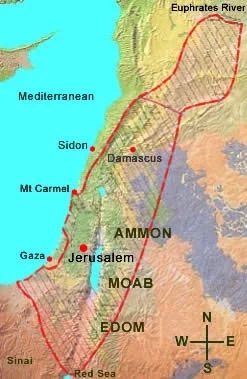
“The wilderness” is down by Sinai; Lebanon is some of the land east of Sidon there; you can see the Euphrates River up in the top right corner, and the “Great Sea” is the Mediterranean Sea on this map. (By the way, this is an outline of the Kingdom of Israel under King David; God DID fulfill His promise to do this!)
Other promises include:
— :5a no man will be able to stand before you all the days of your life
— :5b just as I have been with Moses I will be with you
— :5c “I will not fail you nor forsake you” (a favorite verse of many and a great one for us to remember today!)
— :6 you shall give the people possession of the land)
All these are promises God gave Joshua. And remember, this is not just “anyone” giving him these promises; GOD is giving them! As Hebrews 6:18 says “it is impossible for God to lie.” So Joshua had these great promises as the foundation for His faith and action.
You might remind your group that as II Peter 1:4 says “He has granted to US His precious and magnificent promises” too!
???DISCUSSION/APPLICATION QUESTION???
“What are some of God’s promises that we should claim and act upon today?”
(You/your group can think of many: the promise that whoever calls on Him will be saved; His promise to provide our needs according to His riches in glory; His promise to be with us always, and so on.)
Then BECAUSE of these “magnificent promises” that God gave Joshua, he repeatedly commands him to be strong and courageous. In fact, this repeated command may be THE single most outstanding feature of this text. Look at how many times it’s emphasized in this passage:
GOD tells him 3 times:
— :6 “Be strong & courageous”
— then immediately again in :7: “Only be strong and VERY courageous”
— And again He repeats in :9 “Have I not commanded you? Be strong and courageous”
— THEN ironically, after God commands him, and the people of Israel respond to his leadership, they tell him they’ll follow, but then they add in :18 “only be strong and courageous”!
So FOUR TIMES in this passage all together, three from God and and additional one from the people, Joshua is commanded to be “strong and courageous.”
???DISCUSSION QUESTION???
“Why do you think this particular command is what God would choose to emphasize to Joshua?” Why not something else?
(Answers could include:
— Perhaps Joshua had a tendency to be hesitant or anxious — some people are. Think of Timothy in the New Testament; Paul repeatedly told him not to be afraid or timid. Maybe Joshua had the same tendency to fear, and he needed that.
— And whether he had a tendency to fear or not, as a leader, he WILL face many temptations to doubt and fear, and to be discouraged as events unfold. Think of what all he would face: having to cross the Jordan River at flood stage with all these people; having to capture Jericho, a massive walled city; facing giants in battle; the discouragement of the defeat at Ai, because of the sin of the people. Joshua would have many opportunities to doubt and fear, so he needed this word from the Lord to “be strong and very courageous”!)
But it’s not only Joshua who needs this word, is it?
— We mentioned how Timothy in the New Testament needed it as well, so Paul wrote to him:
— II Timothy 1:7 “God has not given us a spirit of timidity”
— II Timothy 1:8 “do not be ashamed of the testimony of our Lord”
— II Timothy 1:12 “I am not ashamed, for I know Whom I have believed …”
And so on throughout the book. Timothy needed that same word, to be “strong and courageous.”
AND WE NEED IT TODAY TOO! This is why God preserved all these repeated commands to not fear, but be “strong and courageous” as WE serve Him too.
I have not personally added them up and compared them, but I have read in numerous sources that THE single most repeated command in the Bible is “fear not” and variations of that. I believe it!
— When God gave Joshua his commission, He repeatedly commands him here to be strong and courageous, and not fear.
— When the angel appeared to the shepherds in Luke, he said “Fear not …”!
— When the glorious, risen Lord Jesus spoke to His servant John in Revelation and he fell as dead at His feet, the first thing He told him was “do not be afraid”!
— Jesus gives that same instruction to His church in Revelation 2:10, “Do not fear”
And we could go on and on. (Some assert that there are 365 commands in the Bible to fear not, “one for each day;” but let’s be accurate, it’s really closer to just over 100 that literally say that, and many others that teach or imply it.) But we get the point: God DOES repeatedly command us not to be afraid, but to be “strong and courageous” in Him.
Let’s APPLY this a little bit. What does it mean for us today to be “strong and courageous”?
One thing we need to understand is that there are different kinds of “courage.” Sometimes courage is what we call “physical courage”: facing a giant like David, or running into a burning building to deliver someone like a firefighter. But often what God asks from us is not mere physical courage, but MORAL and SPIRITUAL courage: being willing to stand against opposition or ridicule, or popular opinion.
ILLUSTRATION
Right now I am reading John F. Kennedy’s classic book, Profiles in Courage. I’ve long heard about this book, but I’d never read it. I assumed it would be a book full of stories of men who had performed great deeds of physical courage, like Kennedy himself did in World War II when his torpedo boat was sunk by the Japanese. He led his men off that burning boat to safety on an island, and literally towed one man who’d been severely injured, behind him on a rope that he held between his teeth as he swam. That is physical courage!
But unexpectedly to me, Profiles in Courage is NOT about acts of physical courage, but acts of POLITICAL courage, specifically by 8 different senators in U.S. history, who had the courage to defy their political party and/or popular opinion, to do what was right for the country. The first example he used was that of John Quincy Adams, who didn’t cave in to pressure from his home constituency in Massachusetts, to vote to confront the British for impounding our American sailors without due process. Massachusetts businessmen didn’t want to lose their trade dollars from England, and pressured him to vote against it — but Adams resisted that pressure and did what was right instead, and lost his senate seat as a result. Of course he was later elected not only President of the United States, but also U.S. Representative from Massachusetts, where he again demonstrated moral courage by leading the fight for the abolition of slavery. The kind of courage Adams had was not “physical courage, but moral and spiritual courage.
???DISCUSSION/APPLICATION QUESTION???
Understanding that, ask your group to help apply this: “What are some situations where we might need to be ‘strong and courageous’ today?”
(— We might need the courage to witness to someone when the Lord leads us to.
— We might need the courage to stand up for something that is right in church when no one else will.
— We could need courage h to speak up before our friends, or work associates, or in public meetings, about God’s unchanging standards in our world. (Think about the bakers who’ve taken a stand and refused to bake a cake for a “gay marriage.” It took great courage for them to do that. We may have similar instances arise in our family situations, at work, or school, and so on.
— Sometimes it takes not only moral courage, but even physical courage to go on a mission trip, if you have a natural fear of flying, or to have the courage to go to a dangerous place to witness and minister.
— It may take courage for some of us to take a new assignment the Lord gives us: maybe to do something that is “out of our comfort zone” — like teaching a class, or sharing a testimony or speaking in church, or working with teens, etc.
You/your group can think of many such occasions when we might need courage today. The point is, God does NOT say: “Oh, well if you’re afraid, just don’t do it!” No, He wants us to remember all He has promised us, and to step forward in faith and courage to obey Him, just like Joshua did here!
III. The Key to Success (:7b-18)
“:7b “… be careful to do according to all the law which Moses My servant commanded you; do not turn from it to the right or to the left, so that you may have success wherever you go.” 8 “This book of the law shall not depart from your mouth, but you shall meditate on it day and night, so that you may be careful to do according to all that is written in it; for then you will make your way prosperous, and then you will have success. 9 Have I not commanded you? Be strong and courageous! Do not tremble or be dismayed, for the Lord your God is with you wherever you go.”
Now God gives Joshua the key to the strength that will undergird him as he seeks to be courageous and obey God: and that key is found IN HIS WORD! Note the important ways He tells him to relate to His word:
A. DO THE WORD (:7)
“Be careful to DO according to all the Law …”
It’s significant that God didn’t just tell him, “Read” the Law, or “learn” the Law, and so on. He specifically commanded him to DO it! The NASB “be careful to do” is really two verbs in Hebrew:
— “shamar” means “keep, guard, observe, give heed”
— “asah,” is just the Hebrew word “to do.”
So it’s like, “guard yourself to make sure you DO this!” The emphasis is on DOING the word — which is a New Testament emphasis too:
— Jesus made very clear at the conclusion of His Sermon on the Mount in Matthew 7 that the one who “builds his house on the rock” is not the person who just “hears” the word, but the one “who hears these words of Mine and ACTS upon them”!
— James 1:22 famously says “But prove yourselves doers of the word, and not merely hearers who delude themselves.”
ILLUSTRATION:
In the first book of Rick Atkinson’s World War II trilogy, An Army At Dawn, he writes about how in the early days of the North African campaign in World War II, Dwight Eisenhower was very frustrated and wrote: “There’s a lot of big talk and desk hammering around this place — but very few doers!” (p. 59)
Sadly, that statement could too often be made of contemporary Christians too! So often we go to church, and say and hear all kinds of “big talk” and “pulpit hammering” about what we need to do — but then we don’t really DO it! Just like General Eisenhower, God is not looking for “big talk” and “pulpit hammering” today; He’s looking to bless people who will DO what He tells them in His word. It’s very simple. Jesus said “If you love Me, keep My commandments.” Like the old hymn says: “But how much I love Thee, my ACTIONS will show.” The key to success with God is doing what He tells us to do!
And speaking of actions, God shows us another important action He wants us to take in regard to His word, in :8:
B. MEDITATE ON THE WORD (:8)
:8 “This book of the law shall not depart from your mouth, but you shall meditate on it day and night.”
I believe this is a very much unappreciated, and under-practiced verse of scripture, and we are neglecting it to our hurt. God commands us to “meditate” on His word. This Hebrew word (“hagah”) literally means to “mutter” or “murmur.” Robert Alter (a Jewish professor of Hebrew at Cal Berkeley) says the picture is of a Hebrew who has memorized a scripture passage, and is reviewing it as he goes about his day, “muttering” the verse under his breath. If you have memorized scripture, you know what that is like! You’re “muttering” it while you are shaving in the morning, or walking in your neighborhood, or driving in the car. This is exactly what God is commanding us here. My wife Cheryl said, “That’s why He said “This book of the Law shall not depart from your MOUTH — because they were to ‘mutter’ it all day long as they reviewed and meditated on it! That makes so much sense!” This is exactly what God commands us to do with His word.
A prime application of this passage would be to challenge your group to memorize a verse, or a small Psalm or other scripture portion that they choose. Hold yourselves accountable as a class next week and let everyone share how far they’ve gotten. SO many adults quickly say “I just can’t memorize,” but I think honestly many of us have just not tried that hard. God repeatedly says that meditating on His word is a key to success for His people. So challenge your class — and yourself — to take God up on His offer, to meditate on His word, and see the blessing He will give you (which we see in the next Section C).
BUT NOTICE AGAIN: the END PURPOSE of meditating on the word is so that we might DO IT, just like :7 had said. Verse 8 repeats that purpose again, saying we are to meditate on it, “SO THAT (here is the purpose) you may be careful to DO according to all that is written in it.” It’s the exact same Hebrew phrase we saw in :7, meaning “guard/watch”/“to do” what God says in His word.
C. The Promises of Success:
— :7b “so that you may have success wherever you go”
— :8b “then you will make your way prosperous, and then you will have success.”
God says if you will be careful to DO My word, and to make it your delight by meditating on it day and night, I will give you “success” and “prosperity.” Psalm 1 says the same thing: the man whose “delight is in the Law of YHWH, and in His Law he meditates day and night,” will see that “In whatever he does, he prospers.” What fantastic promises these are! We should be lining up to take God up on them — but instead the devil has convinced most of us that we can’t do it!
But be careful: this is NOT a blank check that God will bless just any endeavor you choose to participate in. This doesn’t promise that your acting career will take off, or your stocks will never go down, or that crazy business you’ve dreamed up is guaranteed to succeed. There’s a couple of other considerations we need to be aware of here:
1) The Hebrew word for “have success” here has a base meaning of “act wisely.” God’s word isn’t just some “lucky charm” we carry with us, that will help us win at everything we choose to do. Rather, when we meditate on scripture, and obey it, it helps to live and act wisely, and thus we will be blessed and truly “successful” in the best sense of the word, when we do.
2) AND rather than a blanket promise that God will bless you in whatever YOU might choose to do, in context here it’s a promise that God will bless the endeavors which HE sets before you, just like He did with Joshua here. God told him what He wanted him to do — go take that land — and He promised to bless him in that if he would meditate on, and obey, His word. So we need to understand today that God promises to bless and give us success as we pursue HIS will, not our own!
But it’s still an amazing promise: if we will take God’s word seriously, make it our delight that we “mutter” under our breath all the time, and that we are careful to OBEY, then we will be the most blessed of people. What a promise! Let’s make sure that we take Him up on it, and meditate on, and obey, His word!
CONCLUSION:
:10 “Then Joshua commanded the officers of the people, saying, 11 ‘Pass through the midst of the camp and command the people, saying, “Prepare provisions for yourselves, for within three days you are to cross this Jordan, to go in to possess the land which the Lord your God is giving you, to possess it.”’”
Joshua tells the people: Let’s get going! He’s getting right on with it. He says “within THREE DAYS” they will cross the Jordan. No study committee; no months or years away — let’s go now! That’s the leadership God called for from him. This may be a word for some of US today too: maybe there’s something in your own personal life, or in your church, where God’s saying, “it’s time to act.” It’s time to stop talking about it, and start doing it. You/your group may have some personal applications of this that you can share and pray about.
Then :16 says “They answered Joshua, saying, ‘All that you have commanded us we will do, and wherever you send us we will go. 17 Just as we obeyed Moses in all things, so we will obey you; only may the Lord your God be with you as He was with Moses. 18 Anyone who rebels against your command and does not obey your words in all that you command him, shall be put to death; only be strong and courageous.’”
So the people are with him! They promise to obey. But isn’t it interesting that they end here by saying the very same thing to Joshua that God had told him three times already: for the fourth time in this passage now, Joshua hears these words: “Only be strong and courageous”! (Some of our pastors may need to hear these words of encouragement from us: “Be strong & courageous pastor; we’ll follow you!) But it’s not only for Joshua and for pastors and other leaders; let’s challenge our group members this week to hear those same words from God too — and to act upon them in those areas of our lives, and in our churches, where God is speaking to us! He wants us too, to be “strong and courageous”!
___________________________________________
— Remember there is now a “PRINT” button at the end of the lesson on my blog, that you can hit to print out the lesson in its entirety.
— If you’ll type your email address in the “Follow blog via email” blank on my blog home page, WordPress will automatically send you next week’s lesson and you won’t have to search for it each week.
— And if you write something in the Comments on my blog or YouTube, my commitment is to pray for your and your group and any special request you make, by name this week.
Per my licensing agreement with Lifeway:
— These weekly lessons are based on content from Explore the Bible Adult Resources. The presentation is my own and has not been reviewed by Lifeway.
— Lifeway resources are available at: goExploretheBible.com and: goexplorethebible.com/adults-training
— If you have questions about Explore the Bible resources you may send emails to explorethebible@lifeway.com


Does your church do sign language for Sunday service and Bible study?
The church I currently attend, Trinity Norman, does not have ASL for worship. I’m not sure if there are any small groups etc with it or not.
Our church is in a transition as the previous pastor was asked to resign. We currently have two newly ordained pastors leading the way but we will be in search for a senior pastor in the future. Prayers will definitely be needed as our congregation seeks a new pastor.
Our Pastor a few weeks ago unexpectly for the congregation resigned. Since that time the congregation was informed that for several months our Pastor, the board of deacons, the Personel committee and our church staff tried to resolve the personality conflict but was unsuccessful. We have a very capable Associate Pastor and staff that is leading us to carry on our church mission. We are now putting together a Pastor search committee and preparing to begin the search for the man God is calling to our church. Please pray that our church will remain unified in our mission, that the staff will remain strong in their leadership, and through the time we will pray for God’s guidance.
Our pastor is stepping down in August to go to seminary school. We are currently looking for a pastor. Harris Creek Baptist. Prayers would be greatly appreciated.
Thanks for your helps. I listen to them every week. I am on our Pastor search committee and wordle appreciate your prayers. Our pastor died almost exactly 1 year ago…during VBS. We have been a grieving church. I have been praying for Cheryl also.
At First Baptist – Dillon, SC, we are searching for a Youth Leader as well as a permanent Worship Pastor (Minister of Music). We have been actively searching to fill both positions for several years. Thankfully, we have had church members step up to temporarily fill these roles. Please pray that the LORD connects us with the right ones for these positions. Thank you!!
Shawn, thank you for these lesson preparation videos. They are very helpful and open up many ideas for sharing with our class at West McComb Baptist Church, McComb, MS. We are anxiously searching for a Music Minister and Youth Minister. You are very much appreciated, and we are lifting you and your wife up for her great recovery. God Bless both of you.
Tim Stamps
Shawn, our church needs to renovate our sanctuary. We are a growing church but to accommdate a larger
Please pray for our pastor search team as we look for our new pastor at First Baptist Church, Anderson, SC. God sent us an amazing interim pastor and our church has grown and added many new members during this difficult time, and we are so grateful for these blessings. We would love to keep our interim pastor, however, he is a retired minister and cannot stay. Please pray that God will send just the right person and that God will continue to bless us with new people who want to learn more about Him and whom we can welcome with open arms and hearts. Thank you for you lesson overviews. They are so helpful in preparing my lesson each week. I am continuing to pray for your wife’s complete healing.
Please pray for Second Baptist Church and its pastor search committee in Lake Jackson as we look for a new pastor following the retirement of Brother Gary Thornton. Today, our interim pastor, Daryl Wilson, begins his ministry with us as we seek our new shepherd.