
Includes a suggested introduction to the lesson, text outline and highlights, illustrations you can share, discussion questions for your group, and spiritual life applications you can make. A video version of this overview is available on YouTube at:
INTRODUCTION:
You might post a picture like this, and ask your group if they know what it’s from. (All you Oklahoma church members should know this is the famous “Land Run” of 1889, when Congress opened up the unassigned lands in central Oklahoma for settlement. Everyone who wanted land lined up, and at the firing of the gun/canon/bugle (depending on where you were at noon, April 22, 1889) and they all took off, racing to mark off a plot of land as “theirs.” (Some of you know that those who sneaked in early to mark off a spot were called “Sooners”!)
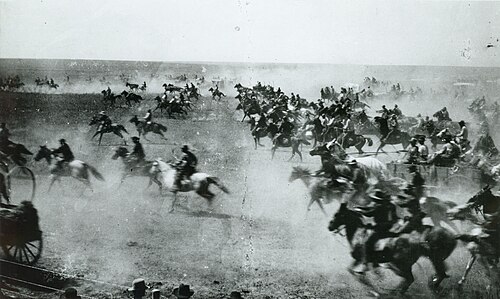
But then you might transition and say that God had a less chaotic means of dividing up the Promised Land, and we’ll look at that this morning in our passage in Joshua 14.
CONTEXT:
This is our next-to-last lesson in Joshua before we move on to a brief study of Judges and Ruth.
We left off with Israel having conquered Jericho, but Achan disobeyed God by taking some silver, gold, and clothes from the city, which God had banned. His sin had a wide impact, leading to the death of 36, the defeat of the army at Ai, and discouragement of the whole nation. He was called to account, and Israel purified themselves so that God would be with them again. He was, and they ended up capturing Ai.
Joshua 8-12 describes more victories en route to the conquest of the Promised Land.
In fact many divide Joshua up into 2 segments:
— Chapters 1-12 describe the conquest of the land
— Chapters 13+ describe the division of the land
So our focus passage this week in Joshua 14:1-15 describes something about how God commanded the Promised Land to be divided — and we also learn some great lessons on faith, work, and perseverance from an old, familiar character who wasn’t content until he’d taken his inheritance in the land he’d been promised.
OUTLINE:
I. The Plan for the Inheritance (14:1-5)
II. The Zeal for the Inheritance (:6-15)
TEXT: Joshua 14:1-15
I. The Plan for the Inheritance (:1-5)
“Now these are the territories which the sons of Israel inherited in the land of Canaan, which Eleazar the priest, and Joshua the son of Nun, and the heads of the [a]households of the tribes of the sons of Israel apportioned to them for an inheritance, 2 by the lot of their inheritance, as the Lord commanded [b]through Moses, for the nine tribes and the half-tribe. 3 For Moses had given the inheritance of the two tribes and the half-tribe beyond the Jordan; but he did not give an inheritance to the Levites among them. 4 For the sons of Joseph were two tribes, Manasseh and Ephraim, and they did not give a portion to the Levites in the land, except cities to live in, with their pasture lands for their livestock and for their property. 5 Thus the sons of Israel did just as the Lord had commanded Moses, and they divided the land.”
As in last week’s lesson, Joshua 7 mentions “the lot.” This is how they divided up the land among the people of Israel. Each tribe received a certain portion of land, and then each family received an inheritance in the land “by lot” — as we saw last week, the casting of some kind of wood/stone lots, like drawing straws, or with their names inscribed on them, to decide who would receive what.
As :2 says, this is just what the Lord had commanded in the Law:
— Numbers 26:55 “But the land shall be divided by lot. They shall receive their inheritance according to the names of the tribes of their fathers.”
(Joshua 16-21 describes in detail, with all the boundaries, how each of the tribes of Israel was given a certain inheritance in the Promised Land “by lot.”
You might show a MAP of the division of the land as it was given by lot to each of the tribes:
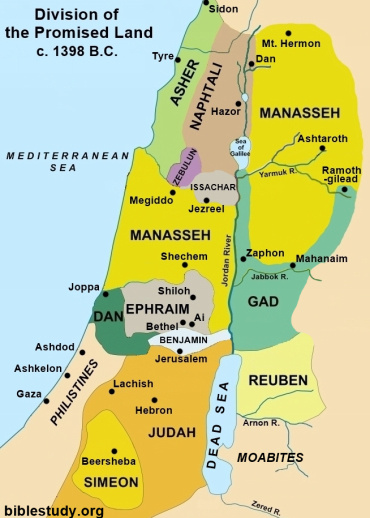
So if you were a member of the tribe of Manasseh, for example (to pick out one easy to see on the map) your family’s inheritance would be inside that yellow region that fell to Manasseh by lot. The land given to Manasseh would then be divided among the families of Manasseh by lot. And that’s how everyone received their portion of the Promised Land.
???DISCUSSION QUESTION???
“What do you think of this way of distributing the land?”
(Everyone will have their own thoughts about it. You might say it sure beat the “madhouse” of the 1889 Land Run in Oklahoma!
The Book of Proverbs has a couple of things to say about the lot that might be helpful:
— Proverbs 16:33 “The lot is cast into the lap, But its every decision is from the Lord.”
— Proverbs 18:18 “The cast lot puts an end to strife And decides between the mighty ones.”
These verses tell us that when that lot was cast, it was determinative for God’s will. It “put an end to strife” — no one argued about it; this was God’s will.
You might point out that scripture does not indicate that we should make decisions by casting lots today. They did it in Acts 1 to select Judas’ replacement, which (as we discussed in a previous lesson) many believe was a mistake — and they never did it again in the New Testament. Instead they were led by scripture, and the Holy Spirit (“it seemed good to the Holy Spirit and to us” the apostles said in Acts 15:28).
A couple of things about this division:
— As the map reminds us, Reuben, Gad, and half the tribe of Manasseh had their inheritance on the other side (east side) of the Jordan, as they had requested.
— and you may notice that the Levites did NOT have an inheritance allotted to them. This was by the Lord’s command in Numbers 18:20 “Then the Lord said to Aaron, “You shall have no inheritance in their land nor own any portion among them; I am your portion and your inheritance among the sons of Israel.”
GOD was the Levites’ inheritance. (Now as we see later in the Book of Joshua, God did give the Levites some cites with pasture land for their flocks.) But they did not receive a chunk of land as their “inheritance and lot” like the other tribes did. God said “I AM your portion and your inheritance.”
Here’s a good application for us today: the Levites’ inheritance in God is a picture of the inheritance that ALL of us as God’s people will one day receive.
Psalm 16:5-6 says: “The LORD is the portion of my inheritance and my cup; You support my lot. The lines have fallen to me in pleasant places.”
Psalm 73:26 “God is the strength of my heart and my portion forever.”
Significantly, David, who wrote Psalm 16, was NOT a Levite! And yet he could proclaim that the LORD (YHWH/Yahweh) was his portion and inheritance. As a member of the tribe of Judah (and as king!) David did have land and possessions in this world. Yet he could say that GOD was his inheritance, because God, more than anything else in this world, was his greatest good, and his great eternal reward. Asaph, who wrote Psalm 73, could say the same thing.
This is the attitude that all of us as Christians should have. Our ultimate “inheritance” is not in this world. We may inherit a home, or land, or possessions here. But our real, ultimate inheritance is not here on earth; it is in heaven/the New Jerusalem, with the Lord. It IS the Lord Himself!
Most of us as God’s people can do more to think and live that way. We need to consider that all the material things of this world are only temporary. They may be useful, or pleasant to us now, and if we keep them in perspective, and use them wisely, there’s nothing wrong with them. But we also need to remember that our ultimate inheritance is with the Lord — and is His very presence itself!
ILLUSTRATION
When Cheryl had her stroke and we were selling our home in Texas and moving to Oklahoma, it was a tumultuous time for us. One of our prayers in that time came from a scripture that the Lord gave both Cheryl & I from Psalm 107:30b, “So He guided them to their desired haven.” We knew God had a “desired haven” for us in Norman where we were moving. And after a brief search, He did bring us to just the right spot. And we love our home! It’s not opulent; it’s a little “cottage,” with just the right size yard where we can plant a few things, but it’s not too big to take care of; a nice back porch where we sit and talk at night; rooms with huge window views that we can each have our quiet times in front of, and so on. It is the perfect place for us. We’re always saying to each other: “The Lord guided us to our desired haven!”
But I also try to keep this perspective: this little house in Norman is not our ULTIMATE “desired haven.” There is another, ultimately great “desired haven” that the Lord is preparing for us with Him in glory. Our real inheritance is not here, but like the Levites, our inheritance is with the Lord.
Some cross references might include:
— Colossians 1:12 “giving thanks to the Father, who has qualified us to share in the inheritance of the saints in Light.”
— I Peter 1:4 “to obtain an inheritance which is imperishable and undefiled and will not fade away, reserved in heaven for you”
— Revelation 21:2-3, “And I saw the holy city, new Jerusalem, coming down out of heaven from God, made ready as a bride adorned for her husband. 3 And I heard a loud voice from the throne, saying, “Behold, the tabernacle of God is among men, and He will [a]dwell among them, and they shall be His people, and God Himself will be among them.”
THIS is our inheritance as Christians: the New Jerusalem, with GOD HIMSELF dwelling among us! We need to live and act like more like it is!
???DISCUSSION/APPLICATION QUESTION???
“In what ways might our lives be different if we really focused on our inheritance in heaven?”
(— we would spend less time and money on things that won’t matter in a year/5 years/eternity;
— we would invest more of our resources in the Kingdom of God
— we would worry less about things that happen now; they aren’t eternal.
— we would serve God more than we do
And so on. You/your group can think of many.)
ILLUSTRATION
Now, if someone were to say, “Well, we don’t want to be ‘too heavenly minded to be any earthly good,’ C.S. Lewis has a response to that:
“… a continual looking forward to the eternal world is not (as some modern people think) a form of escapism or wishful thinking, but one of the things a Christian is meant to do. It does not mean that we are to leave the present world as it is. If you read history you will find that the Christians who did most for the present world were just those who thought most of the next. The Apostles themselves, who set on foot the conversion of the Roman Empire, the great me who built up the Middle Ages, the English Evangelicals abolished the Slave Trade, all left their mark on Earth, precisely because their minds were occupied with Heaven. It is Christians have largely ceased to think of the other that they have become so ineffective in this. Aim at Heaven and you will get earth “thrown in;” aim at earth and you will get neither.” (Mere Christianity, p. 118)
II. The Zeal for the Inheritance
:6 “Then the sons of Judah drew near to Joshua in Gilgal, and Caleb the son of Jephunneh the Kenizzite said to him, “You know the word which the Lord spoke to Moses the man of God concerning you and me in Kadesh-barnea. 7 I was forty years old when Moses the servant of the Lord sent me from Kadesh-barnea to spy out the land, and I brought word back to him as it was in my heart. 8 Nevertheless my brethren who went up with me made the heart of the people [d]melt with fear; but I followed the Lord my God fully. 9 So Moses swore on that day, saying, ‘Surely the land on which your foot has trodden will be an inheritance to you and to your children forever, because you have followed the Lord my God fully.’ 10 Now behold, the Lord has let me live, just as He spoke, these forty-five years, from the time that the Lord spoke this word to Moses, when Israel walked in the wilderness; and now behold, I am eighty-five years old today. 11 I am still as strong today as I was in the day Moses sent me; as my strength was then, so my strength is now, for war and for going out and coming in. 12 Now then, give me this hill country about which the Lord spoke on that day, for you heard on that day that Anakim were there, with great fortified cities; perhaps the Lord will be with me, and I will drive them out as the Lord has spoken.” 13 So Joshua blessed him and gave Hebron to Caleb the son of Jephunneh for an inheritance. 14 Therefore, Hebron became the inheritance of Caleb the son of Jephunneh the Kenizzite until this day, because he followed the Lord God of Israel fully. 15 Now the name of Hebron was formerly [f]Kiriath-arba; for Arba was the greatest man among the Anakim. Then the land had rest from war.” (NASB 1995)
So as they were dividing the land, Joshua’s old friend Caleb (with whom he had spied out the land, and they were the only two who believed God could give it to them) came to him, reminding him of a promise that had been given to him. He said, Moses promised me the land which I spied out, so he says in :12 “Now then, give me this hill country about which the Lord spoke that day …”. Caleb was zealous to take the land he’d been promised. This is a long section, but I’d emphasize a couple of things in it that are very applicable to us today:
A. Zeal in Old Age
Caleb said in :10, “I am 85 years old today …”. And yet he wasn’t “worn out,” or resigned for things to remain as they were. He wanted his inheritance. He said in :12, “Now then, give me this hill country …” He was still zealous to take the land at 85!
That’s an example that all of us would do well to strive to imitate. We shouldn’t have the attitude that we will serve God for some time, and then we can just “kick back” and “coast” the rest of our time on earth. Let’s keep our zeal for serving God.
A couple of weeks ago I spoke on Psalm 92 at our home church here in Norman, with the title, “Finishing Well.” Psalm 92:12-15 says:
“The righteous man will flourish like the palm tree,
He will grow like a cedar in Lebanon.
13 Planted in the house of the Lord,
They will flourish in the courts of our God.
14 They will still yield fruit in old age;
They shall be full of sap and very green,
15 To declare that the Lord is upright;
He is my rock, and there is no unrighteousness in Him.” (NASB 1995)
I love this passage, and it speaks to me as I just had my 67th birthday: don’t stop serving God! There’s a lot to say here, and I can’t share the whole message in this lesson, but it tells us that as we age, we should still seek to grow and serve God to the end.
ILLUSTRATION:
I remember a pastor telling me years ago, that he could tell when a pastor had stopped growing: by when he stopped buying books for his library! He was content with what he had; wasn’t seeking to learn and grow any more. That should challenge many of us, whatever our age: are you just content where you are — or are you still trying to grow and serve God? Are we still “yielding fruit in old age?”
??? DISCUSSION QUESTION
“Can you share someone you know who is advanced in age (like Caleb) and who is still very actively serving God?”
ILLUSTRATION
Some of you may know of Max Barnett, the long-time Baptist Collegiate Ministry director at the University of Oklahoma, who discipled thousands of students and helped launch ministries at multiple colleges across the country. Max was a member of our home church here in Norman, and he just passed away from cancer at age 89. But Max showed us how to finish well. When Max went to M.D. Anderson in Houston a couple of months ago, he continued to witness and minister there. One man told him that his father was not a believer, and Max said, “I’ll call him.” And he did. And he called and witnessed to him not once, but multiple times. That’s “yielding fruit in old age.” Max showed us how to “finish well.”
Max Barnett “finished well.” Caleb in our passage today “Finished Well.” The question for each of us is: “Will I finish well?” Let’s not say those words “I’ve put in my time,” or those sad, sad, words from Psalm 42, “I used to …”. Let’s not be “has been’s,” let’s be “now am’s” who are still yielding fruit for God even as we age. We may retire from our full-time vocation, or even from full-time Christian service or ministry, but as long as we have life and breath, we should seek to serve God in some way. There’s much more to be said on this; I’ll post my sermon on my blog if you’d like to read it.
B. The role of both Faith & Works in God’s promise.
When Caleb said “Give me this hill country,” he didn’t mean, “sign the deed over” so I can peacefully settle in and start building my retirement home! He meant, give me your permission, and I will go and fight for this land! He said in the second part of :12, “Anakim were there, with great fortified cities; perhaps the Lord will be with me, and I will drive them out as the Lord has spoken.”
— “Anakim” were the sons of Anak, the giant. These were the ones the spies spoke of in Numbers 13:33, “And there we saw the Nephilim (the sons of Anak, who come from the Nephilim), and we seemed to ourselves like grasshoppers, and so we seemed to them.”
— So these Anakim/giants were still there, as well as “fortified cities.” The Hebrew word “batzar,” literally means “to make inaccessible.” They’d built walls and ditches around the cities. Deuteronomy 1:28 says “the cities are large, fortified to heaven”! Huge wall and defenses. These were the very things that made the 10 spies 40 years ago, shrink back in fear and turn back from the Promised Land! This was not going to be easy to take.
— So Caleb said we will have to “drive them out”: “yarash,” “take possession of, dispossess.”
HERE’S THE POINT: God “gave” Caleb the Promised Land — :13 says “So Joshua blessed him and gave Hebron to Caleb” — but that didn’t mean Caleb could just sit back and do nothing! He was going to have to go in and fight for that land. It would require much effort on his part. The same thing was true for all Israel. God “gave” them the Promised Land — but they had to go fight for it!
We see this principle throughout God’s word: God promises to do things — but He often accomplishes those things THROUGH HIS PEOPLE as we work!
— Psalm 108:13 says “Through our God, we shall do valiantly.” That Psalm is about warfare, about God giving them the victory and bringing them into a besieged city. He says, God will give us this city — but He’s going to use US to “do valiantly.” In other words, God will do it — but He’ll do it through US as we fight!
— Psalm 104:21 “The young lions roar after their prey, And seek their food from God.” See that? The lions “seek their food from GOD” — and yet they must roar after their prey. GOD will “give it to them,” but they’re responsible to go and get it! (He does the same thing for us, doesn’t He? God will provide our food — but He will provide as we work for it!)
— In the New Testament, Jesus said in Matthew 24, “This gospel of the Kingdom shall be preached in all the world, for a witness to all the nations.” He says, the gospel will go to the whole world. But how will He get the gospel to the whole world? He commands us in Matthew 28, “Go therefore and make disciples of all the nations.” He’ll accomplish it through US as we witness and go on mission.
We need to understand this today too. A lot of people just want to sit around and pray and hope that God will “drop something into our lap” — and sometimes He does! But most often, God’s pattern is that “through our God, WE will do valiantly.” God will provide through the work of His people.
ILLUSTRATION
You’ve probably heard the old saying, “Praise the Lord and pass the ammunition.” The saying came from the December 7, 1941 attack on Pearl Harbor. The American sailors on the cruiser U.S.S. New Orleans were firing their anti-aircraft guns against the attacking planes, but the power failed, and so the sailors had to manually carry the large AA shells to the guns. It was hot and the men were tired, so the chaplain, Howell M. Forgy, walked up and down the line, shouting encouragement to the men: “Praise the Lord and pass the ammunition!”
That’s a good combination, isn’t it: “Praise the Lord and pass the ammunition!” Trust God to give you the victory — but also keep shooting to win that victory!
It’s like another old saying: “Pray like it all depends on God — and work like it all depends on you.” That’s a powerful combination!
??? DISCUSSION/APPLICATION QUESTION???
“What are some things that we might like to see God do, that we should take an active part in fulfilling?”
(— We may pray for God to provide for our family. Good. Now go and get a job!
— We may pray for God to provide for the church budget, but we should also make sure we GIVE towards it!
— We may pray for someone to be saved. Paul did that (Romans 10:1) But also, you go WITNESS to that person! Let God use you to be a part of the answer!
— We may pray for the nations to come to Christ. Fantastic. But let’s also give, and go on mission!
There’s an endless number of things like that, which you/your group can think of — not only in Kingdom work, but also in our own personal and family lives. We should PRAY about these things, yes — but then let’s make sure we DO what God shows us to do about it! Very, very often, God does not just “plop” something in our lap; rather He uses and blesses our efforts, to be a part of answering our prayers.
It’s like James 2:14-18 says:
“What use is it, my brethren, if someone says he has faith but he has no works? Can [n]that faith save him? 15 If a brother or sister is without clothing and in need of daily food, 16 and one of you says to them, “Go in peace, [o]be warmed and be filled,” and yet you do not give them what is necessary for their body, what use is that? 17 Even so faith, if it has no works, is [p]dead, being by itself. 18 But someone [q]may well say, “You have faith and I have works; show me your faith without the works, and I will show you my faith by my works.”
??? APPLICATION QUESTION: (Your group probably won’t want to answer this out loud, but ask them to think about this:)
“Is there something I have been ‘praying about,’ that I need to go and DO something about as well?”
Then you might close with a prayer for God to bless you and your class, while you go and DO His work this week, after you’ve prayed! Remember: God’s blessing and our work, is a powerful combination!
___________________________________________
— Remember if you’d like to read a text version of this overview, or get one of the quotes or stories, or print it out to study or to teach from, you can get a text version on my blog at http://www.shawnethomas.com (I’ll post that address in the comments section on YouTube). And a reminder that there is now a “PRINT” button at the end of the lesson on my blog, that you can hit to print out the lesson in its entirety.
— If you’ll hit “Subscribe” to this video on YouTube, they will automatically send you next week’s lesson and you won’t have to search for it each week.
— And if you write something in the Comments on my blog or YouTube, my commitment is to pray for your and your group and any special request you make, by name this week.
Per my licensing agreement with Lifeway:
— These weekly lessons are based on content from Explore the Bible Adult Resources. The presentation is my own and has not been reviewed by Lifeway.
— Lifeway resources are available at: goExploretheBible.com and: goexplorethebible.com/adults-training
— If you have questions about Explore the Bible resources you may send emails to explorethebible@lifeway.com


Thank you for your dedication and leadership as you prepare these lessons every week. My class uses these resources and your lessons always help me feel more prepared to share them with our class. I appreciate all your research and illustrations.
Shawn please DO post your sermon “Finishing Well” on the blog. I’m 68, still practicing law full time, still teaching Bible study, and trying to figure out where the Lord wants me to go from here.
I did post it on my blog Skip. If you go to my blog home page and scroll down a bit you should see it there. God bless you as you seek to Finish Well. Sounds like you’re on the way!