
Includes a suggested introduction to the lesson, text highlights and outline, illustrations to share, discussion questions for your group, and spiritual life applications to make. A video version of this preview is available on YouTube at:
???DISCUSSION/INTRODUCTION QUESTION???
“Can you share a time when God called you/someone you know, to a special work or ministry?”
(You might share this ILLUSTRATION:
“The Scottish Reformer John Knox was called to the work of preaching and pastoring in the course of a worship service by a preacher who declared it was God’s and the congregation’s will.” But Knox was not excited about it. In fact Lewis Allen writes: “Knox ran out of the gathering in tears and locked himself in his room.” (The Preacher’s Catechism, pp. 57-58)
Some of us may have felt the same way when God called us to do something! We can take comfort that we’re not the only ones who ever responded in a reluctant way! In today’s lesson in Judges 6, we see how one man was very reluctant when God called him, but God showed him something powerful that could overcome all his excuses. This lesson should help us to respond to God as He calls us to follow Him today as well.
CONTEXT:
This is our second lesson in our new study of the Book of Judges. We saw last time in Judges 2 how God tested Israel after they took the Promised Land, by leaving some of the peoples there, to see if Israel would be faithful to Him or not. But they failed that test, and began to worship other gods — and as we saw, they paid the consequences for it. Sin always brings consequences. Israel got into this unhealthy “cycle” of sin, slavery, “temporary repentance” when God would send a “judge” (remember the Hebrew word also means “leader”) to help them — but then they would cycle back to sin again, worse than they were before. That’s the basic cycle we see repeated throughout the Book of Judges.
Judges 3 tells of several “judges” who delivered Israel from oppression, and then Chapters 4 & 5 describe the deliverance of Deborah & Barak in more detail.
This brings us to our focus passage for this week, in Judges 6, which opens with Israel paying the consequences for their sin, and again God will raise up a “judge” to lead them — but like many of us, he is reluctant to follow the call God gave him!
OUTLINE:
I. The Dire Situation (6:1-4)
II. The Message of God (:7-10)
III. The Call of God’s man (:11-17)
TEXT: Judges 6:1-4, 7-16
I. The Dire Situation (6:1-4)
:1 “Then the sons of Israel did what was evil in the sight of the LORD; and the LORD gave them into the hands of Midian seven years. 2 The power of Midian prevailed against Israel. Because of Midian the sons of Israel made for themselves the dens which were in the mountains and the caves and the strongholds. 3 For it was when Israel had sown, that the Midianites would come up with the Amalekites and the sons of the east and go against them. 4 So they would camp against them and destroy the produce of the earth as far as Gaza, and leave no sustenance in Israel as well as no sheep, ox, or donkey.”
So just like last time in Judges 2, here in :1 we see the “Consequences” of sin: “the sons of Israel did what was evil in the sight of the LORD; and the LORD gave them into the hands of Midian …”. It says Midian joined with Amalek and others from the east and kept attacking Israel and devastating their land. It says they would “destroy the produce” as well as either capture or take all their livestock.
It says they did this “As far as Gaza …”.
SHOW ON MAP:
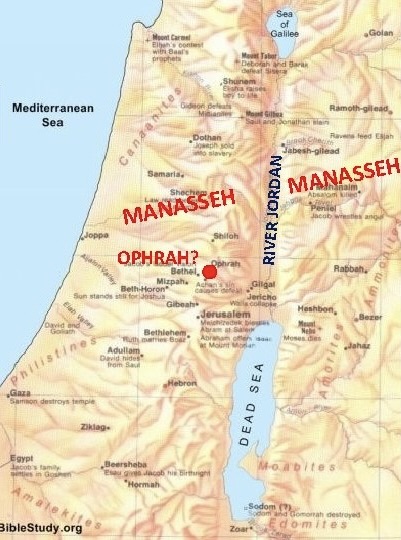
When the LORD called Gideon, he was in Ophrah, so we know they were attacked by this foreign alliance. So they devastated the land from from Ophrah to Gaza. Historians believe Ophrah was west of the Jordan, like this map shows. Then you can see that Gaza is on the coast, at the lower left of this map — so in other words, these foreign armies decimated the WHOLE LAND! This was a tough situation: every time crops would come in, they’d could come and destroy them all, as well as take their animals so they had no chance to get ahead! This was indeed a dire situation they found themselves in — and of course in their case it was a direct result of their sin against God.
Incidentally, the expression in :2, “dens and mountains and caves and strongholds” is the basis for a verse in Hebrews 11, :38, where it says the Old Testament people of God were “wandering in deserts and mountains and caves and holes in the ground.” But it’s a description of the difficult situation they were in.
Similarly, some of us/our class members/family members/churches may find ourselves in some dire situations today.
??? DISCUSSION/APPLICATION???
You and your members can share some of the difficult situations that you/or loved ones are facing. Each of us has our own “dire circumstances” like Israel faced.
Maybe like Israel, some of these came about because of sin, but we know from scripture that not all of them do. Each of our situations is different. But when we have these difficult situations, what can we do? How can God speak to us or use us in these times? We see in the next verses …
II. The Message of God (:7-10)
“7 “Now it came about when the sons of Israel cried to the LORD on account of Midian, 8 that the LORD sent a prophet to the sons of Israel, and he said to them, “Thus says the LORD, the God of Israel, ‘It was I who brought you up from Egypt and brought you out from the house of slavery. 9 I delivered you from the hands of the Egyptians and from the hands of all your oppressors, and dispossessed them before you and gave you their land, 10 and I said to you, “I am the LORD your God; you shall not fear the gods of the Amorites in whose land you live. But you have not obeyed Me.”
So because of the difficult situation that Israel found themselves in, they “cried to the LORD (Yahweh).” And :8 says God sent a prophet to them, and gave them His message. He gave them His perspective on their situation. The word “perspective” literally means “to see, through.” In other words, to “see through” a person’s point of view. So God gives HIS “perspective” on their situation: why has this happened? God says:
— I brought you out of slavery and saved you from Egypt
— He says I gave you this land
— He says I AM “Yahweh” your God. You were not to worship the false gods of this land.
— But then He says: “BUT you have not obeyed Me”!
So in their trouble, God sent them a prophet who gave them His “perspective,” His viewpoint on what was going on. And of course it was that their trouble was a consequence of their sin against Him.
There are several applications of this for us today:
— One is that if we find ourselves in difficult circumstances, we need to consider if that has been cause by our sin. IT IS NOT ALWAYS — we need to emphasize that. Job’s suffering was not a result of his sin. The man in John 9 was not blind because of his sin. The Bible makes it clear: not all suffering is a direct consequence of our sin. BUT we are also remiss if we don’t consider that there ARE times when it is! So we always need to evaluate our lives, and consider: is there something in my life that I need to change; some sin I need to repent of, some habits or actions I need to change, which has brought this on me?
— Another application is that sometimes we need to share this difficult message with others who need to hear it! How would you like to be the prophet who told the people in those dire circumstances that it was a result of their idolatry? But sometimes we need to share that message.
That’s often hard to do, isn’t it? Sometimes we’re reluctant to tell someone that the have brought something on themselves, or that some things in their life need to change. But sometimes that is just what God needs us to do — and if we truly love the person, we will tell them that difficult truth. Remember, Proverbs 27:6 says “Faithful are the wounds of a friend, but the kisses of an enemy are deceitful.” Someone who really loves you, will tell you the truth, even if it hurts. Sometimes God needs us to be that true friend, and tell them the truth, just like the prophet did here!
— Another application is that God always has a word for us, that will help us understand our situations, just like He gave His people here in Judges 6.
If there is a situation in your life that you need some understanding/direction about — search the scriptures for a word from God. HE WILL SHOW YOU, and help you understand.
ILLUSTRATION:
When I graduated from seminary in 1985, I couldn’t wait to see what “megachurch” was going to call me as pastor! Was I in for a surprise! A year went by, and I still didn’t have a church. I was perplexed. What was God doing? I knew He’d called me. I didn’t understand it. So I went to His word. I specifically remember one night, just sitting down with my Bible, praying and seeking God. And He led me to the Beatitudes, which I had been studying. Those 8 qualities describe the character of Christ, which is God’s goal for each of our lives as His children. And over the hours of that night, God showed me: this is My purpose; I am using this situation to refine your character and make you more like Me. And it gave me a peace, knowing what God was doing. And I came out of that time of testing a different minister than I would have, as a result of the refining that took place. But the point here is, I’d have never gotten that insight, had I not asked the Lord to show me what was going on, in His word.
Maybe there’s a situation like this in your life, or some loved one’s life; or in your church, in which you’re wondering: WHY are things like this? Just like here in Judges 6, God has a word for you, that will help you understand. But it’s YOUR responsibility to seek Him in His word, and find the insight/direction that He has for you.
III. The Call of God’s Man (:11-17)
:11 “Then the angel of the LORD came and sat under the oak that was in Ophrah, which belonged to Joash the Abiezrite as his son Gideon was beating out wheat in the wine press in order to save it from the Midianites. 12 The angel of the Lord appeared to him and said to him, “The LORD is with you, O valiant warrior.” 13 Then Gideon said to him, “O my lord, if the LORD is with us, why then has all this happened to us? And where are all His miracles which our fathers told us about, saying, ‘Did not the Lord bring us up from Egypt?’ But now the Lord has abandoned us and given us into the hand of Midian.”
14 The LORD looked at him and said, “Go in this your strength and deliver Israel from the hand of Midian. Have I not sent you?” 15 He said to Him, “O Lord, how shall I deliver Israel? Behold, my family is the least in Manasseh, and I am the youngest in my father’s house.” 16 But the LORD said to him, “Surely I will be with you, and you shall defeat Midian as one man.”
A. The Humbled Leader
So here in :11-17 we are introduced to Gideon, the son of Joash. The name Gideon is significant in itself: it means “warrior.” Literally it means one who “fells” or “cuts down” (implied felling or slaying foes).
Gideon’s position when the Lord speaks to him is ironic: he was “beating out wheat in the wine press in order to save it from the Midianites.” A wine press was usually carved from stone and sunk into the ground (like in this IMAGE):
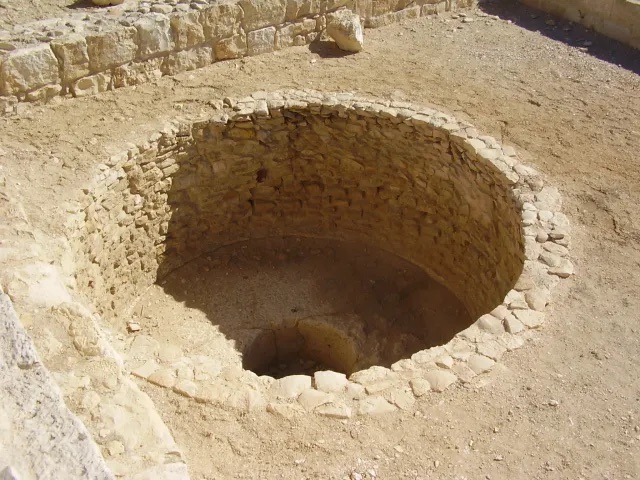
But Gideon was using it here to thresh the wheat, which was usually done in a high place so the wind could blow the chaff away. So he was basically HIDING in the wine press, so the enemies wouldn’t see him and take or destroy the wheat! So this “warrior/feller/Gideon” was hiding in the wine press, for fear of the enemy!
And in this position, :12 says “the angel of the LORD appeared to him.” The Hebrew word for “angel” of the LORD here is “malak,” which can mean “angel,” or it can mean “messenger,” like a human messenger. It’s used in both ways in the Old Testament.
But many believe when the phrase “the angel of the LORD” is used in the Old Testament, it often refers to a pre-incarnation appearance of Christ Himself, called a “Christophany” (literally, “Christ-appearance.”)
— For example, in Genesis 16 when “the angel of the LORD” appear to Sarah, at the end of the encounter :13 says, “Then she called the name of the LORD who spoke to her, “You are a God who sees”; for she said, “Have I even remained alive here after seeing Him?” This makes it clear that this “malak” who appeared to her was definitely no mere human messenger, but the Lord Himself!
We see the same thing in this passage: after Gideon responds to “the angel of the LORD,” :14 says “THE LORD looked at him and said …”. So again, like with Sarah, this was no mere human “messenger” like the prophet earlier in :7, or even an angel, but the LORD Himself, appearing to Gideon.
And the LORD greeted him in :12, “The LORD is with you, O valiant warrior.” “Valiant warrior” was basically Gideon’s name, as we’ve seen. But it was also kind of embarrassing: this “valiant warrior” was hiding in the wine press! But often before the Lord can use us, He has to expose our weaknesses, so that we can learn to depend upon HIM, and not our own strength, which is never sufficient. So He was confronting Gideon with his weakness and shame, with the ultimate aim of getting him to trust Him and follow His call.
??? DISCUSSION/APPLICATION QUESTION ???
“Can you think of some other times when God humbled a person — or allowed them to be humbled — to prepare them for His work?”
(— Moses tried to rescue Israel from Egypt on his own, but failed and went to the wilderness for a time, when God called him, an old, 80-year-old man, to do what only God could help him do.
— Peter was totally humiliated by denying Jesus three times, which prepared him to be restored and used by the Lord.
— My experience after seminary is an example of that; I had to be humbled for God to get me ready to use me in ministry.)
You/your group can think of many examples of this. Jesus said “Blessed are the poor in spirit, for theirs is the Kingdom of Heaven.” Humility and dependence upon the Lord is a foundational quality of the Kingdom of God. We must depend on the Lord to even be saved and enter it; and to be used by Him we must continue to learn that dependence. It’s a lesson we still need today.
B. The Searching Question
But Gideon had another response to the Lord in :13, didn’t he? He asked Him what a question that a lot of people ask in similar circumstances: “O my lord, if the LORD is with us, why then has all this happened to us?”
First, it’s interesting that Gideon addresses the Lord as “adonai,” “my lord,” not “YHWH”/Yahweh. He may not have known at this point just Who it was he was talking to!
But his question is very pertinent. The Bible is so relevant to real-life issues. This is something people ask in real-life situations today: “If the Lord is with us, why then has all this happened to us?”
???DISCUSSION QUESTION???
“What are some situations in life today that might cause us to ask a question like, ‘If God is with us, why has this happened to us?’”
(ILLUSTRATION/EXAMPLE:
We have a sweet family in our church, faithful servants in the youth ministry, whose son was baptized last week while sharing an amazing testimony — and the next day the father, a relatively young man, was diagnosed with advanced pancreatic cancer. Many of us in the church are burdened, and I would ask you to join us in praying for them as he begins treatment this week.
But it’s these kinds of situations that can cause us to ask, “If God is with us, why has this happened to us?”
You/your group can share your own experiences.
I think it’s notable that the Lord did NOT answer Gideon here.
He doesn’t say, “It’s because of x-y-z …”
— for one, God isn’t under obligation to answer our questions!
— for two, He’d already sent the prophet who addressed this in :7. It was because of Israel’s SIN, as we saw last week. Their current situation was a direct consequence of their sin against God.
— But God does not delve into any of that. He doesn’t answer his question at all! He just says in :14, “Go in this your strength and deliver Israel …”.
There are times when God DOES answer us. He doesn’t have to, but sometimes He does. He is very gracious.
But other times, He does not give us an answer (Like Job: as far as we know, Job never knew why all those things happened to him.) Sometimes He just tells us to take the next step, to obey Him, by faith, without knowing all the reasons why.
This may be a good word for you — or for someone in your group this week. Maybe you have some unanswered questions in your spiritual life right now. Why has God allowed something? Why doesn’t He answer a certain question or prayer? But what He is calling you to do right now, is just to take the next step of obedience, that is right in front of you. Just take that next step, and do the next thing that He HAS made clear to you, and trust Him with your questions.
C. The Man’s Excuses
But this wasn’t the end of the story. In :15 Gideon starts giving his excuses as to why he can’t do what the Lord asked him to do: “O Lord (adonai), how shall I deliver Israel? Behold, my family is the least in Manasseh, and I am the youngest in my father’s house.”
(It’s interesting; Gideon seems not to have known Who he was talking to! He calls Him “lord” in :15, which the Hebrew “Adonai.” But then :16 says “The LORD” (all capitals, which means this is YHWH or “Yahweh” in the Hebrew text) “said to him …”. But Gideon seem to realize this.)
But in his response Gideon basically gives excuses for why he can’t do what God is calling him to do:
— “my family is the least in Manasseh”
— “and I am the youngest in my father’s house”
He’s saying, I’m not from some great family, and I don’t have any prominent position. Family heritage can sometimes help a person (For example if your name is Kennedy or Bush it might help get you followers in some places). But Gideon didn’t have this. And even in his insignificant family, he was the youngest, which was a real liability in Israel. Remember David wasn’t considered by his family for anointing by Samuel, because he was the youngest. He was just sent out to watch the sheep — considered a lowly job. This was Gideon’s status — and his excuse for why he couldn’t do what God commanded.
???DISCUSSION/APPLICATION QUESTION???
“What are some of the excuses that WE today often give when God calls us to do something?”
(You/your group can probably think of a lot of these, because we are really good at coming up with these excuses!
— Like Gideon said “I’m the youngest,” many of us say: I’m too young/or conversely: I’m too old! (But remember God didn’t even call Moses until he was 80!)
— Some of us say we aren’t good at public speaking so we can’t share that testimony, or
— I’m not comfortable flying, so I can’t go on that mission trip,
and on and on. We’re as good at making excuses as Gideon was! But God has an answer that overcomes all of our excuses:
D. The Lord’s Answer
What does Yahweh say to him? “Surely I will be with you, and you shall defeat Midian as one man.” To all of Gideon’s excuses — and to all of ours today — God says, Don’t worry about that. All that matters is that I am with you.
God being with us is the only thing we really need, to succeed or overcome. God never promises we won’t have trials and pains and difficulties in this life. He never promises that we won’t “walk through the valley of the shadow of death” like Psalm 23 says. But He does promise that in those dark valleys, He will be with us!
And when God is with us, it makes all the difference:
— The 3 Hebrew children could be thrown into a fiery furnace, but because He was with them, not a hair of their body was singed.
— Paul & Silas were thrown into prison, but because God was with them, 1) they could rejoice and sing even in those circumstances, and 2) He could and did very easily deliver them from those circumstances.
Over and over we see in scripture: It’s not the situation or the circumstances that determines things; what matters more than anything is that GOD IS WITH US. If He’s with us, then nothing else really matters.
ILLUSTRATION:
Shakespeare’s “Henry V” dramatizes a real historical event, the battle of Agincourt between the English army of King Henry V and the French in 1415. Henry’s army was worn down by campaigning, bad weather, and illness, and they were trying to make their way back to England — when all of the sudden a French army that greatly outnumbered them, blocked their way.
On the morning of the battle one of Henry’s men says: “I wish they would not come against us now.”
King Henry replied: “We’re in God’s hand, brother, not in theirs.”
And the English won one of the greatest “upset victories” in history that day at Agincourt. It didn’t matter that the French outnumbered them three to 1 (or 10-1, or whatever the number was, historians argue the actual numbers). What mattered was that God was with them. The presence of God with them was more determinative than their circumstances.
Some of us need to realize that this week, too.
— If God is calling you to do something, it doesn’t matter if “you aren’t up to it,” etc.; all that matters is that He is with you!
— You may be facing some extremely difficult circumstances this week. But if God is with you; you’re going to be ok — really more than “ok”! GOD is with you — that’s all that really matters!
— Maybe you could say: But our church doesn’t even have a pastor — or music leader, or youth minister, or whatever. That doesn’t matter! The only thing that really matters is that GOD IS WITH YOU! If God is with you, He can move in your service with or without any certain person or position. Trust God! The only thing that matters is that He is with you!
This is a good place for us to end our lesson for this week, understanding that all that matters for you/your family/your church/your situation, is that God is with you. Just make sure of one thing: MAKE SURE THAT GOD IS WITH YOU!
— Make sure that Jesus really is your Lord & Savior
— Make sure there is nothing that is hindering your fellowship with Him: no active disobedience, no neglect of time with Him.
— Make sure you have really heard from Him, and that you really know what He is directing you to do.
And if you know that He is with you — then nothing else really matters. God will empower you to do everything He asks you to do, you’ll defeat the enemy, you’ll persevere through every circumstance — because He is with you!
___________________________________________
— Remember there is now a “PRINT” button at the end of the lesson on my blog, that you can hit to print out the lesson in its entirety.
— If you’ll type your email address in the “Follow blog via email” blank on my blog home page, WordPress will automatically send you the next lesson and you won’t have to search for it each week.
— And if you write something in the Comments on my blog or YouTube, my commitment is to pray for your and your group and any special request you make, by name this week.
Per my licensing agreement with Lifeway:
— These weekly lessons are based on content from Explore the Bible Adult Resources. The presentation is my own and has not been reviewed by Lifeway.
— Lifeway resources are available at: goExploretheBible.com and: goexplorethebible.com/adults-training
— If you have questions about Explore the Bible resources you may send emails to explorethebible@lifeway.com


this lesson was for me . I am not a teacher yet my class continues to attend and thank me for the lesson. I can only say “ God helps me each week to add to the quarterly lesson.
This will be my 4th year with this class. I was asked to take it over after our teacher of over 20 years passed away. I cannot feel her shoes. She was such a great teacher, but with God‘s strength and the classes encouragement accepting the class for the coming year.
Thank you so much for the commentary every week. You really don’t know how much it helps me. I look forward to its arrival in my emails.
Sent from my iPhone
Vickie Graham
Senior Lecturer (Ret)
Mathematics Dept
Valdosta State University
Shawn, I have been one of the substitute Sunday school teachers in the absence of our regular teacher. First of all I am not a teacher but with the Lord’s help and your commentary, I have struggled through. This Sunday will be my last as our teacher returns next week.
Thank you so much for your blog and the help that it has given me.
God bless you my brother!
I am right in line with the other comments. I too am not a teacher. Our Sunday School teacher of 16 years retired. With God’s grace my wife and I are in our second year of leading / facilitating the class. Thank you for your insight each week.