
Includes a suggested introduction to the lesson, text outline and highlights, illustrations you can share, discussion questions for your group, and spiritual life applications you can make. A video version of this overview is available on YouTube at:
INTRODUCTION:
ILLUSTRATION:
John Newton, the former slave trader who got saved and wrote the hymn “Amazing Grace,” once wrote to the Rev. Joshua Symonds and said: “Well, when we have said all we can of the aboundings of sin in us, grace still more abounds in Jesus. We cannot be so evil as He is good.” (Letters of John Newton, Josiah Bull, ed., p. 176)
Sometimes it can be hard for us to really fathom just how abundant God’s grace is towards us. Our passage for today gives us a concrete example of the grace of God in action, which helps us to see just how amazing the grace of God really is. The example comes from what many would consider a very unlikely person: a Canaanite prostitute who came to faith in God!
CONTEXT:
We’re in the second week now of our new study in the Book of Joshua. Last time we saw how the Lord commissioned Joshua, Moses’ servant, to lead His people across the Jordan and into the Promised Land. He was repeatedly encouraged by the Lord and by his own people, to be “strong and courageous.” This week we come to Chapter 2, which opens with Joshua sending two men to spy out the land, “especially Jericho” ahead of their advance there. Verse 1 tells us the spies came and stayed in the house of Rahab, a prostitute, in Jericho, and someone informed the King of Jericho that the spies were there. In verse 3 the King tells Rahab to bring out the men — and we pick up the story in our focus passage for this week starting in :4.
OUTLINE:
I. The Unexpected Assistance
II. The Faith Motivation
III. The Promise of Salvation
TEXT: Joshua 2:4-21
I. The Unexpected Assistance (:4-7)
:4 “But the woman had taken the two men and hidden them, and she said, “Yes, the men came to me, but I did not know where they were from. 5 It came about when it was time to shut the gate at dark, that the men went out; I do not know where the men went. Pursue them quickly, for you will overtake them.” 6 But she had brought them up to the roof and hidden them in the stalks of flax which she had laid in order on the roof. 7 So the men pursued them on the road to the Jordan to the fords; and as soon as those who were pursuing them had gone out, they shut the gate.” (NASB)
When the prostitute Rahab was told by the king to give the men over, she told the king they’d already left. His men then went on a “wild goose chase” after Joshua’s spies — who were really still at Rahab’s house in Jericho! So the spies received what might be considered some “unexpected help” from this foreign woman.
Now as we shall see, there are some powerful spiritual points to be made from Joshua 2, about God’s grace, Rahab’s faith, the “scarlet thread” through the Bible, and so on. But here in :4-7 one of the major points of theological discussion through the years has to do with Rahab’s deception of the King of Jericho. She told him the spies had left when they hadn’t, in order to save their lives. Was this wrong?
???DISCUSSION QUESTION???
“Do you think it’s wrong to lie in a situation like this?”
(You might get some interesting input from your class on this. If your group has trouble coming to a conclusion, at least know you’re in good company: theologians are deeply divided on whether Rahab’s lie was a sin or not.
Some point out that God’s people “lied” several times in situations like this in scripture, to protect the lives of His people:
— Rahab did it here in Joshua 2 to save the two spies’ lives;
— In Exodus 1 the midwives lied to Pharaoh, to save the lives of the Hebrew babies, saying the women just gave birth too quickly.
— Later in I Samuel 19, David’s wife Michal lied to Saul’s men, telling them that he was asleep while he escaped.
Tellingly, the scripture does not condemn ANY of these for lying; in fact Rahab appears in “the Hall of faith” of Hebrews 11, and Exodus 1:20 says that “God was good” to the midwives for their actions — so there is some evidence at least that He seems to have approved.
To many it makes sense that there are times — especially in war or grave personal danger — when a person may lie to deceive an enemy intent on evil:
— Must you tell the truth to an attacker seeking to harm your children in your home?
— Must the President tell the truth to our country’s enemies about our defense or military preparation?
They point out that 9th Commandment actually reads “you shall not bear false witness against your neighbor” — in other words, you don’t lie to harm anyone. Many theologians also suggest that in a fallen world we don’t always have good choices: do you “tell a lie,” or give someone up for murder? To them, lying is “the lesser of two evils” and the best choice you can make under the circumstances. (Kind of like some of our election choices!)
But such prominent theologians as Augustine and John Calvin argue that God is truth, and His people should always be absolutely truthful to reflect Him. They believe Rahab’s lie was a sin, although God forgave and used her faith anyway. A third group believes in a “3rd way”: that Rahab should have had enough faith to believe that there was another (3rd) way besides murder or lying, and God could have worked a miracle which allowed her to still tell the truth.
You/your group can discuss this and come to your conclusions. I myself have a hard time believing we should “tell the truth” to wicked enemies and give up a person for murder. God seemed to bless Rahab and others who deceived enemies like this. BUT — and I can’t emphasize this enough — we need to make sure we don’t use very extreme cases like these, which are very, very RARE — honestly, most of us will likely never face this kind of situation — as justification for us to lie about more commonplace things. “Do not lie to one another,” Colossians 3:9 says — and that should absolutely be our regular practice as God’s people.
II. The Faith Motivation (:8-11)
:8 “Now before they lay down, she came up to them on the roof, 9 and said to the men, “I know that the LORD has given you the land, and that the terror of you has fallen on us, and that all the inhabitants of the land have melted away before you. 10 For we have heard how the Lord dried up the water of the Red Sea before you when you came out of Egypt, and what you did to the two kings of the Amorites who were beyond the Jordan, to Sihon and Og, whom you utterly destroyed. 11 When we heard it, our hearts melted and no courage remained in any man any longer because of you; for the LORD your God, He is God in heaven above and on earth beneath.” (NASB)
We saw what Rahab did in :4-7. It was very brave, defying the King of her city! What motivated her to do it? It was her FAITH in God, which she not only confessed, but which she demonstrated by her WORKS or deeds:
A) She confessed YHWH as God
Rahab said in verse 8: ““I know that the LORD has given you the land …”. “The LORD” here (in all 4 capital letters) is “YHWH” in Hebrew, what Bible scholars call the “tetragrammaton,” the 4 Hebrew letters (yod, he, waw, he, from right to left, of course!) which signify “Yahweh.”
ILLUSTRATION
You might share an image of the “tetragrammaton” in Hebrew for your group to see that name:
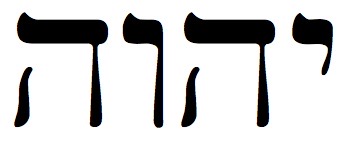
YHWH is the personal name of God, which He gave Moses in Exodus 3 when he asked Him what he should tell the people when they asked His name. So she wasn’t just confessing faith in “any” god — there were other gods the Canaanites believed in: Baal, Asherah, Moloch, etc. — but THIS God, by name, YHWH God; the God of Israel, and the God we now know as the God of the Bible and the God and Father of our Lord Jesus Christ.
Rahab went on to say “YHWH your God, HE is God in heaven above and on earth beneath.” With these words, Rahab confessed YHWH as the one true God of all Creation. It was her “confession of faith.”
It is important that each of us make public confession of our faith in the Lord:
— Romans 10:9 “If you confess with your mouth Jesus as Lord and believe in your heart that God has raised Him from the dead, you will be saved.” CONFESSING Jesus as your Lord is a vital part of salvation.
— Philippians 2 shares what many theologians believe is the early church confession: “every tongue will confess that Jesus Christ is Lord.”
— In I Timothy 6:12, Paul encourages Timothy: “Fight the good fight of faith; take hold of the eternal life to which you were called, and you made the good confession in the presence of many witnesses.” Paul here reminds Timothy of the “confession” he made in Jesus before others.
This is what many churches today making a “profession of faith”: publicly confessing Jesus as our Lord & Savior.
???DISCUSSION/APPLICATION QUESTION???
“Would anyone like to share when/where you made your ‘profession of faith’ in Christ?”
(I confessed my faith in Christ at the First Baptist Church of Harrah, Oklahoma in 1968, and was baptized there.)
You/your group can share your own experiences.
Encourage your group members, if they never have, to confess Christ publicly and be baptized. Baptism is the New Testament “profession of faith”: those who were saved, were baptized, confessing Jesus Christ as their Lord & Savior.
Each of us needs to publicly confess Christ in this way. BUT we also need to back up our confession with our deeds, which we see Rahab do in this passage:
B) She backed up her confession with her DEEDS!
She put her life on the line, and cast her lot with the people of God; she hid the spies, she pointed the king’s men in the wrong direction, and she asked them to spare her and her family when they took the city, which she believed they would do. Rahab did not merely SAY she believed in Yahweh as God, she demonstrated her faith by her subsequent actions.
James 2 — using Rahab as an example! — says that real faith is demonstrated by a person’s works:
:18 “But someone may well say, “You have faith and I have works; show me your faith without the works, and I will show you my faith by my works.” 19 You believe that God is one. You do well; the demons also believe, and shudder. 20 But are you willing to recognize, you foolish fellow, that faith without works is useless? 21 Was not Abraham our father justified by works when he offered up Isaac his son on the altar? 22 You see that faith was working with his works, and as a result of the works, faith was perfected; 23 and the Scripture was fulfilled which says, “And Abraham believed God, and it was reckoned to him as righteousness,” and he was called the friend of God. 24 You see that a man is justified by works and not by faith alone. 25 In the same way, was not Rahab the harlot also justified by works when she received the messengers and sent them out by another way? 26 For just as the body without the spirit is dead, so also faith without works is dead.”
Faith doesn’t just “say” you believe in God. If you really have faith, then like Rahab you’ll show it by your deeds.
ILLUSTRATION
Charles Ellet was the best-known bridge builder in America. Now in 1845 he was focused on building a bridge across the Niagara Falls.
“When the initial cable had been completed, Ellet decided to demonstrate his faith in it in a fashion people would not forget. He had an iron basket made up big enough to hold him and attached it to the cable with pulleys. Then stepping inside, on a morning in March 1848, he pulled himself over the gorge and back in, all in no more than fifteen minutes’ time, and to the great excitement of crowds gathered along both rims. …
Ellet appreciated the historic significance of his feat — he was the first man to cross the gorge-but he was not quite through. Several weeks after a plank catwalk had been strung across, he chose to demonstrate its strength in an even more memorable fashion. He leaped into a tall carriage, gave his horse a slap of the reins, and went rolling heading out onto the little bridge, which as yet had no guardrails and which swayed fearfully beneath horse, carriage, and Ellet, who drove standing up, like a charioteer. Everyone watched aghast, women fainted it is said, and Ellet and his bravado became a legend …”. (David McCullough, The Great Bridge, pp. 74-75)
Ellet didn’t just SAY he believed he could cross the bridge he was constructing over the Niagara; he SHOWED he really believed it by his DEEDS! His ACTIONS backed up his faith.
A question every one of us who has confessed Christ as our Savior should ask ourselves is: “Do MY actions back up my confession of Jesus?”
The old hymn says: “But how much I love Thee my ACTIONS will show.” Rahab SHOWED her faith by her works — and if our faith is real, our life will show it as well. This should challenge many of us Baptists who are often big on proclaiming our “profession of faith” and the doctrine of “once saved always saved,” whether we have works that back up our profession or not. Rahab’s works proved her profession was real. Do yours?
III. The Promise of Salvation (:12-21)
:12 “Now therefore, please swear to me by the Lord, since I have dealt kindly with you, that you also will deal kindly with my father’s household, and give me a pledge of truth, 13 and spare my father and my mother and my brothers and my sisters, with all who belong to them, and deliver our lives from death.” 14 So the men said to her, “Our life for yours if you do not tell this business of ours; and it shall come about when the Lord gives us the land that we will deal kindly and faithfully with you.”
15 Then she let them down by a rope through the window, for her house was on the city wall, so that she was living on the wall. 16 She said to them, “Go to the hill country, so that the pursuers will not happen upon you, and hide yourselves there for three days until the pursuers return. Then afterward you may go on your way.” 17 The men said to her, “We shall be free from this oath [l]to you which you have made us swear, 18 unless, when we come into the land, you tie this cord of scarlet thread in the window through which you let us down, and gather to yourself into the house your father and your mother and your brothers and all your father’s household. 19 It shall come about that anyone who goes out of the doors of your house into the street, his blood shall be on his own head, and we shall be free; but anyone who is with you in the house, his blood shall be on our head if a hand is laid on him. 20 But if you tell this business of ours, then we shall be free from the oath which you have made us swear.” 21 She said, “According to your words, so be it.” So she sent them away, and they departed; and she tied the scarlet cord in the window.” (NASB)
After making her confession of faith, Rahab asks the men to spare her and her family, which they agree to, on the condition that she tie a “scarlet cord” in the window, and gather her family in her home.
So they promised that Rahab and her family would be spared from the destruction of Jericho when Israel came to attack it — based on her confession of faith in Yahweh, and her deeds which attested to her faith. It’s a remarkable story of her inclusion — but it’s even more remarkable when we see just how blessed she was by the grace of God:
— God didn’t just save her and her family from the coming devastation of Jericho when it came.
— She was also brought into the family of Israel.
— She married and had children and participated in the community of God’s people.
— And in fact her child, Boaz, married Ruth, and became a part of the line of the coming Messiah, Jesus, as Matthew 1:5 indicates: “Salmon was the father of Boaz by Rahab.” This foreigner/prostitute, is right there in the genealogical line of Jesus Christ the Messiah!
— And Rahab herself is mentioned in the great “Hall of Faith” of Hebrews 11 (:31). Who could have imagined such a thing?
A. The Amazing Grace
It’s all a lavish display of the GRACE of God. WHO WAS THIS WOMAN, to deserve such treatment by God and His people? She was a “nobody,” and worse than a nobody. Think of how much was against her:
— First of all, she was a woman, a large enough hurdle in ancient societies (and many current ones!)
— Not only that, she was a foreigner to Israel, from the land of the Canaanites, a despised people.
— On top of this, she was no “great person” in the Jericho community; in fact she was a prostitute, the “lowest of the low.”
— And she was an enemy, one of the people Israel would face in the upcoming battle.
And yet despite all this, Rahab could be saved, by God’s grace, through faith, and given all of those great blessings. It’s just a powerful demonstration of the wideness of the grace of God. He really means it when He says,
— “For God so loved the WORLD …”! Anyone, from any ethnicity or background, can be saved. In fact, that Genealogy of Jesus in Matthew 1 includes FOUR women: Rahab, Tamar, Ruth, and Mary. THREE of those were foreign women — just a reminder that the gospel is for ALL nations!
— God really means it when He says: “WHOEVER will call on the name of the Lord will be saved”! ANYONE who will repent of their sins, and put their trust in Jesus as their Lord & Savior, will be saved, by His amazing grace!
This gives hope to every one of US personally: every one of us can be saved, if we will repent and come to Christ.
This also gives hope to everyone we KNOW: nobody is too much of an “outsider” and unable to access the grace of God; no one is “too far gone,” not a “nobody prostitute from a foreign enemy,” not anyone who might be far from God today.
??? DISCUSSION/APPLICATION QUESTION???
“Can you share about an ‘unlikely’ person you know of, who ended up being saved?”
(ILLUSTRATION: Rosaria Butterfield, a liberal, lesbian professor at a New England college, was studying the Bible for an article against the religious right, but was struck by the winsome letter of a pastor who asked her to question some of her presuppositions. The pastor and his wife invited her to their home, and over much time and patient discussion, Rosaria Butterfield ended up getting saved, and she is now a pastor’s wife in Durham, North Carolina!)
You/your group can share stories of family members, church members, famous people, and so on; unlikely people who, like the Apostle Paul, came to Christ. ALL of them are “trophies of the amazing grace of God” — just like Rahab here in Joshua 2.
Jesus told the chief priests and elders in Matthew 21: ““Truly I say to you that the tax collectors and prostitutes will get into the kingdom of God before you. And they DID! Rahab was one of them! And it gives hope to every person, that no matter their sin, they can be saved. I Corinthians 6 talks about “fornicators … adulterers … homosexuals … thieves …” and says: “Such were some of you, but you were WASHED … in the name of the Lord Jesus Christ”! It’s not what you’ve done in the past that matters; if you will repent of your sins, put your faith in the blood of Jesus to cleanse you from sin and confess Him publicly — and then demonstrate that your faith in Him is genuine, by backing it up with your deeds like Rahab did here in Joshua 2, you too can be saved by God’s amazing grace!
B. The “Scarlet Thread”
As we mentioned, the spies told her to put a scarlet cord in her window. The Hebrew here can mean a “thread, cord, line.” It’s hard to imagine in this case that it was merely a “thread,” as it would be difficult to see a mere thread hanging in a window! Ecclesiastes 4:12 uses the same word when it says “a cord of three strands is not easily broken” — so it was likely more like a larger cord that could be seen by the Israelites. When they saw that red cord, they would know to spare the inhabitants. This is very similar to the “blood on the doorpost” of the Exodus — and leads many to believe that this “scarlet cord” which Rahab hung in the window, is symbolic of the promise of God throughout the Old Testament, to send us salvation by the blood of the coming Messiah.
W. A. Criswell, venerable pastor at the First Baptist Church of Dallas from 1944-1994, called it the “scarlet thread” that runs through the whole Old Testament, continually pointing to the coming Messiah, and the blood which He would shed on the cross to purchase our salvation.
You might share examples of these “scarlet threads” throughout the Old Testament which point us to Christ and His blood shed for us in the New Testament:
— the animal slain in the Garden of Eden to provide the skins to cover Adam & Eve
— the sacrifice of the firstlings of his flock which Abel offered and which was pleasing to God.
— the blood on the doorpost in the Passover/Exodus
— the blood of all those repeated Old Testament animal sacrifices points to the ultimate, once-for-all sacrifice of Jesus.
— the piercing of the hands and feet of Psalm 22, which Bible scholars say had no parallel in the life of David, but which point unmistakably to the bloody piercing of Jesus’ hands and feet on the cross for us.
— the “Suffering Servant” of Isaiah 53, who was “like a lamb led to slaughter” for us …
You/your group may think of others. The point is, these “scarlet threads” run all through the Old Testament scriptures, and they all point us to Jesus, and the blood He would shed on the cross for our salvation.
CONCLUSION:
This passage closes in :21, where we see Rahab putting her FAITH TO WORK again: doing what the men asked, and putting that scarlet cord in her window. Again, she didn’t just “say” she believed in Yahweh; she backed it up with her works and her obedience.
So you might close with the challenge: let’s imitate the FAITH of Rahab — and also be comforted that there are no “boundaries” on who God can save and change — He can save and change anyone who will come to Him in repentance and faith. But let’s also be careful to imitate the DEEDS with which Rahab demonstrated that her faith was indeed real!
___________________________________________
— Remember there is now a “PRINT” button at the end of the lesson on my blog, that you can hit to print out the lesson in its entirety.
— If you’ll type your email address in the “Follow blog via email” blank on my blog home page, WordPresswill automatically send you next week’s lesson and you won’t have to search for it each week.
— And if you write something in the Comments on my blog or YouTube, my commitment is to pray for your and your group and any special request you make, by name this week.
Per my licensing agreement with Lifeway:
— These weekly lessons are based on content from Explore the Bible Adult Resources. The presentation is my own and has not been reviewed by Lifeway.
— Lifeway resources are available at: goExploretheBible.com and: goexplorethebible.com/adults-training
— If you have questions about Explore the Bible resources you may send emails to explorethebible@lifeway.com


I enjoy your weekly commentary, and rely on it as a source for my weekly lesson preparation. Thank you.
However, I find it hard to believe that Boaz’s mother is the same Rahab, as the one in Joshua 2. The timeline does not add up. Any thoughts?
I’m grateful that the commentary is helpful to you, Creston. Thank you for letting me know. Regarding Rahab, it is long-standing church history and tradition that it is the Rehab of Jericho who is mentioned in the genealogy in Matthew. This is supported by the fact that there is a Greek article before her name (which is not included with the other names) which we might translate: “THE Rahab”! — i.e., the one we know from Jericho. I will have to admit I have not studied the timeline in depth, but I have read where some Bible students believe that Matthew summarized parts of it for various reasons, and that there could be others in between those listed. Others believe she was very young at Jericho, and very old when they had Boaz! I hope that helps some. I’ll be praying for you Sunday!
My dear brother Shawn, your faithful dedication to the truth of God’s word, the determined loyalty you demonstrate as you share with us your heart and insights, and your devotion to advancing God’s kingdom are remarkable, impactful, and transforming. I pray for you and your dear wife regularly that God will strengthen you both physically, mentally, emotionally, and most of all spiritually and that He will set a hedgerow of protection around you and undergird you with the power of His Spirit. I know you will be found of Him in peace, without spot, and blameless in Jesus. You are a blessing! Your brother in Christ, Darrell
I read your lesson’s every Saturday night.
Thank you for your time, knowledge, teaching.
It is truly a blessing.