
Includes a suggested introduction to the lesson, text outline and highlights, illustrations you can share, discussion questions for your group, and spiritual life applications you can make. A video version of this overview is available on YouTube at:
INTRODUCTION:
???DISCUSSION QUESTION???
“Can you share about a picture/memento you have in your home that reminds you of something special to you?”
(Now, don’t unsubscribe from me for this, college football fans, but the first thing I thought of is a Sunday newspaper I had framed after the 2000 OU/Nebraska game, with the headline “#1 Again.”
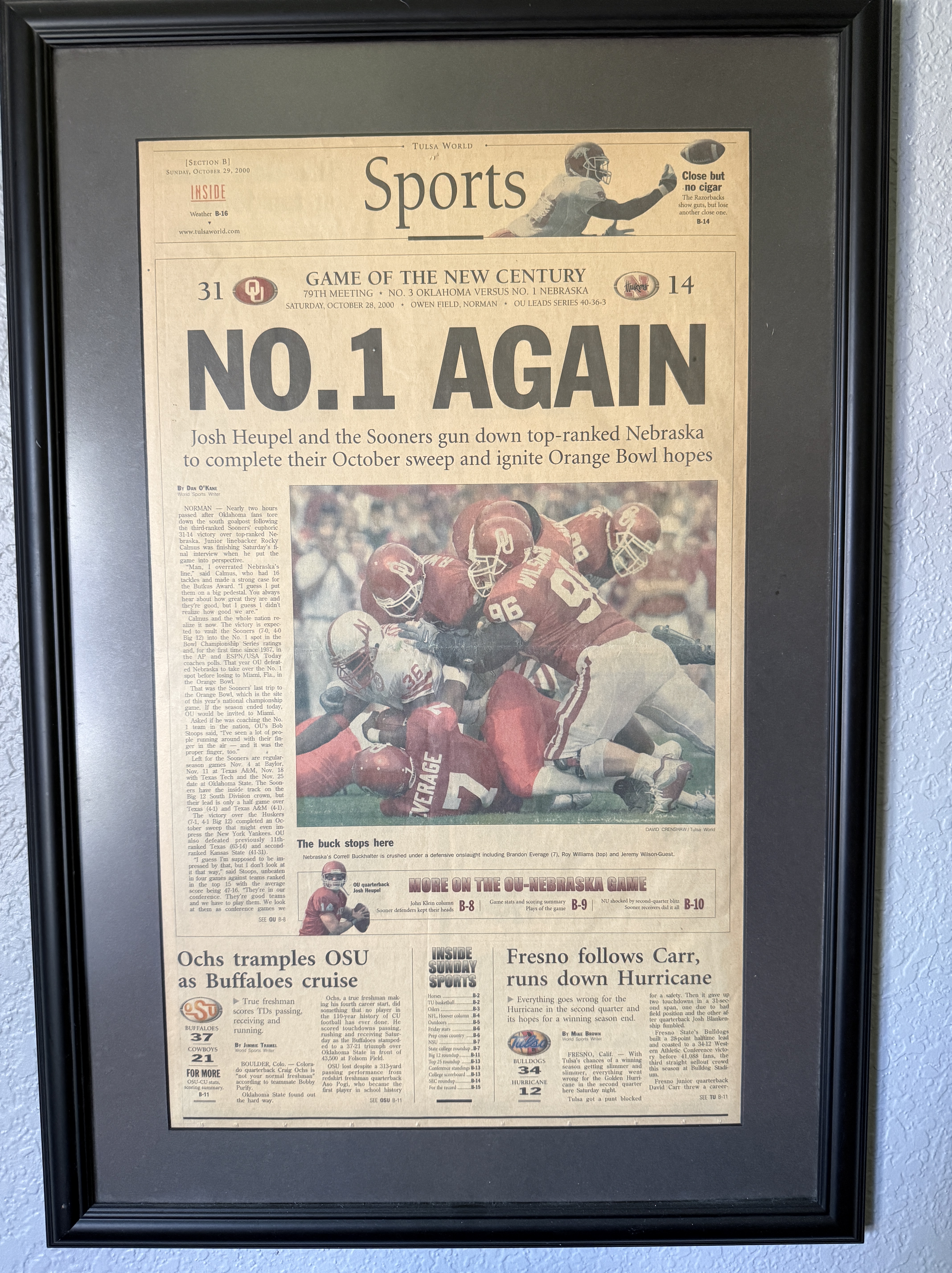
OU had been national champions and in the top 10 most of my adult life, but from 1996-1998 they had several really bad years for them. But with this win, they climbed their way back to #1 again — and ended up winning the National Championship that year. So to me that headline is more than just a memento of an OU win; it’s a symbol that you can make a comeback: that a person who’s been “down” can get back up again; that a church that’s experienced a difficult stretch can get revived and grow again. It’s a continual reminder to me that a comeback is always possible!)
You/your group can share about your own “mementos” and their special meanings to you. Then share that in this morning’s lesson in Joshua, we see how God delivered His people, and He told them to remember it with a very particular kind of memorial.
CONTEXT:
We are continuing our study in the Book of Joshua this week. Last time we saw in Chapter 2 how Joshua sent men to spy out Jericho in preparation for their conquest of the Promised Land. Chapter 3 begins with the people of Israel still on the other (east) side of the Jordan River, making final preparations to cross. In 3:5 Joshua gives Israel one of my very favorite verses: “Consecrate yourselves, for tomorrow the Lord will do wonders among you.” What a command! If we want to see God do wonders among us tomorrow, we need to consecrate ourselves — make ourselves holy — today! And we read that they weren’t just to cross the Jordan in any way they pleased; God specifically told them how to do it in a way that would glorify Him, and also elevate Joshua in the eyes of the people. It’s an episode of God’s blessing that He commanded them to commemorate in a special way.
OUTLINE:
I. The Act of God’s Deliverance (3:14-17)
II. The Memorial of God’s Deliverance (4:1-9)
TEXT: Joshua 3:14-4:9
I. The Act of God’s Deliverance (3:14-17)
“14 ‘So when the people set out from their tents to cross the Jordan with the priests carrying the ark of the covenant before the people, 15 and when those who carried the ark came into the Jordan, and the feet of the priests carrying the ark were dipped in the edge of the water (for the Jordan overflows all its banks all the days of harvest), 16 the waters which were flowing down from above stood and rose up in one heap, a great distance away at Adam, the city that is beside Zarethan; and those which were [b]flowing down toward the sea of the Arabah, the Salt Sea, were completely cut off. So the people crossed opposite Jericho. 17 And the priests who carried the ark of the covenant of the Lord stood firm on dry ground in the middle of the Jordan while all Israel crossed on dry ground, until all the nation had finished crossing the Jordan.” (NASB)
We read here of God’s deliverance of Israel at the Jordan. After years of wilderness wandering, of spying out the land, and making spiritual preparation, they were now ready to cross the Jordan and enter the Promised Land. God would bring them in, in a miraculous way that they would always remember.
— When the priests got to the Jordan, carrying the Ark of the Covenant, they stepped into the water, and as soon as they did, the Hebrew literally says that the waters “stood,” they “rose up one heap.” (Hebrew “ned,” which means “heap, mound, pile.”)
Verse 16 says that the water piled up, way upstream at Adam, by Zarethan. David Howard in his commentary on Joshua references a couple of studies which indicate that Adam and Zarethan were about 15-20 miles upriver from where Israel crossed — so there was plenty of room for the huge group of Israelites to cross.
??? You might ask your group if the manner of this crossing reminds them of anything else in the Bible???
Of course the answer is that this is very much like Israel’s crossing of the Red Sea, isn’t it? It’s a slightly different situation, as there was no army behind them, but the waters standing up in a heap like that so that the entire Israelite people could cross is very similar to the crossing of the Red Sea in Exodus. (Exodus 14:22 and 15:8 both say that the Red Sea stood like a “wall” for Israel in that crossing. In fact the word in 15:8 is also “ned” — “heap, mound, pile” like here in Joshua 3:16) So it is very similar!
I believe this similarity is intentional, part of God’s plan. DID HE NOT SAY in 3:7 “This day I will begin to exalt you in the sight of all Israel, that they may know that just as I have been with Moses, I will be with you.” God wanted Israel to know that just as Moses had been their unquestioned leader, so now Joshua was as well. And what better way to establish this, than to perform a miracle very similar to the one He had performed at the Red Sea when Moses was leader. So now God does the same thing with Joshua in charge, to help establish his leadership in the sight of the people.
— And this was no “typical” Jordan River crossing. The second part of :15 says, “For the Jordan overflows all it banks all the days of the harvest.” David Howard’s commentary on Joshua mentions that this crossing was in March/April, when the Jordan River was still very swollen from the melting of the snow from the mountains, as well as the spring rain.
Some of us have seen pictures of the Jordan River which make it seem very peaceful, and not too challenging to cross, something like this:
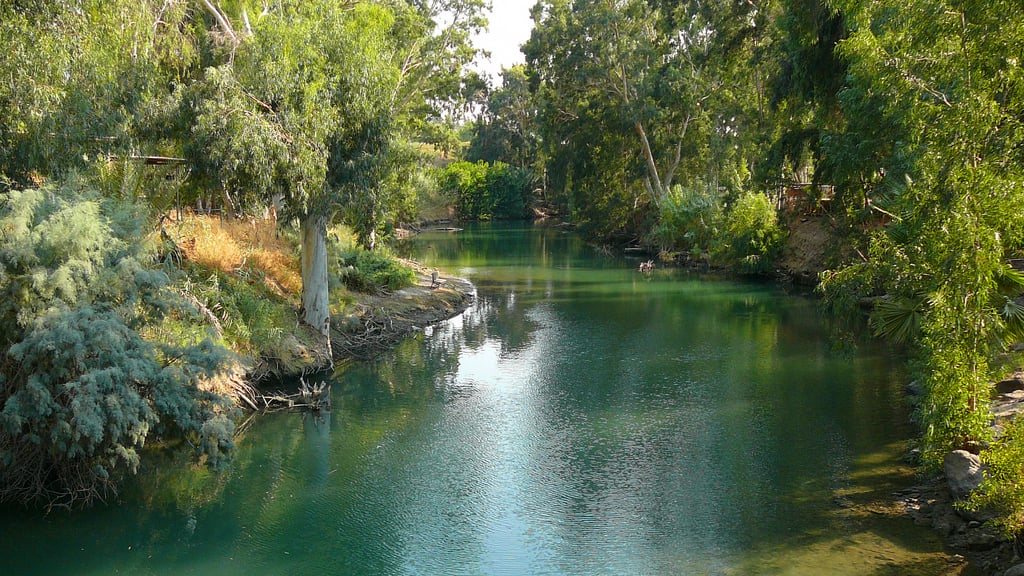
Crossing that would not have been much of a miracle, would it? This is why the Bible emphasizes that this was at flood stage. We need to understand what this involves.
ILLUSTRATION:
An article on Bibleplaces.com, (Seth Rodriguez, 2/17/13) states: “According to a 2010 report about the Jordan River (noted previously on this blog here), the Jordan River contains only 3% of the water that it did 100 years ago. According to that report, the river discharged 1.3 billion cubic meters of water in the 19th and early 20th centuries … The report contrasts this with the current discharge of the river which is 20 to 30 million cubic meters.”
Here is a picture this website shared, of a flood of the Jordan in 1935, which would be more like what was found in Joshua’s time:
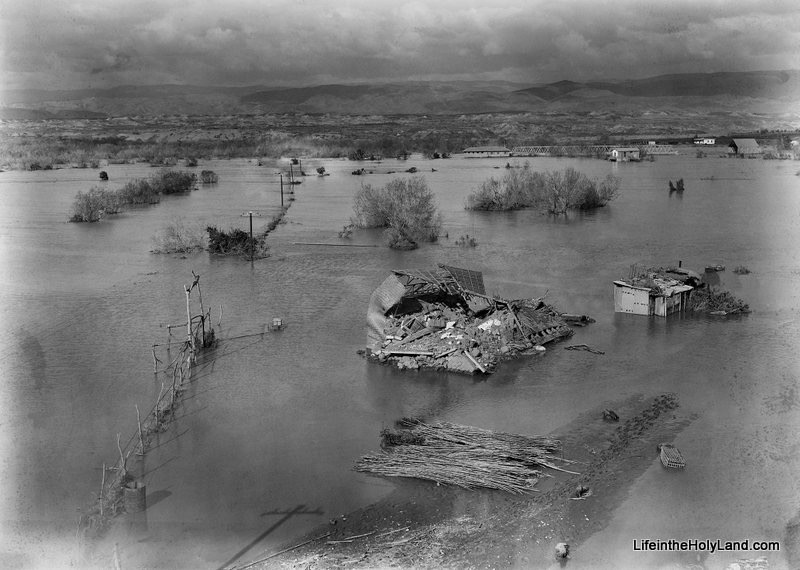
Leading over a million people safely across THAT would be a different story! And that is what God did. He dried that flood stage river so that Israel passed through on “dry ground” (it emphasized that TWICE in :17, “the priests stood firm on DRY GROUND … all Israel crossed on DRY GROUND.” THAT was indeed a great miracle! (Sometimes we have to understand just how great the problem was, to appreciate the magnitude of the miracle; that’s why I’d use this explanation and pictures if you can. You should be able to copy and print/save these from my blog at www.shawnethomas.com).
— Here’s another thing we need to understand: God commanded them to cross the Jordan like this; they were acting in response to His word. Joshua didn’t just “name and claim” that the river would dry up when they stepped into the Jordan. No, God specifically TOLD him to do it this way.
This is a needed reminder for us today, that genuine faith does NOT consist of us just “deciding” to do certain things and believe by faith that God will help us. Rather Biblical faith is when God gives us a command, and we receive His word by faith and step out on it. There is a HUGE difference between the two:
— “presumptuous” faith (what some today call the doctrine of “word faith”) is a person just picking out what they want to believe God for: usually physical health, or business success, a sports win, and so on.
— but genuine Biblical faith is GOD telling us what to believe Him for: most often something for His kingdom and glory, not just our own personal health and prosperity. Hopefully your class can understand this difference, and apply it in their life situations.
So this was a great deliverance that God brought that day: He brought His people safely across a dangerous river at flood stage; He showed them that just as He had saved them at the Red Sea, He was still delivering them today; and He also established the “credentials” of Joshua as the unquestioned leader of His people. It was a big day in the history of Israel, and a great act of deliverance.
— God’s deliverance of Israel across the Jordan here should remind us as Christians of the deliverance He gave us at the cross of Christ. We were all engulfed in the “flood” of our sins — like David says in Psalm 38:4, “My iniquities have gone over my head” — and we had no hope of overcoming them. “You were dead in your trespasses and sins,” Ephesians 2:1 says. “There is none righteous, not even one,” Romans 3:10 says.
BUT GOD, as Ephesians 2 says, had mercy on us in Christ, and saved us by grace through faith. Just like we need to realize just how bad the flood was when God saved Israel through it, sometimes we need a reminder of just how bad our sins were — how lost we were apart from the Lord — as a reminder of how great His salvation in Christ is for us!
— God’s deliverance of Israel here can also remind us as Christians of other deliverances God has given us in our lives.
??? DISCUSSION/APPLICATION QUESTION???
“Can you share about some other deliverances besides salvation God has given YOU personally in your Christian life?”
(Some might share of deliverance from a sin: like our church secretary in Lake Charles, who said that she regretted her habit of smoking, but could never give it up. So one day she just fell down before God and asked: “Lord, give me the desires of a non-smoker” — and when she got up from that prayer, she was changed. She no longer desired to smoke. God had delivered her from it!
Others might share of difficult times in their lives that God brought them out of. Cheryl & I felt totally engulfed in darkness and despair in the immediate aftermath of her stroke in August 2024. But like Psalm 116 says “He delivered my soul from death, my eyes from tears, my feet from stumbling.” God gave both Cheryl & I separately Psalm 116:7 “Return to your rest, O my soul, for the Lord has dealt bountifully with you.” And He did. He rescued us physically, and emotionally, and financially, and in every way from that dark time.)
You/your group can share your own testimonies of God’s deliverances in your lives — it may be the sweetest and most impactful part of the lesson this week! So this first point is on the Act/Acts of God’s Deliverance.
II. The Memorial of God’s Deliverance (4:1-9)
:1 “Now when all the nation had finished crossing the Jordan, the Lord spoke to Joshua, saying, 2 “Take for yourselves twelve men from the people, one man from each tribe, 3 and command them, saying, ‘Take up for yourselves twelve stones from here out of the middle of the Jordan, from the place where the priests’ feet are standing firm, and carry them over with you and lay them down in the lodging place where you will lodge tonight.’” 4 So Joshua called the twelve men whom he had appointed from the sons of Israel, one man from each tribe; 5 and Joshua said to them, “Cross again to the ark of the Lord your God into the middle of the Jordan, and each of you take up a stone on his shoulder, according to the number of the tribes of the sons of Israel. 6 Let this be a sign among you, so that when your children ask later, saying, ‘What do these stones mean to you?’ 7 then you shall say to them, ‘Because the waters of the Jordan were cut off before the ark of the covenant of the Lord; when it crossed the Jordan, the waters of the Jordan were cut off.’ So these stones shall become a memorial to the sons of Israel forever.”
8 Thus the sons of Israel did as Joshua commanded, and took up twelve stones from the middle of the Jordan, just as the Lord spoke to Joshua, according to the number of the tribes of the sons of Israel; and they carried them over with them to the lodging place and put them down there. 9 Then Joshua set up twelve stones in the middle of the Jordan at the place where the feet of the priests who carried the ark of the covenant were standing, and they are there to this day.”
So after God worked this miracle of the Jordan crossing for Israel, He had them do something which would help them remember it for years to come. He told them to have one man from each of the 12 tribes to go back into the Jordan, to where the Ark of the Covenant was in the middle of the River, and for each man to take a stone from the river bottom, which they used to make a “memorial” of sorts, which would help them remember what God had done. (The stones were relatively large, as Joshua told them in :5 to carry them on their shoulder.) Verse 6 says when their children (or others) ask in days to come, what do these stones mean, it would give them an opportunity to tell them how God brought this deliverance. (Verse 9 also indicates that Joshua had 12 stones set in the river where the priests’ feet stood; some question whether there would be two different memorials, but I don’t see any Biblical reason to question it.)
The point here is that God specifically wanted them to remember what He had done for them that day, so He commanded them to make this memorial.
— :6 says “let this be a SIGN among you.” The Hebrew word “oth” literally means a “signal,” but is also used symbolically to mean a “sign, token, or mark.” It was used repeatedly of the “signs” God gave Pharaoh in the plagues, and in Genesis 9:12-13 of the rainbow as the “sign” of His covenant.
— :7 says “these stones shall become a MEMORIAL to the sons of Israel.” The Hebrew word “zikkaron” comes from “zakar,” which means “to remember.” So the stones would remind the people of Israel in days to come, of what God did for them when He brought them into the Promised Land.
We see throughout the scriptures where God commands His people to remember:
— In Exodus 12 He established the Passover, again specifically as a “memorial” (same Bible word “zikkaron”) so that they would remember His deliverance of them in Egypt.
— In Deuteronomy 8:2 He commanded them: “You shall remember all the way which the Lord your God has led you in the wilderness these forty years, that He might humble you, testing you, to know what was in your heart, whether you would keep His commandments or not.”
— In Deuteronomy 6:8-9 He commanded them to put His word on their foreheads and on their doorposts, to help them remember His commands.
— After God gave Israel a victory over the Philistines in I Samuel 7, the prophet Samuel set up a stone which he named “Ebenezer” (“eben” = “stone;” “ezer” = “help”), saying, “Thus far the Lord has helped us. The famous hymn line “Here I raise mine Ebenezer” comes from this episode. It was another memorial stone, like these in Joshua.
— Of course, one of the great memorial commands God has given His people was the memorial of the Lord’s Supper, where Jesus commanded: “Do this in remembrance of Me” — a continuing memorial for Christians — lest we forget that the price of our salvation was the body and the blood of the Lord Jesus.
In all these ways and more, God commands us to remember.
???DISCUSSION QUESTION???
“Why do you think God so often commands us not to forget, or to remember?”
(Because He knows we are so prone to forgetting!
— After that Deuteronomy 6 passage about having His word on their foreheads and doorposts, He said in :12, that when they come into the Promised land and have all the prosperity He’d give them: “watch yourself, that you do not forget the Lord who brought you from the land of Egypt …”. He specifically warned Israel about forgetting Him in the days ahead.
— This actually DID happen in Judges 8:34, where it says: “Thus the sons of Israel did not remember the Lord their God, who had delivered them from the hands of all their enemies on every side.” That book of Judges is the sad story of the destruction and misery that comes about when a people forgets God.
— In Psalm 50 He called the wicked: “you who forget God.”
God has really used this verse to challenge me in recent days. How often do we go for stretches of the day, and don’t really think about God? This has to be one of our biggest problems. We need to remember Him.
— I think of the disciples in Matthew. In Chapter 14, Jesus feeds the 5000. Then in Chapter 15, Jesus is again ministering to a crowd, and He says He doesn’t want to send them away hungry, but in :33 the disciples say: ““Where would we get so many loaves in this desolate place to satisfy such a large crowd?” Seriously? He just fed the 5000, now they are worried about the 4000? Some Bible scholars say this is an indication that there “weren’t really two” episodes of feeding, because if He had just fed the 5000, there is no way they’d have forgotten that and doubted about the 4000. I disagree! That sounds EXACTLY like something people would do! How often do we forget what God has done — often right in the aftermath of some of His greatest blessings?
So God commands us to remember, and sets up these memorials, to commemorate what He has done.
An ILLUSTRATION you can use here/elsewhere:
One of the newer monuments in Washington D.C. is one commemorating the men who fought in the Second World War. The memorial contains panels with bronze engravings of different scenes from the war: soldiers loading artillery pieces, paratroopers jumping out of an airplane, troops landing at D-Day, etc., all of which remind us that “freedom isn’t free;” it cost the lives and great sacrifices of those who came before us. Hopefully memorials like this will help us remember that.

In the same way, God commands His people to do certain things to help us remember His great works on our behalf.
???DISCUSSION/APPLICATION QUESTION???
“What are some other ways we can make “memorials” or do things to help us remember to what God has done?” Do you have some traditions, or have certain things in your church, or your home, that help you remember God’s work/word?
(— Of course the Lord’s Supper is perhaps our best continuing memorial as Christians, as we mentioned; it points to our greatest deliverance, which cost the body and blood of the Lord.
— Some churches have “homecoming” days or other memorial days to help them remember great events in their history.
— Families post scripture on their walls, or posted on plaques, to help them remember. Cheryl prominently posted that verse from Joshua 1:9 that God used so greatly in her life after her stroke, on the cabinet in front of both of our chairs, “Be strong and courageous,” and we see it all the time. This is like what God was talking about in Deuteronomy 6, posting His word prominently in our homes.
— An answered prayer list can be a great memorial. After Cheryl’s stroke I kept a list of all the answered prayers God gave us when we were in such dark days. I actually started off with a list of all the things that we needed Him to help us with — it seemed so overwhelming at first. But one by one, I “bolded” them on my prayer sheet as He answered — until they were all answered, and I said, “God, You did it all!” Now I can go back and look over that list on my prayer sheet on my computer, and it is a continuing “memorial” that reminds me both to be thankful for what He did, and also to trust Him for what lies ahead as well.
— I also think one of the best ways we can remember His word is to literally memorize it, and make sure you review it every week. God specifically used Psalm 37:1-11 to help me trust Him when we were trying to sell our house in Texas after Cheryl’s stroke. I prayed that every day and of course ended up memorizing it. Now every week when I review it, I remember how He answered that prayer.
You/your class can share other examples of things you are doing, that you have seen done by others — and ideas of what you could do, to remember what God has done for you, and not to forget His word. The point of this week’s lesson is: God has done such great things for us. We are such weak human beings, that if we don’t take specific steps to remember, we will forget His deliverances and blessings. So let’s determine to take some specific steps this week to help us remember the good things He has done.
___________________________________________
— Remember there is now a “PRINT” button at the end of the lesson on my blog, that you can hit to print out the lesson in its entirety.
— If you’ll type your email in the “Follow blog via email” blank on my blog home page, WordPress will automatically send you next week’s lesson and you won’t have to search for it each week.
— And if you write something in the Comments section on my blog or YouTube, my commitment is to pray for your and your group and any special request you make, by name this week.
Per my licensing agreement with Lifeway:
— These weekly lessons are based on content from Explore the Bible Adult Resources. The presentation is my own and has not been reviewed by Lifeway.
— Lifeway resources are available at: goExploretheBible.com and: goexplorethebible.com/adults-training
— If you have questions about Explore the Bible resources you may send emails to explorethebible@lifeway.com


Shawne, I think I’ll use your opening illustration, but I’m picking my Alma mater, UA instead. Now, which year? One from the 60’s when I was a student and the Bear was roaming the sidelines? Or maybe the ‘92 game when we defeated Miami soundly under Gene Stallings? Probably I’ll go with a Nick Saben victory, but which one? Sorry, I couldn’t resist. I still rely on your lesson interpretations each week as either the lead or a supplement to the Lifeway book version. Thanks for your faithfulness and unique insights that help me understand God’s word and convey it to my class.
Ha; I love it Bill! Yes you share your “Roll Tide” story and that will be great for your class 👍 and I’m praying for you and your group this morning! 🙏
Thank you, prayers are always appreciated. I hope and trust that Cheryl is progressing well, my prayers for you both. Between you and Mike Howard I am including a LOT of extra material in my lessons, and our class usually turns out the lights in the educational wing every Sunday! (During Covid we flipped and now have worship at 9 and SS at 10:15) But we usually still beat the Methodists to the restaurants for lunch!
SHawn, when I think of memorials to God’s awesome grace my mind always goes back to 2001 when my husband, who is a pharmacist, was diagnosed with Chronic Myeloid Leukemia. His oncologist told us that the drug you need is in clinical trials now but won’t be available for about eighteen months so he began a chemo drug that simply zapped his strength. We prayed and …ten days later, 10 days, God put that medication in my husband’s hands! He is now 83 and still in remission because God sent us a miracle.